
World Heritage Identification Number: 696
World Heritage since: 2000
Category: Cultural Heritage
WHE Type: Buildings & Architectural Ensembles
Transboundary Heritage: No
Endangered Heritage: No
Country: 🇩🇰 Denmark
Continent: Europe
UNESCO World Region: Europe and North America
Map
Kronborg Castle: A Renaissance Masterpiece and Iconic Symbol of Danish History
Kronborg Castle, located in the picturesque coastal town of Helsingør, Denmark, is a remarkable testament to the architectural prowess and strategic vision of the Danish monarchy during the Renaissance period. This impressive fortress, immortalized in the annals of literature through William Shakespeare's iconic play Hamlet, stands as a significant symbol of Danish history and a masterpiece of Renaissance architecture.
The origins of Kronborg Castle date back to 1574 when King Frederick II initiated the construction of the castle on a strategically vital location overlooking the Sund, the strait separating Denmark from Sweden. The castle was designed by the Dutch architect Hans van Steenwinckel the Elder, whose work was influenced by the Dutch Renaissance style, incorporating some elements of the Italian Renaissance. The primary objective of the castle was to serve as a powerful fortification against potential invasions from the north.
The initial phase of construction saw the completion of the main castle building, which boasted an impressive facade characterized by its symmetrical design, tall towers, and ornate decorative elements. The central keep, known as the 'Mule Tower,' dominated the structure, while the outer walls were adorned with bastions and casemates. The castle also featured a moat, drawbridges, and a series of defensive structures that made it a formidable fortress.
In the late 17th century, during the reign of Christian V, the castle underwent extensive reinforcements to adapt to the changing military landscape. The castle's defenses were upgraded with modern artillery, and new structures such as the 'New Fort' and the 'Sound Bastion' were added to strengthen the castle's overall defense system. These modifications ensured that Kronborg Castle remained a potent military stronghold well into the 18th century.
Beyond its military significance, Kronborg Castle holds immense cultural and symbolic value for the Danish people. It is renowned worldwide as Elsinore, the setting for Shakespeare's Hamlet, a play that has captivated audiences for over four centuries. The castle's association with the Bard of Avon has cemented its place in literary history and attracted millions of visitors from around the globe.
Today, Kronborg Castle stands proudly as a UNESCO World Heritage Site, a testament to the ingenuity and vision of the Danish monarchs who built it. Visitors can explore the castle's many rooms, including the magnificent Great Hall, the royal apartments, and the underground casemates. They can also enjoy guided tours, exhibitions, and various events held throughout the year.
Overall, Kronborg Castle is more than just a historic monument; it is a living embodiment of Danish history, culture, and architectural excellence. Its enduring appeal lies in its rich past, its stunning architecture, and its connection to one of the greatest works of literature in history. As you walk through its halls and wander along its ramparts, you cannot help but be awed by the castle's grandeur and the stories it has to tell.
UNESCO Description of the World Heritage Site
Located on a strategically important site commanding the Sund, the stretch of water between Denmark and Sweden, the Royal castle of Kronborg at Helsingør (Elsinore) is of immense symbolic value to the Danish people and played a key role in the history of northern Europe in the 16th-18th centuries. Work began on the construction of this outstanding Renaissance castle in 1574, and its defences were reinforced according to the canons of the period's military architecture in the late 17th century. It has remained intact to the present day. It is world-renowned as Elsinore, the setting of Shakespeare's Hamlet.
UNESCO Justification of the World Heritage Site
Criterion (iv): Kronborg Castle is an outstanding example of the Renaissance castle, and one which played a highly significant role in the history of this region of northern Europe.
Encyclopedia Record: Kronborg
Kronborg is a castle and historical stronghold in the town of Helsingør, Denmark. Immortalised as Elsinore in William Shakespeare's play Hamlet, Kronborg is one of the most important Renaissance castles in Northern Europe. It was inscribed on the UNESCO World Heritage List in 2000.Additional Site Details
Area: Not available
Number of Components: 1
Coordinates: 56.03889 , 12.62083333
Image
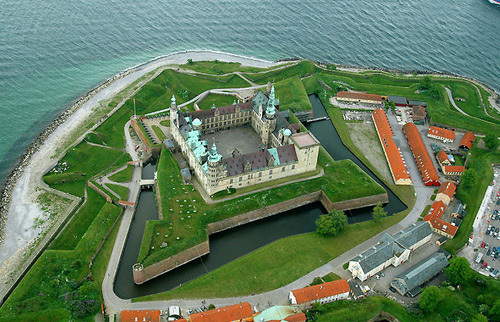
© H.C. Steensen, CC BY-SA 3.0 Resized from original. (This derivative is under the same CC BY-SA license.)
World Heritage Research
Discover scientific research and academic studies that deepen our understanding of Kronborg Castle from its history and significance to its conservation, management, and contemporary challenges.
-
Fakta og fantasi, historiebrug og museernes troværdighed
A cultural-historical exhibition at Kronborg Castle demonstrates that blending contemporary and ancient artworks in a dialogue-based format can effectively engage visitors and provoke reflections on the use of historical narratives. The exhibition, 'Facts and Imagination,' employed a method combining curatorial expertise with historical research to create immersive storytelling experiences. Quotes from visitor interviews highlighted the exhibition's ability to foster critical thinking about historical representation. This approach offers a model for museums to balance factual accuracy with imaginative interpretation while maintaining credibility.
Littrup, S. L., & Grinder-Hansen, P. (2024). Fakta og fantasi, historiebrug og museernes troværdighed. Nordisk Museologi, 35(1-2), 20–36. https://doi.org/10.5617/nm.10817
View Publication Record | Read Publication -
Royal Reveals: LiDAR Mapping of Kronborg Castle, Echoes of Hamlet's Halls
A groundbreaking digital reconstruction of Kronborg Castle, Denmark's iconic Renaissance fortress and setting for Shakespeare's 'Hamlet,' reveals unprecedented architectural details through advanced LiDAR scanning. The study utilized a 16-channel, 360-degree Velodyne VLP-16 LiDAR scanner paired with an Intel RealSense L515 depth camera to capture intricate structural nuances in high resolution. This dataset not only provides a comprehensive 3D model of the castle but also offers valuable resources for researchers studying Simultaneous Localisation and Mapping (SLAM) techniques and floorplan generation, bridging historical preservation with cutting-edge digital mapping technologies.
Davies, L., & Sølvsten, S. (2024). Royal Reveals: LiDAR Mapping of Kronborg Castle, Echoes of Hamlet's Halls (Version 1). arXiv. https://doi.org/10.48550/ARXIV.2409.18752
View Publication Record | Read Publication -
Hamlet Live: the 7 I’s Experiential Strategy Framework for heritage visitor attractions
Kronborg Castle's 'Hamlet Live' offers a groundbreaking experiential strategy for heritage visitor attractions, achieving success through seven interconnected elements—termed the 7 I’s framework. This interactive theatrical experience, set in the Renaissance castle and inspired by Shakespeare’s Hamlet, leverages professional actors’ improvisations to boost revenue and visitor satisfaction. The study, based on observations, interviews, and TripAdvisor reviews, identifies these elements as critical to creating extraordinary experiences. Recommendations are provided for other heritage attractions to replicate this success.
Lund, N. F., Holst-Beck, P., Pine II, B. J., & Leask, A. (2021). Hamlet Live: the 7 I’s Experiential Strategy Framework for heritage visitor attractions. Journal of Heritage Tourism, 17(2), 125–141. https://doi.org/10.1080/1743873x.2021.1951277
View Publication Record | Read Publication -
A Driving Force, Odin Teatret: Ur-Hamlet at Kronborg Castle
A groundbreaking collaboration between Odin Teatret and diverse theatrical traditions showcased the potential of intercultural artistic integration at Kronborg Castle. The study reveals how Odin Teatret's 'Ur-Hamlet' production in 2006, performed at Elsinore Castle, Denmark, demonstrated the efficacy of their 'third theater' concept by blending actors with varied Western and Eastern backgrounds and professional trajectories. This research highlights the distinct artistic practices employed by Odin Teatret, emphasizing the impact of diverse theatre training and experience on the production's success.
Ramis, A. G. (2019). A Driving Force, Odin Teatret: Ur-Hamlet at Kronborg Castle. Revista Brasileira de Estudos Da Presença, 9(3). https://doi.org/10.1590/2237-266088202
View Publication Record | Read Publication -
Whose Castle is it Anyway?: Local/Global Negotiations of a Shakespearean Location
Kronborg Castle, associated with Shakespeare's 'Hamlet,' faces a cultural identity crisis where its fictional reputation overshadows its historical significance. Marketed as 'Hamlet’s Castle' and Elsinore as the 'Home of Hamlet,' the castle's global recognition is driven more by Shakespearean tourism than Danish heritage. This study reveals how Kronborg's identity has been reshaped over two centuries through international Shakespearean performances, reflecting evolving ideologies. It also questions how this identity may adapt amid rising nationalism in Europe and worldwide. The research employs a qualitative approach, analyzing naming conventions, performance traditions, and ideological shifts to explore the tension between local heritage and global cultural narratives.
Refskou, A. S. (2017). Whose Castle is it Anyway?: Local/Global Negotiations of a Shakespearean Location. Multicultural Shakespeare: Translation, Appropriation and Performance, 15(30), 121–132. https://doi.org/10.1515/mstap-2017-0009
View Publication Record | Read Publication
