
World Heritage Identification Number: 1416
World Heritage since: 2014
Category: Natural Heritage
WHE Type: Natural Landscapes & Geographic Features
Transboundary Heritage: No
Endangered Heritage: No
Country: 🇩🇰 Denmark
Continent: Europe
UNESCO World Region: Europe and North America
Map
Stevns Klint: A Geological Testimony to the Cretaceous-Paleogene Extinction Event
Stevns Klint, situated on the Danish island of Zealand, offers a unique glimpse into the Earth's history, making it a significant addition to the UNESCO World Heritage List in 2014. Known colloquially as the Cliffs of Stevns, this 17-kilometer-long white chalk cliff stands as a testament to the Cretaceous-Paleogene (K/P) extinction event, which occurred approximately 65 million years ago.
More to come…UNESCO Description of the World Heritage Site
This geological site comprises a 15 km-long fossil-rich coastal cliff, offering exceptional evidence of the impact of the Chicxulub meteorite that crashed into the planet at the end of the Cretaceous, about 65 million years ago. Researchers think that this caused the most remarkable mass extinction ever, responsible for the disappearance of over 50 per cent of all life on Earth. The site harbours a record of the cloud of ash formed by the impact of the meteorite – the exact site being at the bottom of the ocean off the coast of Mexico’s Yucatán Peninsula. An exceptional fossil record is visible at the site, showing the complete succession of fauna and micro-fauna charting the recovery after the mass extinction.
UNESCO Justification of the World Heritage Site
Criterion (viii): Stevns Klint is a globally exceptional testimony to the impact of meteorite impact on the history of life on Earth. The property provides a globally exceptional representation of the evidence of the Chixulub meteorite impact that took place at the end of the Cretaceous Period, c.67 million years ago. This impact is widely believed by modern scientists to have caused the end of the Age of the Dinosaurs, and led to the extinction of more than 50% of life on Earth. This is the most recent of the major mass extinctions in Earth’s history. Comparative analysis indicates this is the most significant and readily accessible site, of hundreds available, to see the sedimentary record of the ash cloud formed by the meteorite impact, the actual site of the impact being deep underwater offshore the Yucatan peninsula. In addition, the site has iconic scientific importance as the most significant and accessible of the three localities where the radical theory for asteroid driven extinction was developed through the seminal work of Walter and Luis W Alvarez, with their co-workers. Stevns Klint is highly significant in terms of its past, present and future contribution to science especially pertaining to the definition of and explanation of the Cretaceous/Tertiary (K/T) boundary. The outstanding fossil record at Stevns Klint provides a succession of three biotic assemblages including the most diverse end-Cretaceous marine ecosystem known. The million years recorded in the rock at Stevns Klint provides evidence of a climax pre-impact community, fauna that survived a mass extinction event, and the subsequent faunal recovery and increased biodiversity following this event. The fossil record shows which taxa became extinct and which survived and reveals the tempo and mode of evolution of the succeeding post impact fauna that diversified to the marine fauna of today, thus providing important context for the main K/T boundary layer exposed at Stevns Klint.
Encyclopedia Record: Stevns Klint
Stevns Klint, known as the Cliffs of Stevns in English, is a white chalk cliff located some 6 km (3.7 mi) southeast of Store Heddinge on the Danish island of Zealand. Stretching 17 km (11 mi) along the coast, it is of geological importance as one of the best exposed Cretaceous-Tertiary (K/T) boundaries in the world. Subject to frequent erosion, the cliff rises to a height of up to 40 m (130 ft). Because of its exceptional fossil record, Stevns Klint was inscribed on the UNESCO World Heritage List in 2014.Additional Site Details
Area: 50 hectares
Number of Components: 1
Coordinates: 55.2672222222 , 12.4233333333
IUCN World Heritage Outlook
The 2025 Conservation Outlook on Stevns Klint reports the following assessment:
Source: International Union for Conservation of Nature (IUCN) · View assessment
Image
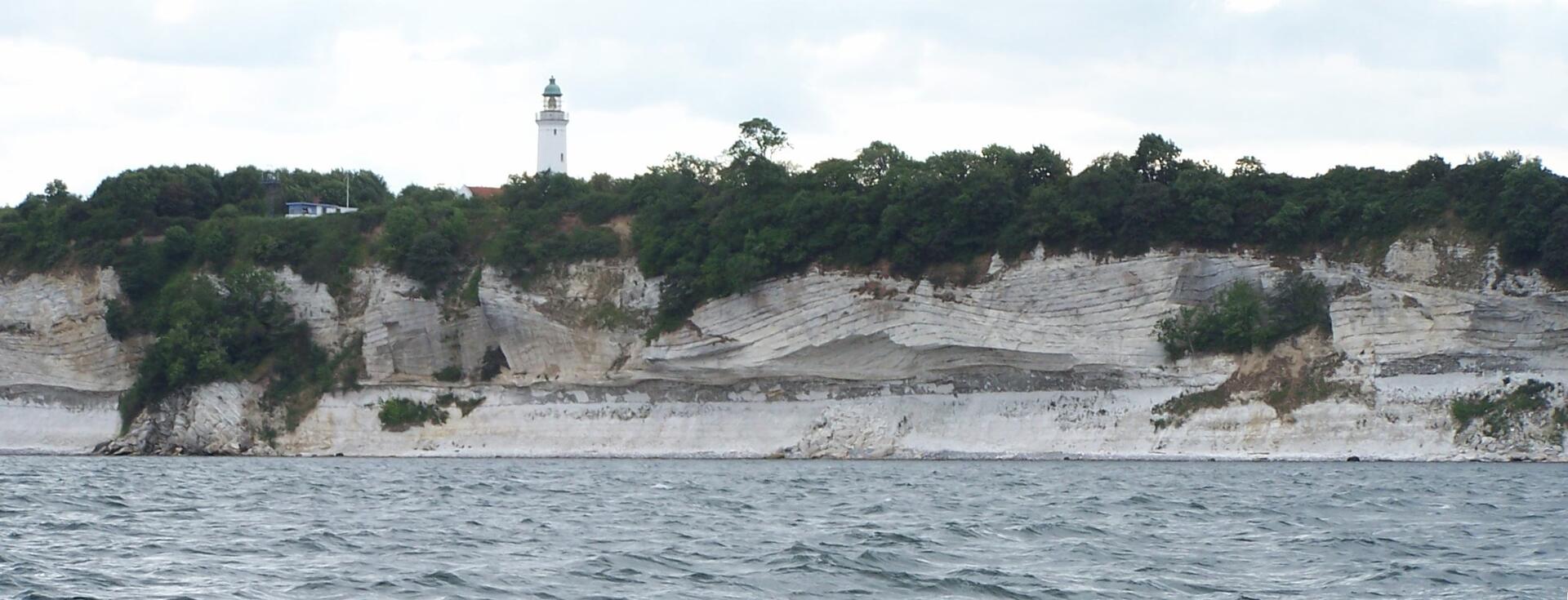
© Niels Elgaard Larsen, CC BY-SA 3.0 Resized from original. (This derivative is under the same CC BY-SA license.)
World Heritage Research
Discover scientific research and academic studies that deepen our understanding of Stevns Klint from its history and significance to its conservation, management, and contemporary challenges.
-
The last Mesozoic brachiopods
A remarkable discovery of the last Mesozoic brachiopods, dating to the topmost Maastrichtian chalk just below the Cretaceous–Paleogene (K–Pg) boundary clay at Stevns Klint, Denmark, sheds light on the climax of a specialized fauna that thrived in the Chalk Sea for 34 million years. This rich brachiopod assemblage, comprising 28 micromorphic species and 1967 individuals, represents the highest richness recorded from any Danish section at or near the K–Pg boundary, surpassing even the most benthos-rich parts of the Upper Cretaceous Chalk Group. The sample, derived from a 25 kg bulk chalk residue, showcases an extraordinary diversity and abundance, reflecting the full range of morphological adaptations to life on fine-grained seafloor. This finding underscores the unique macro-habitat of the Chalk Sea and provides critical insights into the evolutionary trajectory of its brachiopod fauna in the lead-up to the cataclysmic boundary event.
Surlyk, F., Jakobsen, S. L., & Hofstedt, M. (2026). The last Mesozoic brachiopods. Bulletin of the Geological Society of Denmark, 75, 223–234. https://doi.org/10.37570/bgsd-2026-75-12
View Publication Record | Read Publication -
A cluster of the brachiopod Magas chitoniformis (von Schlotheim, 1813) represents settling of a single spatfall on a soft-bodied substrate, probably a sponge: instantaneous burial by a chalk ooze debris flow (Maastrichtian, Denmark).
A remarkable discovery at Stevns Klint, Denmark, reveals a monospecific cluster of the brachiopod Magas chitoniformis preserved in uppermost Maastrichtian chalk. The 53 well-preserved specimens, exhibiting a unimodal size-frequency distribution, indicate they represent a single successful spatfall likely attached to a soft-bodied sponge. The absence of transport or winnowing suggests instantaneous burial by a chalk ooze debris flow, potentially triggered by a major earthquake in the tectonically active Sorgenfrei-Tornquist Zone. This finding provides exceptional evidence of brachiopod attachment to a soft-bodied organism, offering insights into paleoecological dynamics and sedimentary processes during the Late Cretaceous.
Surlyk, F. (2025). A cluster of the brachiopod Magas chitoniformis (von Schlotheim, 1813) represents settling of a single spatfall on a soft-bodied substrate, probably a sponge: instantaneous burial by a chalk ooze debris flow (Maastrichtian, Denmark). Bulletin of the Geological Society of Denmark, 74, 15–24. https://doi.org/10.37570/bgsd-2025-74-02
View Publication Record | Read Publication -
A diminutive pterosaur from the uppermost Maastrichtian chalk of Denmark
A diminutive pterosaur, represented by a fragment of its finger bone, has been discovered in the uppermost Maastrichtian chalk at Stevns Klint, a UNESCO World Heritage site in Denmark. This finding marks the first record of a pterosaur from the chalk of Denmark and challenges previous hypotheses about Late Cretaceous niche partitioning between pterosaurs and birds. The specimen, identified as a proximal phalanx 1 of digit IV, indicates that small-bodied pterosaurs with wingspans under 50 cm persisted until the final 50,000–60,000 years of the Cretaceous period. Researchers compared the fragment to similar elements to determine its size and morphology, providing new insights into the evolutionary dynamics of these prehistoric creatures during a critical period of ecological transition.
Milàn, J., Jakobsen, S. L., & Kramer Lindow, B. E. (2025). A diminutive pterosaur from the uppermost Maastrichtian chalk of Denmark. Acta Palaeontologica Polonica, 70(4), 723–730. https://doi.org/10.4202/app.01252.2025
View Publication Record | Read Publication -
Ammonite survival across the Cretaceous–Paleogene boundary confirmed by new data from Denmark
New evidence from Stevns Klint, Denmark, confirms that ammonites survived the Cretaceous–Paleogene extinction event. Researchers analyzed fossil specimens from the Cerithium Limestone Member, revealing that most ammonites in this unit are autochthonous Danian survivors, not redeposited Maastrichtian fossils. Only one specimen was identified as reworked from the Maastrichtian era. The study combines taphonomic and sedimentological analyses to support this conclusion, challenging previous assumptions about ammonite extinction. This finding raises questions about what ultimately caused the demise of the last surviving ammonites on Earth.
Machalski, M., Olszewska-Nejbert, D., Landman, N. H., Jagt, J. W. M., Garb, M., & Milàn, J. (2025). Ammonite survival across the Cretaceous–Paleogene boundary confirmed by new data from Denmark. Scientific Reports, 15(1). https://doi.org/10.1038/s41598-025-34479-1
View Publication Record | Read Publication -
Carbonated Smart Water Injection for Optimized Oil Recovery in Chalk at High Temperature
Injecting carbonated seawater (CSW) slightly enhances oil recovery in chalk reservoirs at high temperatures, making it the most effective brine among tested options. This study, using Stevns Klint outcrop chalk as an analogue for North Sea chalk reservoirs, found that CSW outperformed other brines like formation water (FW), seawater (SW), and carbonated formation water (CFW) in both secondary and tertiary flooding modes. While oil swelling and viscosity reduction were initially hypothesized as key mechanisms, the research suggests wettability alteration is more likely responsible for the observed increase in oil recovery. The study also confirmed CO2 diffusion from the brine to the oil phase but noted that a significant amount of CO2 remained in the brine, with no notable mineral dissolution or changes in pore surface minerals. These findings highlight the potential of carbonated smart water injection as an environmentally friendly method to boost oil production while reducing greenhouse gas emissions.
Islam Khan, M. A., Kleiberg, S. H., Pinerez Torrijos, I. D., Puntervold, T., & Strand, S. (2023). Carbonated Smart Water Injection for Optimized Oil Recovery in Chalk at High Temperature. E3S Web of Conferences, 367, 1008. https://doi.org/10.1051/e3sconf/202336701008
View Publication Record | Read Publication -
Reaction Kinetics Determined from Core Flooding and Steady State Principles for Stevns Klint and Kansas Chalk Injected with MgCl2 Brine at Reservoir Temperature
A novel methodology to determine reaction kinetics using core flooding and steady-state principles reveals that the dissolution of calcite and precipitation of magnesite in chalk reservoirs occur in a substitution-like manner, with calcium (Ca²⁺) production closely matching magnesium (Mg²⁺) loss. This approach, applied to Stevns Klint chalk from Denmark and Kansas chalk from the USA, demonstrates computationally efficient modeling that avoids complex spatial-temporal simulations. The study, conducted at reservoir temperatures of 100°C and 130°C, shows that injected MgCl₂ brine alters rock wettability and strength, with implications for oil recovery and reservoir management. By varying injection rates and using shut-in tests, the researchers accurately characterized reaction kinetics, providing insights into geochemical behavior under dynamic conditions.
Andersen, P. Ø., Korsnes, R. I., Olsen, A. T., & Bukkholm, E. (2022). Reaction Kinetics Determined from Core Flooding and Steady State Principles for Stevns Klint and Kansas Chalk Injected with MgCl2 Brine at Reservoir Temperature. SPE Improved Oil Recovery Conference. https://doi.org/10.2118/209380-ms
View Publication Record | Read Publication -
Reaction Kinetics Determined from Coreflooding and Steady-State Principles for Stevns Klint and Kansas Chalk Injected with MgCl2 Brine at Reservoir Temperature
Researchers have developed a novel methodology to determine reaction kinetics using coreflooding and steady-state principles, which efficiently characterizes chemical interactions in chalk reservoirs without requiring complex spatial modeling. The study, conducted on Stevns Klint (Denmark) and Kansas (USA) chalks at reservoir temperatures (100–130°C), demonstrated that Ca²⁺ ions were produced while Mg²⁺ ions were retained during injection with MgCl₂ brine, indicating calcite dissolution and magnesite precipitation. This substitution-like process was successfully modeled using a simple kinetic framework with three parameters, which accurately predicted chemical interactions in both oil-bearing chalk reservoirs and outcrop chalks. The methodology offers computational efficiency for reactive flow modeling, particularly for chemically sensitive reservoirs like those at UNESCO World Heritage Site Stevns Klint, where injected seawater can impact wettability and rock strength.
Andersen, P., Korsnes, R., Olsen, A., & Bukkholm, E. (2022). Reaction Kinetics Determined from Coreflooding and Steady-State Principles for Stevns Klint and Kansas Chalk Injected with MgCl2 Brine at Reservoir Temperature. SPE Journal, 27(06), 3406–3425. https://doi.org/10.2118/209380-pa
View Publication Record | Read Publication
