World Heritage Identification Number: 1067
World Heritage since: 2002
Category: Cultural Heritage
WHE Type: Historic Cities & Urban Areas
Transboundary Heritage: No
Endangered Heritage: No
Country: 🇩🇪 Germany
Continent: Europe
UNESCO World Region: Europe and North America
Map
The Historic Centres of Stralsund and Wismar: A Testament to Brick Gothic Architecture and Hanseatic Legacy
The Historic Centres of Stralsund and Wismar, inscribed as a UNESCO World Heritage Site in 2002, offer a unique glimpse into the rich history, architecture, and cultural heritage of northern Germany. These two medieval towns, situated on the Baltic coast, played significant roles as major trading hubs during the 14th and 15th centuries within the Hanseatic League.
Stralsund, officially known as the Hanseatic City of Stralsund, is the fifth-largest city in the northeastern German state of Mecklenburg-Western Pomerania. Its strategic location on the southern coast of the Strelasund, a sound separating the island of Rügen from the mainland, has shaped its history and development. The town’s layout reflects its long history, with narrow streets winding through a dense urban fabric that showcases various architectural styles, particularly Brick Gothic.
Brick Gothic architecture is a distinctive style that emerged in the Baltic region during the Middle Ages. Characterized by its use of red bricks, pointed arches, and ribbed vaults, this style can be seen in numerous buildings throughout Stralsund. One notable example is the Town Hall, whose origins date back to the late 13th and early 14th centuries and which is considered one of the most impressive secular Brick Gothic buildings in the region.
Wismar, located approximately 115 kilometers southwest of Stralsund as the crow flies, shares many similarities with its neighbor. First documented in the early 13th century, Wismar also flourished as a member of the Hanseatic League and later served as a key Swedish administrative center in northern Germany during the 17th and 18th centuries following the Peace of Westphalia in 1648 and into the early 19th century.
Like Stralsund, Wismar boasts a wealth of Brick Gothic structures, including the stunning Marienkirche (St. Mary's Church). While the church heavily damaged during the Second World War and the nave later demolished, its surviving tower, rising to a height of approximately 80 meters, remains a dominant feature of the townscape.
In addition to their architectural treasures, both cities offer insights into daily life during the Hanseatic period. Numerous houses dating from the Middle Ages to the early modern era still stand, providing a tangible connection to the past. Many of these buildings have been adapted for use as museums, shops, and restaurants, ensuring that their historical significance remains accessible to visitors today.
The Historic Centres of Stralsund and Wismar serve as a testament to the enduring legacy of the Hanseatic League and the unique architectural traditions of Brick Gothic. By preserving these historic centers, we not only safeguard our shared cultural heritage but also provide future generations with a valuable window into the past.
UNESCO Description of the World Heritage Site
The medieval towns of Wismar and Stralsund, on the Baltic coast of northern Germany, were major trading centres of the Hanseatic League in the 14th and 15th centuries. In the 17th and 18th centuries they became Swedish administrative and defensive centres for the German territories. They contributed to the development of the characteristic building types and techniques of Brick Gothic in the Baltic region, as exemplified in several important brick cathedrals, the Town Hall of Stralsund, and the series of houses for residential, commercial and crafts use, representing its evolution over several centuries.
UNESCO Justification of the World Heritage Site
Criterion (ii): Wismar and Stralsund, leading centers of the Wendish section of the Hanseatic League from the 13th to 15th centuries and major administrative and defense centers in the Swedish kingdom in the 17th and 18th centuries, contributed to the development and diffusion of brick construction techniques and building types, characteristic features of Hanseatic towns in the Baltic region, as well as the development of defense systems in the Swedish period.
Criterion (iv): Stralsund and Wismar have crucial importance in the development of the building techniques and urban form that became typical of the Hanseatic trading towns, well documented in the major parish churches, the town hall of Stralsund, and the commercial building types, such as the Dielenhaus.
Encyclopedia Record: Stralsund
Stralsund, officially the Hanseatic City of Stralsund, is the fifth-largest city in the northeastern German state of Mecklenburg-Western Pomerania after Rostock, Schwerin, Neubrandenburg and Greifswald, and the second-largest city in the Pomeranian part of the state. It is located on the southern coast of the Strelasund, a sound of the Baltic Sea separating the island of Rügen from the Pomeranian mainland.Additional Site Details
Area: 168 hectares
Number of Components: 2
(iv) — Outstanding example of a type of building or landscape
Coordinates: 54.3025 , 13.08527778
Image
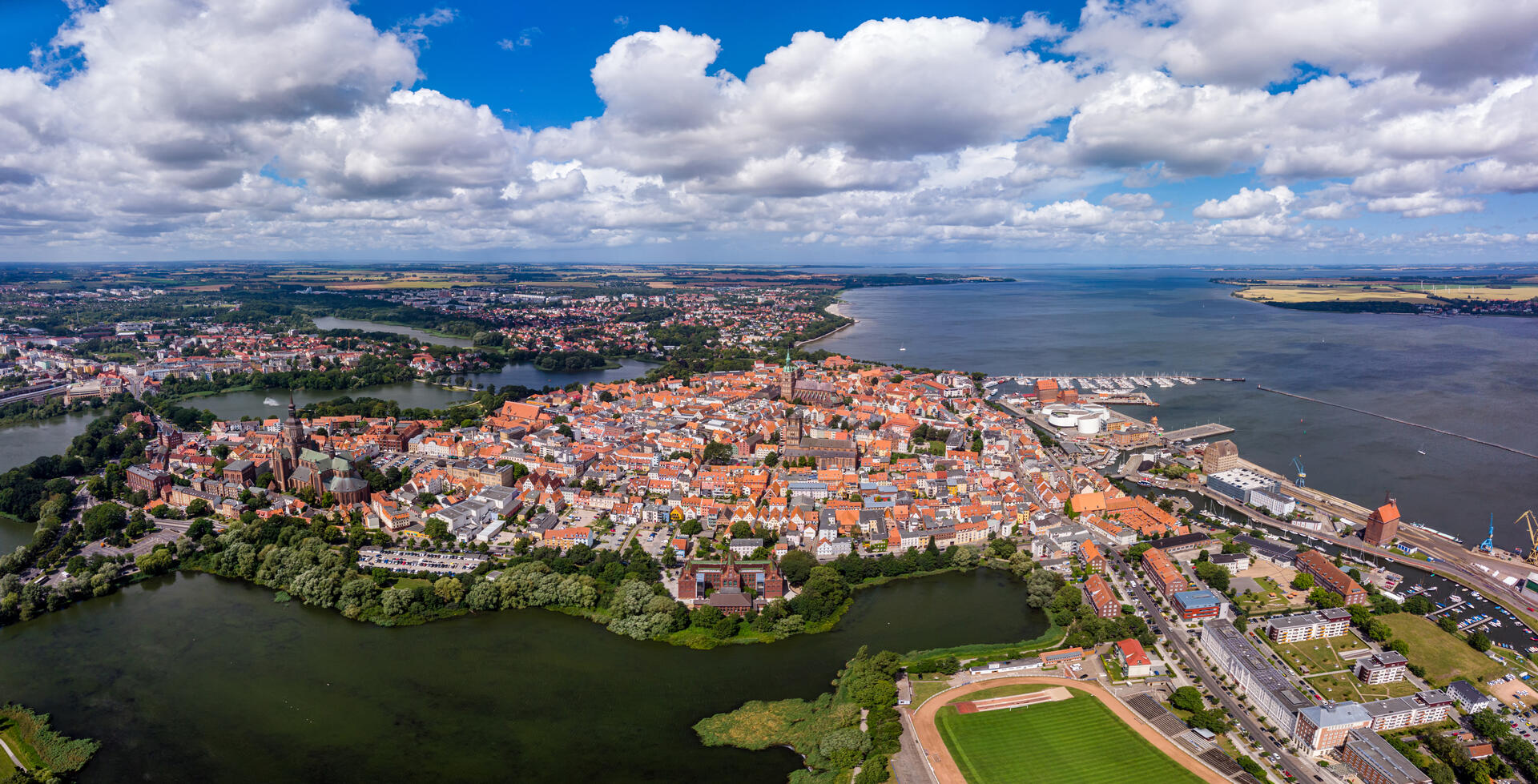
© Ralf Roletschek, CC BY-SA 1.0 fi Resized from original. (This derivative is under the same CC BY-SA license.)