World Heritage Identification Number: 569
World Heritage since: 2005
Category: Cultural Heritage
WHE Type: Historic Cities & Urban Areas
Transboundary Heritage: No
Endangered Heritage: No
Country: 🇦🇱 Albania
Continent: Europe
UNESCO World Region: Europe and North America
Map
Exploring the Rich Cultural Heritage: A Journey through the Historic Centres of Berat and Gjirokastra, Albania
The Historic Centres of Berat and Gjirokastra in Albania offer a unique glimpse into the country's rich cultural heritage, showcasing the architectural beauty and historical significance of these ancient cities. Inscribed as UNESCO World Heritage Sites in 2005 and 2008 respectively, Gjirokastra and Berat provide valuable insights into the diverse religious and cultural communities that have shaped Albania throughout history.
Berat, located in central Albania, is renowned for its impressive castle, known locally as the Kala. This historic fortress, whose origins can be traced back to early fortifications in the 4th century BC, has been expanded over the centuries, with most of its current structures dating from the 13th century.
The citadel area of Berat boasts numerous Byzantine churches, primarily from the 13th century, as well as several mosques constructed during the Ottoman period, with significant mosque construction beginning in the 16th and 17th centuries, following Albania's integration into the Ottoman Empire from 1417 onwards. These religious structures reflect the harmonious coexistence of various faiths and cultures within Berat's ancient walls.
Gjirokastra, situated in the Drinos river valley in southern Albania, is another captivating example of Albanian history. This picturesque town is famous for its outstanding two-story houses, which were predominantly developed during the 17th century. These traditional dwellings, characterized by their distinctive stone facades and sloping roofs, are a testament to the architectural ingenuity of the time.
Beyond its residential architecture, Gjirokastra also preserves other significant historical sites. The town's bustling bazaar, which dates back to the Ottoman period, offers visitors a chance to immerse themselves in the local culture and shop for authentic handicrafts. Additionally, Gjirokastra features an 18th-century mosque and two churches of the same era, further illustrating the multicultural tapestry of this remarkable town.
One cannot discuss the Historic Centres of Berat and Gjirokastra without acknowledging their shared role in bearing witness to the complex and intriguing history of Albania. Both cities have endured various political and cultural transformations, yet they continue to stand as symbols of resilience and unity. Their inclusion in the UNESCO World Heritage List serves not only to preserve their unique architectural and historical value but also to promote international understanding and appreciation for the rich cultural heritage they represent.
To bring it all together, a visit to the Historic Centres of Berat and Gjirokastra offers travelers an unforgettable journey through time, providing a window into the diverse religious and cultural communities that have shaped Albania throughout history. These ancient cities, with their impressive architectural structures and historical significance, serve as powerful reminders of the enduring human spirit and the importance of preserving our collective cultural heritage for future generations.
UNESCO Description of the World Heritage Site
Berat and Gjirokastra are inscribed as rare examples of an architectural character typical of the Ottoman period. Located in central Albania, Berat bears witness to the coexistence of various religious and cultural communities down the centuries. It features a castle, locally known as the Kala, most of which was built in the 13th century, although its origins date back to the 4th century BC. The citadel area numbers many Byzantine churches, mainly from the 13th century, as well as several mosques built under the Ottoman era which began in 1417. Gjirokastra, in the Drinos river valley in southern Albania, features a series of outstanding two-story houses which were developed in the 17th century. The town also retains a bazaar, an 18th-century mosque and two churches of the same period.
UNESCO Justification of the World Heritage Site
Criterion (iii) : Berat and Gjirokastra bear outstanding testimony to the diversity of urban societies in the Balkans, and to longstanding ways of life which have today almost vanished. The town planning and housing of Gjirokastra are those of a citadel town built by notable landowners whose interests were directly linked to those of the central power. Berat bears the imprint of a more independent life style, linked to its handicraft and merchant functions.
Criterion (iv) : Together, the two towns of Gjirokastra and Berat bear outstanding testimony to various types of monument and vernacular urban housing during the Classical Ottoman period, in continuity with the various Medieval cultures which preceded it, and in a state of peaceful coexistence with a large Christian minority, particularly at Berat.
Encyclopedia Record: Historic Centres of Berat and Gjirokastër
The Historic Centres of Berat and Gjirokastër encompasses the cities of Berat and Gjirokastër in southern Albania. Gjirokastër was added to the UNESCO World Heritage Site list in 2005 while Berat was added as a site extension in 2008. They are inscribed as rare examples of an architectural character typical of the Ottoman period.Additional Site Details
Area: 58.9 hectares
Number of Components: 2
(iv) — Outstanding example of a type of building or landscape
Coordinates: 40.0741666667 , 20.1408333333
Image
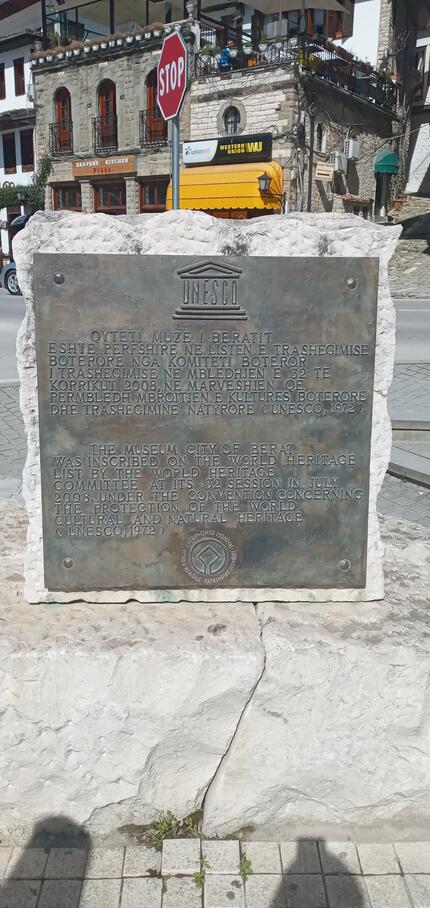
© Simon D. Kist. Used with permission.
World Heritage Research
Discover scientific research and academic studies that deepen our understanding of Historic Centres of Berat and Gjirokastra from its history and significance to its conservation, management, and contemporary challenges.
-
Evaluation of geomorphological conditions in the dynamics of urban development evolution in the city of Gjirokastra
Gjirokastra's urban development over four centuries is intricately linked to its geomorphological conditions, with the city's expansion influenced by terrain vertical zoning and landform transformations. The study reveals that Ottoman-style houses dominate the hilly sectors, while apartment blocks cluster along the Drino valley, reflecting a dynamic interplay between natural relief elements and urban growth. To guide future urban planning, the research emphasizes the need for scientifically-based criteria to balance expansion with the preservation of cultural heritage, considering evolving landforms shaped by increasing urban pressure and tourism.
HOXHA, A. (2026). Evaluation of geomorphological conditions in the dynamics of urban development evolution in the city of Gjirokastra. Cities after Transition: Innovative, Inclu-Sive, Informal?, 116–124. https://doi.org/10.37199/c41000407
View Publication Record | Read Publication -
Vernacular Architecture and the State of Cultural Heritage in Gjirokastra through Restoration Camps: Analysis and Technology Application
Restoration camps in Gjirokastra revealed significant structural vulnerabilities in its vernacular architecture, including stone wall delamination, timber decay, roof leakage, and foundation settlement. The study employed interdisciplinary collaboration among universities, UNESCO, and local authorities to digitally document and conserve these heritage buildings using high-resolution laser-scanning and photogrammetric techniques. Engaging architecture students, researchers, and conservation experts, the camps provided a hands-on approach to preserving the town's unique stone masonry walls, timber roof trusses, and elaborately carved stone window surrounds, all situated on a dramatic hillside overlooking the Drinos River valley.
Vesho, N., Xhexhi, K., Nika, B., & Kyratsis, P. (2026). Vernacular Architecture and the State of Cultural Heritage in Gjirokastra through Restoration Camps: Analysis and Technology Application. Civil Engineering and Architecture, 14(4), 2762–2784. https://doi.org/10.13189/cea.2026.140405
View Publication Record | Read Publication -
Cultural Heritage and Experiential Tourism: Opportunities and Challenges in Greece-Albania Cross-border Area (Berat, Gjirokastra and Ioannina)
A cross-border region spanning Albania and Greece, encompassing Berat, Gjirokastra, and Ioannina, exhibits significant potential for experiential tourism, which can foster social and economic development while preserving cultural heritage. The study highlights that this form of tourism, when sustainably developed, generates employment, protects heritage, and enhances local communities' quality of life. However, its long-term viability is hindered by challenges such as insufficient institutional cooperation between the two countries, inadequate road infrastructure, fragmented marketing strategies, and environmental concerns. To overcome these obstacles, the research proposes strategic measures including cross-border cooperation frameworks, capacity-building programs for local tourism actors, investments in infrastructure, integration of technological innovation, and joint branding initiatives to position the region as a unified destination. The study employed a mixed-methods approach, combining literature reviews, qualitative and quantitative interviews with stakeholders, and GIS analysis to interpret data, offering actionable insights for sustainable tourism development.
PAZARI, F., AVDIA, B., MAMOCI, E.,. (2025). CULTURAL HERITAGE AND EXPERIENTIAL TOURISM: OPPORTUNITIES AND CHALLENGES IN GREECE-ALBANIA CROSS-BORDER AREA (BERAT, GJIROKASTRA AND IOANNINA). Geojournal of Tourism and Geosites, 61(3), 1656–1667. https://doi.org/10.30892/gtg.61324-1534
View Publication Record | Read Publication -
Assessment of the main sustainable tourism indicators in the Protected Areas of the Gjirokastra region
A study assessing sustainable tourism indicators in Gjirokastra, Albania, reveals heightened community awareness of the region's natural and cultural heritage but highlights significant gaps in planning and stakeholder involvement. The research, involving surveys with 112 local residents and 168 visitors, analyzed socio-economic, environmental, infrastructural, and institutional factors to evaluate tourism sustainability. While visitors positively rated socio-economic and environmental conditions, the findings underscore the urgent need for collaborative efforts among stakeholders to prioritize sustainable development without compromising biodiversity conservation or local quality of life.
Boboli, I., Shehu, G., Gaba, L., Bega, R., & Çelo, R. (2025). Assessment of the main sustainable tourism indicators in the Protected Areas of the Gjirokastra region. Acta Scientiarum Polonorum. Oeconomia, 24(4), 5–16. https://doi.org/10.22630/aspe.2025.24.4.13
View Publication Record | Read Publication -
Assessment of grazing capacity in subalpine and alpine summer pastures of Gjirokastra district
Grazing capacity in subalpine and alpine summer pastures of Gjirokastra district, Albania, has been scientifically quantified for the first time. The study analyzed six key habitats—Çajupi, Nëmërçka, Murgana, Trebeshina, Dhëmbeli, and Luca mountain—and determined their dry biomass to assess sheep grazing potential. Findings revealed significant discrepancies between measured capacities and those reported in local literature or practiced by regional authorities, highlighting gaps in traditional grazing management. The research employed standardized methodologies to collect and analyze vegetation data at peak growth stages, providing a data-driven foundation for sustainable livestock breeding practices in these UNESCO-listed sites.
Malo, S., & Hasani, L. (2024). Assessment of grazing capacity in subalpine and alpine summer pastures of Gjirokastra district. Balkan Journal of Interdisciplinary Research, 10(3), 101–110. https://doi.org/10.2478/bjir-2024-0029
View Publication Record | Read Publication -
Power Games: Architecture of Gjirokastra Un til the End of the 19th Century
Gjirokastra's architectural landscape reflects the complex interplay of power dynamics from Greek, Byzantine, Albanian, and Ottoman cultures, with its defensive, residential, and religious structures serving as tangible markers of social hierarchy. This study reveals how shifts in local, regional, and state power have shaped the town's urban form, offering a nuanced understanding of its architectural evolution. By analyzing the cause-and-effect relationships between architecture, urbanism, and social stratification, the research fills a gap in existing literature, providing insights into the intangible cultural influences that underpin Gjirokastra's built environment.
Malec, T. (2024). POWER GAMES: ARCHITECTURE OF GJIROKASTRA UN TIL THE END OF THE 19TH CENTURY. Zeszyty Naukowe Wyższej Szkoły Technicznej W Katowicach, (19), 33–44. https://doi.org/10.54264/0098
View Publication Record | Read Publication -
Technological innovations within the built heritage case study : city of Gjirokastra, Albania
Modern technological innovations, such as audio-visual systems, Virtual Reality tours, and 3D-printed replicas, are enhancing accessibility and inclusivity in the built heritage of Gjirokastra, Albania. These advancements facilitate better interaction for all visitors, including those with disabilities, by improving museum accessibility and community engagement. The study highlights the growing importance of integrating technology to address emerging needs while respecting human rights, ensuring everyone can experience places of outstanding value. Additionally, modernization efforts are crucial for tourism, which supports local economies and promotes cultural heritage preservation.
Bace, Daniela. (2024). Technological innovations within the built heritage case study : city of Gjirokastra, Albania [Central European University]. https://doi.org/10.60644/3748
View Publication Record | Read Publication