World Heritage Identification Number: 570
World Heritage since: 1992
Category: Cultural Heritage
WHE Type: Archaeological Sites
Transboundary Heritage: No
Endangered Heritage: No
Country: 🇦🇱 Albania
Continent: Europe
UNESCO World Region: Europe and North America
Map
Butrint: An Ancient City of Epirus with Rich Cultural Layers
Butrint, located in southern Albania, is a captivating UNESCO World Heritage Site that has been inhabited since prehistoric times. This ancient city, which has seen the rise and fall of various civilizations, boasts a rich cultural heritage that spans from Greek colonization to Roman rule and beyond.
The earliest evidence of human presence at Butrint dates back to the Stone Age. However, it was during the 7th century BC that the site gained significant importance when the Greeks established a colony here. Named Buthrotum, this settlement became an integral part of the wider Greek world and was known for its thriving trade connections with neighboring regions.
Buthrotum continued to flourish under Roman rule, becoming a civitas (city) around the 1st century AD. During this period, impressive structures such as temples, bathhouses, and amphitheaters were constructed, reflecting the wealth and influence of the Roman Empire. One of the most notable edifices from this era is the Temple of Asclepius, dedicated to the god of healing.
Following the decline of the Roman Empire, Butrint experienced a period of prosperity under Byzantine administration. During this time, the city became an important ecclesiastical center, with a bishopric being established. The Basilica of the Blessed Virgin Mary, built during the 5th or 6th century AD, is a testament to the religious significance of Butrint during this period.
However, the city's fortunes took a turn for the worse in the late Middle Ages. Marshes formed in the area, leading to the abandonment of Butrint. Despite this setback, the site remained an important pilgrimage destination due to its association with St. Mary and other saints.
Today, Butrint stands as a repository of ruins representing each period in the city’s development. Visitors can explore the remnants of ancient temples, Roman mosaics, Byzantine churches, and Venetian fortifications. Among the most popular attractions are the Castle of Butrint, which offers stunning views of the Ionian Sea, and the Venetian Tower, a well-preserved example of Venetian architecture.
In conclusion, Butrint is a fascinating UNESCO World Heritage Site that offers a glimpse into the complex history of Epirus. From its origins as a Greek colony to its role as a Roman city and an early Christian bishopric, the site bears witness to the rich cultural layers that have shaped this region over millennia. Whether you are an history enthusiast or simply someone looking to explore the beauty and mystery of the past, Butrint is a must-visit destination.
UNESCO Description of the World Heritage Site
Inhabited since prehistoric times, Butrint has been the site of a Greek colony, a Roman city and a bishopric. Following a period of prosperity under Byzantine administration, then a brief occupation by the Venetians, the city was abandoned in the late Middle Ages after marshes formed in the area. The present archaeological site is a repository of ruins representing each period in the city’s development.
UNESCO Justification of the World Heritage Site
Criterion (iii): The evolution of the natural environment of Butrint led to the abandonment of the city at the end of the Middle Ages, with the result that this archaeological site provides valuable evidence of ancient and medieval civilizations on the territory of modern Albania.
Encyclopedia Record: Butrint
Butrint was an ancient Greek polis and later Roman city and the seat of an early Christian bishopric in Epirus.Additional Site Details
Area: Not available
Number of Components: 1
Coordinates: 39.745732 , 20.02095
Image
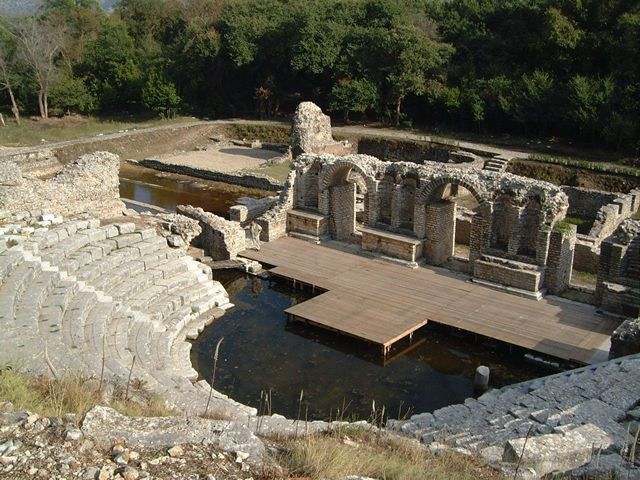
© Simon D. Kist. Used with permission.
World Heritage Research
Discover scientific research and academic studies that deepen our understanding of Butrint from its history and significance to its conservation, management, and contemporary challenges.
-
Bouthrotos (Butrint) in the Archaic and Classical Periods: The Acropolis and Temple of Athena Polias
Archaeological excavations at Butrint, Albania, have revealed significant insights into the urban layout and historical shoreline of Bouthrotos during its Archaic and Classical periods (8th–4th century BCE). The Roman Forum Excavations (RFE) Project uncovered stratified material beneath the forum, allowing researchers to reconstruct the evolution of the acropolis and the Temple of Athena Polias. Notably, the study identified the temple's partial remains and traced the formation processes of the Butrint headland, providing a clearer understanding of its development in relation to Greek colonization in the region.
David R. Hernandez. (2017). Bouthrotos (Butrint) in the Archaic and Classical Periods: The Acropolis and Temple of Athena Polias. Hesperia: The Journal of the American School of Classical Studies at Athens, 86(2), 205. https://doi.org/10.2972/hesperia.86.2.0205
View Publication Record | Read Publication -
Beyond Butrint: The ‘Mursi Survey’, 2008
A field survey east of Butrint, Albania, reveals that the density of Imperial Roman sites extends significantly beyond the ancient city's immediate hinterland. Contrary to previous assumptions about urban continuity and landscape impact, the study finds sparse pre-Roman and post-Roman sites, with intense engagement between Butrint and its hinterland primarily during the Early Roman period following colonization. This challenges the narrative set by Horden and Purcell in The Corrupting Sea (2000), suggesting a more nuanced relationship between urban centers and their surroundings in this region.
Hodges, R., Carr, E., Sebastiani, A., & Vaccaro, E. (2016). BEYOND BUTRINT: THE ‘MURSI SURVEY’, 2008. The Annual of the British School at Athens, 111, 269–297. https://doi.org/10.1017/s0068245415000118
View Publication Record | Read Publication -
Butrint in the mid-Byzantine period: a new interpretation
Recent excavations at Butrint, a UNESCO World Heritage Site on Albania's southwest coast, have uncovered significant evidence that reshapes our understanding of the site during its mid-Byzantine period (8th–15th century). The study, focusing on the Western Defences of the Lower City, reveals new insights into the construction and occupation phases of this fortified area. By analyzing layers of archaeological data, researchers propose a revised chronology for Butrint's Byzantine era, highlighting its strategic importance and adaptive reuse over centuries. This work builds on decades of excavations, including recent collaborations between the Butrint Foundation, the Albanian Institute of Archaeology, and the University of East Anglia.
Kamani, S. (2011). Butrint in the mid-Byzantine period: a new interpretation. Byzantine and Modern Greek Studies, 35(2), 115–133. https://doi.org/10.1179/030701311x12906801091836
View Publication Record | Read Publication -
Ecotourism Opportunities and Challenges in Butrint, Albania, a Unique UNESCO and Ramsar Site
Butrint National Park, a UNESCO World Heritage site since 1992 and a Ramsar site since 2003, presents significant ecotourism potential due to its unique combination of geographical position, landscape, biodiversity, and rich cultural heritage. The park is the most visited by foreign tourists in Albania, with opportunities for year-round visitation through activities like birdwatching, walking trails, biking, and scuba-diving. However, uncontrolled human activities such as illegal urbanization, wetland reclamation, mining, irrational marine aquaculture, hunting, excessive grazing, and fires pose substantial threats to these ecotourism opportunities. The study recommends strategies to mitigate these challenges and maximize the park's potential for sustainable ecotourism development.
Bego, F., & Malltezi, J. (2011). Ecotourism Opportunities and Challenges in Butrint, Albania, a Unique UNESCO and Ramsar Site. Journal of Coastal Research, 61, 150–157. https://doi.org/10.2112/si61-001.9
View Publication Record | Read Publication -
Osteological and molecular identification of brucellosis in ancient Butrint, Albania
A groundbreaking study confirms the presence of brucellosis, a zoonotic disease caused by Brucella bacteria, in human remains from ancient Butrint, Albania. Researchers identified severe vertebral lesions in two adolescent males dating to the 10th–13th centuries AD and ruled out tuberculosis through genetic screening. Positive amplification of Brucella DNA markers—IS6501 insertion element and Bcsp31 gene—in affected bones provided definitive evidence. This discovery suggests brucellosis was endemic in the region during the Middle Ages, offering new insights into past disease dynamics and human-animal interactions at a UNESCO World Heritage Site.
Mutolo, M. J., Jenny, L. L., Buszek, A. R., Fenton, T. W., & Foran, D. R. (2011). Osteological and molecular identification of brucellosis in ancient Butrint, Albania. American Journal of Physical Anthropology, 147(2), 254–263. Portico. https://doi.org/10.1002/ajpa.21643
View Publication Record | Read Publication