World Heritage Identification Number: 682
World Heritage since: 1994
Category: Natural Heritage
WHE Type: Protected Areas & National Parks
Transboundary Heritage: No
Endangered Heritage: No
Country: 🇺🇬 Uganda
Continent: Africa
UNESCO World Region: Africa
Map
Bwindi Impenetrable National Park: A Haven for Endangered Species
The Bwindi Impenetrable National Park, located in south-western Uganda, stands as a testament to the rich biodiversity that Africa harbors. Inscribed as a UNESCO World Heritage Site in 1994, this park spans over 32,000 hectares and serves as a sanctuary for numerous endangered species, most notably the mountain gorilla.
More to come…UNESCO Description of the World Heritage Site
Located in south-western Uganda, at the junction of the plain and mountain forests, Bwindi Park covers 32,000 ha and is known for its exceptional biodiversity, with more than 160 species of trees and over 100 species of ferns. Many types of birds and butterflies can also be found there, as well as many endangered species, including the mountain gorilla.
UNESCO Justification of the World Heritage Site
Criterion (vii): As a key site for biodiversity on the continent, the species richness occurring in this site, recognised also under criteria (x) below, can be considered as a superlative natural phenomenon.
Criterion (x): Due to its diverse habitats ranging from 1,160 to 2,706 m in altitude, location at the intersection of the Albertine, Congo Basin and Eastern Africa ecological zones, and probable role as a Pleistocene refugium, Bwindi is the most important area in Uganda for species due to an exceptional diversity that includes many Albertine Rift endemics. This forest is believed to be a mere remnant of a very large forest which once covered much of western Uganda, Rwanda, Burundi and eastern Democratic Republic of Congo (DRC). The property has the highest diversity of tree species (over 200 species including 10 endemics) and ferns (some 104 species) in East Africa, and maybe the most important forest in Africa for montane forest butterflies with 202 species (84% of the country’s total), including eight Albertine endemics. The forest is very significant as a home to almost half of the population (about 340) of the critically endangered mountain gorilla. With over 347 species of forest birds recorded in the Park,at least 70 out of 78 montane forest bird species occurring in the Albertine Rift region are found in the forest, and 22 of the 36 endemics. Overall, Bwindi hosts numerous globally threatened species including high-profile mammals such as mountain gorilla, chimpanzee, l’Hoest’s monkey and African elephant; birds such as African green broadbill, Grauer’s swamp warbler, Turner’s Eremomela, Chapin’s flycatcher and Shelley’s crimson-wing; and butterflies such as African giant swallowtail and Cream-banded swallowtail.
Encyclopedia Record: Bwindi Impenetrable National Park
Bwindi Impenetrable National Park is a national park in southwestern Uganda. It is part of the Bwindi Impenetrable Forest and is situated along the Democratic Republic of the Congo border next to the Virunga National Park and on the edge of the Albertine Rift. Composed of 321 km2 (124 sq mi) of both lowland and montane forest, it is accessible only on foot. It is a United Nations Educational, Scientific and Cultural Organization-designated World Heritage Site.Additional Site Details
Area: 32,092 hectares
Number of Components: 1
(x) — Contains most important habitats for biodiversity
Coordinates: -1.047 , 29.692
IUCN World Heritage Outlook
The 2025 Conservation Outlook on Bwindi Impenetrable National Park reports the following assessment:
Source: International Union for Conservation of Nature (IUCN) · View assessment
Image
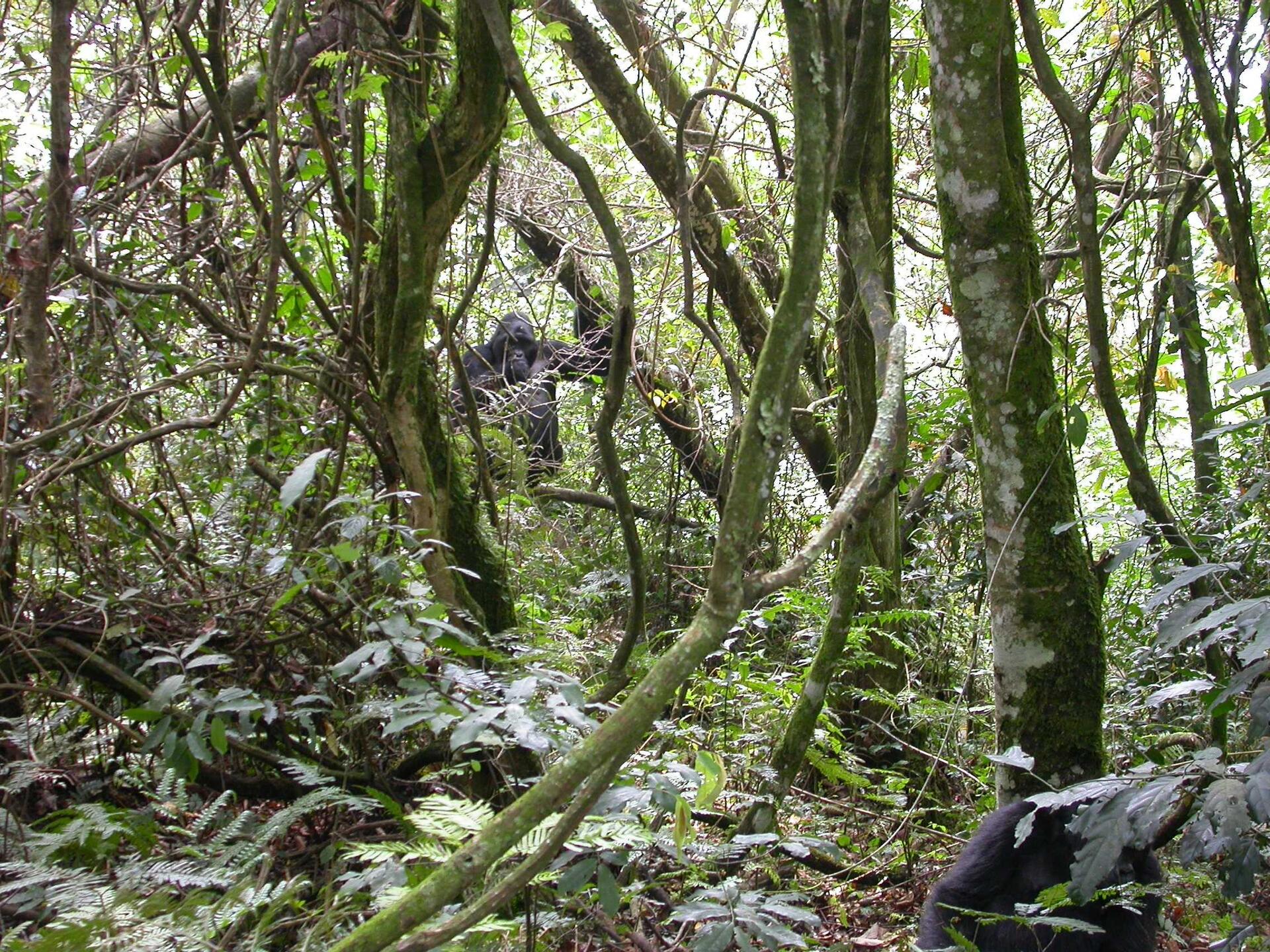
© Unknown, CC BY-SA 3.0 Resized from original. (This derivative is under the same CC BY-SA license.)
World Heritage Research
Discover scientific research and academic studies that deepen our understanding of Bwindi Impenetrable National Park from its history and significance to its conservation, management, and contemporary challenges.
-
Lack of Rule-Adherence During Mountain Gorilla Tourism Encounters in Bwindi Impenetrable National Park, Uganda, Places Gorillas at Risk From Human Disease
Over 98% of mountain gorilla tourism encounters in Bwindi Impenetrable National Park (BINP), Uganda, violated the critical 7-meter human-gorilla distance rule, despite rigorous pre-trek briefings by park rangers. This finding, derived from observational data collected during 53 treks between May and August 2014, reveals a significant risk of disease transmission to endangered mountain gorillas (Gorilla beringei beringei), with 68.2% of observations occurring at distances ≤7 meters and 14% at ≤3 meters. The study highlights systemic non-adherence to Uganda Wildlife Authority (UWA) guidelines, which limit group size and duration while enforcing strict spacing rules. Survey data from 243 tourists suggest potential for improvement, with 73.6% expressing willingness to adopt precautionary measures like face masks to protect gorilla health. These results underscore the urgent need for stronger enforcement and education to mitigate disease risks in this critical conservation context.
Weber, A., Kalema-Zikusoka, G., & Stevens, N. J. (2020). Lack of Rule-Adherence During Mountain Gorilla Tourism Encounters in Bwindi Impenetrable National Park, Uganda, Places Gorillas at Risk From Human Disease. Frontiers in Public Health, 8. https://doi.org/10.3389/fpubh.2020.00001
View Publication Record | Read Publication -
Gorilla Tourism in Bwindi Impenetrable National Park, Uganda: An Actor-Network Perspective
Gorilla tourism in Bwindi Impenetrable National Park, Uganda, has evolved through multiple 'translations' of the gorilla's role, shaping its significance across hunting, scientific, conservation, and tourism networks. Using actor-network theory (ANT), this study reveals how gorillas transitioned from trophies to symbols of scientific curiosity, endangered species, and finally, key attractions in tourism. The research highlights the dynamic interplay between human actors and gorillas, demonstrating that gorilla tourism's permanence stems from these shifting relationships. By applying ANT's concepts of ordering, materiality, and multiplicity, the study offers new perspectives on agency in tourism, conservation, and development, emphasizing how gorillas are actively shaped by their social contexts.
van der Duim, R., Ampumuza, C., & Ahebwa, W. M. (2014). Gorilla Tourism in Bwindi Impenetrable National Park, Uganda: An Actor-Network Perspective. Society & Natural Resources, 27(6), 588–601. https://doi.org/10.1080/08941920.2014.901459
View Publication Record | Read Publication -
Tourism revenue sharing policy at Bwindi Impenetrable National Park, Uganda: a policy arrangements approach
A study on tourism revenue sharing (TRS) at Bwindi Impenetrable National Park, Uganda, reveals that the policy's governance capacity is low due to structural incongruence among its dimensions—actors, resources, rules of the game, and discourses. Despite participatory reforms, the Uganda Wildlife Authority retains control over resources and sets the rules, leaving local communities undercompensated for conservation costs. Weak communication, unfair distribution, corruption claims, and powerful local elites further exacerbate these issues. The research, based on qualitative data from BINP and surrounding parishes, suggests that addressing inequities in TRS design could enhance its potential to support conservation through development.
Ahebwa, W. M., van der Duim, R., & Sandbrook, C. (2011). Tourism revenue sharing policy at Bwindi Impenetrable National Park, Uganda: a policy arrangements approach. Journal of Sustainable Tourism, 20(3), 377–394. https://doi.org/10.1080/09669582.2011.622768
View Publication Record | Read Publication -
Ecotourism: The Modern Predator? Implications of Gorilla Tourism on Local Livelihoods in Bwindi Impenetrable National Park, Uganda
Ecotourism, often hailed as a tool for conservation and local development, may instead perpetuate poverty and dependency in nearby communities. A study analyzing gorilla tourism's impact on rural villagers adjacent to Bwindi Impenetrable National Park, Uganda, reveals that the commodification of wilderness for foreign visitors shifts control to international organizations, creating new forms of vulnerability rather than alleviating hardship. Through a year of ethnographic fieldwork, the research exposes how ecotourism's 'new' relations between people and parks often reinforce existing power imbalances.
Laudati, A. (2010). Ecotourism: The Modern Predator? Implications of Gorilla Tourism on Local Livelihoods in Bwindi Impenetrable National Park, Uganda. Environment and Planning D: Society and Space, 28(4), 726–743. https://doi.org/10.1068/d15708
View Publication Record | Read Publication -
The Encroaching Forest: Struggles Over Land and Resources on the Boundary of Bwindi Impenetrable National Park, Uganda
Bwindi Impenetrable National Park's expansion into privately owned land represents a new form of state control, primarily through conservation policies that dispossess local farmers and restrict their access to resources. This encroachment not only limits rural communities' ability to respond to crop raiding but also prevents them from utilizing their own land, highlighting a significant conflict between wildlife protection and human rights in Uganda. The study employs a case analysis approach to explore these dynamics, emphasizing the broader implications of state-led conservation strategies on local livelihoods.
Laudati, A. A. (2010). The Encroaching Forest: Struggles Over Land and Resources on the Boundary of Bwindi Impenetrable National Park, Uganda. Society & Natural Resources, 23(8), 776–789. https://doi.org/10.1080/08941920903278111
View Publication Record | Read Publication