World Heritage Identification Number: 684
World Heritage since: 1994
Category: Natural Heritage
WHE Type: Protected Areas & National Parks
Transboundary Heritage: No
Endangered Heritage: No
Country: 🇺🇬 Uganda
Continent: Africa
UNESCO World Region: Africa
Map
Exploring the Majestic Rwenzori Mountains National Park
The Rwenzori Mountains National Park, a UNESCO World Heritage Site since 1994, is nestled within the western region of Uganda. Covering approximately 996 square kilometers, this protected area encompasses the primary portion of the Rwenzori mountain range, home to Africa's third tallest peak, Mount Margherita, standing at an impressive height of 5,109 meters above sea level.
More to come…UNESCO Description of the World Heritage Site
The Rwenzori Mountains National Park covers nearly 100,000 ha in western Uganda and comprises the main part of the Rwenzori mountain chain, which includes Africa's third highest peak (Mount Margherita: 5,109 m). The region's glaciers, waterfalls and lakes make it one of Africa's most beautiful alpine areas. The park has many natural habitats of endangered species and a rich and unusual flora comprising, among other species, the giant heather.
UNESCO Justification of the World Heritage Site
Criterion (vii): The Rwenzoris are the legendary “Mountains of the moon”, a reflection of the mist-shrouded mountains of this rugged massif that tower almost 4,000 m above the Albertine Rift Valley, making them visible from great distances. These mountains offer a unique and pristine landscape of alpine vegetation studded with charismatic giant lobelias, groundsels, and heathers which have been called “Africa’s botanical big game”. The combination of spectacular snow-capped peaks, glaciers, V-shaped valleys, fast flowing rivers with magnificent waterfalls, clear blue lakes and unique flora contributes to the area’s exceptional natural beauty.
Criterion (x): Because of their altitudinal range, and the nearly constant temperatures, humidity and high insolation, the mountains support the richest montane flora in Africa. There is an outstanding range of species, many of which are endemic to the Albertine Rift and bizarre in appearance. The natural vegetation has been classified as belonging to five distinct zones, determined largely by altitude and aspect. The higher altitude zones, covered by heath and Afro-alpine moorland, extend from around 3,500 m to the snow line and represent the rarest vegetation types on the African continent. Significant species include the giant heathers, groundsels, lobelias and other endemics. In terms of fauna, the Rwenzoris have been recognised as an Important Bird Area with 217 bird species recorded to date, a number expected to increase as the park becomes better surveyed. The montane forests are also a home to threatened species such as the African forest elephant, eastern chimpanzee and l’Hoest’s monkey. The endangered Rwenzori black-fronted or red duiker, believed to be a very localized subspecies or possibly a separate species, appears to be restricted to the Park.
Encyclopedia Record: Rwenzori Mountains National Park
Rwenzori Mountains National Park is a Ugandan national park and UNESCO World Heritage Site located in the Rwenzori Mountains. Almost 1,000 km2 (386 sq mi) in size, the park has Africa's third highest mountain peak and many waterfalls, lakes, and glaciers. The park is known for its beautiful plant life.Additional Site Details
Area: 99,600 hectares
Number of Components: 1
(x) — Contains most important habitats for biodiversity
Coordinates: 0.223611111 , 29.92416667
IUCN World Heritage Outlook
The 2025 Conservation Outlook on Rwenzori Mountains National Park reports the following assessment:
Source: International Union for Conservation of Nature (IUCN) · View assessment
Image
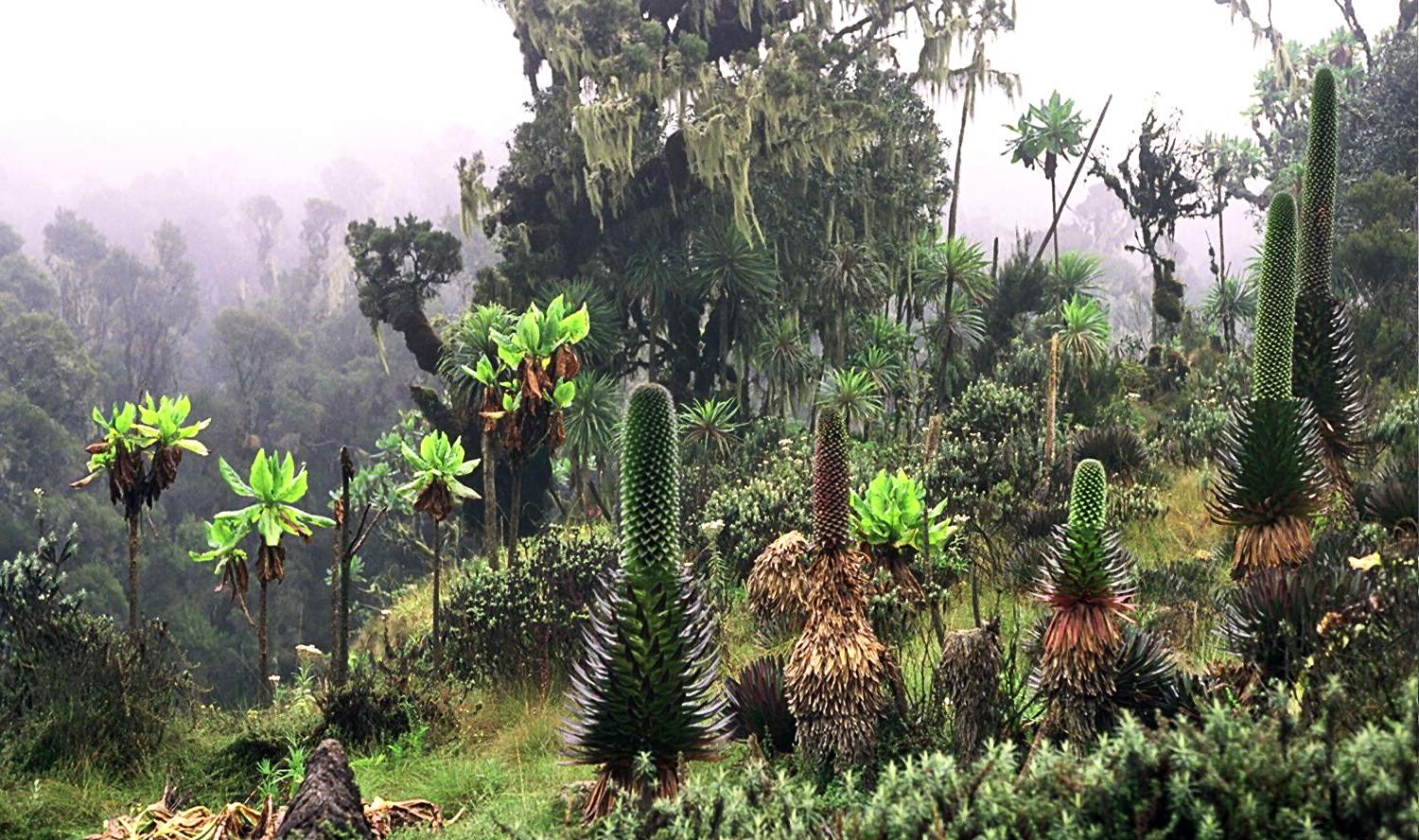
© Manuel Werner, Germany(Wikipedia-Kontakt: de:Benutzer:Werner, Deutschland), CC BY-SA 2.5 Resized from original. (This derivative is under the same CC BY-SA license.)
World Heritage Research
Discover scientific research and academic studies that deepen our understanding of Rwenzori Mountains National Park from its history and significance to its conservation, management, and contemporary challenges.
-
Land Suitability Mapping of the Most Illegally Harvested Plant Species using a GIS-based Model in Uganda
Land suitability mapping reveals significant spatial variation in the potential habitats for six illegally harvested plant species in Uganda, with highly suitable areas concentrated in the western and southwestern highlands of the Albertine Rift. This study used a GIS-based Multi-Criteria Evaluation (MCE) framework combined with the Analytic Hierarchy Process (AHP) to integrate climatic variables, soil properties, topography, and land-use data, generating species-specific suitability maps. While montane species like Prunus africana and Arundinaria alpina showed restricted suitability in cooler, wetter highlands, adaptable species such as Albizia coriaria and Albizia gummifera exhibited broader distribution patterns. The findings highlight the potential for ex-situ conservation and ecological restoration outside protected areas, offering spatially explicit guidance to mitigate pressure on in-situ populations and promote sustainable management of valuable plant resources.
Muhesi, N., Nuwagira, U., Tinkasimire, R., & Hakiza, A. (2026). Land Suitability Mapping of the Most Illegally Harvested Plant Species using a GIS-based Model in Uganda. East African Journal of Environment and Natural Resources, 9(2), 266–288. https://doi.org/10.37284/eajenr.9.2.5017
View Publication Record | Read Publication -
The long-term hazard cascade of an unprecedented wildfire in a tropical mountain ecosystem
A wildfire that burned 31 km² of pristine tropical forest and wetland in Uganda's Rwenzori Mountains National Park in February 2012 triggered a long-term hazard cascade, including ten major floods since then. Two debris floods required large-scale humanitarian responses, while post-fire erosion widened the River Nyamwamba sevenfold, breaching copper-cobalt mine tailings and mobilizing an estimated 744,000 tons of waste into the river. Slow vegetation recovery at high altitudes and feedback loops between hazards have prolonged this high-risk state. The study combines remote sensing, humanitarian records, field surveys, and interviews to highlight the urgent need for understanding emergent tropical mountain fires and their downstream impacts.
Veness, W., Day, M., Ross, A. C., Bamutaze, Y., Han, J., Mulangwa, D., Mwesigwa, A., Ntale, E., Tindimugaya, C., Guma, B., Stephens, E., & Buytaert, W. (2026). The long-term hazard cascade of an unprecedented wildfire in a tropical mountain ecosystem. Natural Hazards and Earth System Sciences, 26(6), 3045–3075. https://doi.org/10.5194/nhess-26-3045-2026
View Publication Record | Read Publication -
Monitoring the Spatio-Temporal Patterns of Forest Gaps and Health in the Rwenzori Mountains National Park, Western Uganda
Research reveals that forest gaps in the Rwenzori Mountains National Park, a UNESCO World Heritage Site in Uganda, have exhibited significant spatio-temporal variability from 2013 to 2025. The study found non-linear patterns of disturbance, with gap sizes peaking at 1,421.49 hectares between 2015 and 2019, followed by reductions and a sharp resurgence in 2025 (1,381.1 hectares). Vegetation health declined notably in 2017 and 2025, likely due to illegal logging, fire, landslides, and climate stressors, while canopy density also fluctuated, declining significantly by 2025. Multiple linear regression analysis explained 97.2% of canopy density variation, highlighting the strong positive effects of NDVI, EVI, elevation, slope, and rainfall, whereas temperature negatively influenced canopy density. The findings underscore that forest gap formation is driven by both natural and anthropogenic pressures, necessitating enhanced monitoring, stricter conservation policies, and elevation-sensitive forest management to prevent long-term degradation in this ecologically sensitive montane ecosystem.
Nuwagira, U., Barasa, B., Muhesi, N., Namayengo, S., & Hakiza, A. (2026). Monitoring the Spatio-Temporal Patterns of Forest Gaps and Health in the Rwenzori Mountains National Park, Western Uganda. East African Journal of Environment and Natural Resources, 9(3), 159–184. https://doi.org/10.37284/eajenr.9.3.5356
View Publication Record | Read Publication -
The politics of monitoring and evaluation: Implications for evidence generation and use
Monitoring and evaluation (M&E) in conservation efforts, particularly in UNESCO World Heritage Sites like the Rwenzori Mountains National Park, is not merely a technical process but also a political one that shapes how performance evidence is generated and utilized. Research reveals that M&E is often aligned to meet donor requirements rather than local needs, with political leaders engaging in monitoring for electoral benefits. This study, conducted across three Ugandan national parks and neighboring communities using qualitative methods such as interviews and participant observation, highlights the need to acknowledge both the positive and negative implications of M&E politics to achieve its objectives effectively.
Ochen-Ochen, I. (2025). The politics of monitoring and evaluation: Implications for evidence generation and use. African Evaluation Journal, 13(1). https://doi.org/10.4102/aej.v13i1.792
View Publication Record | Read Publication -
Indigenous knowledge for climate action at the Ekyisalhalha kya Karoro sacred site, adjacent to Rwenzori mountains national park in Kasese
Indigenous knowledge (IK) holds significant potential for climate change mitigation, particularly in regions where modern science has limited reach. A case study at the Ekyisalhalha kya Karoro sacred site near Rwenzori Mountains National Park in Uganda demonstrates that traditional practices—such as rainwater harvesting, weather forecasting, and sustainable farming—can effectively address climate risks like rising temperatures, flooding, and desertification. The research highlights IK's accessibility and relevance for climate adaptation strategies, yet its underutilization in current interventions is noted. Using participatory qualitative methods, including interviews with cultural leaders, local authorities, and civil society representatives, the study underscores the need to re-energize and integrate IK into broader climate action frameworks.
Nsibambi, F., & Akiiki, A. A. (2024). Indigenous knowledge for climate action at the Ekyisalhalha kya Karoro sacred site, adjacent to Rwenzori mountains national park in Kasese. Journal of Cultural Heritage Management and Sustainable Development, 14(5), 798–801. https://doi.org/10.1108/jchmsd-05-2024-0111
View Publication Record | Read Publication -
The dark side of the moon: first insights into the microbiome structure and function of one of the last glacier-fed streams in Africa
A unique microbial ecosystem thrives in one of Africa's last glacier-fed streams, offering insights into the future of high-latitude glacial environments. The study reveals that the benthic microbiome in Rwenzori Mountains National Park is distinct from other glacier-fed systems, with novel taxa and a dominance of heterotrophic processes driven by abundant photoautotrophs like cyanobacteria and diatoms. Metagenomics shows nearly all prokaryotes can oxidize organic carbon, while over 80% engage in fermentation and acetate oxidation, suggesting tight coupling between primary producers and other microbes. This ecosystem's stability, likely due to the environmental conditions of the Afrotropics, contrasts with higher-latitude systems where glacier shrinkage may increase primary production.
Michoud, G., Kohler, T. J., Ezzat, L., Peter, H., Nattabi, J. K., Nalwanga, R., Pramateftaki, P., Styllas, M., Tolosano, M., De Staercke, V., Schön, M., Marasco, R., Daffonchio, D., Bourquin, M., Busi, S. B., & Battin, T. J. (2023). The dark side of the moon: first insights into the microbiome structure and function of one of the last glacier-fed streams in Africa. Royal Society Open Science, 10(8). https://doi.org/10.1098/rsos.230329
View Publication Record | Read Publication -
Tourist Agroforestry Landscape from the Perception of Local Communities: A Case Study of Rwenzori, Uganda
Local communities in Ruboni, Uganda, exhibit a strong affinity for the agroforestry landscapes surrounding Rwenzori Mountains National Park, despite ecological and socio-economic pressures threatening land use sustainability. The study reveals that while cultivated features are less central to residents' perceptions of their environment compared to natural elements, both are perceived as beautiful. Residents also express a desire for improved human-engineered facilities, indicating a nuanced relationship with their landscape. This research underscores the need for an integrated land governance model that balances strict protection within the park with more flexible land use outside, addressing current challenges to sustainability.
Iacopino, S., Piazzi, C., Opio, J., Muhwezi, D. K., Ferrari, E., Caporale, F., & Sitzia, T. (2022). Tourist Agroforestry Landscape from the Perception of Local Communities: A Case Study of Rwenzori, Uganda. Land, 11(5), 650. https://doi.org/10.3390/land11050650
View Publication Record | Read Publication