World Heritage Identification Number: 1022
World Heritage since: 2001
Category: Cultural Heritage
WHE Type: Buildings & Architectural Ensembles
Transboundary Heritage: No
Endangered Heritage: No
Country: 🇺🇬 Uganda
Continent: Africa
UNESCO World Region: Africa
Map
The Tombs of Buganda Kings at Kasubi: A Spiritual and Architectural Marvel
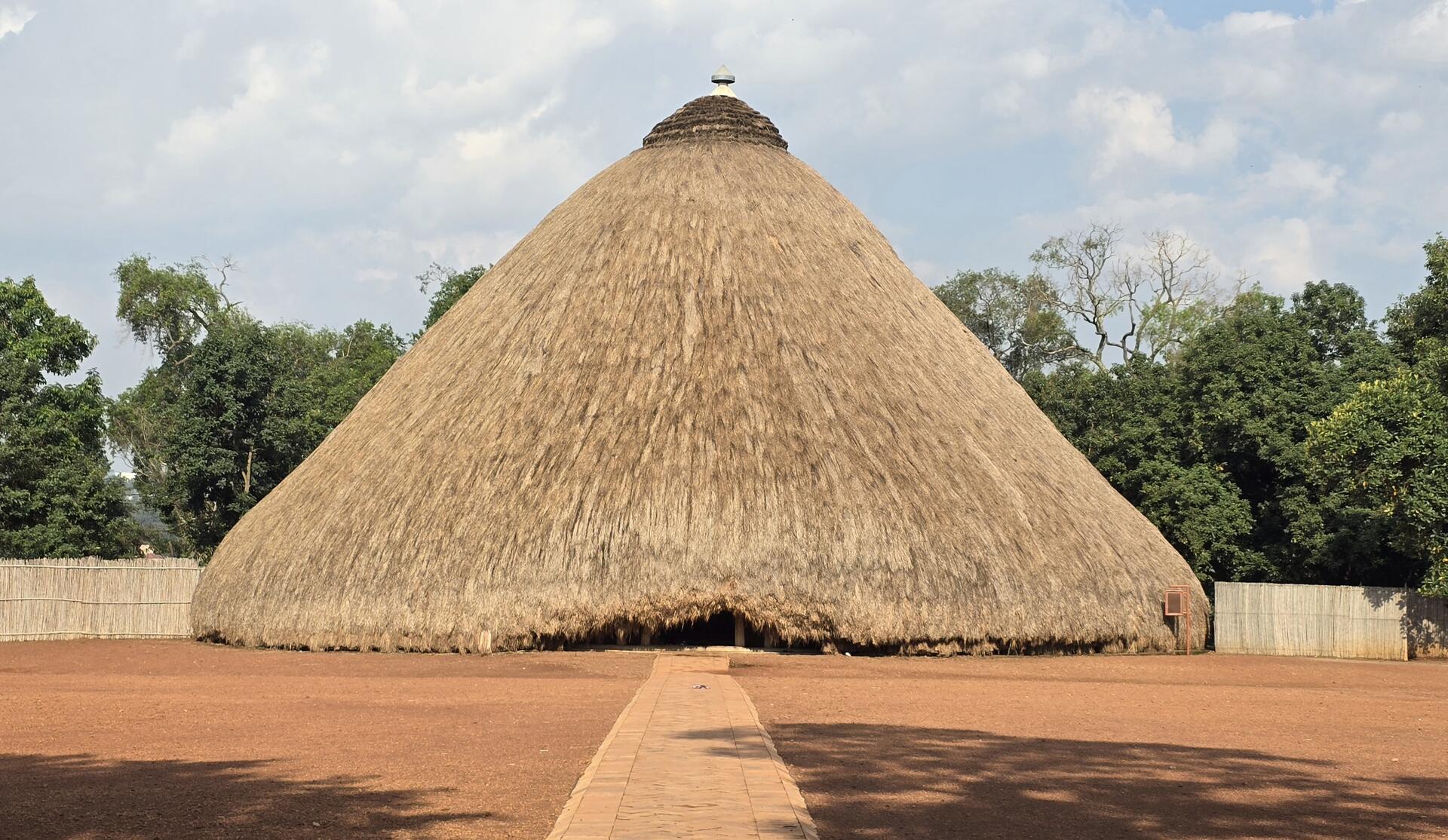
The Tombs of Buganda Kings at Kasubi, located in Kampala, Uganda, stand as a testament to the rich cultural heritage and architectural prowess of the Ganda people. Inscribed as a UNESCO World Heritage Site in 2001, this significant site has been recognized for its unique blend of spiritual, political, and architectural value.
More to come…UNESCO Description of the World Heritage Site
The Tombs of Buganda Kings at Kasubi constitute a site embracing almost 30 ha of hillside within Kampala district. Most of the site is agricultural, farmed by traditional methods. At its core on the hilltop is the former palace of the Kabakas of Buganda, built in 1882 and converted into the royal burial ground in 1884. Four royal tombs now lie within the Muzibu Azaala Mpanga, the main building, which is circular and surmounted by a dome. It is a major example of an architectural achievement in organic materials, principally wood, thatch, reed, wattle and daub. The site's main significance lies, however, in its intangible values of belief, spirituality, continuity and identity.
UNESCO Justification of the World Heritage Site
Criterion (i): The Kasubi Tombs site is a master piece of human creativity both in its conception and its execution.
Criterion (iii): The Kasubi Tombs site bears eloquent witness to the living cultural traditions of the Baganda.
Criterion (iv): The spatial organization of the Kasubi Tombs site represents the best extant example of a Baganda palace/architectural ensemble. Built in the finest traditions of Ganda architecture and palace design, it reflects technical achievements developed over many centuries.
Criterion (vi): The built and natural elements of the Kasubi Tombs site are charged with historical, traditional, and spiritual values. It is a major spiritual centre for the Baganda and is the most active religious place in the kingdom.
Encyclopedia Record: Kasubi Tombs
The Kasubi Tombs in Kampala, Uganda, is the site of the burial grounds for four kabakas and other members of the Baganda royal family. As a result, the site remains an important spiritual and political site for the Ganda people, as well as an important example of traditional architecture. It became a UNESCO World Heritage Site in December 2001, when it was described as "one of the most remarkable buildings using purely vegetal materials in the entire region of sub-Saharan Africa".Additional Site Details
Area: 26.8 hectares
Number of Components: 1
(iii) — Unique or exceptional testimony to a cultural tradition
(iv) — Outstanding example of a type of building or landscape
(vi) — Directly associated with events or living traditions
Coordinates: 0.348611111 , 32.55138889
World Heritage Research
Discover scientific research and academic studies that deepen our understanding of Tombs of Buganda Kings at Kasubi from its history and significance to its conservation, management, and contemporary challenges.
-
Applying the Historic Urban Landscape approach to changing African contexts. The Tombs of Buganda Kings at Kasubi at the heart of an integrated strategy for Kampala
A pilot project applying the Historic Urban Landscape (HUL) approach has successfully addressed urban development challenges at the UNESCO World Heritage Site 'Tombs of Buganda Kings at Kasubi' in Kampala, Uganda. The initiative, supported by UNESCO and the Government of Norway, focused on integrating heritage preservation with its urban context, as recommended by the 2011 HUL guidelines. This effort contributed to the site's removal from the World Heritage List in Danger (WHLD) in 2023 after extensive reconstruction, documentation, and capacity-building efforts following a devastating fire in 2010. The project also developed guidelines for the buffer zone, ensuring sustainable urban development while preserving the site's cultural significance.
Ssebuyungo, C., Zamarbide Urdaniz, A., & Barry, A. (2024). Applying the Historic Urban Landscape approach to changing African contexts. The Tombs of Buganda Kings at Kasubi at the heart of an integrated strategy for Kampala. Proceedings Africa24 Conference. https://doi.org/10.4995/africa24.2024.18966
View Publication Record | Read Publication -
Old Scandals, New Memories: Mayanja’s Transformation in Buganda (18th-21st centuries)
A century-old stuffed leopard, Mayanja, central to Buganda's royal mythology and history, was destroyed in the 2010 fire at Kasubi. The study reveals that Mayanja embodies multiple layers of myth, including a river, god, and symbol of execution, while serving as a site for both memory and the erasure of subversive pasts. Notably, incest myths were developed in the 19th century to obscure the tyrannical rule of King Kagulu and the subsequent reign of female rulers from the leopard clan. The research employs historical analysis to trace the transformation of Mayanja's narrative, highlighting its role in both preserving and obliterating Ganda history.
Médard, H. (2022). Old Scandals, New Memories: Mayanja’s Transformation in Buganda (18th-21st centuries) (M. Paul, Trans.). Les Cahiers d’Afrique de lEst, 57. https://doi.org/10.4000/eastafrica.1689
View Publication Record | Read Publication -
Time Travel in Heritage Reconstruction: The Case of the Kasubi Royal Tombs at Kampala, Uganda
The Kasubi Royal Tombs serve as a living cultural and spiritual hub where ancestral spirits guide reconstruction efforts amid crises. Two devastating fires in the past decade disrupted its functioning but revealed how past events, pacts, and ritual roles of clans and mediums provide critical frameworks for recovery. This study highlights the role of immaterial heritage—ancestral guidance—in shaping tangible solutions for damaged sites, offering a people-centred approach to heritage reconstruction that integrates spiritual, social, and material dimensions. By analyzing historical patterns of decision-making and capacity-building, the research underscores the importance of ancestral traditions in orienting stakeholders toward sustainable recovery, informing future generations, and preserving cultural integrity.
Nsubuga, J. (2025). Time Travel in Heritage Reconstruction: The Case of the Kasubi Royal Tombs at Kampala, Uganda. Heritage Reconstruction and People: Integrated Recovery after Trauma, 245–256. https://doi.org/10.56500/c-r2131
View Publication Record | Read Publication -
Developing a Viable Cultural Heritage Tourism Site at the Tombs of the Masingo at Swongozwi: Lessons Drawn from the Muzibu-Azaala-Mpanga, Kasubi, Uganda
Cultural heritage tourism development at indigenous African sites faces significant resistance from custodians, as demonstrated by the tombs of the Masingo dynasty in South Africa. Unlike Uganda's Kasubi Tombs, where local support for tourism exists, Swongozwi custodians rejected economic activities, highlighting the tension between poverty alleviation opportunities and cultural preservation. This study, using historical critical analysis, key informant interviews, and site visits, underscores the need to prioritize indigenous attitudes toward culture and identity in heritage management strategies. The findings align with prior research on the Vhavenda, suggesting that while tourism could benefit communities, custodial reluctance often hinders such initiatives.
Mafukata, M. A., Khan, A., & Moseki, M. (2021). Developing a Viable Cultural Heritage Tourism Site at the Tombs of the Masingo at Swongozwi: Lessons Drawn from the Muzibu-Azaala-Mpanga, Kasubi, Uganda. African Journal of Hospitality, Tourism and Leisure, 10(4)(10(4)), 1257–1274. https://doi.org/10.46222/ajhtl.19770720-161
View Publication Record | Read Publication