World Heritage Identification Number: 156
World Heritage since: 1981
Category: Natural Heritage
WHE Type: Protected Areas & National Parks
Transboundary Heritage: No
Endangered Heritage: No
Country: 🇹🇿 United Republic of Tanzania
Continent: Africa
UNESCO World Region: Africa
Map
Serengeti National Park: A Natural Wonder of Africa
The Serengeti National Park, located in northern Tanzania, is a vast expanse of savannah covering approximately 14,800 square kilometers. While designated as a protected area in 1940, it was officially established as a national park in 1951. This world-renowned site has been recognized as a UNESCO World Heritage Site since 1981. The park spans the Mara and Simiyu regions, as well as parts of the Arusha region in Tanzania.
The Serengeti's most iconic feature is the annual migration of millions of wildebeests, zebras, and gazelles. This epic journey follows the animals' pursuit of fresh grazing lands and permanent water sources. While the timing of the migration can vary slightly based on seasonal rainfall and food availability, the journey generally occurs year-round, following a cyclical pattern: calving (Jan–Mar), movement north (Apr–June), river crossings (July–Oct), and return south (Nov–Dec).
During this period, these herbivores traverse the Serengeti, crossing its diverse landscapes, from open grasslands to wooded kopjes (rocky outcrops). The animals' movements are closely followed by a variety of predators, including lions, hyenas, and cheetahs, making the Serengeti a hotspot for wildlife viewing.
The Serengeti ecosystem supports a rich diversity of species, with over 1.5 million large mammals residing within its borders. In addition to the migratory herds, the park is home to elephants, rhinos, leopards, and various primate species such as baboons and vervet monkeys. The avian life is equally vibrant, with over 500 bird species recorded, ranging from eagles and vultures to storks and flamingos.
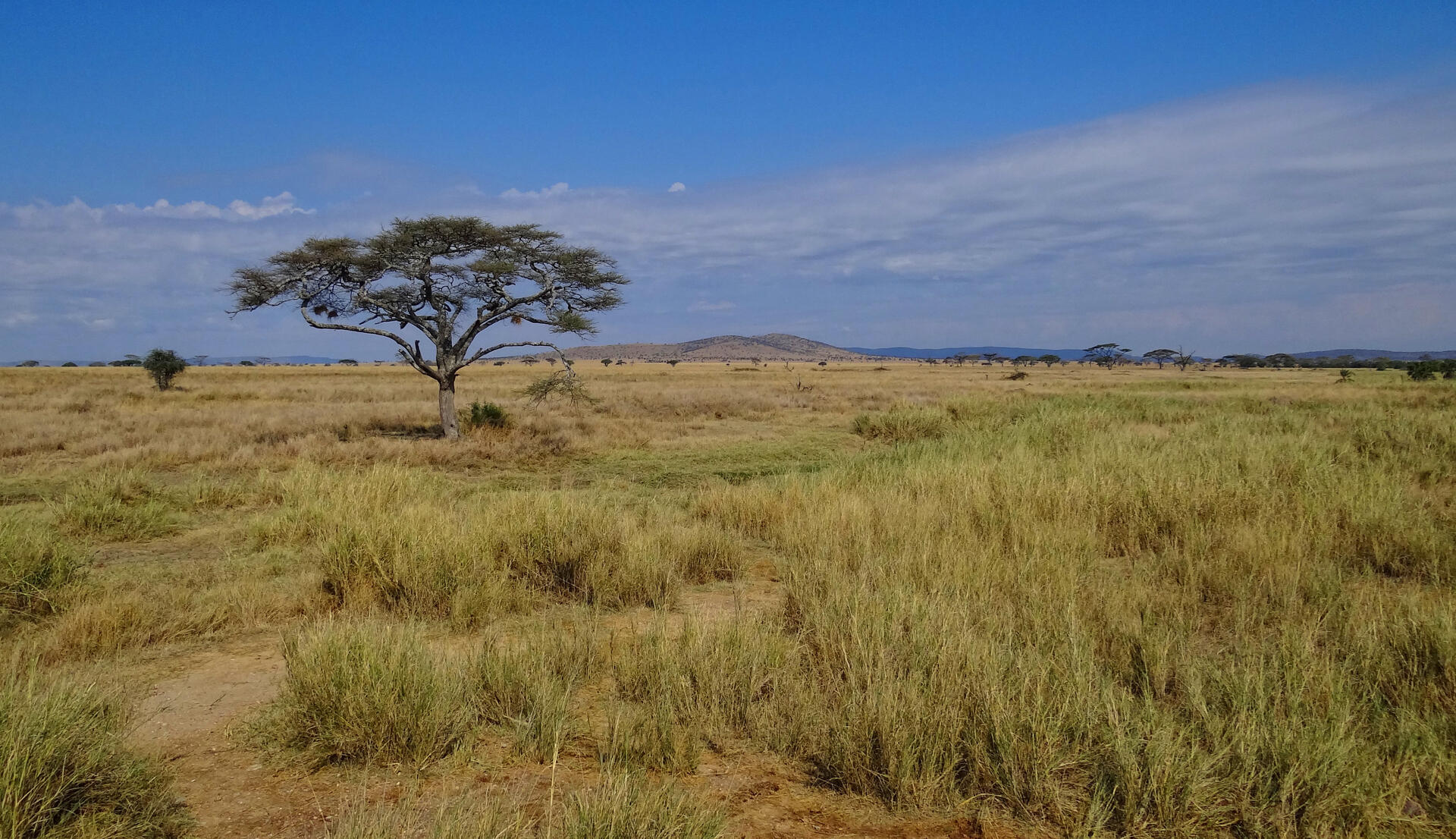
The park's landscape is characterized by its rolling grasslands, punctuated by acacia trees and the distinctive kopjes. These rocky formations provide essential shelter for many animal species and offer unique photographic opportunities for visitors. The Serengeti's rivers and streams, notably the Mara and Grumeti, support a diverse aquatic ecosystem and serve as vital water sources for the migrating herds.
Yet, the rivers are not only crucial water sources for the park’s wildlife but also central to one of the most dramatic scenes of the Great Migration. Each year, millions of wildebeests, zebras, and gazelles must cross these treacherous rivers in search of fresh grazing land, often facing the perilous jaws of crocodiles lurking beneath the water’s surface.
The Nile crocodile, with its immense size and strength, waits motionless along the riverbanks, ready to ambush migrating animals. These apex predators play a vital role in maintaining the balance of the ecosystem by controlling populations of herbivores and scavengers. The river crossings, particularly at the Mara River, are notorious for their intensity, as herds of animals rush through the water, often falling prey to waiting crocodiles.
The Serengeti National Park is not only a haven for wildlife but also plays a crucial role in scientific research. The park is home to numerous long-term ecological studies, contributing significantly to our understanding of African ecosystems and the impacts of climate change.
Visiting the Serengeti National Park offers travelers a chance to witness one of nature's greatest spectacles while supporting conservation efforts. With responsible tourism practices, visitors can contribute to the preservation of this remarkable ecosystem and help ensure its continued survival for future generations.
UNESCO Description of the World Heritage Site
The vast plains of the Serengeti comprise 1.5 million ha of savannah. The annual migration to permanent water holes of vast herds of herbivores (wildebeest, gazelles and zebras), followed by their predators, is one of the most impressive natural events in the world.
UNESCO Justification of the World Heritage Site
Criterion (vii): The Serengeti plains harbour the largest remaining unaltered animal migration in the world where over one million wildebeest plus hundreds of thousands of other ungulates engage in a 1,000 km long annual circular trek spanning the two adjacent countries of Kenya and Tanzania. This spectacular phenomenon takes place in a unique scenic setting of ‘endless plains’: 25,000km2 of treeless expanses of spectacularly flat short grasslands dotted with rocky outcrops (kopjes) interspersed with rivers and woodlands. The Park also hosts one of the largest and most diverse large predator-prey interactions worldwide, providing a particularly impressive aesthetic experience.
Criterion (x): The remarkable spatial-temporal gradient in abiotic factors such as rainfall, temperature, topography and geology, soils and drainage systems in Serengeti National Park manifests in a wide variety of aquatic and terrestrial habitats. The combination of volcanic soils combined with the ecological impact of the migration results in one of the most productive ecosystems on earth, sustaining the largest number of ungulates and the highest concentration of large predators in the world. The ecosystem supports 2 million wildebeests, 900,000 Thomson’s gazelles and 300,000 zebras as the dominant herds. Other herbivores include 7,000 elands, 27,000 topis, 18,000 hartebeests, 70,000 buffalos, 4,000 giraffes, 15,000 warthogs, 3,000 waterbucks, 2,700 elephants, 500 hippopotamuses, 200 black rhinoceroses, 10 species of antelope and 10 species of primate. Major predators include 4,000 lions, 1000 leopards, 225 cheetahs, 3,500 spotted hyenas and 300 wild dogs. Of these, the black rhino Diceros bicornis, leopard Panthera pardus, African elephant Loxodonta africana and cheetah Acynonix jubatus are listed in the IUCN Red List. There are over 500 species of birds that are perennially or seasonally present in the Park, of which five species are endemic to Tanzania. The Park has the highest ostrich population in Tanzania and probably Africa, making the population globally important.
Encyclopedia Record: Serengeti National Park
The Serengeti National Park is a large national park in northern Tanzania that stretches over 14,763 km2 (5,700 sq mi). It is located in eastern Mara Region and northeastern Simiyu Region and contains over 15,000 km2 (5,800 sq mi) of virgin savanna. The park was established in 1940.Additional Site Details
Area: 1,476,300 hectares
Number of Components: 1
(x) — Contains most important habitats for biodiversity
Coordinates: -2.33333 , 34.56667
World Heritage Research
Discover scientific research and academic studies that deepen our understanding of Serengeti National Park from its history and significance to its conservation, management, and contemporary challenges.
-
Tourism infrastructure and physiological stress in free-ranging impalas (Aepyceros melampus) of Serengeti National Park
Large-scale tourism infrastructure in Serengeti National Park elevates physiological stress in free-ranging impalas (Aepyceros melampus), even when tourists are absent. Researchers measured faecal glucocorticoid metabolites (FGMs) as a stress indicator, revealing significantly higher FGM levels in impalas near lodges compared to those near permanent tented camps or seasonal campsites. This suggests that the mere presence of substantial tourist facilities can induce stress in wildlife, posing potential risks to biodiversity. The study highlights the need for future research to identify specific infrastructure features driving this stress response, aiming to inform more sustainable tourism and conservation strategies.
Kessy, B. M., Arukwe, A., Mbise, F. P., Hariohay, K. M., Palme, R., Røskaft, E., & Ranke, P. S. (2026). Tourism infrastructure and physiological stress in free-ranging impalas (Aepyceros melampus) of Serengeti National Park. Global Ecology and Conservation, 67, e04130. https://doi.org/10.1016/j.gecco.2026.e04130
View Publication Record | Read Publication -
Habitat selection by an extraordinary savannah raptor: environmental factors driving abundance of the Secretarybird Sagittarius serpentarius in the Serengeti National Park (Tanzania)
A groundbreaking study reveals that Secretarybirds (Sagittarius serpentarius) thrive in the Serengeti National Park's transition zones, where extensive grasslands meet open woodlands or treed shrublands. Researchers estimated a population of 1,513 individuals with densities peaking at 2.3 birds per 10 km². Secretarybirds favor flat terrains with seasonal rivers and annual precipitation below 900 mm, avoiding areas with low vegetation cover or excessive prescribed burning (>60%). Pairs prefer closed treed shrublands, while single birds are more common in heterogeneous habitats. This research provides critical insights for long-term conservation efforts in Tanzania's Serengeti ecosystem.
Romani, F., Mmassy, E. C., Pellitteri-Rosa, D., Posillico, M., & Ramella Levis, E. (2025). Habitat selection by an extraordinary savannah raptor: environmental factors driving abundance of the Secretarybird Sagittarius serpentarius in the Serengeti National Park (Tanzania). Bird Study, 72(3), 263–286. https://doi.org/10.1080/00063657.2025.2490776
View Publication Record | Read Publication -
Interplay of competition and facilitation in grazing succession by migrant Serengeti herbivores
A groundbreaking study reveals that the migration of herbivores in Serengeti National Park is governed by a dynamic interplay of competition and facilitation, characterized as a 'push-pull' mechanism. Large-bodied zebras are nudged ahead of wildebeest due to competitive grazing, while their consumption of grass facilitates the arrival of smaller gazelles. This balance was observed through an 8-year study involving camera-trap surveys, GPS-collared herbivores, and fecal DNA metabarcoding, providing unprecedented insights into the mechanisms regulating large-scale ungulate migrations. Natural experiments, such as wildfires and rainfall, further demonstrated how these forces can disrupt or strengthen grazing succession patterns.
Anderson, T. M., Hepler, S. A., Holdo, R. M., Donaldson, J. E., Erhardt, R. J., Hopcraft, J. G. C., Hutchinson, M. C., Huebner, S. E., Morrison, T. A., Muday, J., Munuo, I. N., Palmer, M. S., Pansu, J., Pringle, R. M., Sketch, R., & Packer, C. (2024). Interplay of competition and facilitation in grazing succession by migrant Serengeti herbivores. Science, 383(6684), 782–788. https://doi.org/10.1126/science.adg0744
View Publication Record | Read Publication -
Proximate causes and perceptions of livestock keepers toward the risks of illegal grazing in Serengeti National Park
Livestock keepers in Serengeti National Park (SNP) primarily graze illegally due to insufficient pasturage and water in surrounding districts, compounded by high cattle competition. While most fear arrest within the park, large herders mitigate risks from wild animals using defensive techniques. The study highlights the need for authorities to adapt grazing practices based on rangeland conditions, stocking rates, and readiness to reduce illegal grazing. Conducted via semi-structured questionnaires, this research sheds light on the proximate causes and perceptions of risks among livestock keepers in SNP.
Matungwa, L. E., Joseph Kegamba, J., Wilbard Kisingo, A., & Masuruli, M. B. (2024). Proximate causes and perceptions of livestock keepers toward the risks of illegal grazing in Serengeti National Park. African Geographical Review, 44(1), 30–47. https://doi.org/10.1080/19376812.2024.2318752
View Publication Record | Read Publication -
Rocky outcrops form islands of high and unique tree biodiversity within an ocean of grass in Serengeti National Park
Rocky outcrops, or kopjes, in Serengeti National Park act as biodiversity hotspots for trees, significantly increasing tree abundance and species richness compared to the surrounding grass-dominated savannah. These unique ecosystems host distinct tree communities, particularly at sites with lower precipitation, where differences between kopje and matrix plots are most pronounced. Dominant tree species on kopjes exhibit functional traits such as evergreen foliage, higher specific leaf area, lower leaf nitrogen content, and reduced spine density, suggesting adaptations to locally moist conditions and lower fire frequencies. This study highlights the critical role of kopjes in shaping tree biodiversity, with potential implications for ecosystem functioning and higher trophic levels.
van der Plas, F., & Olff, H. (2024). Rocky outcrops form islands of high and unique tree biodiversity within an ocean of grass in Serengeti National Park. African Journal of Ecology, 62(3). Portico. https://doi.org/10.1111/aje.13313
View Publication Record | Read Publication -
Spatial and temporal niche overlap of aardwolves and aardvarks in Serengeti National Park, Tanzania
Aardwolves and aardvarks, two ecologically similar nocturnal insectivores, exhibit high spatial and temporal niche overlap in Serengeti National Park, Tanzania. Research using multispecies occupancy models with 105 remote camera detections (2016–2018) revealed a positive interaction between their occupancy probabilities, suggesting commensalism where aardwolves benefit from increased food accessibility due to aardvark presence. While slope, grassland proportion, and termite mound density did not influence occupancy, aardwolf occupancy increased with distance from permanent water sources, possibly to avoid predation risk. Both species showed high diel activity overlap during wet and dry seasons, remaining largely nocturnal. These findings enhance understanding of their ecological roles as termite consumers and potential ecosystem engineers.
van den Bosch, M., Kellner, K. F., Mkasanga, I., Mwampeta, S. B., Fyumagwa, R., Gantchoff, M. G., Patterson, B. R., & Belant, J. L. (2023). Spatial and temporal niche overlap of aardwolves and aardvarks in Serengeti National Park, Tanzania. Ecology and Evolution, 13(11). Portico. https://doi.org/10.1002/ece3.10718
View Publication Record | Read Publication -
Charcoal Whirlwinds and Post-Fire Observations in Serengeti National Park Savannahs
Researchers documented rare 'charcoal whirlwinds'—dust devils that lofted large quantities of charcoal into the atmosphere following wildfires in Serengeti National Park, Tanzania. These phenomena, observed in two distinct savannah regions (Western Corridor and Lamai), exhibited unique characteristics such as color, funnel shape, and height, depending on local land cover types and fuel canopies. The study leveraged field observations, meteorological data, and satellite imagery to analyze the spatiotemporal patterns of these whirlwinds, though direct measurements of particulate matter were not conducted. Findings suggest that charcoal-laden whirlwinds play a significant but understudied role in redistributing organic material across landscapes, with potential implications for regional-to-global atmospheric particle fluxes and depositional environments like lakes and wetlands.
Courtney Mustaphi, C. J., Vos, H. C., Marchant, R., & Beale, C. (2022). Charcoal Whirlwinds and Post-Fire Observations in Serengeti National Park Savannahs. Tanzania Journal of Science, 48(2), 460–473. https://doi.org/10.4314/tjs.v48i2.20
View Publication Record | Read Publication