World Heritage Identification Number: 606
World Heritage since: 1991
Category: Cultural Heritage
WHE Type: Protected Areas & National Parks
Transboundary Heritage: No
Endangered Heritage: No
Country: 🇧🇷 Brazil
Continent: Americas
UNESCO World Region: Latin America and the Caribbean
Map
Serra da Capivara National Park: A Window into Ancient Human History
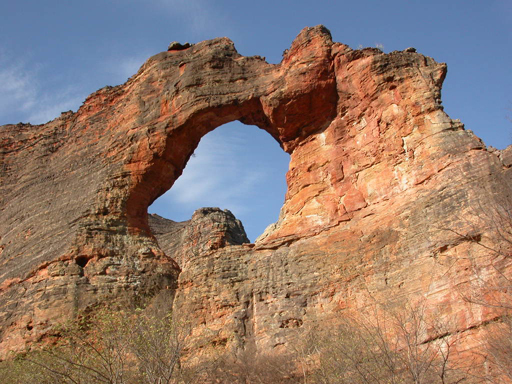
The Serra da Capivara National Park, located in the northeastern region of Brazil, stands as a testament to one of the oldest human communities in South America. Established in 1987 and inscribed as a UNESCO World Heritage Site in 1991, this protected area offers a unique glimpse into the lives of our ancestors dating back over 25,000 years.
More to come…UNESCO Description of the World Heritage Site
Many of the numerous rock shelters in the Serra da Capivara National Park are decorated with cave paintings, some more than 25,000 years old. They are an outstanding testimony to one of the oldest human communities of South America.
UNESCO Justification of the World Heritage Site
Criterion (iii): The Serra da Capivara National Park bears exceptional testimony to one of the oldest populations to inhabit South America. It constitutes and preserves the largest ensemble of archaeological sites, and the the oldest examples of rock art in the Americas. Moreover, the iconography of the paintings allows us to identify information about the region’s early peoples.
Encyclopedia Record: Serra da Capivara National Park
Serra da Capivara National Park is a national park in the Northeastern region of Brazil. The area has many prehistoric paintings.Additional Site Details
Area: 130,600 hectares
Number of Components: 1
Coordinates: -8.718634 , -42.652436
World Heritage Research
Discover scientific research and academic studies that deepen our understanding of Serra da Capivara National Park from its history and significance to its conservation, management, and contemporary challenges.
-
Insights into the evolutionary history of the most skilled tool-handling platyrrhini monkey: Sapajus libidinosus from the Serra da Capivara National Park
Researchers have uncovered that the capuchin monkey Sapajus libidinosus, residing in Brazil's Serra da Capivara National Park, exhibits a unique evolutionary trajectory linked to advanced tool-use behaviors. Their study reveals a discrete but constant population growth since the Holocene, coinciding with the emergence of the Caatinga biome—a semi-arid ecosystem rich in hard fruits and seeds processed using tools. Genetic analysis (CYTB sequences) suggests that S. libidinosus developed and maintained its autochthonous culture through cognitive innovation, social learning tolerance, adaptive genetic traits, terrestriality, and abundant natural resources. These factors created 'hot spots' for cultural diversification, enabling the species to thrive in a challenging environment with remarkable tool-handling skills surpassing those of other non-human primates.
Lima, T., Fam, B., Tavares, G. M., Falótico, T., Cantele, C., Fanti, L., Landau, L., Viscardi, L. H., Vargas-Pinilla, P., Barrientos-Diaz, O., Pissinatti, A., Sortica, V. A., Ottoni, E. B., Segatto, A. L. A., Turchetto-Zolet, A. C., & Bortolini, M. C. (2023). Insights into the evolutionary history of the most skilled tool-handling platyrrhini monkey: Sapajus libidinosus from the Serra da Capivara National Park. Genetics and Molecular Biology, 46(3 suppl 1). https://doi.org/10.1590/1678-4685-gmb-2023-0165
View Publication Record | Read Publication -
Bryophytes of Serra da Capivara National Park, Piauí, Brazil
A bryofloristic survey of Serra da Capivara National Park, located in the Caatinga biome of Brazil, identified 62 species of bryophytes, including mosses, hepatics, and a hornwort. The study revealed that about 60% of these species have broad distributions across Brazil, while others exhibit moderate or restricted distributions. Notably, 22 species were recorded for the first time in the Caatinga biome, 34 in the state of Piauí, and two in the Northeast Region of Brazil. This survey underscores the significance of Serra da Capivara National Park as a critical area for bryophyte conservation, highlighting the importance of continued floristic inventories in Brazil to better understand its diverse and understudied bryoflora.
Gomes do Nascimento, G. M., Mendes da Conceição, G., Fernandes Peralta, D., & Oliveira, H. C. d. (2019). Bryophytes of Serra da Capivara National Park, Piauí, Brazil. Check List, 15(5), 833–845. https://doi.org/10.15560/15.5.833
View Publication Record | Read Publication -
Late Pleistocene Deer in the Region of the National Park “Serra da Capivara” (Piauí, Brazil)
A groundbreaking discovery in the UNESCO World Heritage Site of Serra da Capivara National Park, Piauí, Brazil, reveals the presence of two deer species during the Late Pleistocene epoch. Fossil analysis from the Lagoa dos Porcos deposit identified a small deer (genus Mazama) and a larger, previously unrecorded species in the region, Morenelaphus sp. This marks the first documentation of Morenelaphus in Piauí State, significantly expanding its known paleogeographic distribution. The study also highlights ecological distinctions between cervid fauna in the park's karstic areas and the alluvial plain of Lagoa dos Porcos, offering new insights into Pleistocene biodiversity patterns in northeastern Brazil.
Valli, A. (2018). Late Pleistocene Deer in the Region of the National Park “Serra da Capivara” (Piauí, Brazil). Quaternary, 1(1), 4. https://doi.org/10.3390/quat1010004
View Publication Record | Read Publication -
The manifold use of pounding stone tools by wild capuchin monkeys of Serra da Capivara National Park, Brazil
Wild capuchin monkeys (Sapajus libidinosus) in Serra da Capivara National Park, Brazil, exhibit a uniquely diverse use of pounding stone tools (PSTs), surpassing other known populations. Unlike most capuchins that primarily use PSTs to open hard palm nuts, these monkeys employ them for multiple purposes: cracking seeds and fruits, breaking or enlarging holes in tree trunks or rocks, pulverizing pebbles, and sequentially with probe stick tools to access hidden prey. The study suggests active selection of larger stones, indicating a sophisticated tool choice behavior. This research highlights the remarkable cognitive flexibility and adaptability of these capuchins, offering new insights into their behavioral ecology.
Falótico, T., & Ottoni, E. B. (2016). The manifold use of pounding stone tools by wild capuchin monkeys of Serra da Capivara National Park, Brazil. Behaviour, 153(4), 421–442. https://doi.org/10.1163/1568539x-00003357
View Publication Record | Read Publication -
Herpetofauna of protected areas in the Caatinga II: Serra da Capivara National Park, Piauí, Brazil
A comprehensive survey of Serra da Capivara National Park, Brazil, reveals 37 herpetofaunal species, including lizards, snakes, frogs, a caecilian, and a chelonian. The study, conducted over 30 days using multiple trapping methods, suggests that local biodiversity remains underestimated, with rarefaction curves indicating potential undiscovered diversity. An atypical drought during the survey period may have affected captures, particularly of amphibians and snakes. Notably, water-dependent and forest-dependent species were found in canyons ('Boqueirões'), hinting at relictual rainforest fragments that require further study and conservation attention.
Cavalcanti, L. B. d. Q., Costa, T. B., Colli, G. R., Costa, G. C., França, F. G. R., Mesquita, D. O., Palmeira, C. N. S., Pelegrin, N., Soares, A. H. B., Tucker, D. B., & Garda, A. A. (2014). Herpetofauna of protected areas in the Caatinga II: Serra da Capivara National Park, Piauí, Brazil. Check List, 10(1), 18. https://doi.org/10.15560/10.1.18
View Publication Record | Read Publication -
Cross-Dating (Th/U-14C) of Calcite Covering Prehistoric Paintings at Serra da Capivara National Park, Piaui, Brazil
A study using cross-dating techniques (Th/U and AMS 14C) on calcite deposits covering prehistoric paintings at Serra da Capivara National Park, Brazil, suggests that these paintings may be younger than previously proposed. The research, published in Radiocarbon, analyzed samples from three rockshelters, including Toca da Gameleirinha (Pedra Pintada), and found ages younger than 12,000 years for the calcite formations. This challenges earlier estimates that suggested much older dates (>35 kyr BP) based on thermoluminescence (TL) and electron paramagnetic resonance (EPR) dating methods. The findings contribute to the ongoing debate about the age of rock art in the region and its implications for understanding human settlement in the Americas.
Fontugne, M. (2013). Cross-Dating (Th/U-14C) of Calcite Covering Prehistoric Paintings at Serra da Capivara National Park, Piaui, Brazil. Radiocarbon, 55(3–4). https://doi.org/10.2458/azu_js_rc.55.16254
View Publication Record | Read Publication -
Cross-Dating (Th/U-14C) of Calcite Covering Prehistoric Paintings at Serra da Capivara National Park, Piaui, Brazil
New cross-dating analysis of calcite deposits covering prehistoric paintings at Serra da Capivara National Park suggests the artworks may be younger than previously thought. Using coupled accelerator mass spectrometry (AMS) 14C and multi-collector inductively coupled plasma mass spectrometry (MC-ICPMS) 230Th/U dating, researchers found ages younger than 12,000 years for calcite samples from Toca da Gameleirinha. This challenges earlier estimates exceeding 35,000 years derived from thermoluminescence and electron paramagnetic resonance methods, reigniting debates on the antiquity of human settlement in South America and the chronology of rock art.
Fontugne, M., Shao, Q., Frank, N., Thil, F., Guidon, N., & Boeda, E. (2013). Cross-Dating (Th/U-14C) of Calcite Covering Prehistoric Paintings at Serra da Capivara National Park, Piaui, Brazil. Radiocarbon, 55(3), 1191–1198. https://doi.org/10.1017/s0033822200048104
View Publication Record | Read Publication -
Notes on Food Habits of Armadillos (Cingulata, Dasypodidae) and Anteaters (Pilosa, Myrmecophagidae) at Serra Da Capivara National Park (PiauÍ State, Brazil)
A rare study on the dietary habits of armadillos and anteaters in Brazil's Caatinga biome reveals that invertebrates, particularly termites (Isoptera) and ants/hymenopterans, form the primary food source for six species: nine-banded armadillo (Dasypus novemcinctus), seven-banded armadillo (D. septemcinctus), pichiciego (Euphractus sexcinctus), giant anteater (Myrmecophaga tridactyla), southern tamandua (Tamandua tetradactyla), and three-banded armadillo (Tolypeutes tricinctus). Surprisingly, seeds were also a significant component in the diets of most species, including the giant anteater and southern tamandua. Researchers analyzed fecal and stomach samples from individuals at Serra da Capivara National Park to uncover these insights, contributing critical data on the ecological roles of these mammals in the Caatinga ecosystem.
Vaz, V. C., Santori, R. T., Jansen, A. M., Delciellos, A. C., & D’Andrea, P. S. (2012). Notes on Food Habits of Armadillos (Cingulata, Dasypodidae) and Anteaters (Pilosa, Myrmecophagidae) at Serra Da Capivara National Park (PiauÍ State, Brazil). Edentata, 13(1), 84–89. https://doi.org/10.5537/020.013.0107
View Publication Record | Read Publication -
Quaternary deposits in the Serra da Capivara National Park and surrounding area, Southeastern Piauí state, Brazil
Research on Quaternary deposits in Serra da Capivara National Park, Brazil, reveals that the landscape evolution began around 436,515 years ago with clayey sediment deposition by the Piau River. The study identified colluvial and alluvial deposits indicating a semiarid climate, with fluvial channels likely exhibiting a braided pattern between 296,550 and 116,300 years ago. Depositional processes intensified during the last glacial maximum in the Northern Hemisphere, occurring between 15,800 and 10,350 years ago, marking the transition from Pleistocene to Holocene. The study used morphostratigraphical, sedimentological, and geochronological methods, including luminescence dating (thermoluminescence and optically stimulated luminescence), to interpret paleoenvironmental events.
Santos, J. C., Barreto, A. M. F., & Suguio, K. (2012). Quaternary deposits in the Serra da Capivara National Park and surrounding area, Southeastern Piauí state, Brazil. Geologia USP. Série Científica, 12(3), 115–132. https://doi.org/10.5327/z1519-874x2012000300008
View Publication Record | Read Publication -
World Heritage in poverty alleviation: Serra da Capivara National Park, Brazil
Serra da Capivara National Park, a UNESCO World Heritage Site in northeast Brazil, represents a significant archaeological and geological treasure. The park's semi-arid landscape, characterized by cliffs up to 270 meters high and extensive canyons, preserves a rich heritage of rock paintings and engravings within its sandstone walls. This unique physiographical meeting point between plateaus and an ancient plain also serves as a crucial watershed for the region's river systems. The study highlights the park's dual role in both cultural preservation and poverty alleviation, emphasizing its importance as a bridge between contrasting geological zones and its potential to contribute to sustainable development in the surrounding Piauí and Bom Jesus do Gurgeia regions.
Pessis, A.-M., Guidon, N., & Martin, G. (2012). World Heritage in poverty alleviation: Serra da Capivara National Park, Brazil. World Heritage, 301–311. https://doi.org/10.1017/cbo9781139567657.032
View Publication Record | Read Publication