World Heritage Identification Number: 821
World Heritage since: 1997
Category: Cultural Heritage
WHE Type: Historic Cities & Urban Areas
Transboundary Heritage: No
Endangered Heritage: No
Country: 🇧🇷 Brazil
Continent: Americas
UNESCO World Region: Latin America and the Caribbean
Map
The Historic Centre of São Luís: A Unique Iberian Colonial Town in Brazil
The Historic Centre of São Luís, inscribed as a UNESCO World Heritage Site in 1997, offers a captivating glimpse into the rich history and cultural heritage of Brazil. Located on Upaon-açu Island, in the Baía de São Marcos, the city serves as the capital and largest urban center of the state of Maranhão. With a population of over one million inhabitants, it boasts the second-largest maritime extension among Brazilian states, spanning an impressive 640 kilometers.
More to come…UNESCO Description of the World Heritage Site
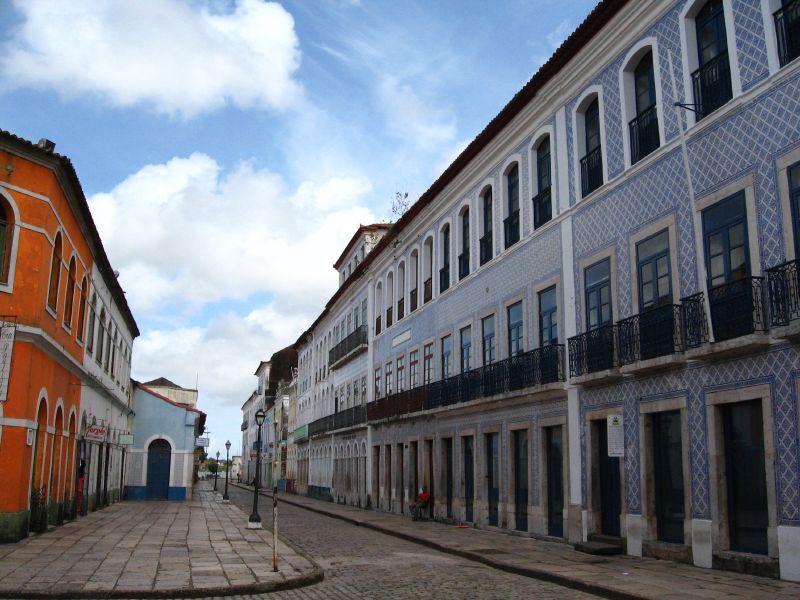
The late 17th-century core of this historic town, founded by the French and occupied by the Dutch before coming under Portuguese rule, has preserved the original rectangular street plan in its entirety. Thanks to a period of economic stagnation in the early 20th century, an exceptional number of fine historic buildings have survived, making this an outstanding example of an Iberian colonial town.
UNESCO Justification of the World Heritage Site
Criterion (iii): The Historic Centre of São Luís bears exceptional testimony to Portuguese colonial civilisation.
Criterion (iv): The Historic Centre of São Luís is an outstanding example of a Portuguese colonial town adapted to the climatic conditions of equatorial South America.
Criterion (v): The Historic Centre of São Luís is an outstanding example of a colonial town which has preserved its urban fabric, harmoniously integrated with its natural setting, to an exceptional degree.
Encyclopedia Record: Historic Centre of São Luís
The Historic Centre of São Luís is located on the Island of São Luis on the Bay of São Marcos in São Luís, the capital of Maranhão, Brazil. The historic center covers an area of 220 hectares, and has approximately 4,000 properties from the 18th and 19th centuries within protected state and federal zones. Part, but not all, of the Historic Center was declared a World Heritage Site in 1997. The Brazilian National Institute of Historic and Artistic Heritage (IPHAN) describes the Historic Center as "an exceptional example of a Portuguese colonial city adapted to the climatic conditions of equatorial South America, and which has preserved its urban fabric harmoniously integrated into its surrounding environment." Pedro Teotónio Pereira, ambassador to Brazil and first director of the Gulbenkian Foundation, described São Luís as "the most Portuguese city in Brazil".Additional Site Details
Area: 66.65 hectares
Number of Components: 1
(iv) — Outstanding example of a type of building or landscape
(v) — Outstanding example of traditional human settlement
Coordinates: -2.530054 , -44.303369
World Heritage Research
Discover scientific research and academic studies that deepen our understanding of Historic Centre of São Luís from its history and significance to its conservation, management, and contemporary challenges.
-
Digital Cartography of the Historic Centre of São Luís, Brazil
A digital cartography of São Luís's Historic Centre, Brazil, reveals how technological tools like Google My Maps can democratize access to cultural heritage and foster cultural citizenship. The study maps key cultural spaces using qualitative methods, including bibliographic, documentary, and field research, emphasizing the role of technology in preserving and promoting cultural diversity. It highlights the importance of demarcating cultural assets for education, research, and public engagement, drawing on theoretical frameworks by Canclini (2015) and Santos (2001). The findings underscore Google My Maps' potential to enhance knowledge sharing and civic participation in heritage conservation.
Bottentuit Junior, J. B., Santos, D. W. d., Costa, M. J. M., Mesquita, M. N., & Viana, J. A. R. (2020). Digital Cartography of the Historic Centre of São Luís, Brazil. International Journal for Innovation Education and Research, 8(8), 240–249. https://doi.org/10.31686/ijier.vol8.iss8.2512
View Publication Record | Read Publication -
Cidades-patrimônio e espaços de lazer: equipamentos de lazer no Centro Histórico de São Luís (MA)
Despite hosting a rich array of leisure equipment, São Luís's historic center underutilizes these resources for tourism and public engagement. Research reveals key challenges: inflexible operating hours, limited publicity, and lack of structured programming hinder their potential to boost cultural tourism. The study, combining bibliographic analysis with field observations, cataloged these assets but found significant gaps in their promotion and accessibility. Addressing these issues could strengthen the city's heritage preservation efforts while enhancing visitor experiences.
Moutinho, A. M. S., & Cutrim, K. D. G. (2016). Cidades-patrimônio e espaços de lazer: equipamentos de lazer no Centro Histórico de São Luís (MA). Revista Brasileira de Ecoturismo (RBEcotur), 9(1). https://doi.org/10.34024/rbecotur.2016.v9.6499
View Publication Record | Read Publication