
World Heritage Identification Number: 1183
World Heritage since: 2006
Category: Cultural Heritage
WHE Type: Archaeological Sites
Transboundary Heritage: No
Endangered Heritage: No
Country: 🇹🇿 United Republic of Tanzania
Continent: Africa
UNESCO World Region: Africa
Map
Unraveling the Secrets of Kondoa Rock-Art Sites: A Journey Through Time and Culture
The Kondoa Rock-Art Sites, nestled in the heart of central Tanzania, offer a captivating glimpse into the rich cultural tapestry of the past. Inscribed as a UNESCO World Heritage Site in 2006, these ancient paintings etched onto the rocky outcrops have stood the test of time, providing a unique testament to the evolving socio-economic landscape and spiritual beliefs of various societies that once inhabited this region.
More to come…UNESCO Description of the World Heritage Site
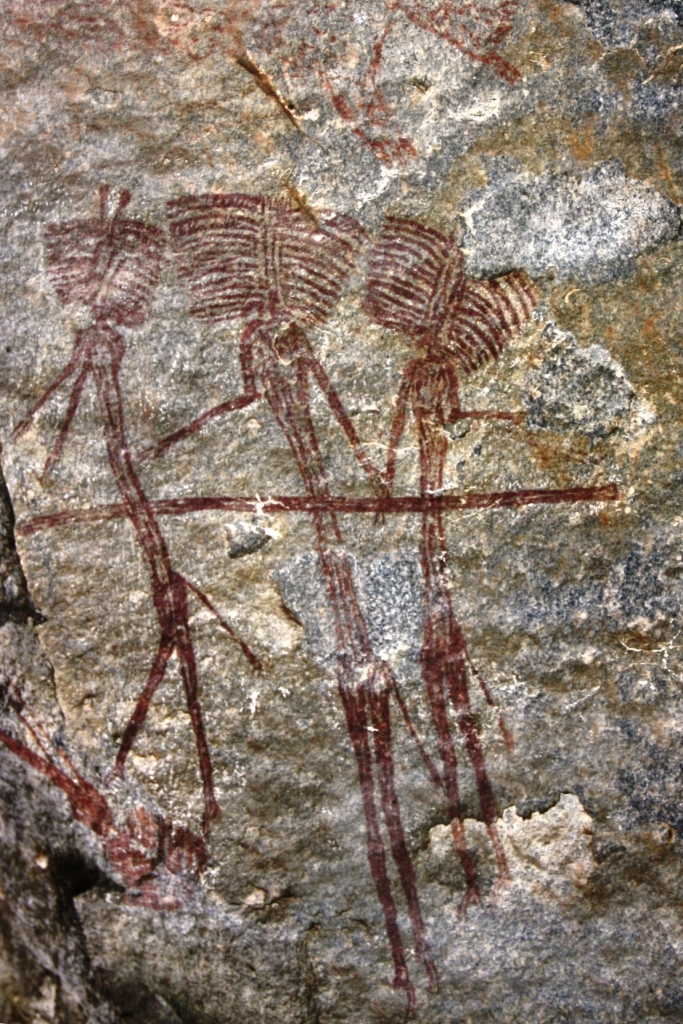
On the eastern slopes of the Masai escarpment bordering the Great Rift Valley are natural rock shelters, overhanging slabs of sedimentary rocks fragmented by rift faults, whose vertical planes have been used for rock paintings for at least two millennia. The spectacular collection of images from over 150 shelters over 2,336 km2 , many with high artistic value, displays sequences that provide a unique testimony to the changing socio-economic base of the area from hunter-gatherer to agro-pastoralist, and the beliefs and ideas associated with the different societies. Some of the shelters are still considered to have ritual associations with the people who live nearby, reflecting their beliefs, rituals and cosmological traditions.
UNESCO Justification of the World Heritage Site
Criterion (iii): The rock art sites at Kondoa are an exceptional testimony to the lives of hunter-gatherers and agriculturalists who have lived in the area over several millennia, and reflect a unique variation of hunter-gatherer art from southern and central Africa and a unique form of agro-pastoralist paintings.
Criterion (vi): Some of the rock art sites are still used actively by local communities for a variety of ritual activities such as rainmaking, divining and healing. These strong intangible relationships between the paintings and living practices reinforce the links with those societies that created the paintings, and demonstrate a crucial cultural continuum.
Encyclopedia Record: Kondoa Rock-Art Sites
The Kondoa Rock-Art Sites or Kondoa Irangi Rock Paintings are a series of ancient paintings on rockshelter walls in central Tanzania. The Kondoa region was declared a UNESCO World Heritage Site in 2006 because of its impressive collection of rock art. These sites were named national monuments in 1937 by the Tanzania Antiquities Department. The paintings are located approximately nine kilometres east of the main highway (T5) from Dodoma to Babati, about 20 km north of Kondoa town, in Kondoa District of Dodoma Region, Tanzania. The boundaries of the site are marked by concrete posts. The site is a registered National Historic Sites of Tanzania.Additional Site Details
Area: 233,600 hectares
Number of Components: 1
(vi) — Directly associated with events or living traditions
Coordinates: -4.7244444444 , 35.8338888888
Image
©

World Heritage Research
Discover scientific research and academic studies that deepen our understanding of Kondoa Rock-Art Sites from its history and significance to its conservation, management, and contemporary challenges.
-
Geoarchaeology and Heritage Management: Identifying and Quantifying Multi-Scalar Erosional Processes at Kisese II Rockshelter, Tanzania
A multi-scalar geoarchaeological study at Kisese II rockshelter, Tanzania, reveals alarming erosion rates that threaten the loss of significant Pleistocene-Holocene archaeological records. Analysis shows a maximum sediment loss of 68 cm over 63 years, with ongoing erosion estimated at ~1 cm/year, suggesting the potential removal of much of the last ~4000 years of archaeological deposits. The study combines regional-, landscape-, and site-scale analyses, including historical records, aerial photographs, field surveys, and micromorphological examination, to document changes in vegetation cover, erosional regimes, and sedimentary dynamics since the 1920s. These findings underscore the urgency for mitigation strategies to preserve the remaining stratigraphy at this UNESCO World Heritage Site.
Patania, I., Porter, S. T., Keegan, W. F., Dihogo, R., Frank, S., Lewis, J., Mashaka, H., Ogutu, J., Skosey-Lalonde, E., Tryon, C. A., Niespolo, E. M., Colarossi, D., & Ranhorn, K. L. (2022). Geoarchaeology and Heritage Management: Identifying and Quantifying Multi-Scalar Erosional Processes at Kisese II Rockshelter, Tanzania. Frontiers in Earth Science, 9. https://doi.org/10.3389/feart.2021.665193
View Publication Record | Read Publication -
Rock Art Recording and Documentation in Ikungi, Singida (Tanzania)
A groundbreaking discovery of cupule and gong rock engravings, previously undocumented in the Singida region of Tanzania, sheds new light on the diversity of rock art in East Africa. Unlike earlier studies that focused solely on northern Tanzania and central regions without incorporating local perspectives, this research systematically documented ten sites through reconnaissance surveys and ethnographic inquiries, revealing previously unknown features and their cultural significance to surrounding communities. This is the first study to report such engravings in the vicinity of the UNESCO-listed Kondoa Rock-Art Sites, expanding our understanding of rock art distribution and interpretation in the region.
Itambu, M. P. (2022). Rock Art Recording and Documentation in Ikungi, Singida (Tanzania). Tanzania Zamani: A Journal of Historical Research and Writing, 14(1), 181–216. https://doi.org/10.56279/tza20211416
View Publication Record | Read Publication -
The Philosophical Dilemma of Conserving the African Heritage: A Case Study of the Treatment of the Kondoa Rock Art World Heritage Site in Tanzania
A philosophical dilemma emerges in conserving Africa's heritage, exemplified by the Kondoa Rock Art World Heritage Site in Tanzania. This study reveals that local communities view rock art as a dynamic cultural construct, emphasizing intangibility, change, and continuity, contrasting sharply with modern conservation principles of materiality, permanency, and durability. Through in-depth interviews, focus group discussions, and non-participant observation involving 37 participants, the research highlights the need for an integrated approach that blends traditional and modern conservation tenets while prioritizing community engagement. This dual perspective challenges conventional conservation practices and underscores the significance of cultural context in heritage preservation.
Kisusi, R. L., & Lwoga, N. B. (2021). The Philosophical Dilemma of Conserving the African Heritage: A Case Study of the Treatment of the Kondoa Rock Art World Heritage Site in Tanzania. Conservation and Management of Archaeological Sites, 23(5-6), 221–234. https://doi.org/10.1080/13505033.2022.2160074
View Publication Record | Read Publication -
‘Varimu Valale’: Rock Art as World Heritage in a Ritual Landscape of Central Tanzania
Kondoa-Irangi's rock art, spanning from at least 3,500 years ago to the 'Late Whites' created within the last 200 years, forms a significant ritual landscape in Central Tanzania. While local accounts highlight only two clusters of sites with rock art, the broader area is deeply embedded with ancestral clanspirits like Rangi and Alagwa, underscoring its cultural and spiritual importance. Mungumi wa Kolo, a flagship site for Kondoa-Irangi's rock art, is poised to be nominated for UNESCO World Heritage status due to its ritual significance. This study, conducted in 2001, aimed to explore the local engagement with these sites, revealing their multifaceted role beyond mere artistic expression.
Chalcraft, J. (2020). ‘Varimu Valale’: Rock Art as World Heritage in a Ritual Landscape of Central Tanzania. The Qualities of Time, 35–53. https://doi.org/10.4324/9781003135449-4
View Publication Record | Read Publication -
Middle and Later Stone Age chronology of Kisese II rockshelter (UNESCO World Heritage Kondoa Rock-Art Sites), Tanzania
Kisese II rockshelter, part of the UNESCO World Heritage Kondoa Rock-Art Sites in Tanzania, reveals that behavioral innovations associated with modern humans emerged gradually between 46,000 and 34,300 years ago. This study provides one of the most robust chronological sequences for East Africa using 29 radiocarbon dates on ostrich eggshell beads, showing that backed microliths and red ochre use became widespread during this period. The transition from Middle Stone Age (MSA) to Later Stone Age (LSA) lithic technologies began around 39,000 years ago, with LSA technologies fully established by the Last Glacial Maximum. These findings challenge the notion of a rapid, uniform shift in human behavior, instead highlighting regional variability and time-transgressive changes.
Tryon, C. A., Lewis, J. E., Ranhorn, K. L., Kwekason, A., Alex, B., Laird, M. F., Marean, C. W., Niespolo, E., Nivens, J., & Mabulla, A. Z. P. (2018). Middle and Later Stone Age chronology of Kisese II rockshelter (UNESCO World Heritage Kondoa Rock-Art Sites), Tanzania. Plos One, 13(2), e0192029. https://doi.org/10.1371/journal.pone.0192029
View Publication Record | Read Publication -
The rock art of Kondoa District, Tanzania
Despite nearly a century of research, the rock art of Kondoa District, Tanzania—part of the UNESCO World Heritage Site—lacks a widely accepted stylistic sequence or clear attribution to specific groups. This study resolves these challenges by introducing a systematic analytical framework that integrates both artistic content and geographical context. The analysis identifies three distinct yet overlapping traditions in the region's rock art, each linked to specific ethnic groups. By providing evidence-based authorship ascriptions, the research reveals the complex cultural interactions and settlement patterns of Kondoa District, offering a foundation for future studies on rock art interpretation.
Bwasiri, E. J., & Smith, B. W. (2015). The rock art of Kondoa District, Tanzania. Azania: Archaeological Research in Africa, 50(4), 437–459. https://doi.org/10.1080/0067270x.2015.1120436
View Publication Record | Read Publication