World Heritage Identification Number: 609
World Heritage since: 1991
Category: Natural Heritage
WHE Type: Protected Areas & National Parks
Transboundary Heritage: No
Endangered Heritage: No
Country: 🇮🇩 Indonesia
Continent: Asia
UNESCO World Region: Asia and the Pacific
Map
Komodo National Park: A Unique Ecosystem Protecting the Largest Living Lizard
Komodo National Park, located in the Indonesian archipelago, is a unique ecosystem that serves as a sanctuary for the world's largest living lizard, the Komodo dragon. Established in 1980, this national park spans across three major islands - Komodo, Padar, and Rinca - along with 26 smaller ones, covering an area of approximately 1,733 square kilometers. The park is located entirely within the West Manggarai Regency of the East Nusa Tenggara province, though it is situated near the maritime border with West Nusa Tenggara.
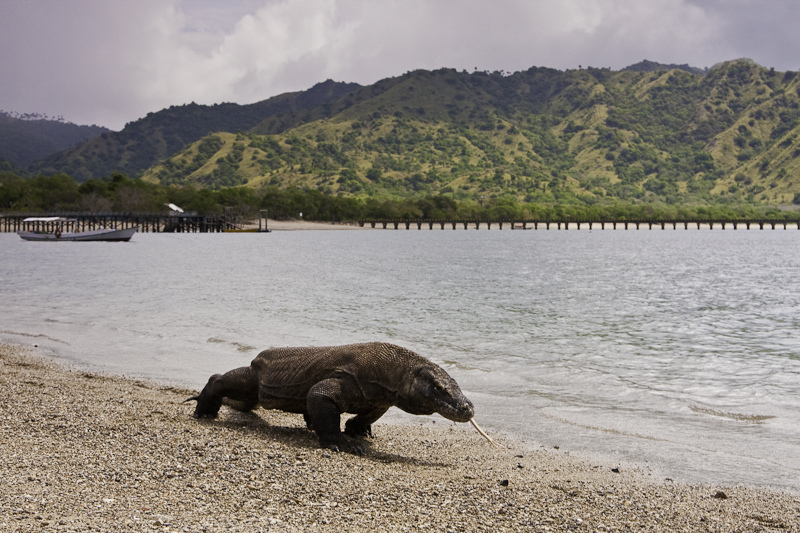
The Komodo dragon (Varanus komodoensis) is the park's most iconic resident, with a wild population of approximately 3,100 to 3,500 individuals. These massive lizards can grow up to 3 meters in length and weigh more than 70 kilograms. As apex predators, Komodo dragons play a crucial role in maintaining ecological balance within their habitat. Endemic to a small number of Indonesian islands, they are of great scientific interest, particularly in studies of evolution, island biogeography, and reptilian physiology.
The landscape of Komodo National Park is as diverse as its wildlife. Rugged hillsides covered in dry savannah grasslands and pockets of thorny green vegetation create a striking contrast against the pristine white sandy beaches and the vibrant blue waters teeming with marine life. The park's coral reefs host a rich variety of marine species, including over 1,000 species of fish and 260 species of reef-building coral, making it a popular destination for snorkeling and diving enthusiasts
In addition to the Komodo dragon, the park is home to a variety of other terrestrial species. These include the Timor deer (Rusa timorensis), the primary prey of the Komodo dragon, as well as wild boar, water buffalo, and the orange-footed scrubfowl (Megapodius reinwardt). The park's diverse birdlife also includes the critically endangered lesser sulphur-crested cockatoo and the white-bellied sea eagle. Notably, the park serves as a habitat for several dangerous snake species, such as the Javan spitting cobra and the Timor python.
The Komodo dragon is a highly adaptable carnivore with a varied diet that also includes wild boar, and water buffalo. While deer and boar are its most common prey, Komodo dragons are also capable of hunting much larger animals such as water buffalo, particularly targeting young, weak, or injured individuals. They rely on stealth, powerful jaws, and sharp serrated teeth to inflict deep wounds, often following prey until it succumbs to blood loss or exhaustion.
Komodo National Park was designated a UNESCO World Heritage Site in 1991 due to its exceptional natural beauty and unique biodiversity. It is also part of UNESCO’s Man and the Biosphere Programme, highlighting its importance in balancing conservation with sustainable human activity. The park lies within the Wallacea biodiversity hotspot, a region noted for its high levels of endemism and evolutionary significance, highlighting its global significance in preserving Earth's rich natural heritage.
Visiting Komodo National Park offers travelers the rare opportunity to witness the majestic Komodo dragon in its natural habitat, while exploring dramatic landscapes and vibrant marine ecosystems. To ensure safety and conservation, visitors must follow strict regulations. Guided tours are mandatory, and close interaction with wildlife is prohibited to protect both humans and animals.
Today, Komodo National Park is a testament to the wonders of nature and the importance of conservation efforts. Its unique ecosystem, home to the world's largest living reptile, showcases the beauty and complexity of Earth's biodiversity. As a UNESCO World Heritage Site and a Man and Biosphere Reserve, Komodo National Park continues to play a crucial role in preserving our planet's natural treasures for future generations to appreciate and learn from.
UNESCO Description of the World Heritage Site
These volcanic islands are inhabited by a population of around 5,700 giant lizards, whose appearance and aggressive behaviour have led to them being called 'Komodo dragons'. They exist nowhere else in the world and are of great interest to scientists studying the theory of evolution. The rugged hillsides of dry savannah and pockets of thorny green vegetation contrast starkly with the brilliant white sandy beaches and the blue waters surging over coral.
UNESCO Justification of the World Heritage Site
Criterion (vii): Komodo National Park is a landscape of contrasts between starkly rugged hillsides of dry savanna, pockets of thorny green vegetation, brilliant white sandy beaches and blue waters surging over coral, unquestionably one of the most dramatic landscapes in all of Indonesia. Demonstrating exceptional natural beauty that is all the more remarkable as a counterpoint to the dominant lushness of vegetation which characterizes vast areas of forested Indonesia, and with which most of the world associates the archipelago. An irregular coastline characterized by bays, beaches and inlets separated by headlands, often with sheer cliffs falling vertically into the surrounding seas which are reported to be among the most productive in the world adds to the stunning natural beauty of landscapes dominated by contrasting vegetation types, providing a patchwork of colours.
Criterion (x): Komodo National Park contains the majority of the world’s areas in which wild populations of the Komodo dragon lizard still exist. The largest and heaviest of the world’s lizards, the species is widely known for its impressive size and fearsome appearance, its ability to effectively prey on large animals, and a tolerance of extremely harsh condition. The population, estimated at around 5,700 individuals is distributed across the islands of Komodo, Rinca, Gili Motong and some coastal regions of western and northern Flores. Other fauna recorded in the park are characteristic of the Wallacean zoogeographic region with seven species of terrestrial mammal, including an endemic rat (Rattus rintjanus) and the crab-eating macaque (Macaca fascicularis) and 72 species of birds, such as the lesser sulphur-crested cockatoo (Cacatua sulphurea), the orange-footed scrub fowl (Megapodius reinwardt), and noisy friarbird (Philemon buceroides). The coral reefs fringing the coast of Komodo are diverse and luxuriant due to the clear water, intense sunlight and rapid exchange of nutrient-rich water from deeper areas of the archipelago. The marine fauna and flora are generally the same as that found throughout the Indo Pacific area, though species richness is very high, notable marine mammals include blue whale (Balaenoptera musculus) and sperm whale (Physeter catodon) as well as 10 species of dolphin, dugong (Dugong dugon) and five species of sea turtles.
Encyclopedia Record: Komodo National Park
Komodo National Park is a national park in Indonesia located within the Lesser Sunda Islands in the border region between the provinces of East Nusa Tenggara and West Nusa Tenggara. The park includes the three larger islands Komodo, Padar and Rinca, and 26 smaller ones, with a total area of 1,733 km2. The national park was founded in 1980 to protect the Komodo dragon, the world's largest lizard. Later it was dedicated to protecting other species, including marine species. In 1991 the national park was declared a UNESCO World Heritage Site and a Man and Biosphere Reserve. It is considered one of the world's 25 biodiversity hotspots.Additional Site Details
Area: 219,322 hectares
Number of Components: 1
(x) — Contains most important habitats for biodiversity
Coordinates: -8.54333 , 119.48944
IUCN World Heritage Outlook
The 2025 Conservation Outlook on Komodo National Park reports the following assessment:
Source: International Union for Conservation of Nature (IUCN) · View assessment
World Heritage Research
Discover scientific research and academic studies that deepen our understanding of Komodo National Park from its history and significance to its conservation, management, and contemporary challenges.
-
Mapping Mangrove Above-Ground Carbon Using Multi-Source Remote Sensing Data and Machine Learning Approach in Loh Buaya, Komodo National Park, Indonesia
A novel hybrid model combining Extreme Gradient Boosting (XGB) and Genetic Algorithm (GA) has demonstrated high accuracy in estimating mangrove above-ground carbon (AGC) in Loh Buaya, Komodo National Park, Indonesia. The model achieved an R² of 0.857 during training and 0.758 during testing, significantly outperforming other machine learning techniques like Random Forest and Support Vector Machine. Using multisource remote sensing data—including optical imagery from Sentinel-2B, Synthetic Aperture Radar (SAR), and a national Digital Elevation Model (DEM)—the study estimated AGC ranging from 2.52 to 123.89 Mg C ha⁻¹, with an average of 57.16 Mg C ha⁻¹. This approach offers a fast, reliable, and scalable method for quantifying mangrove carbon stocks using open-source data, with potential global applications in tropical ecosystems.
Rijal, S. S., Pham, T. D., Noer’Aulia, S., Putera, M. I., & Saintilan, N. (2023). Mapping Mangrove Above-Ground Carbon Using Multi-Source Remote Sensing Data and Machine Learning Approach in Loh Buaya, Komodo National Park, Indonesia. Forests, 14(1), 94. https://doi.org/10.3390/f14010094
View Publication Record | Read Publication -
Residency, movement patterns, behavior and demographics of reef manta rays in Komodo National Park
Reef manta rays (Mobula alfredi) in Komodo National Park exhibit distinct site affinities, with higher residency probabilities at remote southern sites like Manta Alley. Despite proximity, manta rays show strong preference for specific areas such as Karang Makassar and Mawan, which are only 5 km apart. Seasonal movements between Manta Alley and central sites (~35.5 km) were observed, with more rays traveling south to north. Female manta rays demonstrated greater mobility than males. The study, utilizing a decade-long photo-identification dataset (2013–2018), identified 1,085 individuals and noted that tourism growth correlated with increased dive boat activity at popular sites. Injuries from fishing gear and predation were documented in 8% of the population. This research provides foundational data for manta ray conservation, highlighting critical habitats and the need to mitigate tourism impacts.
Germanov, E. S., Pierce, S. J., Marshall, A. D., Hendrawan, I. G., Kefi, A., Bejder, L., & Loneragan, N. (2022). Residency, movement patterns, behavior and demographics of reef manta rays in Komodo National Park. PeerJ, 10, e13302. Portico. https://doi.org/10.7717/peerj.13302
View Publication Record | Read Publication -
Tourism accessibility in protected islands: the case of the Komodo National Park, Indonesia
A novel framework for tourism accessibility in protected islands has been established, identifying three key dimensions—destination accessibility, individual accessibility, and protected island accessibility—that significantly influence tourists' decisions to visit. The study, conducted through surveys of 487 respondents using factor analysis and structural equation modeling, reveals that while convenience (e.g., safety, hygiene, environmental ethics) enhances visitation, protected island accessibility can act as a restrictive factor, potentially limiting tourism to preserve fragile ecosystems. This balance between convenience and constraint is critical for sustainable management, particularly in UNESCO World Heritage Sites like Komodo National Park, where mass tourism risks ecosystem degradation. The findings underscore the need to design visitor programs that prioritize ecological preservation while ensuring accessibility remains inclusive yet controlled.
Rahmafitria, F., Dirgahayani, P., Putro, H. P. H., Rosyidie, A., & Hudalah, D. (2022). Tourism accessibility in protected islands: the case of the Komodo National Park, Indonesia. Tourism Review, 78(3), 966–985. https://doi.org/10.1108/tr-03-2022-0110
View Publication Record | Read Publication -
A community perspective on local ecotourism development: lessons from Komodo National Park
Ecotourism, often hailed as a sustainable development strategy, has fallen short of its promises for local communities and natural resource conservation in Komodo National Park (KNP), a prominent UNESCO World Heritage Site. A critical analysis reveals that despite KNP's transition to an ecotourist-driven economy, it has failed to meet sustainable development goals effectively. The study highlights the complex, multi-layered nature of local communities and their integration into regional economies, advocating for broader tourism policies that engage multiple stakeholders beyond immediate protected areas. Using qualitative research methods, including participant observation, this paper challenges the narrative around ecotourism's benefits, contributing valuable insights to the ongoing debate on its effectiveness as a sustainable development tool.
Lasso, A. H., & Dahles, H. (2021). A community perspective on local ecotourism development: lessons from Komodo National Park. Tourism Geographies, 25(2-3), 634–654. https://doi.org/10.1080/14616688.2021.1953123
View Publication Record | Read Publication -
Dragon Tourism in Komodo National Park, Indonesia: Its Contribution to Conservation & Local Development
Tourism to Komodo National Park (KNP) in Indonesia, often touted as ecotourism, fails to meet sustainability ideals despite minimal ecological disturbance. While financial contributions to conservation barely cover operational costs, potential revenue could be significantly increased by adjusting fees. Independent tourists contribute more to the local economy than package or cruise passengers, who provide negligible benefits due to the enclave nature of their operations. The study highlights that current tourism models in KNP reflect traditional patterns rather than sustainable ecotourism principles, emphasizing the need for ongoing evaluation and reorientation toward true sustainability. This research offers a cost-effective template for assessing nature-based tourism impacts, applicable globally.
Walpole, M. J. (2021). Dragon Tourism in Komodo National Park, Indonesia: Its Contribution to Conservation & Local Development. University of Kent. https://doi.org/10.22024/UNIKENT/01.02.86399
View Publication Record | Read Publication -
Preliminary Study of the Effect of Tourism Activities on Litter Pollution: A Case Study on Padar Island, Komodo National Park, Indonesia
A preliminary study on Padar Island, Komodo National Park, Indonesia, reveals that tourism activities significantly contribute to litter pollution, with plastic waste dominating the 146 items collected. Filter cigarette butts (33.56%), candy wrappers (12.33%), and wet tissues/wipes (11.64%) were the most prevalent types of litter, linked to smoking, food consumption, and hiking activities. The research highlights the urgent need for stronger awareness strategies and controls to mitigate environmental degradation caused by tourism in this UNESCO World Heritage Site.
Cordova, M., Purbonegoro, T., Puspitasari, R., Subandi, R., Kaisupy, M., Wibowo, S., Nurjamin, N., Suparmo, S., & Sapulete, S. (2021). Preliminary Study of the Effect of Tourism Activities on Litter Pollution: A Case Study on Padar Island, Komodo National Park, Indonesia. Journal of Ecological Engineering, 22(8), 131–139. https://doi.org/10.12911/22998993/140265
View Publication Record | Read Publication -
Reviews: Komodo National Park as a conservation area for the komodo species (Varanus komodoensis) and sustainable tourism (ecotourism)
Komodo National Park (KNP) in Indonesia serves as a critical conservation area for the endangered Komodo dragon (Varanus komodoensis) while also supporting sustainable ecotourism. The study highlights that KNP's vast land and marine habitats—covering 603 km² and 1,214 km² respectively—host rich biodiversity, including 277 terrestrial species, 253 coral species, over 1,000 fish species, and 25 whale/dolphin species. The research emphasizes that ecotourism in KNP can foster local economic growth and conservation awareness, but barriers such as limited budgets, low public engagement, and marketing challenges hinder community participation. By integrating conservation with tourism, KNP demonstrates a model for balancing ecological protection with sustainable development.
HIDYARKO, A. I. F., GAYATRI, A. C., RIFA, V. A., Astuti, A., KUSUMANINGRUM, L., MAU, Y. S., RUDIHARTO, H., & SETYAWAN, A. D. (2021). Reviews: Komodo National Park as a conservation area for the komodo species (Varanus komodoensis) and sustainable tourism (ecotourism). International Journal of Tropical Drylands, 5(1). https://doi.org/10.13057/tropdrylands/t050105
View Publication Record | Read Publication -
The Effect of E-WOM on Destination Image and Attitude Towards to the Visit Intention in Komodo National Park, Indonesia
A study reveals that electronic word of mouth (E-WOM) significantly influences destination image and tourist attitudes, which in turn affect visit intention to Komodo National Park, Indonesia. Using data from 388 TripAdvisor users, the research employed Structural Equation Modeling (SEM) with Partial Least Squares analysis to assess relationships among these factors under a new government membership policy. Findings underscore the importance of E-WOM in shaping perceptions and behaviors, offering valuable insights for tourism marketing strategies in Indonesia. This work contributes to e-commerce marketing, destination branding, and e-tourism research.
Choirisa, S. F., Purnamaningsih, P., & Alexandra, Y. (2021). THE EFFECT OF E-WOM ON DESTINATION IMAGE AND ATTITUDE TOWARDS TO THE VISIT INTENTION IN KOMODO NATIONAL PARK, INDONESIA. Journal of Tourism Destination and Attraction, 9(1), 49–60. https://doi.org/10.35814/tourism.v9i1.1876
View Publication Record | Read Publication -
Community Participation and Sustainable Tourism Development Model in Komodo National Park
A study on Komodo National Park (KNP) reveals that sustainable, community-based tourism development could improve by over 2% if stakeholders commit to enhancing rural tourism employment, local business activities, livelihood alternatives, and economic growth. Key factors include conservation awareness programs, community involvement in planning, training for tourism employees on cultural heritage, and adherence to social protocols. These efforts would boost attraction ratings, tourism facilities, protection of historical sites, and environmentally conscious tourism operators. The research used Structural Equation Modelling (SEM) to analyze local community perspectives on the As of tourism framework—Attraction, Access, and Amenities—highlighting pathways for long-term sustainable development in this UNESCO World Heritage Site.
BENU, F., MUSKANAN, M. W., KING, P. G., ASA, H. M., & WULAKADA, H. H. (2020). Community Participation and Sustainable Tourism Development Model in Komodo National Park. Journal of Environmental Management and Tourism, 11(2), 250. https://doi.org/10.14505//jemt.v11.2(42).03
View Publication Record | Read Publication -
Invasive toads are close to but absent from Komodo National Park
A survey conducted between February and April 2018 found no evidence of the invasive Asian toad (Duttaphrynus melanostictus) within Komodo National Park, despite its abundance on nearby Sumbawa Island. The study used Visual Encounter Surveys across Rinca Island, Komodo Island (both part of the park), Flores Island (Labuan Bajo and Cumbi village), and Sape (Sumbawa Island). While two amphibian species were recorded in Komodo National Park and seven across all locations, the invasive toad was absent from Flores but thrived in Sape. This suggests that while the park remains free of this potential ecological threat, vigilance is needed due to its proximity on Sumbawa Island.
Kennedi, U. F., Kusrini, M. D., Ariefiandy, A., & Mardiastuti, A. (2020). Invasive toads are close to but absent from Komodo National Park. BIO Web of Conferences, 19, 17. https://doi.org/10.1051/bioconf/20201900017
View Publication Record | Read Publication -
Role of culture in the emotional response towards komodo dragon in Komodo and Rinca Islands of Komodo National Park
A significant finding from this study is that cultural beliefs and values play a crucial role in shaping local communities' emotional responses towards Komodo dragons, thereby influencing conservation support. While 98.5% of respondents considered the dragons dangerous, 60.6% of Komodo villagers held positive perceptions, contrasting with 47.6% moderate perceptions among Rinca villagers. This difference is attributed to distinct cultural attachments; Komodo villagers perceive dragons as 'cousins' and thus avoid harming them, while Rinca villagers, being migrants, lack such connections. Consequently, Komodo villagers showed higher coexistence beliefs (83%) and conservation support (81.5%) compared to Rinca villagers (65.3%). The study highlights the importance of integrating local cultural values in wildlife conservation efforts.
Sunkar, A., Kusrini, M. D., & Ramadhani, F. S. (2020). Role of culture in the emotional response towards komodo dragon in Komodo and Rinca Islands of Komodo National Park. BIO Web of Conferences, 19, 21. https://doi.org/10.1051/bioconf/20201900021
View Publication Record | Read Publication -
Tourism Governance in Komodo National Park, Indonesia: Blessing or Curse?
Tourism governance in Komodo National Park (KNP), Indonesia, primarily benefits residents of Komodo Island while excluding those on Rinca Island from socio-economic prosperity. The study reveals that tourism management is largely controlled by KNP officials, with local people confined to roles as naturalist guides. This qualitative research, involving interviews with community leaders, guides, village heads, and tourism managers across two villages, highlights the uneven distribution of tourism's economic advantages within the park's vicinity.
KODIR, A., TANJUNG, A., SUMARMI, Dr., AHMAD, R., SIMANJUNTAK, T. B.,. (2019). TOURISM GOVERNANCE IN KOMODO NATIONAL PARK, INDONESIA: BLESSING OR CURSE? GeoJournal of Tourism and Geosites, 27(4), 1401–1417. https://doi.org/10.30892/gtg.27424-443
View Publication Record | Read Publication -
The coral-killing sponge Chalinula nematifera as a common substrate generalist in Komodo National Park, Indonesia
A coral-killing sponge, Chalinula nematifera, has been identified as a common substrate generalist in Komodo National Park, Indonesia. This sponge, originally from the Marshall Islands, is raising concerns due to its rapid range expansion and ability to overgrow various coral species. Observed at six out of ten sites in October 2016, it was found interacting with living corals belonging to 13 species, some of which are new host records. Additionally, it colonized dead coral colonies previously covered by algae or sediment, as well as encrusting coralline algae, showing no clear preference for specific hosts or depth ranges. The study highlights the sponge's adaptability and potential impact on coral ecosystems.
Turicchia, E., Hoeksema, B. W., & Ponti, M. (2018). The coral-killing sponge Chalinula nematifera as a common substrate generalist in Komodo National Park, Indonesia. Marine Biology Research, 14(8), 827–833. https://doi.org/10.1080/17451000.2018.1544420
View Publication Record | Read Publication -
Temporal and spatial dynamics of insular Rusa deer and wild pig populations in Komodo National Park
A 12-year study on Komodo National Park revealed that the population dynamics of Rusa deer and wild pigs are strongly influenced by density-dependent factors, with island-specific patterns and spatial synchrony. While Rusa deer populations declined slightly on two larger islands (Nusa Kode and Rinca) but increased on Gili Motang, wild pig populations showed contrasting trends, declining on Komodo Island and increasing on Rinca. These findings highlight the critical role of density dependence in tropical large herbivore populations, which are vital prey for the endangered Komodo dragon. The study used dung counts along transects to estimate abundance, confirming the need for continued monitoring to ensure the conservation of both ungulate species and their apex predator.
Ariefiandy, A., Forsyth, D. M., Purwandana, D., Imansyah, J., Ciofi, C., Rudiharto, H., Seno, A., & Jessop, T. S. (2016). Temporal and spatial dynamics of insular Rusa deer and wild pig populations in Komodo National Park. Journal of Mammalogy, 97(6), 1652–1662. https://doi.org/10.1093/jmammal/gyw131
View Publication Record | Read Publication -
Exit the Dragon? Collapse of Co-management at Komodo National Park, Indonesia
A collaborative management initiative at Komodo National Park, designed to balance tourism and biodiversity conservation, collapsed after just five years despite significant investment. The study identifies the failure as rooted in the narrow design of the initiative and the political ecology of Indonesia's civil service, characterized by persistent corruption and weak environmental awareness. This research highlights the challenges of managing complex social-ecological systems, particularly in World Heritage Sites with high tourist interest and diverse stakeholder involvement.
Cochrane, J. (2013). Exit the Dragon? Collapse of Co-management at Komodo National Park, Indonesia. Tourism Recreation Research, 38(2), 127–143. https://doi.org/10.1080/02508281.2013.11081740
View Publication Record | Read Publication