World Heritage Identification Number: 642
World Heritage since: 1991
Category: Cultural Heritage
WHE Type: Religious Sites & Sacred Architecture
Transboundary Heritage: No
Endangered Heritage: No
Country: 🇮🇩 Indonesia
Continent: Asia
UNESCO World Region: Asia and the Pacific
Map
Exploring the Majestic Prambanan Temple Compounds: A Unique Testament to Ancient Indonesian Culture
The Prambanan Temple Compounds, inscribed as a UNESCO World Heritage Site in 1991, stand as a testament to the rich cultural heritage of ancient Indonesia. Located in the Special Region of Yogyakarta, in southern Java, these temples are dedicated to the Trimūrti, the divine expressions of creation, preservation, and destruction in Hinduism.
More to come…UNESCO Description of the World Heritage Site
Built in the 10th century, this is the largest temple compound dedicated to Shiva in Indonesia. Rising above the centre of the last of these concentric squares are three temples decorated with reliefs illustrating the epic of the Ramayana, dedicated to the three great Hindu divinities (Shiva, Vishnu and Brahma) and three temples dedicated to the animals who serve them.
UNESCO Justification of the World Heritage Site
Criterion (i): Prambanan Temple Compounds presents the grandiose culture of Siva art as a masterpiece of the classical period in Indonesia, and the region.
Criterion (iv): The property is an outstanding religious complex, characteristic of Siva expression of the 10th century.
Encyclopedia Record: Prambanan
Prambanan is a 9th-century Hindu temple compound in the Special Region of Yogyakarta, in southern Java, Indonesia, dedicated to the Trimūrti, the expression of God as the Creator (Brahma), the Preserver (Vishnu) and the Destroyer (Shiva). The temple compound is located approximately 17 kilometres (11 mi) northeast of the city of Yogyakarta on the boundary between Central Java and Yogyakarta provinces.Additional Site Details
Area: Not available
Number of Components: 1
(iv) — Outstanding example of a type of building or landscape
Coordinates: -7.75222 , 110.49167
Image
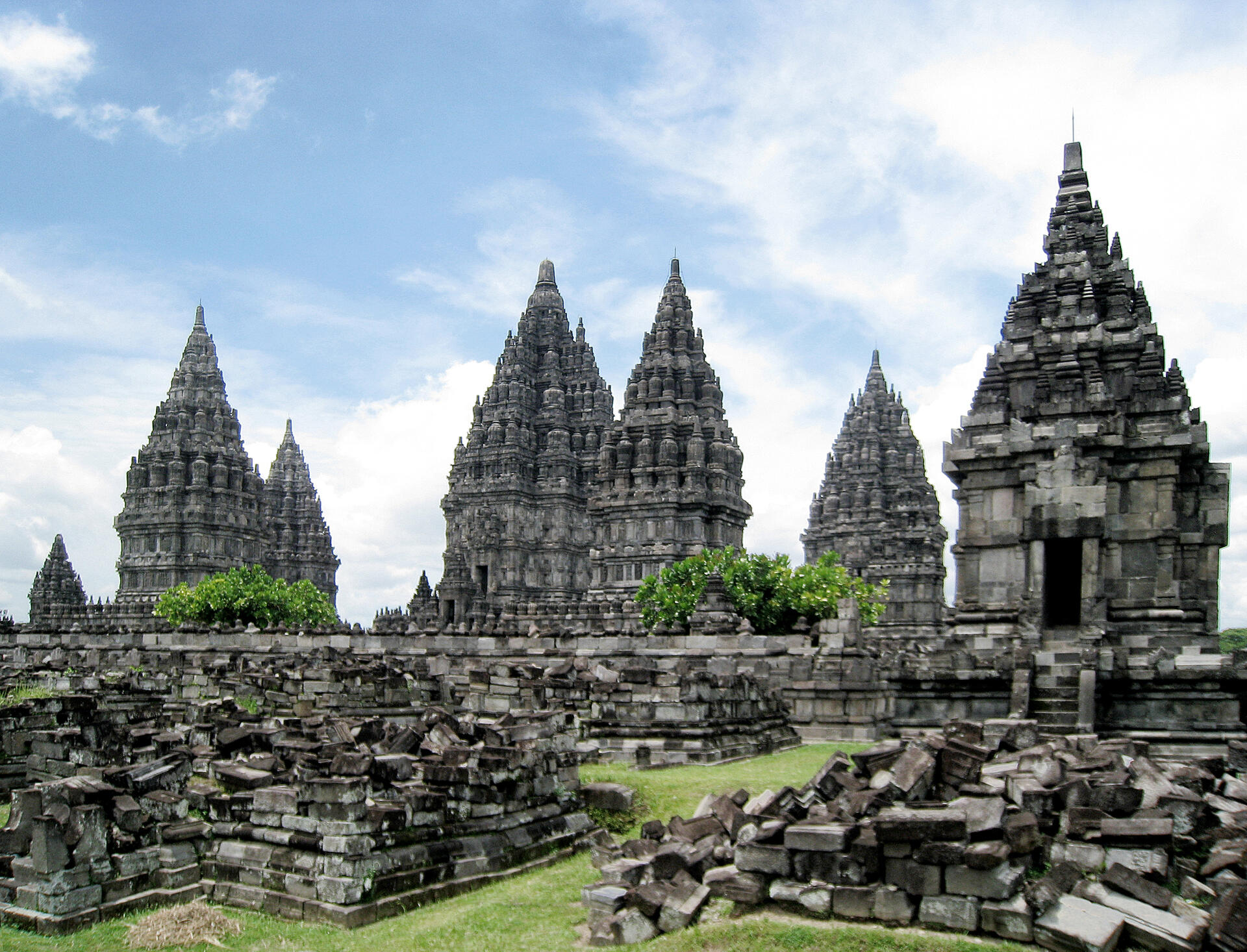
© Gunawan Kartapranata, CC BY-SA 3.0 Resized from original. (This derivative is under the same CC BY-SA license.)
World Heritage Research
Discover scientific research and academic studies that deepen our understanding of Prambanan Temple Compounds from its history and significance to its conservation, management, and contemporary challenges.
-
The Impact of Pandemic COVID-19 To Cultural Heritage Tourism Prambanan Temple Compounds
Prambanan Temple Compounds, the largest Hindu temple complex in Indonesia and a UNESCO World Heritage Site candidate, faced severe tourism decline during the COVID-19 pandemic. The study highlights a drastic drop in both domestic and international visitors, significantly impacting revenue and operations. To mitigate these effects, Taman Wisata Candi (TWC), the managing entity, implemented adaptive strategies to ensure visitor safety while maintaining attraction. This qualitative research employed in-depth interviews, observations, and document reviews to assess the site's profile, pandemic impacts, and stakeholder responses. Findings underscore the need for resilient tourism models that balance heritage preservation with public health measures, offering insights for similar cultural sites globally.
Nuria Dewi, L. (2022). The Impact of Pandemic COVID-19 To Cultural Heritage Tourism Prambanan Temple Compounds. Journal of Mandalika Review, 1(2), 19–23. https://doi.org/10.55701/mandalika.v1i2.34
View Publication Record | Read Publication -
An Analysis Of Using English Sentence Structures Of Indonesian Tour Guides In Prambanan Temple
Indonesian tour guides at Prambanan Temple predominantly use simple English sentences, with fewer compound and complex structures. This finding emerges from a descriptive qualitative study that assessed the grammatical competency of guides in constructing English sentences during their tours. The research highlights a tendency toward simplicity in sentence formation, which may impact communication effectiveness in an international tourism context like Prambanan. The study employed a focused analysis on the percentage and types of sentences produced by respondents, providing insights into language use patterns among guides in heritage site interpretation.
Anisa, I. (2020). An Analysis Of Using English Sentence Structures Of Indonesian Tour Guides In Prambanan Temple. JELLE : Journal of English Literature, Linguistics, and Education, 1(2). https://doi.org/10.31941/jele.v1i2.1222
View Publication Record | Read Publication