World Heritage Identification Number: 411
World Heritage since: 1987
Category: Cultural Heritage
WHE Type: Archaeological Sites
Transboundary Heritage: No
Endangered Heritage: No
Country: 🇲🇽 Mexico
Continent: Americas
UNESCO World Region: Latin America and the Caribbean
Map
Exploring the Ancient Wonders of the Pre-Hispanic City and National Park of Palenque
The Pre-Hispanic City and National Park of Palenque, located in the heart of the dense tropical rainforest of Chiapas, Mexico, offers a captivating glimpse into the rich cultural heritage of the ancient Maya civilization. Inscribed as a UNESCO World Heritage Site in 1987, Palenque stands as a testament to the artistic, architectural, and intellectual prowess of this remarkable civilization.
More to come…UNESCO Description of the World Heritage Site
A prime example of a Mayan sanctuary of the classical period, Palenque was at its height between AD 500 and 700, when its influence extended throughout the basin of the Usumacinta River. The elegance and craftsmanship of the buildings, as well as the lightness of the sculpted reliefs with their Mayan mythological themes, attest to the creative genius of this civilization.
UNESCO Justification of the World Heritage Site
Criteria (i): Palenque is an incomparable achievement of Mayan art. The structures are characterized by a lightness which resulted from the new construction techniques and drainage methods that were developed in order to reduce the thickness of the walls. The expanded interior space, multiple openings, and the use of galleries give the architecture a rare elegance, richly decorated with sculptures and stucco of a type never previously seen.
Criteria (ii): The influence exerted by Palenque was considerable throughout the basin of the Usumacinta, extending even as far away as Comalcalco, on the western border of the Mayan cultural zone.
Criteria (iii): Palenque bears a unique testimony to the mythology and the rites of the Mayas, notably in the incredible number of sculpted reliefs on interior walls of the palaces and temples.
Criteria (iv): Older than the ensemble at Tikal, whose major monuments were constructed a hundred years later, the group of ceremonial buildings at Palenque is an outstanding example of a ceremonial and civic site corresponding to the middle of the Classic period in the Maya area.
Encyclopedia Record: Palenque
Palenque, also anciently known in the Itza Language as Lakamha, was a Maya city-state in southern Mexico that perished in the 8th century. The Palenque ruins date from ca. 226 BC to ca. 799 AD. After its decline, it was overgrown by the jungle of cedar, mahogany, and sapodilla trees, but has since been excavated and restored. It is located near the Usumacinta River in the Mexican state of Chiapas, about 130 km (81 mi) south of Ciudad del Carmen, 150 meters (490 ft) above sea level. It is adjacent to the modern town of Palenque, Chiapas. It averages a humid 26 °C (79 °F) with roughly 2,160 millimeters (85 in) of rain a year.Additional Site Details
Area: 1,772 hectares
Number of Components: 1
(ii) — Significant interchange of human values
(iii) — Unique or exceptional testimony to a cultural tradition
(iv) — Outstanding example of a type of building or landscape
Coordinates: 17.48333 , -92.05
Image
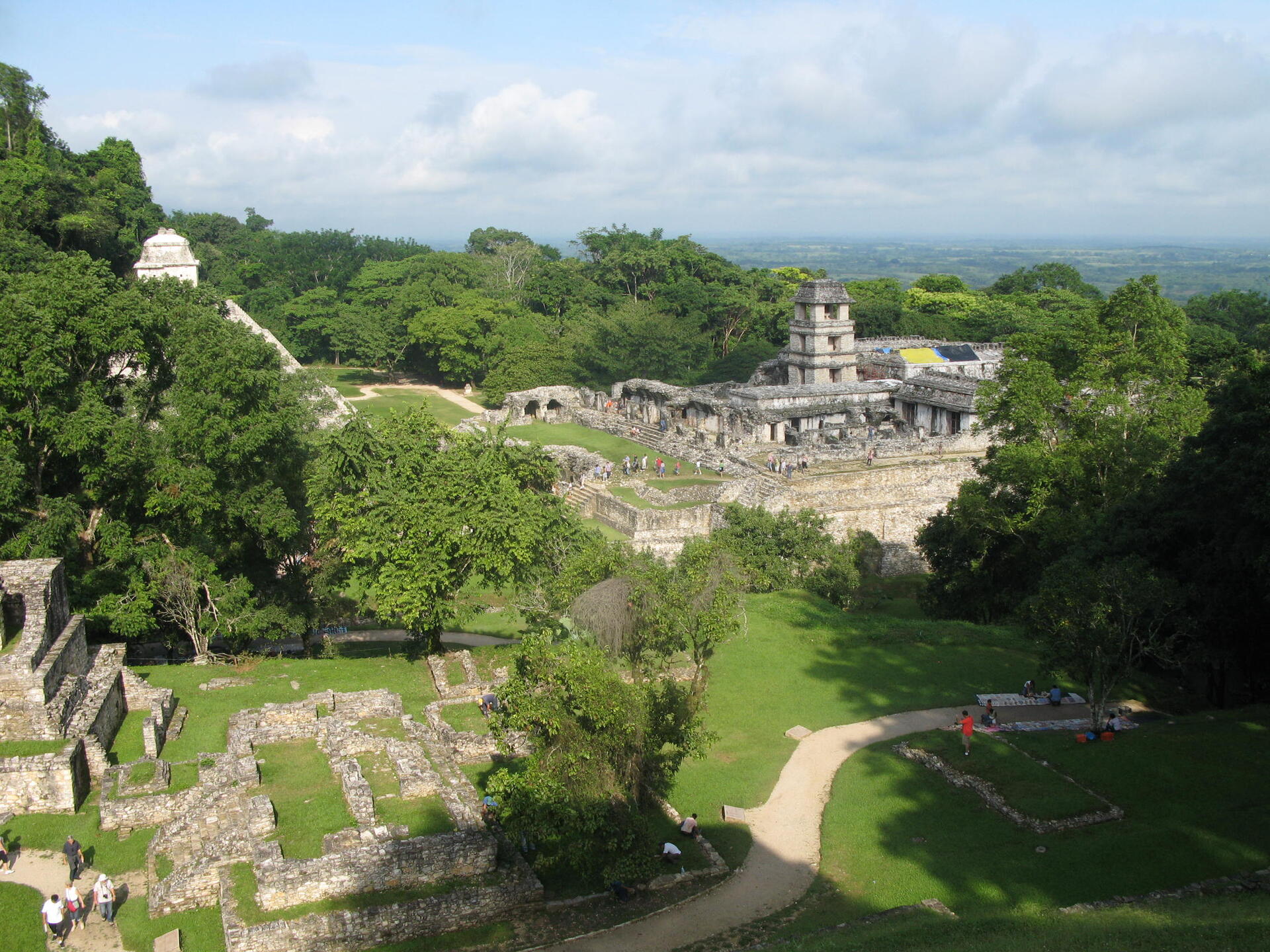
© Ljuba brank at Slovenian Wikipedia, CC BY-SA 3.0 Resized from original. (This derivative is under the same CC BY-SA license.)
World Heritage Research
Discover scientific research and academic studies that deepen our understanding of Pre-Hispanic City and National Park of Palenque from its history and significance to its conservation, management, and contemporary challenges.
-
Beyond the Final Say: Social Coordination Shapes Success in Howler Monkey (Alouatta pigra) Vocal Duels
Research on black howler monkeys (Alouatta pigra) in Palenque National Park, Mexico, reveals that social coordination and strategic vocal behavior significantly influence the outcomes of intergroup contests. The study found that groups were more likely to succeed when they ended a vocal bout, especially if adult males terminated simultaneously or at least one female contributed. Longer sequences and initiating with a roar also increased success rates. These findings suggest that howler monkeys use coordinated vocal displays as reliable indicators of motivation and group cohesion, reducing the need for physical conflicts. The research highlights the importance of collective behavior in shaping intergroup competition dynamics among primates.
Briseño-Jaramillo, M., & Lemasson, A. (2026). Beyond the Final Say: Social Coordination Shapes Success in Howler Monkey (Alouatta pigra) Vocal Duels. International Journal of Primatology, 47(4), 1071–1091. https://doi.org/10.1007/s10764-026-00563-0
View Publication Record | Read Publication -
The relationships between dung beetles and monkeys in the Neotropical region
Research at the Pre-Hispanic City and National Park of Palenque, Mexico, reveals that dung beetles—particularly small species of Canthon—form strong mutualistic relationships with arboreal monkeys in Neotropical forests. These beetles are highly mobile and rely on monkey dung for reproduction, playing a crucial role in nutrient cycling within tree canopies. While similar associations exist globally (e.g., with African monkeys, Indian primates, or Australian marsupials), Palenque’s ecosystem is dominated by Canthon euryscelis, C. angustatus, and other species that thrive in tropical forests. The study highlights the need for standardized methodologies to better understand dung beetle behavior, including foraging strategies, brood ball formation, and mating patterns—critical insights as tropical deforestation threatens these delicate ecological interactions.
Halffter, G., & Favila, M. E. (2023). The relationships between dung beetles and monkeys in the Neotropical region. Frontiers in Ecology and Evolution, 11. https://doi.org/10.3389/fevo.2023.1212879
View Publication Record | Read Publication -
Developing an interoperable cloud-based visualization workflow for 3D archaeological heritage data: The Palenque 3D Archaeological Atlas
A novel cloud-based workflow enables interoperable visualization, analysis, and sharing of high-resolution 3D archaeological data from the UNESCO World Heritage Site of Palenque. The Palenque 3D Archaeological Atlas leverages open-source WebGL technology to integrate and contextualize giga-scale datasets—captured through photogrammetry and LiDAR—allowing researchers to measure, annotate, and compare complex structures directly via web browsers. This approach breaks down computational barriers that previously hindered data accessibility, fostering collaboration and archiving without requiring specialized software. The system supports multi-modal data integration, enhancing archaeological research at unprecedented scales.
Campiani, A., McAvoy, S., Lercari, N., Liendo Stuardo, R., Jiménez Delgado, G., López Mejía, J., Rissolo, D., & Kuester, F. (2023). Developing an interoperable cloud-based visualization workflow for 3D archaeological heritage data: The Palenque 3D Archaeological Atlas. Digital Applications in Archaeology and Cultural Heritage, 31, e00293. https://doi.org/10.1016/j.daach.2023.e00293
View Publication Record | Read Publication -
Phenotypic and Genomic Characterization of Streptomyces pakalii sp. nov., a Novel Species with Anti-Biofilm and Anti-Quorum Sensing Activity in ESKAPE Bacteria
Researchers have identified Streptomyces pakalii sp. nov., a novel species from the Streptomycetaceae family, isolated from jungle soil in Palenque National Park, Mexico. This bacterium demonstrates significant anti-biofilm and anti-quorum sensing activity against ESKAPE bacteria, including Acinetobacter baumannii and Klebsiella pneumoniae, offering potential for developing new antimicrobial strategies. Genomic analysis revealed a 7.6 Mb genome with high G+C content (71.6%), encoding putative proteins involved in antibiotic biosynthesis, carbon metabolism, and DNA modification. Phylogenetic studies confirmed its distinct status as a new species, closely related to Streptomyces badius and Streptomyces globisporus, supported by average nucleotide identity (ANI) and virtual DNA-DNA hybridization data. The discovery highlights the biotechnological potential of microbial diversity in UNESCO World Heritage Sites for combating multi-resistant infections.
Chávez-Hernández, M., Ortiz-Álvarez, J., Morales-Jiménez, J., Villa-Tanaca, L., & Hernández-Rodríguez, C. (2023). Phenotypic and Genomic Characterization of Streptomyces pakalii sp. nov., a Novel Species with Anti-Biofilm and Anti-Quorum Sensing Activity in ESKAPE Bacteria. Microorganisms, 11(10), 2551. https://doi.org/10.3390/microorganisms11102551
View Publication Record | Read Publication -
Aprovechamiento del Paisaje y Manejo de la Fauna en Palenque, Chiapas
A recent zooarchaeological study at the UNESCO World Heritage Site of Palenque, Mexico, reveals sophisticated Mayan practices for managing animal populations during the Late Classic period. Researchers from the Proyecto Regional Palenque (PREP) analyzed sediment samples from an elite residential complex, uncovering diverse faunal remains—primarily freshwater fish—as well as plant material. This approach allowed them to reconstruct paleolandscapes and identify evidence of selective hunting, domestication, or captivity strategies, providing new insights into the ecological and social dimensions of Mayan urban life. Unlike previous studies focused solely on species identification, this research integrates biological and anthropological perspectives to deepen our understanding of human-animal interactions in ancient Mesoamerica.
Varela Scherrer, C. M., & Liendo Stuardo, R. (2021). APROVECHAMIENTO DEL PAISAJE Y MANEJO DE LA FAUNA EN PALENQUE, CHIAPAS. Ancient Mesoamerica, 33(2), 294–308. https://doi.org/10.1017/s095653612100002x
View Publication Record | Read Publication -
Fiesta y ritual en el Grupo IV de Palenque
A ritual deposit behind the J3 Structure of Group IV, Palenque, reveals hierarchical collective ceremonies characteristic of Classic Mayan societies. These ceremonies, often culminating in festivals and communal meals, show varied archaeological signatures, complicating their interpretation. The study focuses on a specific deposit linked to an elite residential space occupied by a distinguished noble lineage, providing insights into the practices of officiants and assistants during such events. Through careful excavation and analysis, researchers uncover evidence of food and beverage consumption, offering a rare glimpse into the ceremonial and social dynamics of this ancient Mayan city.
Ciudad Ruiz, A., Varela Scherrer, C. M.,. (2021). Fiesta y ritual en el Grupo IV de Palenque. Estudios de Cultura Maya, 58, 11–44. https://doi.org/10.19130/iifl.ecm.2021.58.23861
View Publication Record | Read Publication -
Cognitive maps in the wild: revealing the use of metric information in black howler monkey route navigation
Research reveals that black howler monkeys (Alouatta pigra) at Palenque National Park, Mexico, incorporate metric information—such as distances and angles between locations—into their route-based cognitive maps, a strategy previously undocumented in non-human animals. The study, which analyzed 3104 hours of ranging data from five monkey groups over a year, found that while movement was constrained along habitual routes, the observed route networks were more complex and efficient than simulated ones without metric information. This suggests that these primates use cognitively demanding navigation strategies to optimize their movements, challenging the notion that non-human animals rely solely on simple route-based navigation.
de Guinea, M., Estrada, A., Nekaris, K. A.-I., & Van Belle, S. (2021). Cognitive maps in the wild: revealing the use of metric information in black howler monkey route navigation. Journal of Experimental Biology, 224(15). https://doi.org/10.1242/jeb.242430
View Publication Record | Read Publication