World Heritage Identification Number: 1061
World Heritage since: 2002
Category: Mixed Cultural Heritage and Natural Heritage
WHE Type: Archaeological Sites
Transboundary Heritage: No
Endangered Heritage: No
Country: 🇲🇽 Mexico
Continent: Americas
UNESCO World Region: Latin America and the Caribbean
Map
Exploring the Ancient Maya City and Protected Tropical Forests of Calakmul, Campeche
The Ancient Maya City and Protected Tropical Forests of Calakmul, Campeche, located in the southern part of Mexico's Yucatán Peninsula, combines the remains of a major ancient Maya city with extensive tropical forests. Inscribed on the UNESCO World Heritage List in 2002 as a cultural property, the property was extended in 2014 to include its surrounding protected tropical forests and was recognized as a mixed cultural and natural heritage property.
Calakmul was part of a wider network of Maya cities and was one of Tikal's major rivals during much of the Classic period. Tikal, located in present-day Guatemala, and Calakmul were powerful kingdoms that competed for political influence across the southern Maya lowlands. Their rivalry and interactions are documented through inscriptions and archaeological evidence, making Calakmul an important place for understanding the political history of the ancient Maya world.
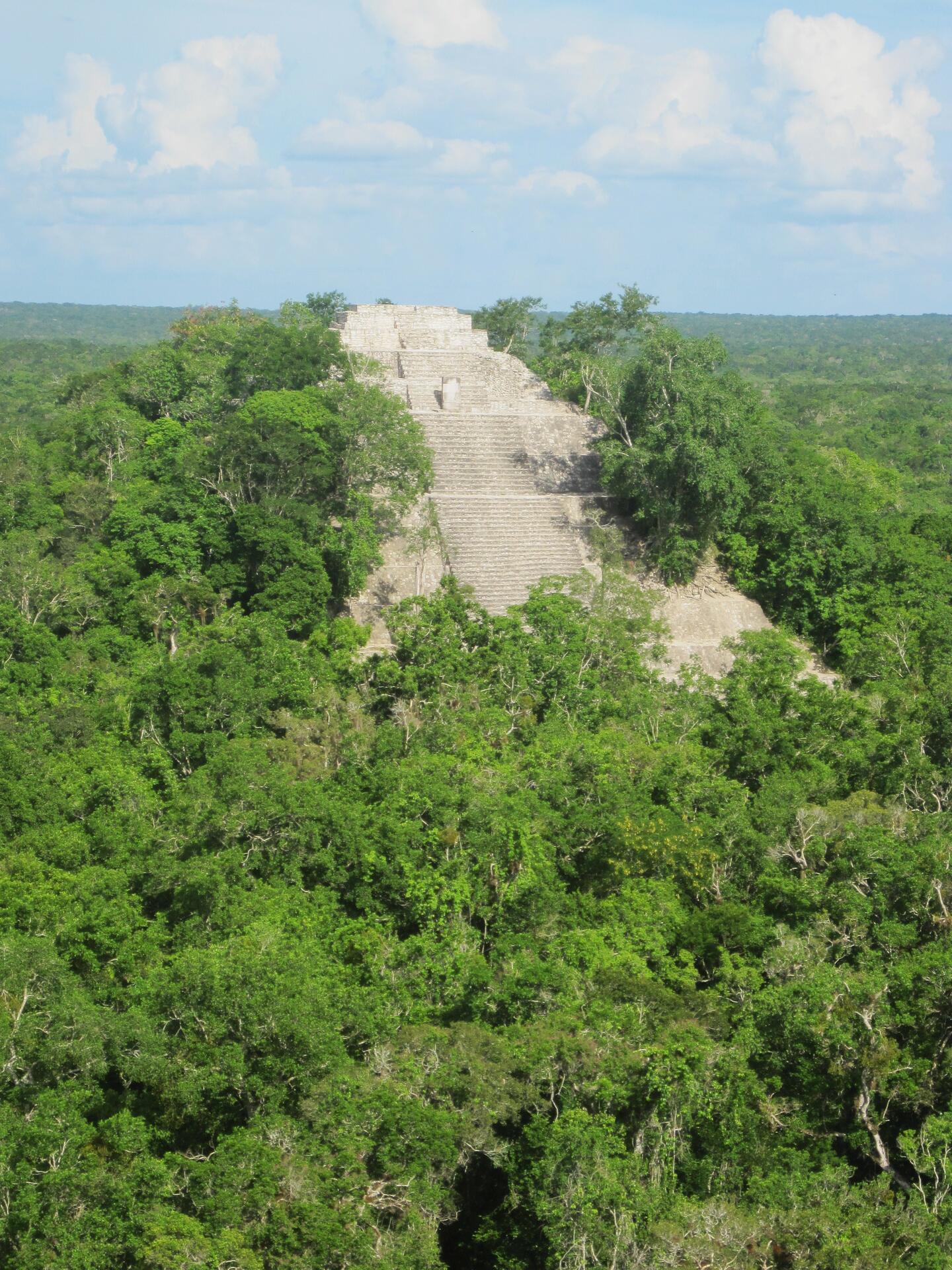
Among its most prominent features are the Great Plaza and the enormous Structure II, one of the largest Maya pyramids in the region. Numerous carved monuments, including stelae bearing inscriptions and representations of rulers, provide valuable evidence of the city's political history and its relationships with other Maya centers.
Calakmul was part of a wider network of Maya cities and was the principal rival of Tikal, located in present-day Guatemala, during much of the Classic period. The two powerful kingdoms were involved in a long struggle for political influence across the southern Maya lowlands. Their rivalry and interactions are documented through inscriptions and archaeological evidence, making Calakmul an important site for understanding the political history of the ancient Maya world.
Beyond its archaeological importance, the property protects an extensive area of tropical and subtropical forest within the Calakmul Biosphere Reserve. The forests form part of the Selva Maya, one of the largest remaining tracts of tropical forest in Mesoamerica. The area supports a remarkable variety of plant and animal life, including numerous species of mammals, birds, reptiles, and other wildlife. Among the species found in the region are jaguars, pumas, ocelots, howler monkeys, spider monkeys, and several species of tropical birds.
One of the most remarkable features of Calakmul is the close relationship between its ancient cultural landscape and the surrounding forest. The Maya developed settlements, agricultural systems, water-management practices, and other forms of adaptation suited to the region's environment. The archaeological remains therefore provide evidence not only of monumental architecture and political power but also of how ancient Maya communities interacted with and adapted to their surroundings.
Visitors to Calakmul can explore the archaeological site through trails that lead among temples, plazas, palaces, and other ancient structures surrounded by dense forest. The secluded setting provides opportunities to experience both the archaeological remains and the region's wildlife. Visitors may encounter species such as howler monkeys, spider monkeys, and a variety of birds while exploring the site and its surrounding forest.
Today, the Ancient Maya City and Protected Tropical Forests of Calakmul, Campeche, represents an important connection between Maya cultural heritage and the natural environment. Its monumental architecture, carved monuments, extensive archaeological landscape, and rich tropical forests provide valuable insights into both the ancient Maya civilization and the biodiversity of the region. Its UNESCO World Heritage status recognizes the exceptional cultural and natural significance of this remarkable landscape.
UNESCO Description of the World Heritage Site
The site is located in the central/southern portion of the Yucatán Peninsula, in southern Mexico and includes the remains of the important Maya city Calakmul, set deep in the tropical forest of the Tierras Bajas. The city played a key role in the history of this region for more than twelve centuries and is characterized by well-preserved structures providing a vivid picture of life in an ancient Maya capital. The property also falls within the Mesoamerica biodiversity hotspot, the third largest in the world, encompassing all subtropical and tropical ecosystems from central Mexico to the Panama Canal.
UNESCO Justification of the World Heritage Site
Criterion (i): As a whole, the area is unique in that it preserves largely intact remains of the relatively rapid development of the Maya civilization in a hostile environment of tropical forest. The information available for research is vital for understanding multiple aspects of Maya culture and its evolution in the central lowlands of the Yucatan peninsula. The archaeological sites in the area constitute remnants of at least 1500 years (from ca. 500 B.C. to A.D. 1000) of intensive population growth and evolution of social complexity, conditioned by a successful adaptation to the inhospitable natural setting and accompanied by technological achievements and cultural development in general, which is reflected in the architecture, hieroglyphic writing, sculpted monuments and fine arts.
Criterion (ii): Pertaining to the Preclassic and Classic Maya civilization, the cultural aspects of the property include a mixture of autochthonous developments and exchange of ideas with the neighbouring regions. The creative combination of different traditions resulted in specific architectural styles, fine arts and modifications of natural landscape. While Calakmul, the largest site in the area, displays 120 commemorative stelae with relief carvings, including hieroglyphic inscriptions with important information on regional political history and territorial organization, a number of monuments of this kind have also been found at other major and medium centres, including La Muñeca, Uxul, Oxpemul, Balakbal, Champerico, Altamira and Cheyokolnah.
Criterion (iii): The property witnessed an unprecedented growth of an extraordinary civilization, which came to an abrupt end at the end of the Classic period. Considering that, after the dramatic population decline evidenced in the abandonment of virtually all the settlements in the 9th and 10th centuries A.D., the area has ever since remained practically uninhabited and has suffered little recent intervention, it represents an exceptional testimony to a long-living civilization and offers a unique opportunity to understand both the foundations of its florescence and the causes of its collapse.
Criterion (iv): The archaeological sites in the property contain some unrivalled examples of Maya monumental architecture, mostly pertaining to the so-called Peten tradition in the core area and the Rio Bec style confined to its north-eastern fringes. While the first is exemplified by palaces and huge temple pyramids at sites such as Calakmul, Yaxnohcah and Balakbal, which mirror the growth of social complexity during the Preclassic and Early Classic periods, the second represents a Late Classic development, characterized by false pyramid temples, normally in the shape of twin towers, and stone mosaic façade decorations. Since the epigraphic records show that the Classic period political geography of the area was overwhelmed by the Kaan, one of the most powerful royal dynasties, which in the Late Classic moved its capital city from Dzibanché to Calakmul, future research, is expected to clarify whether, or to what extent, the political domination of the Kaan dynasty, and its alliances and rivalries with the neighbouring polities, are reflected in the diverging trajectories of cultural development.
Criterion (ix): The mature tropical forests of Calakmul provide extraordinary evidence of the long-standing interaction between man and nature, insofar as they display a floristic composition and structure largely resulting from thousand-year old Maya agricultural and forestry practices, which intertwine processes of human selection and regeneration of natural systems, both considered traditional management practices among native communities still inhabiting in the buffer zone and surrounding areas. These processes resulted in a complex mosaic of tropical forests communities which allows complex ecological and trophic networks. It is also an important area for water recharging for the whole Yucatan Peninsula, a key factor in the development of the Maya Culture in the Ancient City of Calakmul and its surroundings.
Criterion (x): The tropical rain forest vegetation of the Property and the region of Calakmul, developed under particular seasonal dry conditions, contains a rich biodiversity and critical habitats for a number of endemic and threatened species and populations. The species are adapted to particular geomorphological and environmental conditions, such as the reduced availability of water and moisture, the presence of forest fires and hurricanes, and karst soils; conditions that impose strong limitations on the growth of plants characteristic of moister tropical forests. The area contains the greatest abundance of wildlife and the highest diversity of mammals in the Mayan Region; it is home to two out of the three species of primates, two out of the four species of edentates, and five out of the six feline species (cats) existing in Mexico.
Encyclopedia Record: Calakmul
Calakmul is a Maya archaeological site in the Mexican state of Campeche, deep in the jungles of the greater Petén Basin region. It is 35 kilometres (22 mi) from the Guatemalan border. Calakmul was one of the largest and most powerful ancient cities ever uncovered in the Maya lowlands.Additional Site Details
Area: 331,397 hectares
Number of Components: 1
(ii) — Significant interchange of human values
(iii) — Unique or exceptional testimony to a cultural tradition
(iv) — Outstanding example of a type of building or landscape
(ix) — Outstanding example representing ecological and biological processes
(x) — Contains most important habitats for biodiversity
Coordinates: 18.0530277778 , -89.7372833333
IUCN World Heritage Outlook
The 2025 Conservation Outlook on Ancient Maya City and Protected Tropical Forests of Calakmul, Campeche reports the following assessment:
Source: International Union for Conservation of Nature (IUCN) · View assessment
Image
© Pavel Kirillov from St.Petersburg, Russia, CC BY-SA 2.0 Resized from original. (This derivative is under the same CC BY-SA license.)
World Heritage Research
Discover scientific research and academic studies that deepen our understanding of Ancient Maya City and Protected Tropical Forests of Calakmul, Campeche from its history and significance to its conservation, management, and contemporary challenges.
-
Revealing “Unequal Natures”—The Paradox of Water Vulnerability for People on the Periphery of Calakmul Biosphere Reserve, Mexico
A striking imbalance exists between ecological conservation and socioeconomic development around the Calakmul Biosphere Reserve, Mexico. Despite being a UNESCO World Heritage Site with advanced conservation measures—such as management plans, advisory councils, and payments for ecosystem services—68% of households in adjacent communities face prolonged water scarcity, experiencing over 30 days annually without access to water. This paradox, revealed through household surveys and stakeholder interviews, underscores the structural mismatch between conservation efforts and local human well-being in protected areas.
Casanova-Madera, G., Rivera-Núñez, T., Schmook, B., Calmé, S., Molina-Rosales, D. O., & White, R. M. (2026). Revealing “Unequal Natures”—The Paradox of Water Vulnerability for People on the Periphery of Calakmul Biosphere Reserve, Mexico. Land, 15(1), 124. https://doi.org/10.3390/land15010124
View Publication Record | Read Publication -
Spatiotemporal diversity of medium and large-sized terrestrial mammals in the Maya Forest, Mexico
The Calakmul Biosphere Reserve (CBR) serves as a critical refuge for 28 species of medium and large-sized mammals, with higher richness and abundance observed within its boundaries compared to surrounding areas. A six-year study (2016–2022) revealed distinct spatial patterns in mammal communities, influenced by habitat use and environmental conditions. Temporal fluctuations in relative abundance suggest that water availability and extreme climatic events significantly impact these assemblages. While the CBR acts as a stronghold for biodiversity, adjacent community-managed territories also play a vital role in supporting species persistence, particularly those threatened by land-use change and hunting pressure. The presence of key species like jaguar (Panthera onca), Baird's tapir (Tapirus bairdii), and white-lipped peccary (Tayassu pecari) underscores the reserve’s strategic importance for conserving large terrestrial mammals in Mexico.
Contreras-Moreno, F. M., Jesús-Espinosa, D., Sánchez-Pinzón, K. G., Méndez-Tun, J. M., Bautista-Ramírez, P., Petrone, S., López-Castilla, H. M. J., Sánchez-Cordero, V., Rojas-Sánchez, J. V., & Flores-Martínez, J. J. (2026). Spatiotemporal diversity of medium and large-sized terrestrial mammals in the Maya Forest, Mexico. European Journal of Wildlife Research, 72(2). https://doi.org/10.1007/s10344-026-02078-8
View Publication Record | Read Publication -
Mamíferos medianos y grandes que habitan Balam Kú
A recent study identifies the medium to large mammals inhabiting Balam Kú, a critical component of the UNESCO-listed Ancient Maya City and Protected Tropical Forests of Calakmul. These species play vital roles in maintaining ecological balance within one of Mesoamerica's largest tropical forest mosaics, the Selva Maya. The research highlights the biodiversity significance of this protected area, emphasizing its importance as a refuge for wildlife amid extensive natural reserves in Campeche, Mexico. The study employs field observations and data analysis to document the presence and distribution of these key mammalian species.
López-Cruz, D., Reyna-Hurtado, R., & Hernández-Sánchez, A. (2026). Mamíferos medianos y grandes que habitan Balam Kú. Therya Ixmana, 5(3), 142–145. https://doi.org/10.12933/therya_ixmana-26-856
View Publication Record | Read Publication -
Trailblazing development: Effects of state-led interventions on forest degradation patterns and local governance in the Calakmul—Sian Ka’an Corridor, Mexico
State-led interventions in Mexico's Calakmul–Sian Ka’an Corridor (CSC) significantly alter forest degradation patterns, with effects varying non-linearly based on prior forest condition, disturbance history, and local governance. Unlike deforestation, degradation dominates forest change dynamics, with biomass loss depending on disturbance type, rate, and recovery potential. The study reveals that local communities selectively adapt conservation and development interventions through existing rules, labor practices, and aspirations, rather than uniformly resisting or supporting them. Using remote sensing, institutional analysis, and scenario modeling, the research demonstrates that future land-use trajectories hinge on whether interventions strengthen long-term landscape investments like agroforestry or exacerbate short-term deforestation pressures.
Calzada, Leonardo. (2026). Trailblazing development: Effects of state-led interventions on forest degradation patterns and local governance in the Calakmul—Sian Ka’an Corridor, Mexico. No Publisher Supplied. https://doi.org/10.7282/T3-5YD9-QP50
View Publication Record | Read Publication -
Witnessing the Colonization of a Biodiversity Stronghold by Coyotes Using Local People’s Knowledge
Research reveals that coyote colonization in the Calakmul Biosphere Reserve, a critical biodiversity hotspot, has accelerated significantly over the past decade. Using local ecological knowledge (LEK) from 272 and 461 participants across 30 communities, the study mapped spatio-temporal patterns of coyote expansion, showing nonlinear range growth. Notably, 88% of respondents reported coyote-related knowledge, with 38% acquiring it outside Calakmul through migration, underscoring LEK's dynamic and translocal nature. The findings highlight parallel yet asynchronous progression of colonization and knowledge development, emphasizing the need for early detection to manage coyote-ecosystem interactions. Conservation efforts should prioritize community-based monitoring strategies in collaboration with local communities.
Serrano-Mac-Gregor, I., Calmé, S., Schmook, B., Molina-Rosales, D., Sponarski, C. C., & Abreu-Montero, J. A. (2026). Witnessing the Colonization of a Biodiversity Stronghold by Coyotes Using Local People’s Knowledge. Tropical Conservation Science, 19. https://doi.org/10.1177/19400829261476968
View Publication Record | Read Publication -
Carbon stocks and biodiversity diverge between seasonally flooded and semi-evergreen tropical forests in the Yucatan Peninsula: implications for conservation in a threatened dry landscape
Research in the Calakmul region reveals that seasonally flooded lowland forests (SFLF) store significantly less carbon but exhibit higher biodiversity compared to semi-evergreen tropical forests (SETF). While SETFs showed greater basal area, canopy height, and carbon stocks (118.9 t C ha⁻¹ vs. 63.6 t C ha⁻¹), SFLFs demonstrated greater species diversity due to reduced competitive dominance from periodic flooding. Floristic composition differed entirely between the two forest types, with no overlap in species distribution. The study highlights the ecological importance of SFLFs and warns that projected drought trends could lead to landscape-scale carbon losses, which low-resolution global models may overlook. These findings underscore the need for nuanced conservation strategies that account for the unique ecological roles of seasonally flooded forests.
López-Martínez, J. O., Macario-Mendoza, P. A., Gómez-Rodríguez, G. A., Munguía-Rosas, M. A., Charbonnier, F., & Siordia, O. S. (2026). Carbon stocks and biodiversity diverge between seasonally flooded and semi-evergreen tropical forests in the Yucatan Peninsula: implications for conservation in a threatened dry landscape. Frontiers in Forests and Global Change, 9. https://doi.org/10.3389/ffgc.2026.1862978
View Publication Record | Read Publication -
Ecological-based insights into bat populations in the Yucatan Peninsula under a One Health approach: coexistence or biophobia
Research on bat populations in the Yucatán Peninsula reveals that land use significantly impacts both bat diversity and their gut microbiome, with conserved and agricultural landscapes supporting higher species richness compared to suburban areas. The study identified 18 bat species, predominantly frugivorous, from 308 sampled individuals, establishing a baseline for zoonotic disease screening in the region. Using a One Health approach, the team also assessed public perception, finding that children generally exhibited positive responses toward bats, underscoring the need for educational initiatives to foster biophilic attitudes. The gut microbiome of these bats was dominated by Pseudomonadota, Bacillota, and Actinobacterota, with notable bacterial families including Enterobacteriaceae, Staphylococcaceae, and Streptococcaceae.
Sánchez-Soto, Ma. F., Gaona, O., Mercado-Juárez, R., Yanez-Montalvo, A., de León-Lorenzana, A., Borja-Martínez, G., Zaldívar, D., Rodríguez-González, S., Hernández-Villegas, E. N., Moreira-Soto, A., Drexler, J. F., Suzán, G., Vázquez-Domínguez, E., & Falcón, L. I. (2025). Ecological-based insights into bat populations in the Yucatán Peninsula under a One Health approach: coexistence or biophobia. Frontiers in Conservation Science, 5. https://doi.org/10.3389/fcosc.2024.1488378
View Publication Record | Read Publication