World Heritage Identification Number: 64
World Heritage since: 1979
Category: Mixed Cultural Heritage and Natural Heritage
WHE Type: Protected Areas & National Parks
Transboundary Heritage: No
Endangered Heritage: No
Country: 🇬🇹 Guatemala
Continent: Americas
UNESCO World Region: Latin America and the Caribbean
Map
Exploring the Ancient Wonders and Rich Biodiversity of Tikal National Park
Tikal National Park, located in Guatemala's Petén Department, protects the ancient Maya city of Tikal and the surrounding tropical forests. Established in 1955, the park was inscribed on the UNESCO World Heritage List in 1979 as a mixed cultural and natural heritage site. Covering approximately 57,600 hectares as a UNESCO World Heritage property, it is renowned for its remarkable archaeological remains and exceptional biodiversity.
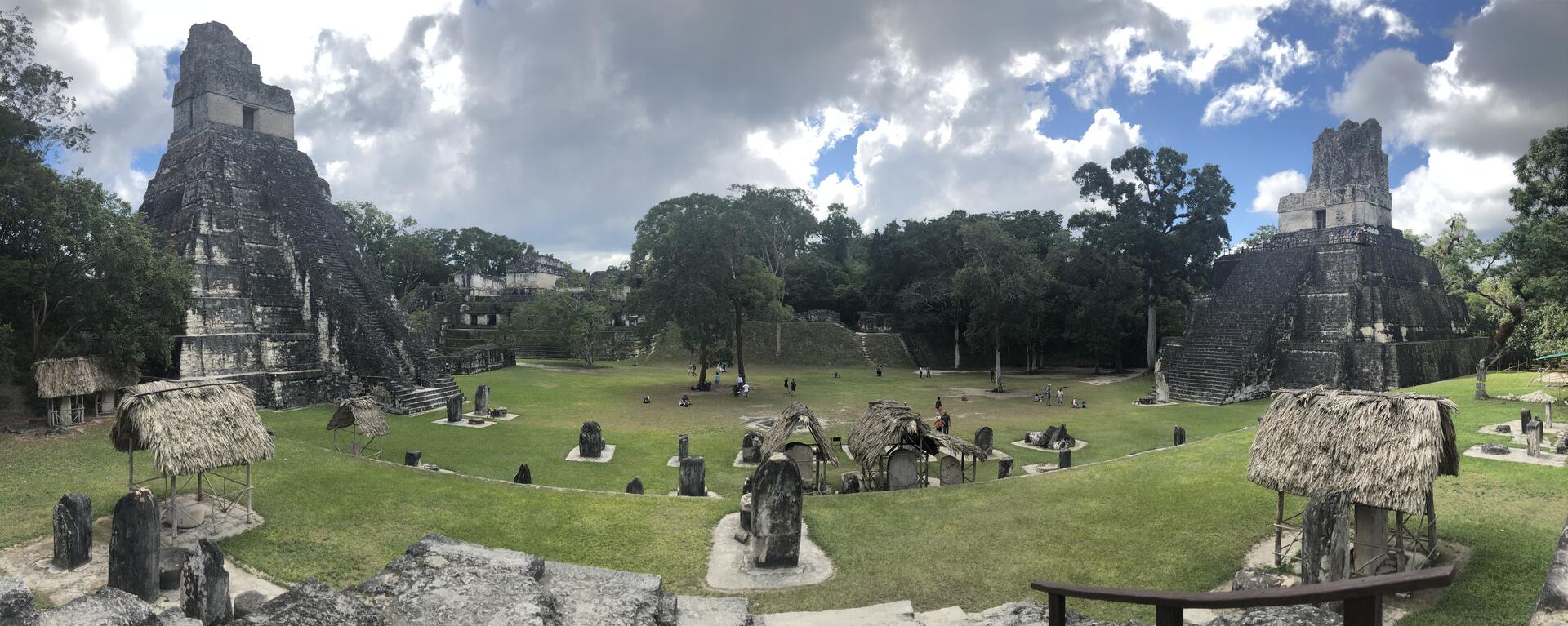
The ancient city of Tikal, one of the major centers of Maya civilization, was inhabited from at least the 6th century BC until around the 10th century AD. The archaeological site contains imposing temples, palaces, ceremonial platforms, public squares, residences, ball courts, terraces, and ancient roads. Many of these monumental structures have survived for centuries within the surrounding tropical forest. Tikal also contains an extensive network of ancient causeways and roads that connected important areas of the city and its surrounding settlements.
Tikal was part of a much wider network of Maya cities and political centers that flourished across present-day Guatemala, Belize, Mexico, Honduras, and El Salvador. During the Classic period, Tikal was one of the most powerful cities in the southern Maya lowlands and maintained political, military, and diplomatic relationships with other major hubs. Its long rivalry with Calakmul, located in present-day Mexico, was particularly significant in the political history of the Maya world. Tikal's monuments and inscriptions provide important evidence of these connections and of the broader development of Maya civilization.
Beyond the monumental center, Tikal National Park contains numerous archaeological remains scattered throughout the surrounding landscape. Residential areas, reservoirs known as aguadas, and other archaeological sites provide evidence of the large and complex society that once occupied the region. These remains offer valuable insights into the settlement patterns, agricultural practices, political organization, and everyday life of the ancient Maya.
In addition to its rich cultural heritage, Tikal National Park is renowned for its exceptional biodiversity. The protected area encompasses tropical broadleaf forests, palm forests, wetlands, and savanna environments. These varied habitats support more than 2,000 species of higher plants, including more than 200 tree species, as well as a remarkable diversity of mammals, birds, reptiles, amphibians, fish, and invertebrates.
The park is home to an impressive range of wildlife. More than 330 bird species have been recorded, including the ocellated turkey, crested eagle, ornate hawk-eagle, and great curassow. The mammalian fauna includes five species of felids—the jaguar, puma, ocelot, margay, and jaguarundi—as well as Baird's tapir and several species of monkeys. The park therefore provides important habitat for numerous species of conservation importance.
Visitors to Tikal National Park can explore its archaeological monuments and surrounding forests along established trails and through guided excursions. Guided tours provide opportunities to learn about the history and archaeology of the ancient Maya city as well as the ecology of the surrounding forest. Accommodation is available in and around the park, allowing visitors to spend more time exploring both the archaeological site and its natural surroundings.
Today, Tikal National Park stands as an outstanding example of the relationship between cultural heritage and the natural environment. Its monumental Maya architecture, extensive archaeological landscape, diverse ecosystems, and abundant wildlife make it one of Guatemala's most important cultural and natural heritage destinations. Its inscription as a UNESCO World Heritage Site recognizes both the exceptional cultural importance of Tikal and the remarkable biodiversity of the surrounding landscape.
UNESCO Description of the World Heritage Site
In the heart of the jungle, surrounded by lush vegetation, lies one of the major sites of Mayan civilization, inhabited from the 6th century B.C. to the 10th century A.D. The ceremonial centre contains superb temples and palaces, and public squares accessed by means of ramps. Remains of dwellings are scattered throughout the surrounding countryside.
UNESCO Justification of the World Heritage Site
Criterion (i): Tikal National Park is an outstanding example of the art and human genius of the Maya. Its wealth of architectural and artistic expressions also contains important symbolic elements, such as the concept of pyramid-as mountains that define a universe where human beings coexisted with their environment. It is also an exceptional place of cosmological connotations and was considered to have been a “stage” for theatrical representations.
Criterion (iii): Tikal National Park has unique elements that illustrate the historic, mythical and biographic data of the Tikal dynastic sequence. These exceptional records span over 1,161 years (292 BC to 869 AD) and register the lives of 33 rulers who reigned over a vast territory of the ancient Maya world. The earliest stone sculpture is Stela 29 dated to the year 292 and the last monument sculptured is Stela 11 dated to the year 869.
Criterion (iv): The archaeological remains at Tikal National Park reflect the cultural evolution of Mayan society from hunter-gathering to farming, with an elaborate religious, artistic and scientific culture. The most representative remains show different stages and degrees of evolution in terms of architectural development related to religious activities and ceremonies. They also exemplify the political, social and economic organization achieved, as expressed by the urban layout its palaces, temples, ceremonial platforms, and residential areas and the wealth of monuments decorated with hieroglyphic inscriptions.
Criterion (ix): The landscape mosaic comprising savannas, lush forests, wetlands and various freshwater systems is part of the Maya Forest, one of the conservation gems of Central America, hosting a rich diversity of flora and fauna as a result of a remarkable evolution of species and ecological communities. The seemingly pristine ecosystems represent an impressive natural recovery after historic conversion and intensive land and resource use during the many centuries as one of the centres of the Mayan civilisation. The ongoing biological and ecological processes are supported and protected by the large scale of the Maya Forest, and particularly its many conservation areas.
Criterion (x): The Petén Region and the Maya Forest are home to an impressive diversity of flora and fauna across its various terrestrial and freshwater habitats. More than 2000 higher plants, including 200 tree species have been inventoried. Palms, epiphytes, orchids and bromeliads abound in the various forest types. The more than 100 mammals include over 60 species of bat, five species of felids - Jaguar, Puma, Ocelot, Margay and Jaguarundi, as well as Mantled Howler Monkey and many endangered species such as Yucatan Spider Monkey and Baird's Tapir. The more than 330 recorded bird species include the near-threatened Ocellated Turkey, Crested Eagle and Ornate Hawk-Eagle, as well as the vulnerable Great Curassow. Of the more than 100 reptiles the endangered Central American River Turtle, Morelet's Crocodile and 38 species of snakes stand out. In addition to 25 known amphibian species, there is a noteworthy fish fauna and a great diversity of invertebrates. The property is also known for wild varieties of several important agricultural plants.
Encyclopedia Record: Tikal National Park
Tikal National Park is a national park located in Guatemala, in the northern region of the Petén Department. Stretching across 57,600 hectares, it contains the ancient Mayan city of Tikal and the surrounding tropical forests, savannas, and wetlands. In 1979, Tikal National Park was declared as a World Heritage Site by UNESCO, because of the outstanding Mesoamerican ruins at Tikal and the unique ecology of the surrounding landscape.Additional Site Details
Area: 57,600 hectares
Number of Components: 1
(iii) — Unique or exceptional testimony to a cultural tradition
(iv) — Outstanding example of a type of building or landscape
(ix) — Outstanding example representing ecological and biological processes
(x) — Contains most important habitats for biodiversity
Coordinates: 17.21666667 , -89.61666667
IUCN World Heritage Outlook
The 2025 Conservation Outlook on Tikal National Park reports the following assessment:
Source: International Union for Conservation of Nature (IUCN) · View assessment
World Heritage Research
Discover scientific research and academic studies that deepen our understanding of Tikal National Park from its history and significance to its conservation, management, and contemporary challenges.
-
Species richness and endemicity of carnivorans in protected areas of the Yucatan Peninsula
Only 9.48% of critical habitats for carnivoran species richness and endemicity in the Yucatán Peninsula are currently protected, despite these areas being vital for conservation. The study identified that southern Quintana Roo, southeastern Campeche, the Tabasco-Chiapas border, and northern Belize-Guatemala exhibit peak species richness, while Cozumel Island and south-central Tabasco show high endemicity. Using ecological niche modeling and diversity range analysis, researchers mapped these patterns to assess representation within existing protected areas (PAs). Key PAs partially covering priority zones include Sierra del Lacandón, Laguna del Tigre, Tikal, Yaxhá-Nakum-Naranjo National Parks in Guatemala; Rio Bravo Conservation Area in Belize; and Calakmul Biosphere Reserve in Mexico. The findings emphasize the urgent need to expand PA coverage to safeguard the region's unique carnivoran assemblages and their ecosystem functions.
Contreras-Díaz, R. G., Osorio-Olvera, L., Nori, J., Soberón, J., Martín, G., Gaona, O., & Chiappa-Carrara, X. (2026). Species richness and endemicity of carnivorans in protected areas of the Yucatan Peninsula. Perspectives in Ecology and Conservation, 24(3), 323–331. https://doi.org/10.1016/j.pecon.2026.04.002
View Publication Record | Read Publication -
New queen? Evidence of a long-living Jaguar Panthera onca (Mammalia: Carnivora: Felidae) in Tikal National Park, Guatemala
Researchers have identified evidence suggesting the presence of a long-living jaguar (Panthera onca) within Tikal National Park, Guatemala. This individual, likely a female, was recorded during a 2018 camera trapping study and traced back to 2009, indicating potential long-term residency in one of the largest conserved forests in the Neotropics, the Selva Maya. The findings highlight the need for systematic, long-term studies to evaluate jaguar populations and assess the effectiveness of protected areas in ensuring species conservation. This discovery contributes to the limited understanding of jaguar longevity and residency patterns in wild environments.
Carlos A. Gaitán, Manolo J. García, M. André Sandoval-Lemus, Vivian R. González-Castillo, Gerber D. Guzmán-Flores, & Cristel M. Pineda. (2022). New queen? Evidence of a long-living Jaguar Panthera onca (Mammalia: Carnivora: Felidae) in Tikal National Park, Guatemala. Journal of Threatened Taxa, 14(7), 21388–21395. https://doi.org/10.11609/jott.5813.14.7.21388-21395
View Publication Record | Read Publication -
Inscripciones jeroglíficas mayas misceláneas sobre cerámica del Clásico Temprano en el Parque Nacional Tikal, Guatemala
A previously overlooked fragment of Maya hieroglyphic text from Tikal National Park, Guatemala, reveals the earliest known mention of the enigmatic title 'tumam' and provides insights into an unknown royal lineage from the Petén region during the Early Classic period. This discovery stems from a 2013 project focused on re-documenting ceramic collections at the Tikal Conservation and Research Center (CCIT). The research, part of the 'Epigraphic Atlas of Peten, Phase I,' aimed to analyze lesser-studied hieroglyphic texts preserved in the park. By systematically re-examining ceramic fragments, the study uncovered significant epigraphic evidence that contributes to our understanding of Maya dynastic accounts and titles during this crucial period.
Beliaev, D. (2021). Inscripciones jeroglíficas mayas misceláneas sobre cerámica del Clásico Temprano en el Parque Nacional Tikal, Guatemala. https://doi.org/10.5281/ZENODO.5787871
View Publication Record | Read Publication -
Modelling the ancient maize agriculture potential of landforms in Tikal National Park, Guatemala
A predictive model of ancient maize agriculture in Tikal National Park reveals that bajo margins were likely used for sustained farming, while upland Rendolls soils showed long-term C3 vegetation signatures, suggesting diverse food production systems. The study combined non-parametric regression, stable carbon isotopes, soil properties, and remote-sensing data to identify areas with strong C4 isotopic enrichment indicative of maize cultivation. Upland regions lacked clear C4 signals, implying alternative land-use practices such as silviculture or forest gardens. This approach provides a cost-effective method for reconstructing subsistence strategies in ancient polities.
Balzotti, C. S., Webster, D. L., Murtha, T. M., Petersen, S. L., Burnett, R. L., & Terry, R. E. (2013). Modelling the ancient maize agriculture potential of landforms in Tikal National Park, Guatemala. International Journal of Remote Sensing, 34(16), 5868–5891. https://doi.org/10.1080/01431161.2013.798876
View Publication Record | Read Publication