World Heritage Identification Number: 119
World Heritage since: 1988
Category: Cultural Heritage
WHE Type: Historic Cities & Urban Areas
Transboundary Heritage: No
Endangered Heritage: Yes
Country: 🇲🇱 Mali
Continent: Africa
UNESCO World Region: Africa
Map
Timbuktu: A Historic Hub of Trade, Learning, and Culture
Timbuktu, officially known as Tombouctou, is an ancient city located in the Tombouctou Region in Mali. The city lies approximately 20 kilometers north of the Niger River and serves as the regional capital. Despite its remote desert location near the southern edge of the Sahara Desert, Timbuktu has long been an important center of culture, trade, and religion in West Africa and was inscribed as a UNESCO World Heritage Site in 1988.
Timbuktu reached its peak during the 15th and 16th centuries when it became one of the most important intellectual and spiritual centers in Africa, and a center for the propagation of Islam throughout the region. During this period, the city flourished under the influence of the Mali Empire and later the Songhai Empire. Timbuktu was also a major hub in the trans-Saharan trade network, connecting West Africa with North Africa and the Mediterranean world.
The city became famous for Islamic scholarship. Scholars gathered in its mosques and schools to study theology, law, mathematics, astronomy, and literature. Thousands of manuscripts were produced and preserved in Timbuktu, many of which still exist today. Because of its many revered scholars and saints, Timbuktu became known as “The City of 333 Saints.”
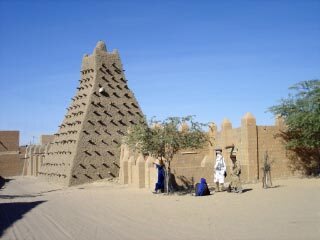
Three historic mosques symbolize Timbuktu’s golden age and remain central to its identity: the Djingareyber Mosque, the Sankore Mosque, and the Sidi Yahia Mosque. The Djingareyber Mosque was built in 1327 during the reign of the famous ruler Mansa Musa following his pilgrimage to Mecca. Constructed primarily from mud bricks reinforced with wooden beams, the mosque is one of Timbuktu’s most iconic buildings and remains an active place of worship.
The Sankore Mosque became one of the most important centers of Islamic learning in Africa. Scholars teaching around the mosque formed what is often referred to as the University of Timbuktu, a loose network of scholars and students rather than a formal university in the modern sense. The Sidi Yahia Mosque, completed in the 15th century, was named after the respected scholar Sidi Yahya al‑Tadelsi, who served as its imam. Like the other historic buildings in the city, it is built in the distinctive Sudano-Sahelian architectural style. These monuments, along with several historic mausoleums, are recognized as part of the World Heritage Site.
Timbuktu’s mosques were surrounded by numerous madrasas (Islamic schools) where scholars taught students from across West Africa and the wider Islamic world. The Sankore scholarly tradition in particular attracted thousands of students. Subjects studied included Islamic law, theology, grammar, astronomy, medicine, and mathematics. The city’s scholars produced a large body of written works, preserved today as the famous Timbuktu manuscripts, which provide valuable insight into African intellectual history.
Before its rise as a major intellectual and trade center, Timbuktu was established by the Tuareg people as a small seasonal settlement and trading post in the 11th–12th centuries. Its strategic location near the Niger River and on trans-Saharan trade routes allowed it to grow steadily, attracting merchants, pilgrims, and early scholars. The Tuareg played an important role in connecting Timbuktu to other Sahelian and Saharan trade networks, facilitating the exchange of salt, gold, and other goods that laid the foundation for the city’s later prosperity.
In 1591, Timbuktu was conquered by Moroccan forces, marking the end of its political autonomy under the Songhai Empire and beginning a period of economic and intellectual decline. Later, in the late 19th and early 20th centuries, the city became part of French Sudan under colonial rule, bringing formal administration and integrating Timbuktu into the French colonial system.
Today, Timbuktu remains a symbolic cultural and religious center in Mali, though its influence is far smaller than during its medieval peak. Since 2012, it has been placed on the List of World Heritage in Danger due to the threats posed by armed conflict and environmental pressures such as desertification that threaten the historic mud-brick buildings, which require continuous maintenance and restoration. The city has also experienced periods of conflict, particularly during the occupation of northern Mali by militant groups in 2012, when several historic mausoleums were damaged or destroyed.
Restoration efforts supported by international organizations have since helped rebuild many of these sites. Although tourism once played a role in the local economy, security concerns in recent years have greatly reduced international travel to the region. Timbuktu faces ongoing security, economic, and humanitarian challenges. As of 2026, the city is formally controlled by the Malian government and its armed forces, while Islamist militant groups operate in surrounding regions of northern Mali, leaving overall security fragile.
Timbuktu stands as a remarkable symbol of West Africa’s rich intellectual and cultural heritage. Its mosques, manuscripts, and scholarly traditions reflect a period when the city was one of the most important centers of learning in the Islamic world. Today, Timbuktu remains a powerful reminder of Africa’s historical contributions to global scholarship and culture, underscoring the importance of preserving this precious heritage.
UNESCO Description of the World Heritage Site
Home of the prestigious Koranic Sankore University and other madrasas, Timbuktu was an intellectual and spiritual capital and a centre for the propagation of Islam throughout Africa in the 15th and 16th centuries. Its three great mosques, Djingareyber, Sankore and Sidi Yahia, recall Timbuktu's golden age. Although continuously restored, these monuments are today under threat from desertification.
UNESCO Justification of the World Heritage Site
Criterion (ii): The mosques and holy places of Timbuktu have played an essential role in the spread of Islam in Africa at an early period.
Criterion (iv): The three great mosques of Timbuktu, restored by the Qadi Al Aqib in the 16th century, bear witness to the golden age of the intellectual and spiritual capital at the end of the Askia dynasty.
Criterion (v): The three mosques and mausoleums are outstanding witnesses to the urban establishment of Timbuktu, its important role of commercial, spiritual and cultural centre on the southern trans-Saharan trading route, and its traditional characteristic construction techniques. Their environment has now become very vulnerable under the impact of irreversible change.
Encyclopedia Record: Timbuktu
Timbuktu is an ancient city in Mali, situated 20 kilometres north of the Niger River. It is the capital of the Tombouctou Region, one of the 19 administrative regions of Mali, having a population of around one million people in the 2022 census.Additional Site Details
Area: Not available
Number of Components: 1
(iv) — Outstanding example of a type of building or landscape
(v) — Outstanding example of traditional human settlement
Coordinates: 16.77333333 , -2.999444444
World Heritage Research
Discover scientific research and academic studies that deepen our understanding of Timbuktu from its history and significance to its conservation, management, and contemporary challenges.
-
Human seroprevalence of rift valley fever in the Timbuktu region, Mali, 2021
A population-based study in the Timbuktu region, Mali, revealed a human seroprevalence of Rift Valley fever (RVF) at 10.7%, mirroring the 10% prevalence observed in cattle. This finding underscores the circulation of Rift Valley fever virus (RVFV) among humans across five districts, despite no prior reported epidemics. Using competitive ELISA techniques on 983 volunteers, researchers demonstrated significant exposure risks due to close human-animal contact. The study highlights the urgent need for strengthened public health strategies to mitigate potential future outbreaks in this UNESCO World Heritage Site.
DIARRA, I., TRAORE, A., AYHAN, N., THIRION, L., CISSOKO, M., ARAMA, S., SANKARE, M. H., THIERO, M., KOITA, B., DIAKITE, A., CISSE, A., MAIGA, O., & Lamballerie, X. d. (2025). Human seroprevalence of rift valley fever in the Timbuktu region, Mali, 2021. World Journal of Biology Pharmacy and Health Sciences, 24(2), 266–273. https://doi.org/10.30574/wjbphs.2025.24.2.0997
View Publication Record | Read Publication -
The dysfunctional copy: “Mali Magic,” loss and the digital remake of the Timbuktu archive
The Timbuktu archive, long associated with narratives of heritage in peril, reveals that its preservation is deeply intertwined with a history of loss and remaking. While digitization efforts have gained prominence due to recent threats—such as the 2012 rebel takeover—this study highlights how copying has been a traditional and generative mode of preservation and knowledge production for centuries. It examines the physical anatomy of manuscripts, colonial plunder, and post-independence archival reconstitution, underscoring that loss is not merely destructive but also constitutive of the archive's identity. The research approach combines historical analysis with critical reflection on digitization, challenging its status as a definitive solution while acknowledging its potential for both preservation and new forms of knowledge dissemination.
Molins Lliteras, S. (2024). The dysfunctional copy: “Mali Magic,” loss and the digital remake of the Timbuktu archive. Social Dynamics, 50(1), 43–59. https://doi.org/10.1080/02533952.2024.2320551
View Publication Record | Read Publication -
Arabic Poetry in Timbuktu during the 19th and 20th Centuries: A Model Study
A rich tradition of Arabic poetry, largely overlooked despite its significance, thrived in Timbuktu during the 19th and 20th centuries. This study highlights that poets from tribes such as the Tuareg, Ansar, and Kunta produced works of high literary value, incorporating diverse themes like love, praise, elegy, satire, and religious subjects, while employing sophisticated rhetorical devices. The research underscores Timbuktu's unique role in Arabic literature, challenging its marginalization in scholarly discourse. By analyzing these texts, the study reveals their cultural, historical, and scientific importance, offering a model for understanding Malian African literature written in Arabic.
Maiga, M. A. (2024). ARABIC POETRY IN TIMBUKTU DURING THE 19th AND 20th CENTURIES: A MODEL STUDY. Uluslararası Dil Edebiyat Ve Kültür Araştırmaları Dergisi, 7(3), 399–416. https://doi.org/10.37999/udekad.1482942
View Publication Record | Read Publication -
From Algiers to Timbuktu: Multi-Local Research in Colonial History Across the Saharan Divide
Research reveals that the 'Saharan Divide,' a long-standing conceptual barrier separating sub-Saharan Africa and North Africa, persists prominently in colonial-era scholarship despite its extensive historiography. This study introduces a 'multi-local' research approach, challenging traditional Area Studies divisions by integrating archival findings from multiple African sites. A key discovery involves Algerian educators teaching in colonial schools across Mauritania and French Soudan, illustrating the fluidity of trans-Saharan connections during this period. By adopting this method, scholars can reconceptualize multi-sited research and reassess how historical knowledge is structured, offering a more nuanced understanding of colonial-era Africa.
Anderson, S. D. (2022). From Algiers to Timbuktu: Multi-Local Research in Colonial History Across the Saharan Divide. History in Africa, 49, 277–299. https://doi.org/10.1017/hia.2021.22
View Publication Record | Read Publication -
Hayal İle Gerçek Arasında Timbuktu İmgesi
Timbuktu, located on the southern edge of the Sahara Desert, embodies two contrasting images: its physical reality and legendary status. The city's fame was cemented during Mansa Musa's pilgrimage to Cairo, where he distributed vast amounts of gold, capturing European interest. This attention was amplified by depictions in the Catalan Atlas, which portrayed Timbuktu as a symbol of wealth and mystery. The study delves into the journey of European explorers seeking to reach Timbuktu, analyzing their initial impressions upon arrival. It also explores how Timbuktu's legendary image was formed, sustained over centuries, and influenced by real experiences, giving rise to phrases and sayings that endure today.
DEMİRER, A. (2022). HAYAL İLE GERÇEK ARASINDA TİMBUKTU İMGESİ. Çeşm-I Cihan (Tarih Kültür Ve Sanat Araştırmaları Dergisi) E-Dergisi. https://doi.org/10.30804/cesmicihan.1115788
View Publication Record | Read Publication -
An Analysis of the Strategies Employed to Curate, Conserve and Digitize the Timbuktu Manuscripts
A collaborative effort between the governments of South Africa and Mali has significantly advanced the preservation, curation, and digitization of the Timbuktu Manuscripts, offering a nuanced understanding of intellectual history that transcends traditional single-format analysis. The study highlights how integrated strategies—including conservation, publication, and digitization—enrich historical interpretation by leveraging complementary formats. Central to this work is the Tombouctou Manuscripts Project at the University of Cape Town, which emphasizes the transformative potential of archives in redefining continental narratives. These interventions collectively mark a pivotal moment in safeguarding and interpreting one of Africa's most valuable cultural treasures.
Saptouw, F. (2021). An Analysis of the Strategies Employed to Curate, Conserve and Digitize the Timbuktu Manuscripts. Zenodo. https://doi.org/10.5281/ZENODO.4506443
View Publication Record | Read Publication -
Factors hindering health care delivery in nomadic communities: a cross-sectional study in Timbuktu, Mali
Nomadic communities in Timbuktu, Mali, face significant barriers to accessing healthcare due to their mobile lifestyle and the inadequacy of existing health services. A cross-sectional study involving 520 participants from Ber and Gossi communes revealed that transportation challenges (79.4%), service quality concerns (39.2%), and high costs (35.7%) are primary obstacles. Additionally, over a quarter of respondents expressed discomfort with gender-mismatched healthcare providers. These findings highlight the need for tailored health policies and interventions that address mobility, affordability, and cultural sensitivities to improve community-based health outcomes in nomadic populations.
Sangare, M., Coulibaly, Y. I., Coulibaly, S. Y., Dolo, H., Diabate, A. F., Atsou, K. M., Souleymane, A. A., Rissa, Y. A., Moussa, D. W., Abdallah, F. W., Dembele, M., Traore, M., Diarra, T., Brieger, W. R., Traore, S. F., Doumbia, S., & Diop, S. (2021). Factors hindering health care delivery in nomadic communities: a cross-sectional study in Timbuktu, Mali. BMC Public Health, 21(1). https://doi.org/10.1186/s12889-021-10481-w
View Publication Record | Read Publication