World Heritage Identification Number: 1139
World Heritage since: 2004
Category: Cultural Heritage
WHE Type: Archaeological Sites
Transboundary Heritage: No
Endangered Heritage: Yes
Country: 🇲🇱 Mali
Continent: Africa
UNESCO World Region: Africa
Map
The Tomb of Askia: A Testimony to the Power and Riches of the Songhai Empire
The Tomb of Askia, located in the city of Gao, Mali, stands as a significant historical landmark and a testament to the grandeur and influence of the Songhai Empire. Inscribed as a UNESCO World Heritage Site in 2004, this architectural marvel offers insights into the rich cultural heritage and the monumental mud-building traditions of West Africa's Sahel region.
More to come…UNESCO Description of the World Heritage Site
The dramatic 17-m pyramidal structure of the Tomb of Askia was built by Askia Mohamed, the Emperor of Songhai, in 1495 in his capital Gao. It bears testimony to the power and riches of the empire that flourished in the 15th and 16th centuries through its control of the trans-Saharan trade, notably in salt and gold. It is also a fine example of the monumental mud-building traditions of the West African Sahel. The complex, including the pyramidal tomb, two flat-roofed mosque buildings, the mosque cemetery and the open-air assembly ground, was built when Gao became the capital of the Songhai Empire and after Askia Mohamed had returned from Mecca and made Islam the official religion of the empire.
UNESCO Justification of the World Heritage Site
Criterion (ii) : The Tomb of Askia reflects the way the local building traditions, in response to Islamic needs, absorbed influences from North Africa to create a unique architectural style across the West African Sahel.
Criterion (iii): The Tomb of Askia is an important vestige of the Songhai Empire, which once dominated the Sahel lands of West Africa and controlled the lucrative trans-Saharan trade.
Criterion (iv): The Tomb of Askia reflects the distinctive architectural tradition of the West African Sahel and in particular the way buildings evolve over centuries through regular, traditional maintenance practices.
Encyclopedia Record: Tomb of Askia
The Tomb of Askia, in Gao, Mali, is believed to be the burial place of Askia Muhammad I, one of the Songhai Empire's most prolific emperors. It was built at the end of the fifteenth century and is designated as a UNESCO World Heritage Site.Additional Site Details
Area: 4.24 hectares
Number of Components: 1
(iii) — Unique or exceptional testimony to a cultural tradition
(iv) — Outstanding example of a type of building or landscape
Coordinates: 16.2898 , -0.04456
Image
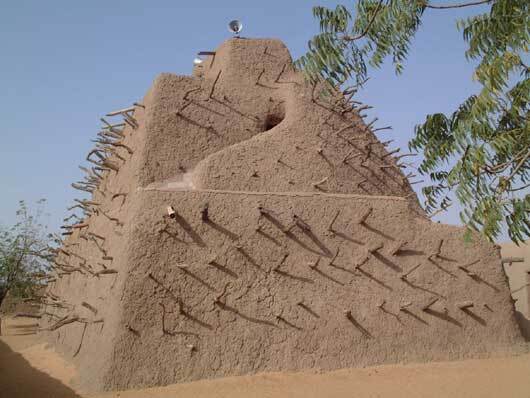
© Taguelmoust, CC BY-SA 3.0 Resized from original. (This derivative is under the same CC BY-SA license.)
World Heritage Research
Discover scientific research and academic studies that deepen our understanding of Tomb of Askia from its history and significance to its conservation, management, and contemporary challenges.
-
The Impact of Climate Change on Cultural Heritage: The Case of the Tomb of Askia
The Tomb of Askia, a UNESCO World Heritage Site in Gao, faces severe threats from climate change-induced flooding and desertification, exacerbated by regional insecurity. Despite the UN's 2030 Agenda for Sustainable Development, these challenges remain unaddressed due to insufficient reporting and understanding of their interrelationships. The study highlights the urgent need for improved data collection and integrated strategies to mitigate environmental degradation and safeguard cultural heritage in vulnerable regions.
Samaké, M. (2025). The Impact of Climate Change on Cultural Heritage: The Case of the Tomb of Askia. Blue Papers, 4(2). https://doi.org/10.58981/bluepapers.2025.2.03
View Publication Record | Read Publication -
Sahel:Art and Empires on the Shores of the Sahara
The exhibition 'Sahel: Art and Empires on the Shores of the Sahara' at The Metropolitan Museum of Art revealed the rich artistic heritage of West Africa, spanning from the 3rd to the 19th century. It showcased over 200 works from the empires of Ghana, Mali, and Songhay, as well as other kingdoms, highlighting their material cultures in stone, clay, wood, bronze, gold, textiles, musical instruments, and illuminated manuscripts. The exhibition spatially anchored these artifacts near historic landmarks, providing a comprehensive historical context. It also introduced lesser-known forms of material culture and utilized interdisciplinary research to bridge gaps between the Sahel's history and its legendary states.
Imperato, P. J. (2022). Sahel:Art and Empires on the Shores of the Sahara. African Arts, 55(1), 83–85. https://doi.org/10.1162/afar_r_00641
View Publication Record | Read Publication -
Role of the Traditional Masonry Corporation in the Process of Reconstruction of the Destroyed Mausolees in Timbuktu, Mali
The reconstruction of the destroyed mausoleums in Timbuktu, Mali, following the 2012 military coup and occupation, highlighted the critical role of traditional masonry corporations in preserving cultural heritage. A participatory approach involving local masons, who possess deep technical knowledge and ritual practices, proved essential for the successful rehabilitation of these World Heritage Sites. The study emphasizes that empowering traditional craftsmanship not only ensures the authenticity of reconstruction but also fosters community engagement and the transmission of indigenous expertise to international architects. This collaborative effort, supported by UNESCO and global partners, demonstrated the resilience of local knowledge systems in safeguarding endangered cultural properties.
Cissé, L. (2020). Role of the Traditional Masonry Corporation in the Process of Reconstruction of the Destroyed Mausolees in Timbuktu, Mali. The Future of the Bamiyan Buddha Statues, 123–134. https://doi.org/10.1007/978-3-030-51316-0_8
View Publication Record | Read Publication