World Heritage Identification Number: 194
World Heritage since: 1982
Category: Cultural Heritage
WHE Type: Archaeological Sites
Transboundary Heritage: No
Endangered Heritage: No
Country: 🇩🇿 Algeria
Continent: Africa
UNESCO World Region: Arab States
Map
Timgad: A Well-Preserved Example of Roman Urban Planning
Timgad, officially known as Colonia Marciana Ulpia Traiana Thamugadi, is a remarkable testament to the architectural prowess of the ancient Romans. Located in the Aurès Mountains of modern-day Algeria, this UNESCO World Heritage Site was established in AD 100 by Emperor Trajan as a military colony. Its exceptional preservation offers a unique insight into Roman urban planning and daily life during the Roman Empire.
More to come…UNESCO Description of the World Heritage Site
Timgad lies on the northern slopes of the Aurès mountains and was created ex nihilo as a military colony by the Emperor Trajan in AD 100. With its square enclosure and orthogonal design based on the cardo and decumanus, the two perpendicular routes running through the city, it is an excellent example of Roman town planning.
UNESCO Justification of the World Heritage Site
Criterion (ii): The site of Timgad, with its Roman military camp, its model town-planning and its particular type of civil and military architecture reflects an important interchange of ideas, technologies and traditions exercised by the central power of Rome on the colonisation of the high plains of Antique Algeria.
Criterion (iii): Timgad adopts the guidelines of Roman town-planning governed by a remarkable grid system. Timgad thus constitutes a typical example of an urban model, the permanence of the original plan of the military encampment having governed the development of the site throughout all the ulterior periods and still continues to bear witness to the building inventiveness of the military engineers of the Roman civilization, today disappeared.
Criterion (iv): Timgad possesses a rich architectural inventory comprising numerous and diversified typologies, relating to the different historical stages of its construction: the defensive system, buildings for the public conveniences and spectacles, and a religious complex. Timgad illustrates a living image of Roman colonisation in North Africa over three centuries.
Encyclopedia Record: Timgad
Timgad was a Roman city in the Aurès Mountains of Algeria. It was founded by the Roman Emperor Trajan around 100 AD. The full name of the city was Colonia Marciana Ulpia Traiana Thamugadi. Emperor Trajan named the city in commemoration of his mother Marcia, eldest sister Ulpia Marciana, and father Marcus Ulpius Traianus.Additional Site Details
Area: 90.54 hectares
Number of Components: 1
(iii) — Unique or exceptional testimony to a cultural tradition
(iv) — Outstanding example of a type of building or landscape
Coordinates: 35.4841666667 , 6.4688611111
Image
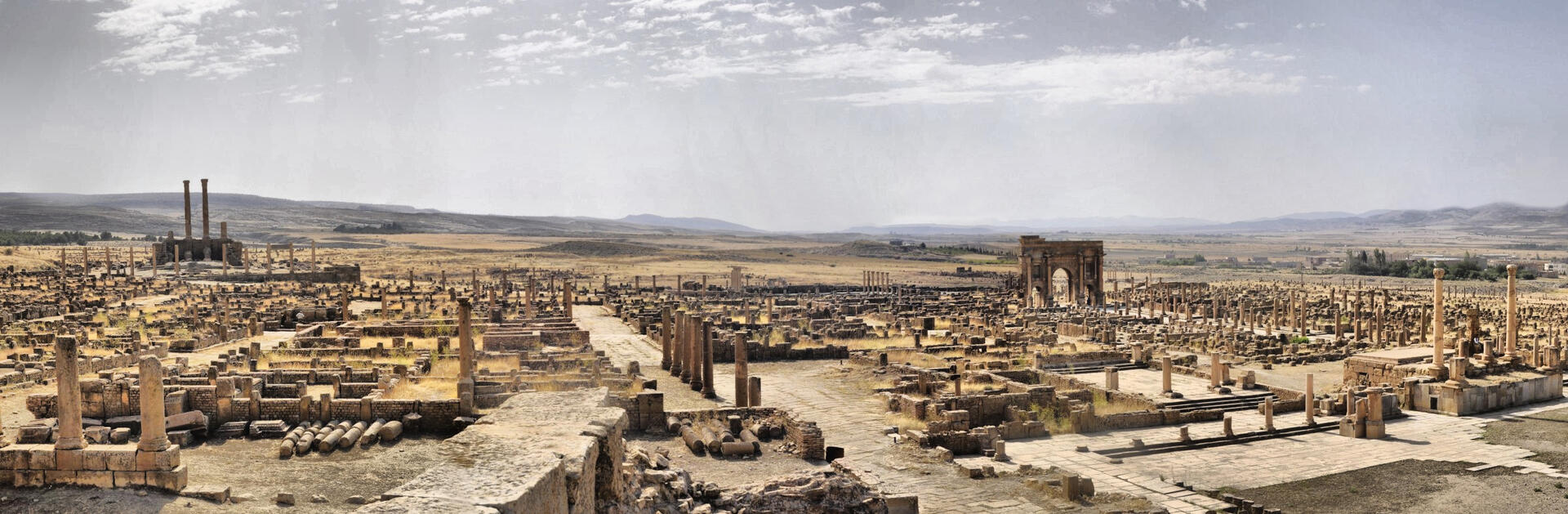
© Hamza-sia, CC BY-SA 3.0 Resized from original. (This derivative is under the same CC BY-SA license.)
World Heritage Research
Discover scientific research and academic studies that deepen our understanding of Timgad from its history and significance to its conservation, management, and contemporary challenges.
-
The Luminous Ambience of an Ancient Roman Public Building: A Characterization of the Inner Daylit Environment of Rogatianus Library in Thamugadi City (Timgad, Algeria)
A new analysis reveals that the ancient Roman library at Timgad, Algeria, was not uniformly daylit, suggesting its use varied spatially and temporally. The study compared Vitruvian design principles with previous research on Roman libraries before using 3D geometric modeling and Radiance simulations to characterize daylighting conditions in the library's large reading room. This approach highlights how the library's luminous environment influenced activities like consulting, reading, and storing books, offering insights into its functional adaptation to Timgad's unique climate.
Djouadi, H., Belakehal, A., & Zanovello, P. (2025). The Luminous Ambience of an Ancient Roman Public Building: A Characterization of the Inner Daylit Environment of Rogatianus Library in Thamugadi City (Timgad, Algeria). Heritage, 8(8), 300. https://doi.org/10.3390/heritage8080300
View Publication Record | Read Publication -
Military Strategies of Roman Cities Establishment Based on the Space Syntax Analysis Applied to the Vestiges of Timgad
Roman urban planning, particularly in Timgad (Algeria), was intricately designed to serve military and administrative objectives. A study using Space Syntax Analysis (SSA) revealed that the city's grid-like layout prioritized surveillance and control, with key military structures strategically placed along main roads and urban nodes. High SSA indicators—such as connectivity, integration, entropy, control, controllability, and through vision—demonstrated a deliberate effort to dominate space while reinforcing imperial authority. This synergy between military logic and urban design suggests that Roman town planning was not only functional but also symbolic, shaping long-lasting colonial city models beyond the Empire's duration.
Guedouh, M. S., Youcef, K., Belmahdi, H. S., Khadraoui, M. A., & Saraoui, S. (2025). Military Strategies of Roman Cities Establishment Based on the Space Syntax Analysis Applied to the Vestiges of Timgad. Heritage, 8(8), 324. https://doi.org/10.3390/heritage8080324
View Publication Record | Read Publication -
A preliminary mineralogical and physicochemical characterization of the Neogene clays from the Timgad Basin (Massif of Aurès, NE Algeria): potential use in the manufacturing of bricks and ceramic industry
Neogene clays from the Timgad Basin (Massif of Aurès, NE Algeria) exhibit ideal mineralogical and physicochemical properties for brick and ceramic manufacturing. These non-refractory clays, dominated by kaolinite with notable illite, chlorite, and mixed-layer clay minerals, alongside quartz and calcite, demonstrate medium plasticity but require degreasing treatment—such as adding coarse sand—to optimize their use in terra cotta production. The study employed X-ray diffraction, fluorescence, scanning electron microscopy, laser granulometry, and geotechnical tests to characterize the clays, revealing high Atterberg limits that necessitate preliminary processing for industrial applications.
Lamouri, B., Labadi, S. A., Boukoffa, M., Chouaf, I., Djouder, H., Djaiz, F., & Bouabsa, L. (2022). A preliminary mineralogical and physicochemical characterization of the Neogene clays from the Timgad Basin (Massif of Aurès, NE Algeria): potential use in the manufacturing of bricks and ceramic industry. SN Applied Sciences, 4(5). https://doi.org/10.1007/s42452-022-05029-5
View Publication Record | Read Publication -
Memory and the urban environment: experiencing the streets of Severan Timgad
Urban landscapes in antiquity were not just physical spaces but also repositories of collective memory, shaped by both top-down planning and bottom-up practices. A study on Severan Timgad reveals how the city's grid plan, public buildings, and honorific inscriptions were deliberately staged to evoke a sense of continuity and development, reinforcing the urban environment as a living memory. Inhabitants further contributed to this memory through everyday interactions, demonstrating that memory was not solely an architectural or political construct but also a dynamic product of daily life. The research combines spatial analysis with epigraphic evidence to illustrate how Timgad's streets served as both a stage for imperial propaganda and a canvas for communal identity.
Lamare, N. (2022). Memory and the urban environment: experiencing the streets of Severan Timgad. Libyan Studies, 53, 129–141. https://doi.org/10.1017/lis.2022.12
View Publication Record | Read Publication -
Systematic and ecological study of mosquitoes (Diptera: Culicidae) in the region of Timgad, Algeria
A systematic and ecological study of mosquitoes (Diptera: Culicidae) in the region of Timgad, Algeria, identified five mosquito species over a year-long period. Culiseta longiareolata was found to be the most abundant, with three significant population peaks. The research also examined the correlation between mosquito larval density and water quality, using monthly sampling via the 'Dipping' method for larvae collection and subsequent laboratory identification. This study provides valuable insights into the biodiversity and ecological dynamics of mosquitoes in the Timgad region, contributing to our understanding of their distribution and environmental interactions.
Belkhiri, N., Aberkane, N., Hedjouli, Z., Habbachi, W., & Benhissen, S. (2022). Systematic and ecological study of mosquitoes (Diptera: Culicidae) in the region of Timgad, Algeria. Journal of Biodiversity Conservation and Bioresource Management, 8(1), 49–56. https://doi.org/10.3329/jbcbm.v8i1.62222
View Publication Record | Read Publication -
Indagini preliminari e rilievo architettonico di due magazzini sull’antico sito di Thamugadi (Timgad)
Archaeological investigations at the UNESCO World Heritage Site of Timgad (Thamugadi) have uncovered a trove of Roman-era artifacts from two storage facilities, providing rare insights into daily life and trade during the 2nd century AD. Among the findings are Christian lamps, bronze keys, Roman balance hooks, fibulae, coins, and ornate hairpins, alongside fragments of bone, ivory, glass, and pottery. The discovery also includes a millstone, hinting at agricultural practices in the region. The study employed preliminary surveys and architectural documentation to analyze these structures, contributing valuable data to understanding the economic and social dynamics of this ancient city.
Martorella, F., & Bahloul, F.-Z. (2020). Indagini preliminari e rilievo architettonico di due magazzini sull’antico sito di Thamugadi (Timgad). Chronique Des Activités Archéologiques de l’École Française de Rome. https://doi.org/10.4000/cefr.4092
View Publication Record | Read Publication -
Archaeological Sites and Tourism: Protection and Valorization, Case of Timgad (Batna) Algeria
A comprehensive analysis of Timgad, Algeria, reveals that despite its status as a UNESCO World Heritage Site since 1982 and its significant cultural and economic potential, the site lacks adequate tourism planning, leading to suboptimal protection and valorization efforts. The study identifies key socio-economic characteristics of visitors and their perceptions, highlighting the urgent need for a coherent strategy that balances heritage preservation with sustainable development. Using field studies, document analysis, questionnaires, and statistical methods, researchers propose recommendations aimed at enhancing Timgad's role as both a cultural asset and an economic resource. This work underscores the importance of integrated approaches in safeguarding archaeological sites for future generations.
KHERROUR, L., HATTAB, S., REZZAZ, M. A.,. (2020). ARCHAEOLOGICAL SITES AND TOURISM: PROTECTION AND VALORIZATION, CASE OF TIMGAD (BATNA) ALGERIA. GeoJournal of Tourism and Geosites, 28(1), 289–302. https://doi.org/10.30892/gtg.28123-470
View Publication Record | Read Publication