World Heritage Identification Number: 794
World Heritage since: 1997
Category: Cultural Heritage
WHE Type: Archaeological Sites
Transboundary Heritage: No
Endangered Heritage: No
Country: 🇹🇳 Tunisia
Continent: Africa
UNESCO World Region: Arab States
Map
Thugga/Dougga: A Well-Preserved Roman Small Town in North Africa
Thugga/Dougga, located near Téboursouk in northern Tunisia, is a remarkable archaeological site that offers a unique glimpse into the history of North Africa. Inscribed as a UNESCO World Heritage Site in 1997, this small Roman town stands out as one of the best-preserved examples of its kind in the region.
More to come…UNESCO Description of the World Heritage Site
Before the Roman annexation of Numidia, the town of Thugga, built on an elevated site overlooking a fertile plain, was the capital of an important Libyco-Punic state. It flourished under Roman and Byzantine rule, but declined in the Islamic period. The impressive ruins that are visible today give some idea of the resources of a small Roman town on the fringes of the empire.
UNESCO Justification of the World Heritage Site
Criterion (ii): The site of Dougga is an outstanding example of the birth, development and history of an indigenous city since the second millennium BC. The site of Dougga conserves the complete ruins of an antique city with all its components and provides the best known example of town layout of an indigenous foundation, adapted to town planning on the Roman model.
Criterion (iii): The important epigraphic collection (over 2000 Libyan, Punic, bilingual, Greek and above all Latin inscriptions) has made a decisive contribution to the decipherment of the Libyan language and knowledge of the social and municipal life of the Numidians, testifying to the level of development attained by the city during the 3rd and 2nd centuries BC. Over approximately two and a half centuries, two legally distinct communities, one comprising an indigenous population and the other a community of settlers who were Roman citizens, coexisted in the same town and on the same territory. They both equally participated in the development and flourishing of the city. Whilst retaining its largely Numidian urban fabric, Thugga therefore took on the aspect of a Roman monumental city. In this respect, it constitutes a representative example of a Maghreb city under the Numidian kings and during the first centuries of the Roman Empire. In comparison to similar sites in North Africa, the ruins of the Roman and pre-Roman city of Thugga are surprisingly complete and well preserved. Consequently, they illustrate in an exceptional manner what daily life was like in a small provincial town during the Roman period.
Encyclopedia Record: Dougga
Dougga or Thugga or TBGG was a Berber, Punic and Roman settlement near present-day Téboursouk in northern Tunisia. The current archaeological site covers 75 hectares. UNESCO qualified Dougga as a World Heritage Site in 1997, believing that it represents "the best-preserved Roman small town in North Africa". The site, which lies in the middle of the countryside, has been protected from the encroachment of modern urbanization, in contrast, for example, to Carthage, which has been pillaged and rebuilt on numerous occasions. Dougga's size, its well-preserved monuments and its rich Numidian-Berber, Punic, ancient Roman, and Byzantine history make it exceptional. Amongst the most famous monuments at the site are a Libyco-Punic Mausoleum, the Capitol, the Roman theatre, and the temples of Saturn and of Juno Caelestis.Additional Site Details
Area: 75 hectares
Number of Components: 1
(iii) — Unique or exceptional testimony to a cultural tradition
Coordinates: 36.42361 , 9.22028
Image
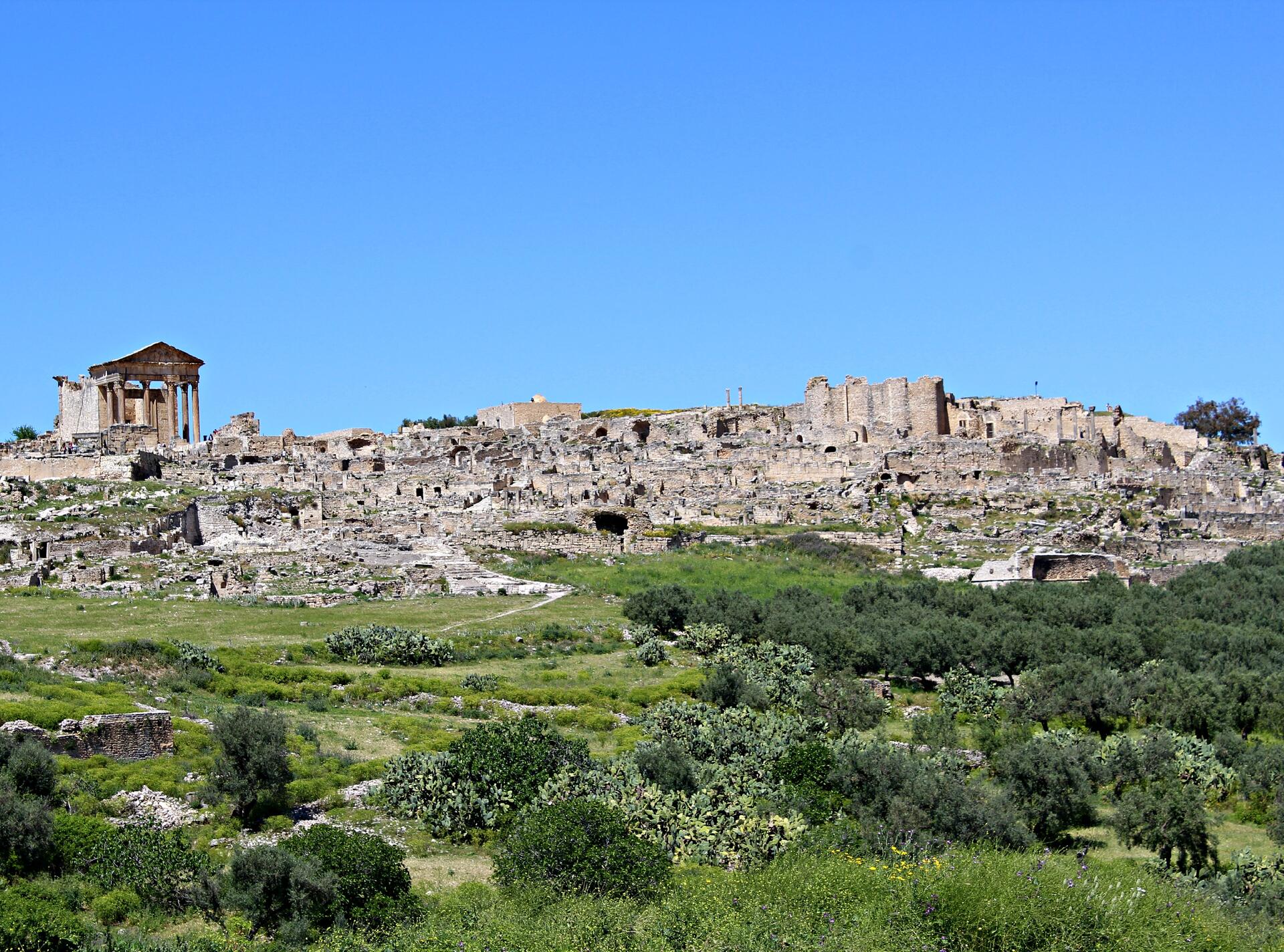
© Emna Trabelsi, CC BY-SA 3.0 Resized from original. (This derivative is under the same CC BY-SA license.)
World Heritage Research
Discover scientific research and academic studies that deepen our understanding of Dougga / Thugga from its history and significance to its conservation, management, and contemporary challenges.
-
Local Communities and Archaeological Sites in Tunisia: A Case Study at Dougga (Ancient Thugga) about Cultural Memory and Cultural Markers in the Longue Durée
A persistent cultural memory rooted in Numidian, Punic, and Roman periods persists at Dougga (ancient Thugga), Tunisia, as demonstrated by the enduring cult of Oum Khoula. This study reveals that local communities' oral traditions and reverence for archaeological sites—particularly the marabout associated with a Roman aqueduct cistern—embody deep historical continuity, despite challenges in proving direct lineage. The research employs a case study approach, analyzing cultural markers, legends, and symbols to illustrate how modern cultural identity in the Maghreb is shaped by ancient layers of history. It also examines the implications for archaeologists in interpreting such living traditions, highlighting their significance beyond mere historical reconstruction.
Whitehouse, J., & Harize, S. (2023). Local Communities and Archaeological Sites in Tunisia: A Case Study at Dougga (Ancient Thugga) about Cultural Memory and Cultural Markers in the Longue Durée. Journal of African Archaeology, 21(1), 63–80. https://doi.org/10.1163/21915784-bja10024
View Publication Record | Read Publication -
Les deux metae du cirque de Thugga (Dougga) : nouvelles lectures
A newly discovered block from the meta prima of Thugga's circus, unearthed during a 2018 field campaign led by Samir Aounallah and Véronique Brouquier-Reddé, has significantly revised the dating and interpretation of the monument's inscriptions. This finding challenges previous scholarly understandings of the magistrates' roles and the circus's dedication to the imperial family, prompting a reevaluation of its historical significance. The study combines archaeological fieldwork with epigraphic analysis to shed new light on Dougga's ancient urban landscape.
Cuzel, P. (2022). Les deux metae du cirque de Thugga (Dougga) : nouvelles lectures. Antiquités Africaines, 58, 35–48. https://doi.org/10.4000/antafr.5218
View Publication Record | Read Publication -
L’ensemble funéraire romain de la nécropole du Nord‑Ouest à Dougga
Archaeological research at Dougga, a UNESCO World Heritage Site in Tunisia, has uncovered over 2,500 epitaphs from five distinct Roman-era burial zones, with more than 500 remaining unpublished. These inscriptions provide invaluable insights into the social structure and cultural practices of the ancient city, which thrived during the Roman period as Thugga. The study employed systematic excavation techniques to analyze these epitaphs, revealing details about the lives, professions, and relationships of Dougga's inhabitants. This discovery significantly enriches our understanding of Roman funeral traditions in North Africa.
Aounallah, S., Brouquier-Reddé, V., Bonifay, M., Chérif, A., Hadded, F., de Larminat, S., Mukaï, T., & Poupon, F. (2020). L’ensemble funéraire romain de la nécropole du Nord‑Ouest à Dougga. Antiquités Africaines, 56, 221–244. https://doi.org/10.4000/antafr.2957
View Publication Record | Read Publication -
Remarques sur la topographie rurale et urbaine du pagus et de la ciuitas de Thugga (Dougga, Tunisie)
A study of the Roman-era territory and urban landscape of Thugga (Dougga, Tunisia) reveals that while the boundaries of its pagus remained stable due to immunity from 205 AD until municipalization, distinguishing between rural (pagus) and urban (civitas) domains within the broader territory remains elusive. However, inscriptions clarify public domain allocations in the urban area, showing a reciprocal exchange under Emperor Commode that led to rapid community fusion. The research also attempts to differentiate urban necropolises attributed to each entity. Using epigraphic evidence, the study reconstructs administrative and spatial dynamics, offering insights into Thugga's unique territorial organization within Carthage's pertica.
Aounallah, S., & Maurin, L. (2013). Remarques sur la topographie rurale et urbaine du pagus et de la ciuitas de Thugga (Dougga, Tunisie). Hommes, Cultures et Paysages de l’Antiquité À La Période Moderne, 27–55. https://doi.org/10.4000/books.pur.34345
View Publication Record | Read Publication -
Thugga (Dougga)
Thugga (Dougga) is renowned for its strategic location overlooking the Wadi Khaled Valley in modern Tunisia. This site offers significant insights into ancient urban planning and architecture, showcasing a blend of Punic, Roman, and Byzantine influences. The research highlights Thugga's historical importance as a center of culture, religion, and administration during antiquity. The study employs a comprehensive approach, integrating archaeological evidence with historical records to reconstruct the site's evolution over centuries. Key discoveries include well-preserved structures such as temples, theaters, and public baths, which provide a window into the daily life and governance of ancient Thugga.
Morton, T. J. (2012). Thugga (Dougga). The Encyclopedia of Ancient History. Portico. https://doi.org/10.1002/9781444338386.wbeah16150
View Publication Record | Read Publication