World Heritage Identification Number: 685
World Heritage since: 1994
Category: Natural Heritage
WHE Type: Protected Areas & National Parks
Transboundary Heritage: No
Endangered Heritage: No
Country: 🇪🇸 Spain
Continent: Europe
UNESCO World Region: Europe and North America
Map
Doñana National Park: A Biodiverse Haven in Southern Spain
Doñana National Park, located in the autonomous community of Andalusia, spans across the provinces of Huelva, Cádiz, and Seville in southern Spain. Named after Doña Ana de Silva y Mendoza, wife of the 7th Duke of Medina Sidonia, this expansive natural reserve encompasses an area of approximately 543 square kilometers (209.65 square miles). Of this total area, 135 square kilometers (52.12 square miles) are designated as a protected zone.
More to come…UNESCO Description of the World Heritage Site
Doñana National Park in Andalusia occupies the right bank of the Guadalquivir river at its estuary on the Atlantic Ocean. It is notable for the great diversity of its biotopes, especially lagoons, marshlands, fixed and mobile dunes, scrub woodland and maquis. It is home to five threatened bird species. It is one of the largest heronries in the Mediterranean region and is the wintering site for more than 500,000 water fowl each year.
UNESCO Justification of the World Heritage Site
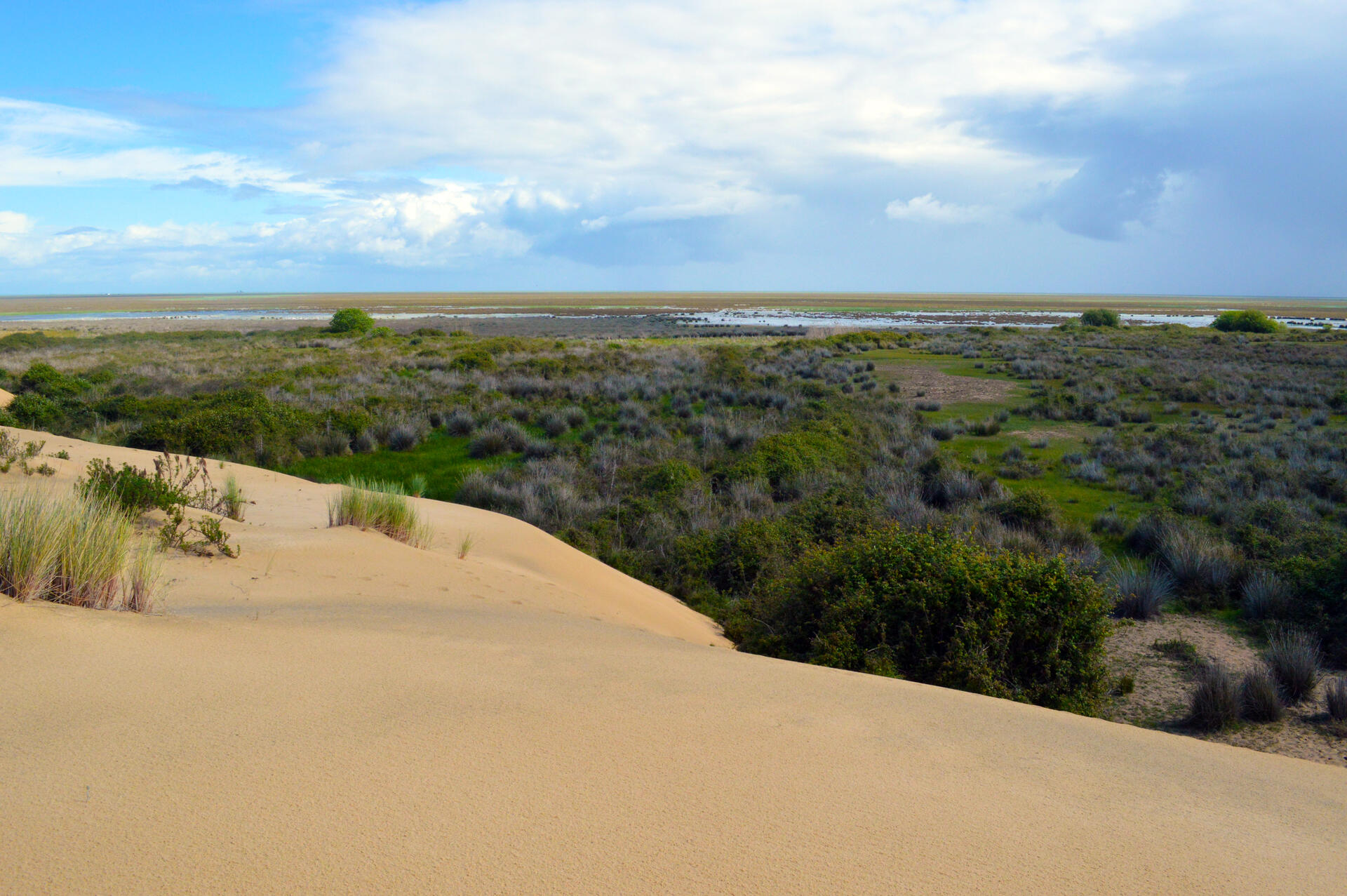
Criterion (vii): Many authors have stressed the exceptional beauty, the solitude offered by its landscapes and the untouched nature of Doñana, and in particular its vast wild expanses which include various types of habitats (marshes, forests, beaches, dunes, lagoons). Its 38 km beach is completely virgin, and its marshes are home to spectacular colonies of nesting birds.
Criterion (ix): The marshes of the Guadalquivir River are an example of geological processes developed during the Pleistocene. Doñana contains the last area of Guadalquivir marshes unaltered by agriculture or urban development. The marshes are the result of the sinking of the Upper Miocene and Lower Pliocene continental plate, which resulted in a depression later filled with fluvial and aeolian deposits. In addition, Doñana has an exceptionally wide range of well-preserved coastal freshwater and swampy ecosystems, where, in addition to the vast expanse of marshes, permanent and, especially, temporary lagoons abound which may appear in particularly rainy years. This heterogeneity of environments makes it one of the most important centres of biodiversity in Europe. Likewise, its various sandy ecosystems dominated by the Mediterranean scrub, with the presence of brushwood and open forests, are very suitable habitats for carnivorous species such as the Iberian Lynx (Lynx pardinus) and large ungulates. In the coastal area, the constant deposition of sandbanks and the generation of very dynamic and active mobile trains of dunes are distinctive. These dune systems are among the largest in continental Europe and clearly show the primary and secondary stages of vegetation succession in the region.
Criterion (x): The Park is home to a great diversity of flora and fauna, in particular an avifauna made up of around 360 nesting and migratory species. It has breeding populations of several globally threatened faunal species such as Marbled Teal (Marmorenetta angustirostris), White-headed Duck (Oxyura leucocephala), Iberian Imperial Eagle (Aquila adlberti) and Iberian Lynx (Lynx pardinus). The flora includes Chicoria hueca (Avellara fistulosa), Onopordun hinojense, Adenocarpus gibssianus, and Rorippa valdes-bermejoi. Doñana and in particular its marshes are recognized as a wetland of international importance for many species of waterfowl, breeding and wintering, and it is a bottleneck on the migratory route between Western Europe and West Africa, with concentrations of about 500,000 wintering birds per year. Mentioning only the best-known kingdoms, more than 1,400 species of flora have been identified, representing 114 families of superior plants, some endemic and new to science. This diversity of species is also reflected in the variety of environments representative of saline, sweet, lentic or lotic aquatic ecosystems, or xerophilic, hydrophilic, dune or forest terrestrial ecosystems. The extraordinary richness of the fauna of Doñana is a direct consequence of the diversity of the mosaic of habitats and ecosystems that it shelters. Birds are probably the best-known group, with some 360 species, but there are also 38 different species of mammals. The Doñana area is considered one of the most important in Spain for reptiles and amphibians, having been classified as an area of exceptional herpetological interest with 42 species. Among the fish communities present, it is worth noting the Apricaphanius baeticus, and the sea lamprey. In Doñana there are also a large number of invertebrate species, terrestrial and aquatic, which include more than 1,200 taxa.
Encyclopedia Record: Doñana National Park
Doñana National Park or Parque Nacional y Natural de Doñana is a natural reserve in Andalusia, southern Spain, in the provinces of Huelva, Cádiz and Seville. It covers 543 km2 (209.65 sq mi), of which 135 km2 (52.12 sq mi) are a protected area. It is named after Doña Ana de Silva y Mendoza, wife of the 7th Duke of Medina Sidonia.Additional Site Details
Area: 54,251.7 hectares
Number of Components: 1
(ix) — Outstanding example representing ecological and biological processes
(x) — Contains most important habitats for biodiversity
Coordinates: 36.9477 , -6.358861
IUCN World Heritage Outlook
The 2025 Conservation Outlook on Doñana National Park reports the following assessment:
Source: International Union for Conservation of Nature (IUCN) · View assessment
Image
© Gabriela Coronado Hernández, CC BY-SA 4.0 Resized from original. (This derivative is under the same CC BY-SA license.)
World Heritage Research
Discover scientific research and academic studies that deepen our understanding of Doñana National Park from its history and significance to its conservation, management, and contemporary challenges.
-
Groundwater overexploitation drives freshwater turtle declines in Doñana National Park
Groundwater overexploitation in Doñana National Park has driven significant declines in freshwater turtle populations over three decades. The Mediterranean pond turtle (Mauremys leprosa) and the European pond turtle (Emys orbicularis) have seen dramatic decreases in abundance—56.9% and 74.1%, respectively—and their distribution has contracted sharply, particularly for E. orbicularis. Both species are now concentrated in a shrinking subset of long-hydroperiod ponds, indicating severe loss of functional habitat at the landscape scale. The study used a snapshot resampling design with standardized fyke nets to survey the park's pond network in 1991–1994 and 2021–2024, quantifying abundance through capture–mark–recapture methods. These findings underscore that legal protection alone is insufficient without addressing basin-scale hydrological pressures. Urgent reductions in groundwater withdrawal, restoration of the pond network, and hydrologically explicit monitoring are necessary to reverse these declines and prevent local extinctions.
de Felipe, M., Colorado-Pedrero, L., Keller, C., Serrano, L., Andreu, A. C., Arribas, R., Ramírez-Soto, M., & Díaz-Paniagua, C. (2026). Groundwater overexploitation drives freshwater turtle declines in Doñana National Park. Biological Conservation, 315, 111730. https://doi.org/10.1016/j.biocon.2026.111730
View Publication Record | Read Publication -
Groundwater/Surface Water Temperature Variations and Hydrogeological Implications in Doñana National Park
A recent study on Doñana National Park reveals significant groundwater and surface water temperature shifts during a dry-warm period (2020–2023), marked by reduced precipitation and rising air temperatures. While shallow piezometers (~15 m depth) showed increased annual mean water temperatures, deep piezometers recorded a decrease in water temperature and reduced variability. A phase shift between groundwater temperature extremes and air temperature variations was also observed, with its magnitude depending on sensor depth. These findings highlight the sensitivity of Doñana's wetlands to global environmental changes and provide insights into aquifer recharge and discharge dynamics at local and regional scales. The research analyzed eight hydrometeorological years (2016–2024) using temperature data from sand-dune ponds and piezometers, offering a comprehensive assessment of flow variability under extreme climatic conditions.
Yanes, J. L., Jiménez-Bonilla, A., Martínez-Caro, M., Fernández-Ayuso, A., & Rodríguez-Rodríguez, M. (2025). Groundwater/Surface Water Temperature Variations and Hydrogeological Implications in Doñana National Park. Environments, 12(3), 83. https://doi.org/10.3390/environments12030083
View Publication Record | Read Publication -
A Semi-Automatic Remote-Sensing-Based System for the Early Detection of Cyanobacterial Blooms: The Case of the Doñana National Park (Spain)
A semi-automatic remote-sensing system demonstrates significant potential for the early detection of cyanobacterial blooms, offering a rapid and efficient tool for monitoring water quality. The study, conducted in Doñana National Park from 2020 to 2023, combines in-situ hyper-spectral measurements with satellite data from Copernicus Sentinel-2, revealing that while satellite observations are more sensitive to general phytoplankton biomass, they provide critical spatial insights for assessing ecosystem health. In-situ hyper-spectral data, however, enable precise detection of cyanobacteria concentrations. The research also introduces an automatic processing chain and user-friendly interface to streamline data exploitation, making it accessible for monitoring teams in national parks.
Martínez-Fornos, G., Talone, M., Cobos, J., Bustamante, J., & Díaz-Delgado, R. (2025). A Semi-Automatic Remote-Sensing-Based System for the Early Detection of Cyanobacterial Blooms: The Case of the Doñana National Park (Spain). Wetlands, 45(6). https://doi.org/10.1007/s13157-025-01962-4
View Publication Record | Read Publication -
Bone weathering in a Mediterranean climate region: An experimental case study from Doñana National Park (Spain)
Bone weathering progresses more slowly in Mediterranean climates, with larger animals exhibiting even slower rates. This study, conducted over six years at Doñana National Park (Spain), found that horse tibias reached only stage 1 weathering, aligning with previous findings on body size effects. Unlike tibias, wild boar skulls showed distinct modifications due to structural differences. The research also characterized local meteorological and soil conditions, contributing to the calibration of weathering scales in Mediterranean contexts—a critical gap given the region's abundant fossil assemblages.
Pizarro-Monzo, M., Domingo, L., Negro, J. J., Cantero, E., Martín-Perea, D. M., & Domingo, M. S. (2025). Bone weathering in a Mediterranean climate region: An experimental case study from Doñana National Park (Spain). PLOS One, 20(10), e0335508. https://doi.org/10.1371/journal.pone.0335508
View Publication Record | Read Publication -
Using Satellite Remote Sensing to Estimate Rangeland Carrying Capacity for Sustainable Management of the Marismeño Horse in Doñana National Park, Spain
A six-year satellite-based study reveals critical seasonal patterns in vegetation productivity and grazing suitability within Doñana National Park, essential for the sustainable management of the endangered Marismeño horse. The research, utilizing Landsat 8 and Sentinel-2 data, identified strong seasonal cycles with peak biomass and nutritive value in spring, followed by sharp declines in summer. Ecotonal zones like La Vera y Sotos served as vital refuges during drought-induced resource shortages, highlighting their importance for the horse's survival. The study demonstrates the reliability of a multi-sensor approach for fine-scale mapping of forage dynamics, offering a scalable tool to support biodiversity conservation and the resilience of Mediterranean rangeland ecosystems under increasing climate variability.
Ramírez-Juidias, E., Díaz de la Serna-Moreno, Á., & Delgado-Pertíñez, M. (2025). Using Satellite Remote Sensing to Estimate Rangeland Carrying Capacity for Sustainable Management of the Marismeño Horse in Doñana National Park, Spain. Animals, 15(24), 3507. https://doi.org/10.3390/ani15243507
View Publication Record | Read Publication -
Groundwater decline has negatively affected the well-preserved amphibian community of Doñana National Park (SW Spain)
Groundwater decline has significantly reduced the amphibian diversity within Doñana National Park, SW Spain. A comparative survey between 2003-2004 and 2021-2022 revealed a decline in the occurrence of all 11 amphibian species present, with only two species (Pelophylax perezi and Hyla meridionalis) still found across more than half of the sampling area. The mean number of species per grid cell dropped from 4.3 to 3.1, indicating a substantial loss in biodiversity. This decline is attributed to groundwater overexploitation outside the park, which has led to shorter hydroperiods and pond desiccation, exacerbated by recent drought conditions. Restoration efforts focusing on reducing groundwater exploitation are critical to preserving Doñana's amphibian community.
Díaz-Paniagua, C., Florencio, M., de Felipe, M., Ramírez-Soto, M., Román, I., & Arribas, R. (2024). Groundwater decline has negatively affected the well-preserved amphibian community of Doñana National Park (SW Spain). Amphibia-Reptilia, 45(2), 205–217. https://doi.org/10.1163/15685381-bja10179
View Publication Record | Read Publication -
Validation of Gross Primary Production Estimated by Remote Sensing for the Ecosystems of Doñana National Park through Improvements in Light Use Efficiency Estimation
A novel approach to estimating gross primary production (GPP) in Doñana National Park, Spain, demonstrates that the inclusion of the Sentinel-2 Land Surface Water Index (LSWI) significantly improves model accuracy compared to traditional light use efficiency (LUE) models. The study, validated with eddy covariance data from two distinct ecosystems—xeric shrubs and seasonal marshes—reveals that water status has a greater influence on GPP than meteorological variables in this water-scarce region. This finding underscores the potential of integrating remote sensing data to enhance carbon assimilation monitoring in heterogeneous landscapes, offering critical insights for global change research.
Gómez-Giráldez, P. J., Cristóbal, J., Nieto, H., García-Díaz, D., & Díaz-Delgado, R. (2024). Validation of Gross Primary Production Estimated by Remote Sensing for the Ecosystems of Doñana National Park through Improvements in Light Use Efficiency Estimation. Remote Sensing, 16(12), 2170. https://doi.org/10.3390/rs16122170
View Publication Record | Read Publication