World Heritage Identification Number: 1560
World Heritage since: 2018
Category: Cultural Heritage
WHE Type: Historic Cities & Urban Areas
Transboundary Heritage: No
Endangered Heritage: No
Country: 🇪🇸 Spain
Continent: Europe
UNESCO World Region: Europe and North America
Map
The Caliphate City of Medina Azahara: A Window into the Golden Age of Al-Andalus
The Caliphate City of Medina Azahara, inscribed as a UNESCO World Heritage Site in 2018, offers a captivating glimpse into the opulence and grandeur of the Western Islamic civilization during the Golden Age of Al-Andalus. Situated on the western outskirts of modern-day Córdoba, Spain, this archaeological marvel stands as a testament to the architectural prowess, cultural richness, and political might of the Umayyad dynasty.
More to come…UNESCO Description of the World Heritage Site
The Caliphate city of Medina Azahara is an archaeological site of a city built in the mid-10th century CE by the Umayyad dynasty as the seat of the Caliphate of Cordoba. After prospering for several years, it was laid to waste during the civil war that put an end to the Caliphate in 1009-1010. The remains of the city were forgotten for almost 1,000 years until their rediscovery in the early 20th century. This complete urban ensemble features infrastructure such as roads, bridges, water systems, buildings, decorative elements and everyday objects. It provides in-depth knowledge of the now vanished Western Islamic civilization of Al-Andalus, at the height of its splendour.
UNESCO Justification of the World Heritage Site
Criterion (iii): The abandoned Caliphate City of Medina Azahara, being a new city planned and built as a state initiative, attests in an exceptional way to the Umayyad cultural and architectural civilization, and more generally to the development of the western Islamic civilization of Al-Andalus.
Criterion (iv): The Caliphate City of Medina Azahara is an outstanding example of urban planning combining architectural and landscape approaches, the technology of urban infrastructure, architecture, decoration and landscape adaptation, illustrating the significant period of the 10th century CE when the Umayyad caliphate of Cordoba was proclaimed in the Islamic West.
Encyclopedia Record: Madinat al-Zahra
Madinat al-Zahra or Medina Azahara was a fortified palace-city on the western outskirts of Córdoba in present-day Spain. Its remains are a major archaeological site today. The city was built in the 10th century by Abd ar-Rahman III (912–961), a member of the Umayyad dynasty and the first caliph of Al-Andalus. It served as the capital of the Caliphate of Córdoba and its center of government.Additional Site Details
Area: 111 hectares
Number of Components: 1
(iv) — Outstanding example of a type of building or landscape
Coordinates: 37.8858888889 , -4.8676944444
Image
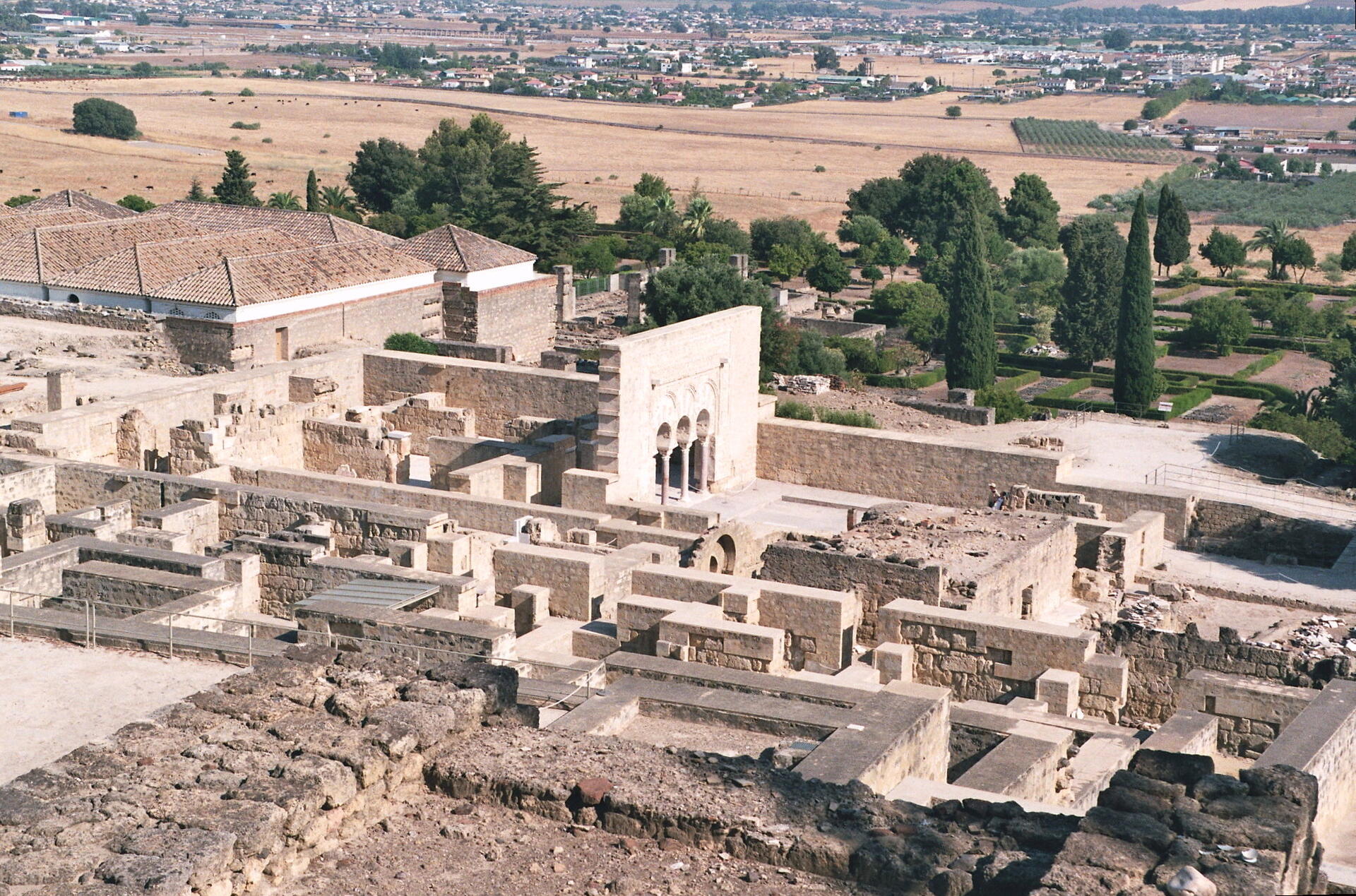
© Rabe!, CC BY-SA 4.0 Resized from original. (This derivative is under the same CC BY-SA license.)
World Heritage Research
Discover scientific research and academic studies that deepen our understanding of Caliphate City of Medina Azahara from its history and significance to its conservation, management, and contemporary challenges.
-
Endnotes: Islamic Architecture through Western Eyes: Palaces around the Mediterranean. Volume 3
A comprehensive analysis of Islamic palatial architecture around the Mediterranean, from Algiers to Baghdad, reveals that many grand structures—particularly those dating from the 17th to 19th centuries—were shaped by Western perceptions and influences. The study focuses on civil architecture, excluding religious sites, and highlights how these palaces in cities like Medina Azahara (Madinat al-Zahra) reflect a blend of local traditions and external aesthetic trends. By examining textual and visual sources, the research offers new insights into the interplay between Islamic architectural innovation and Western artistic sensibilities during this period.
Greenhalgh, M. (2026). Endnotes: Islamic Architecture through Western Eyes: Palaces around the Mediterranean. Volume 3. Brill Online. https://doi.org/10.6084/M9.FIGSHARE.31406853
View Publication Record | Read Publication -
The Structure of the Muslim Town and Town Planning
A comprehensive analysis reveals that Muslim towns, particularly those in Morocco and al-Andalus, were often planned settlements with structured layouts, challenging the notion of their being entirely unplanned. The study focuses on newly established towns such as Sijilmasa, Madinat al-Zahra (Medina Azahara), Madinat al Fath, Rabat, and Fez Jedid, providing detailed insights into their urban planning and architectural organization. By examining Jewish neighborhoods and other planned settlements, the research highlights the deliberate design principles that shaped Muslim towns, offering a nuanced understanding of their spatial development.
Hass-Klau, C. (2025). The Structure of the Muslim Town and Town Planning. The History of Urban Planning in Spain, Portugal and Morocco, 56–76. https://doi.org/10.4324/9781003440093-4
View Publication Record | Read Publication -
Aesthetic of appropriation
This study reveals how Christian Iberian rulers employed Umayyad spolia—such as basins and capitals—as a strategic visual tool to assert legitimacy, memory, and identity. By analyzing the reuse of these elements in buildings like San Isidoro de León and churches across Jaca, Valencia, Santander, and Tarragona (12th–13th centuries), it demonstrates that Christian territories adapted an 'Umayyad aesthetic of appropriation,' creating a shared visual language. The research adopts a comparative, interdisciplinary approach, tracing this phenomenon from Umayyad al-Andalus to later Taifa, Almoravid, Almohad, and Christian kingdoms, highlighting its continuity and cultural significance.
Ocón, J. E. (2024). Aesthetic of appropriation. The Visual Culture of Al-Andalus in the Christian Kingdoms of Iberia, 81–100. https://doi.org/10.4324/9781003489047-6
View Publication Record | Read Publication -
The Visual Culture of al-Andalus in the Christian Kingdoms of Iberia
A comparative and interdisciplinary analysis reveals that the reuse of antique spolia, particularly in Umayyad al-Andalus—evident in landmarks like the Mosque of Córdoba and Madinat al-Zahra—established a distinct visual culture that was later adopted by Christian kingdoms in Iberia. This transfer and adaptation, observed in churches such as Santa Cristina de Lena and San Miguel de Escalada during the 9th–10th centuries, persisted through subsequent Islamic dynasties (Taifa, Almoravid, Almohad) and Christian rulers of León, Castile, and Aragon. The study highlights how these strategies, exemplified by the reuse of Umayyad basins and capitals in sites like San Isidoro de León and the Monastery of Las Huelgas, contributed to a shared visual language, reinforcing legitimacy, memory, and identity across medieval Iberia.
Monteira, I. (2024). The Visual Culture of al-Andalus in the Christian Kingdoms of Iberia (, Ed.). Routledge. https://doi.org/10.4324/9781003489047
View Publication Record | Read Publication -
Cordoba Menjadi Saksi Masa Kejayaan Peradaban Islam
Cordoba emerged as the pinnacle of Islamic civilization during its golden age, surpassing contemporaries like Baghdad and Cairo in intellectual, architectural, and economic achievements. This study reveals Cordoba's unparalleled advancements under Islamic rule, including a renowned university, one of the world's largest mosques at the time (the Great Mosque of Cordoba), and Europe's longest bridge, which facilitated social and economic activities. The research also highlights the city's cultural assimilation, blending Spanish and Berber traditions with Islamic influences, while its thriving economy sustained this prosperity for over seven centuries. Conducted as a literature-based study, it synthesizes historical sources to demonstrate how Cordoba became a beacon of learning, science, and art, leaving a lasting legacy on European development.
Ghoni, A., & Roza, E. (2024). CORDOBA MENJADI SAKSI MASA KEJAYAAN PERADABAN ISLAM. Tajdid: Jurnal Pemikiran Keislaman Dan Kemanusiaan, 8(2), 59–71. https://doi.org/10.52266/tadjid.v8i2.3101
View Publication Record | Read Publication -
Spolia and Umayyad Mosques
A striking absence of Roman and Late-antique spolia in the construction of the Umayyad mosque at Madinat al-Zahra' contrasts with their widespread use in other Umayyad mosques, such as Córdoba's Friday Mosque. While spolia were typically employed for aesthetic, religious, ideological, or political reasons, the capitals designed for Madinat al-Zahra's prayer room exhibit unique characteristics resembling Visigothic models and suggest a rushed production process. This study synthesizes existing research on Umayyad mosque construction using spolia and proposes new interpretations for these distinctive capitals, offering insights into their cultural and historical significance.
González Gutiérrez, C. (2022). Spolia and Umayyad Mosques. Journal of Islamic Archaeology, 9(1), 83–104. https://doi.org/10.1558/jia.23646
View Publication Record | Read Publication -
Algo más sobre marfiles de Madinat al-Zahra
A detailed analysis of the plant-based decorative elements on ivory sculptures from the workshop of Madinat al-Zahra reveals the intricate craftsmanship and botanical richness characteristic of Cordoban art. The study, conducted by Chr. Ewerts, meticulously dissected these elements to uncover their symbolic and aesthetic significance, providing new insights into the artistic techniques and cultural influences of the Caliphate City of Medina Azahara.
Valdés Fernández, F. (2020). Algo más sobre marfiles de Madinat al-Zahra. Madrider Mitteilungen, 54 (2013). https://doi.org/10.34780/MM.V54I0.1015
View Publication Record | Read Publication