World Heritage Identification Number: 37
World Heritage since: 1979
Category: Cultural Heritage
WHE Type: Archaeological Sites
Transboundary Heritage: No
Endangered Heritage: No
Country: 🇹🇳 Tunisia
Continent: Africa
UNESCO World Region: Arab States
Map
The Archaeological Site of Carthage: A Testimony to Ancient Civilization and Empire
The Archaeological Site of Carthage, located in modern-day Tunisia, stands as a significant remnant of one of the most powerful civilizations and empires of antiquity. This World Heritage Site, inscribed by UNESCO in 1979, offers a captivating glimpse into the rich history, culture, and influence of Carthage that once dominated much of the Mediterranean region.
Founded around the 9th century BC, Carthage was initially a Phoenician colony established on the Gulf of Tunis. Over time, it evolved into a major maritime and commercial power, developing extensive trade networks across the western and central Mediterranean. These connections reached regions such as Spain, Sicily, Sardinia, Malta, North Africa, and southern Italy, facilitating the exchange of goods including grain, wine, olive oil, metals, and textiles.
Carthage’s strategic coastal location enabled it to become one of the most important commercial hubs of the ancient world. A pinnacle of Carthage’s engineering was its cothon, or military and commercial harbors. These unique, circular ports were an architectural marvel of the Punic era, capable of sheltering hundreds of vessels and symbolizing the city's naval supremacy.
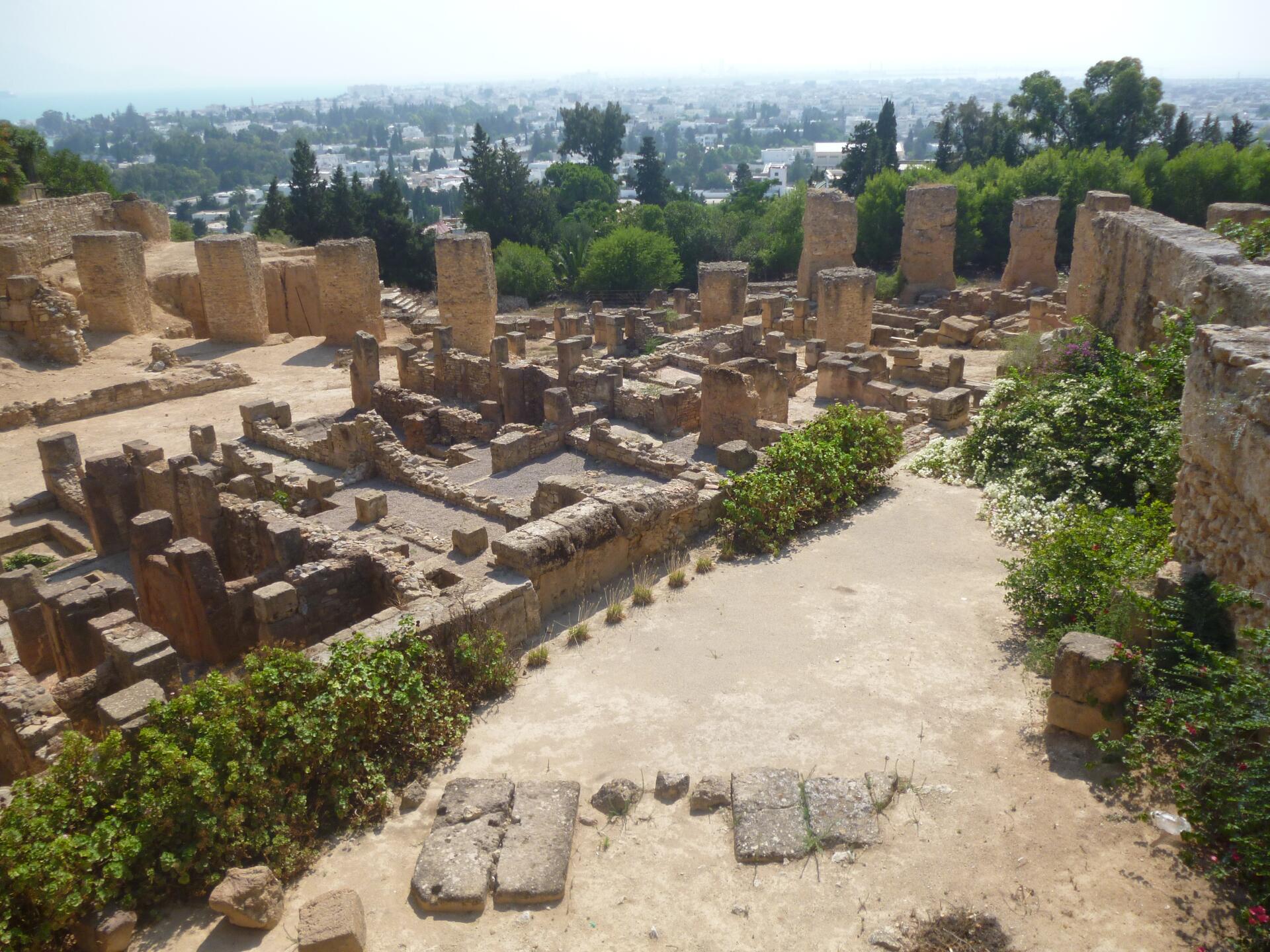
Carthage's prosperity extended beyond trade, as it also cultivated a brilliant civilization marked by impressive architectural achievements, advanced urban planning, and innovative cultural practices. Archaeological remains such as the Byrsa Hill acropolis, the Punic necropoleis, and the Tophet attest to the city’s Phoenician-Punic heritage. Following the Roman conquest, new structures—including forums, theaters, and bath complexes—were added, transforming Carthage into a monumental Roman city while preserving traces of its earlier identity.
In the late 3rd century BC, Carthage found itself at odds with Rome, leading to the infamous Punic Wars. Despite brilliant tactical victories under the legendary general Hannibal, Carthage was ultimately defeated and deliberately destroyed by Roman forces in 146 BC, marking the end of its independent existence. The site, however, did not lose its importance; it was later rebuilt by the Romans and became the capital of the prosperous province of Africa Proconsularis.
Under Roman rule, Carthage flourished once again, emerging as one of the largest and wealthiest cities of the western empire. Impressive structures such as the Antonine Baths, aqueducts, and civic buildings date from this period. The city declined after the Vandal conquest in the 5th century AD and later passed into Byzantine and then Arab hands. Over time, its political and urban significance faded, though its ruins remained a powerful symbol of past grandeur.
Today, the Archaeological Site of Carthage serves as a testament to the remarkable history and legacy of Carthage. Visitors can explore major landmarks such as Byrsa Hill, the Tophet, and the Antonine Baths, along with museums that display artifacts uncovered through decades of excavation. Together, these remains provide valuable insight into the social, religious, and political life of one of antiquity’s most influential cities.
In summary, the Archaeological Site of Carthage represents a vital link to one of antiquity’s most influential powers. Its rich heritage, spanning over a millennium, continues to captivate scholars, historians, and tourists alike, offering a unique window into the past and a lasting reminder of the indelible impact Carthage had on the world.
UNESCO Description of the World Heritage Site
Carthage was founded in the 9th century B.C. on the Gulf of Tunis. From the 6th century onwards, it developed into a great trading empire covering much of the Mediterranean and was home to a brilliant civilization. In the course of the long Punic wars, Carthage occupied territories belonging to Rome, which finally destroyed its rival in 146 B.C. A second – Roman – Carthage was then established on the ruins of the first.
UNESCO Justification of the World Heritage Site
Criterion (ii): Phoenician foundation linked to Tyre and Roman refoundation on the orders of Julius Cesar, Carthage was also the capital of a Vandal kingdom and the Byzantine province of Africa. Its antique ports bear witness to commercial and cultural exchanges over more than ten centuries. The tophet, sacred place dedicated to Baal, contains numerous stelae where numerous cultural influences are in evidence. Outstanding place of blossoming and diffusion of several cultures that succeeded one another (Phoenico-Punic, Roman, Paleochristian and Arab); Carthage has exercised considerable influence on the development of the arts, architecture and town planning in the Mediterranean.
Criterion (iii): The site of Carthage bears exceptional testimony to the Phoenico-Punic civilization being at the time the central hub in the western basin of the Mediterranean. It was also one of the most brilliant centres of Afro-Roman civilization.
Criterion (vi): The historic and literary renown of Carthage has always nourished the universal imagination. The site of Carthage is notably associated with the home of the legendary princess of Tyre, Elyssa-Dido, founder of the town, sung about by Virgil in the Aeneid; with the great navigator-explorer, Hannon, with Hannibal, one of the greatest military strategists of history, with writers such as Apulée, founder of Latin-African literature, with the martyr of Saint Cyprien and with Saint Augustin who trained and made several visits there.
Encyclopedia Record: Archaeological site of Carthage
The Archaeological Site of Carthage is a site dispersed in the current city of Carthage (Tunisia) and classified as part of the World Heritage by UNESCO since 1979.Additional Site Details
Area: 498.08 hectares
Number of Components: 13
(iii) — Unique or exceptional testimony to a cultural tradition
(vi) — Directly associated with events or living traditions
Coordinates: 36.85278 , 10.32333
Image
©
World Heritage Research
Discover scientific research and academic studies that deepen our understanding of Archaeological Site of Carthage from its history and significance to its conservation, management, and contemporary challenges.
-
Carthage
The archaeological site of Carthage, once a dominant Mediterranean power, has been rediscovered through centuries of exploration and excavation. This book highlights how the site's remnants were gradually uncovered, often controversially, bringing its legendary past back into public consciousness. From the first identification of Punic artifacts to the systematic excavations that followed, the narrative traces the efforts of antiquarians, travelers, and scientists who pieced together Carthage's history. The process revealed a city founded by Queen Dido, destroyed in wars with Rome, and later reborn as a Roman and Christian center. However, the exploration also involved the plunder of artifacts for European museums, raising ethical questions about the preservation and representation of heritage.
Bingham, S., Gillings, M., Baird, J. A., Symonds, M., Whitley, J., Cooley, A. E., Pearson, M. P., Leighton, R., Sweeney, N. M., Crawford, H., MacDonald, E., & Pollard, J. (2024). Carthage (, Ed.). Bloomsbury Publishing Plc. https://doi.org/10.5040/9781350380271
View Publication Record | Read Publication -
Staging Archaeology: Empire as Reality Effect at the 1906–07fêtes de Carthage
The 1906–07 fêtes de Carthage, staged at the recently excavated Roman theatre of Carthage, revealed archaeology's dual role as both a nostalgic celebration and a historicist tool during French colonization in Tunisia. These elaborate pageants, involving hundreds of actors and sumptuous period costumes, drew on archaeological findings to depict French colonizers as preservers of ancient culture while consigning colonial violence to the realm of performance. The 1907 pageant featured two specially commissioned plays, including one that juxtaposed a modern poet with a Carthaginian priestess at her excavated tomb site. This study demonstrates how archaeology, as an emerging science, helped police the boundary between past and present, serving a historicist sense of time that legitimized colonial narratives through the 'reality effect'—a technique that made staged performances appear authentic.
Sherman, D. J. (2021). Staging Archaeology: Empire as Reality Effect at the 1906–07fêtes de Carthage. Classical Receptions Journal, 13(3), 336–367. https://doi.org/10.1093/crj/claa024
View Publication Record | Read Publication -
An Archaeological History of Carthaginian Imperialism
Archaeological evidence challenges traditional Greco-Roman narratives of Carthaginian imperialism, revealing that the 6th–4th century BCE Carthaginian Empire differed significantly from its portrayal in ancient sources. By prioritizing archaeological and epigraphic records over textual accounts, this study demonstrates that Carthage's expansion mirrored patterns seen in Athenian and Roman empires—through colonization, political integration of dependencies, and trade network centralization. Contrary to prior interpretations linking destruction layers in Sardinia to 6th-century military campaigns, the research argues that Carthaginian imperial manifestations closely resemble those of other ancient empires, suggesting a more nuanced and structured system than previously assumed.
Pilkington, Nathan Laughlin. (2013). An Archaeological History of Carthaginian Imperialism. Columbia University. https://doi.org/10.7916/D80G3SCF
View Publication Record | Read Publication