
World Heritage Identification Number: 1769
World Heritage since: 2026
Category: Cultural Heritage
WHE Type: Buildings & Architectural Ensembles
Transboundary Heritage: No
Endangered Heritage: No
Country: 🇹🇳 Tunisia
Continent: Africa
UNESCO World Region: Arab States
Map
A Spiritual Haven: The Enchanting Village of Sidi Bou Saïd
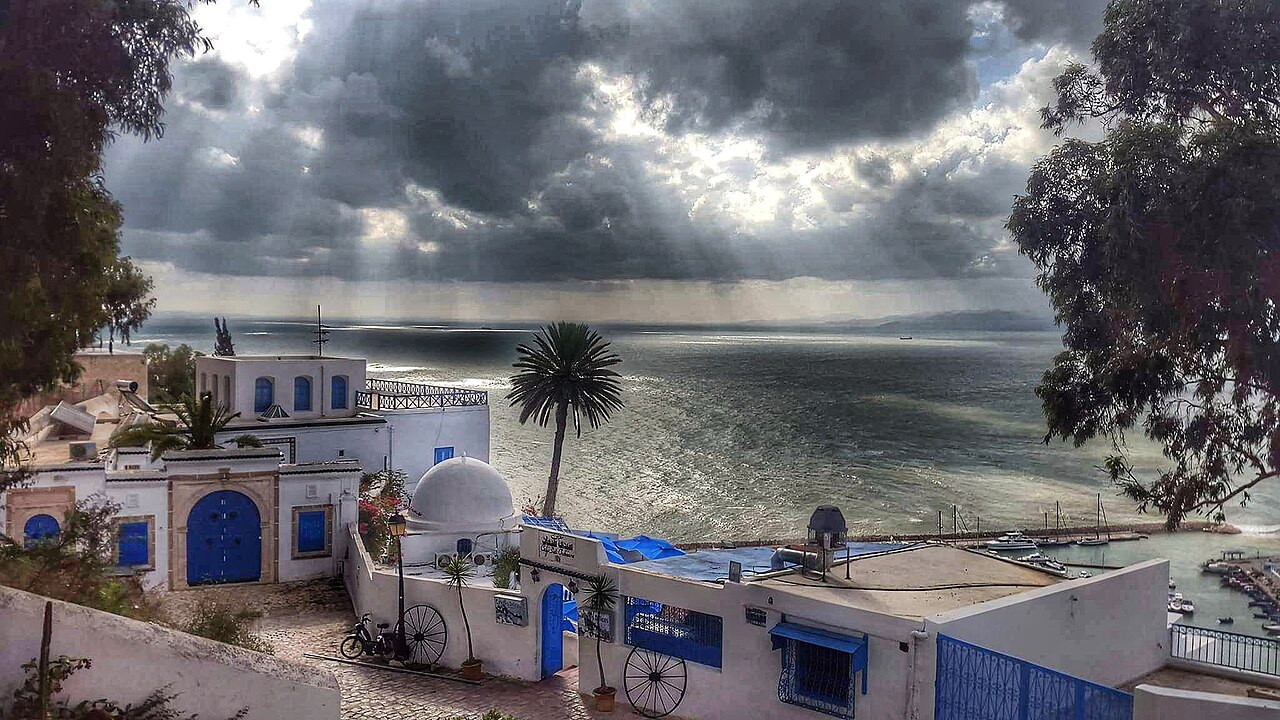
The Village of Sidi Bou Saïd, nestled along the Mediterranean coast of Tunisia, stands as a captivating testament to the harmonious fusion of geomorphology, architecture, and spirituality. Inscribed as a UNESCO World Heritage Site in 2026, this picturesque settlement offers a unique blend of cultural heritage, natural beauty, and mystical allure.
More to come…UNESCO Description of the World Heritage Site
The property is a picturesque village perched on a promontory overlooking the Mediterranean Sea, harmoniously integrated into the cliff topography. It developed around the tomb of a Sufi master and saint, known as Sidi Bou Saïd, who lived in the 12th-13th centuries. Through its architectural fabric and urban planning in symbiosis with the natural environment, its recognisable aesthetic created by emblematic colours, and a mystic aura associated with the Sufi spirituality that permeates the site, the property brings together geomorphology, architecture, and spirituality. It has long inspired artists and continues to attract visitors seeking spiritual serenity.UNESCO Justification of the World Heritage Site
Criterion (iii): The Village of Sidi Bou Saïd represents an exceptional testimony to the tradition of village foundations based on a symbiotic relationship formed between the spiritual authority of a saint and the temporal power of a ruling dynasty. It exemplifies in an exceptional way the phenomenon of sanctuary-villages, fundamental to the social and political history of the Maghreb, that developed as a result of a saint’s prestige which provided religious legitimacy to the sovereign, and the sovereign’s patronage which, in return, ensured the perpetuation and prosperity of the saint's sanctuary and village.
Encyclopedia Record: Sidi Bou Said
Sidi Bou Saïd is a town in northern Tunisia, located about 20 km northeast of the capital, Tunis.Additional Site Details
Area: 76.54 hectares
Number of Components: 1
Coordinates: 36.871028 , 10.348639
World Heritage Research
Discover scientific research and academic studies that deepen our understanding of Village of Sidi Bou Saïd from its history and significance to its conservation, management, and contemporary challenges.
-
A Quantitative and Qualitative Experimental Framework for the Evaluation of Urban Soundscapes: Application to the City of Sidi Bou Saïd
A novel experimental framework combining 3D acoustic and psycho-acoustic sensors, ambisonics, and sound morphological analysis offers a comprehensive approach to evaluating urban soundscapes. This method, applied to the historic center of Sidi Bou Saïd in Tunisia, reveals significant discrepancies between measured acoustic data and human perception, as captured through questionnaires. The framework provides a holistic understanding of soundscape environments, bridging quantitative measurements with qualitative evaluations. It introduces an additional dimension to urban planning studies by offering insights into how soundscapes are perceived, highlighting the importance of integrating perceptual data into spatial design.
Hammami, M. A., & Claramunt, C. (2024). A Quantitative and Qualitative Experimental Framework for the Evaluation of Urban Soundscapes: Application to the City of Sidi Bou Saïd. ISPRS International Journal of Geo-Information, 13(5), 152. https://doi.org/10.3390/ijgi13050152
View Publication Record | Read Publication -
La cage Sidi Bou Saïd, symbole culturel et identitaire
The traditional 'cage de Sidi Bou Saïd' emerges as a powerful cultural and identity symbol, blending art, history, and Mediterranean heritage. This study reveals its role as a locus of memory, where local and regional influences converge to shape collective identity. Through ethnographic fieldwork, historical analysis, and anthropological insights, the research dissects the craftsmanship, materials, and tools used in its creation while highlighting its semantic richness. The cage, mimicking architectural and artisanal traditions, serves as a tangible representation of cultural diversity, bridging Mediterranean and local narratives. This work advances understanding of how such artifacts function in identity formation, offering a nuanced perspective on intangible heritage preservation.
Ben Barka, I. (2024). La cage Sidi Bou Saïd, symbole culturel et identitaire. Socio-Anthropologie, 49, 227–243. https://doi.org/10.4000/11yyj
View Publication Record | Read Publication -
Caractérisation granulométrique et minéralogique des sédiments de surface de la frange littorale Sidi Bou Said - La Goulette
A detailed analysis of surface sediments along the coastal zone between Sidi Bou Saïd and La Goulette reveals distinct granulometric and mineralogical patterns. Fine sands dominate shallow areas (-2 to -10 m), while the beach top transitions from average sands near Sidi Bou Saïd to finer sands toward La Goulette, indicating a spatial sorting of sediments influenced by transverse currents. Mineralogical analysis shows quartz as the predominant component, with lesser amounts of calcite and dolomite, and clay minerals including kaolinite, smectite, and illite. This study highlights the dynamic sediment distribution shaped by coastal currents, providing insights into the geomorphological processes affecting this UNESCO World Heritage Site.
SAIDI, H., BRAHIM, M., & GUEDDARI, M. (2004). Caractérisation granulométrique et minéralogique des sédiments de surface de la frange littorale Sidi Bou Said - La Goulette. INSTM Bulletin : Marine and Freshwater Sciences, 31(INSTM Bulletin : Marine and Freshwater Sciences, Vol. 31 (2004), 97–106. https://doi.org/10.71754/INSTM.BULLETIN.V31.771
View Publication Record | Read Publication -
L'architecture des maisons de villégiature tunisiennes : Entre vision de la mer et la dar comme référence. Les exemples de Tunis et de Hammamet (1900-1980)
A study of Tunisian seaside villas (1900–1980) reveals three distinct architectural models shaped by Western and local influences. The 'arabizing' model (pre-1930) emphasized expressive traditional motifs, while the 'abstract' model (interwar period) stripped down forms, blending vernacular architecture with natural harmony—a shift from rejection to modernized adaptation of Arab-Muslim design. The 'modernized' model (post-1945) integrated contemporary strategies with tempered references to traditional Tunisian elements, often through stylized motifs. These models emerged as European elites and later Tunisians adapted coastal living, creating a hybrid architecture that balances tradition, modernity, and environmental sensitivity. The research analyzes 80 villas in Tunis and Hammamet, offering a framework for understanding this evolving patrimonial heritage.
Hlel, M. L’architecture des maisons de villégiature tunisiennes : Entre vision de la mer et la dar comme référence. Les exemples de Tunis et de Hammamet (1900-1980). https://doi.org/10.70675/5bd651bfz6c7dz4a95z90c1zfc73cf7c7d80
View Publication Record | Read Publication -
Vers une méthodologie duale de qualification et de perception de paysages sonores : expérimentation dans le contexte urbain de Sidi Bou Saïd
A dual methodology combining quantitative and qualitative approaches effectively qualifies the soundscapes of urban environments, as demonstrated by experiments in Sidi Bou Saïd. This approach integrates multidimensional acoustic measurements, psychoacoustic analyses, and immersive 3D assessments with socio-acoustic evaluations involving human practitioners. The study highlights the feasibility and value of this dual method, bridging measured data with perceived realities to enrich soundscapes analysis. Findings offer new perspectives for urban planners, policymakers, and practitioners in preserving and enhancing urban acoustic environments.
Hammami, M. A. Vers une méthodologie duale de qualification et de perception de paysages sonores : expérimentation dans le contexte urbain de Sidi Bou Saïd. https://doi.org/10.70675/d2ef5d0czef21z4658z95c0z1fe0ceed4d20
View Publication Record | Read Publication -
An acoustic and psycho-acoustic experimental setup for analysing urban soundscapes
A novel psycho-acoustic experimental setup demonstrates the feasibility of analyzing and visualizing urban soundscapes in real-world environments, offering insights into biological, geophysical, and anthropogenic sounds. The approach integrates acoustic measurements with ambisonic recordings using multiple sensors, providing a comprehensive framework for interpreting complex soundscapes. Conducted in Sidi Bou Saïd, Tunisiathe study highlights the potential of this method to enhance our understanding of urban acoustics and its implications for heritage conservation.
Hammami, M. A., & Claramunt, C. (2021). An acoustic and psycho-acoustic experimental setup for analysing urban soundscapes. Proceedings of the 29th International Conference on Advances in Geographic Information Systems, 103–106. https://doi.org/10.1145/3474717.3483916
View Publication Record | Read Publication -
Vers une approche psychoacoustique et qualitative des paysages sonores de la commune de Sidi Bou Saïd
A novel psychoacoustical and qualitative approach to assessing urban soundscapes has been successfully demonstrated in the UNESCO World Heritage Site of Sidi Bou Saïd. This study highlights the feasibility of combining quantitative acoustic measurements with subjective perceptions from local stakeholders, revealing that such an integrated method can effectively capture the complexity of sound environments in dense urban settings. The findings underscore the importance of blending objective data with qualitative insights to fully understand and preserve the auditory character of heritage landscapes.
Amin Hammami, M., & Claramunt, C. (2020). Vers une approche psychoacoustique et qualitative des paysages sonores de la commune de Sidi Bou Saïd. Revue Internationale de Géomatique, 30(3-4), 215–243. https://doi.org/10.3166/rig.2021.00113
View Publication Record | Read Publication
