World Heritage Identification Number: 750
World Heritage since: 1996
Category: Cultural Heritage
WHE Type: Archaeological Sites
Transboundary Heritage: No
Endangered Heritage: No
Country: 🇲🇷 Mauritania
Continent: Africa
UNESCO World Region: Arab States
Map
Ancient Ksour of Ouadane, Chinguetti, Tichitt, and Oualata: A Testament to Islamic Culture in Western Sahara
The Ancient Ksour of Ouadane, Chinguetti, Tichitt, and Oualata are a group of four historic settlements located in the Sahara Desert region of present-day Mauritania. These ksour (plural for ksar) were established during the 11th and 12th centuries to cater to the needs of the caravan trade routes traversing the desert. In 1996, they were collectively inscribed as a UNESCO World Heritage Site, acknowledging their significance as repositories of Islamic culture and traditional architecture in the western Sahara.
More to come…UNESCO Description of the World Heritage Site
Founded in the 11th and 12th centuries to serve the caravans crossing the Sahara, these trading and religious centres became focal points of Islamic culture. They have managed to preserve an urban fabric that evolved between the 12th and 16th centuries. Typically, houses with patios crowd along narrow streets around a mosque with a square minaret. They illustrate a traditional way of life centred on the nomadic culture of the people of the western Sahara.
UNESCO Justification of the World Heritage Site
Criterion (iii): The Ksour bear unique witness to a nomadic culture and trade in a desert environment. Their roots go back to the Middle Ages. Established in a desert environment bordering the Maghreb and the large ensembles of the «bilad es-sudan», they were prosperous centres from which radiated an intense religious and cultural life.
Criterion (iv): The ancient ksour are medieval towns with an outstanding example of the type of architectural ensembles illustrating seven centuries of human history. They contain an original and decorative stone architecture, and present a typical model of habitat of Saharan ksour, particularly well integrated to the environment. Their urban fabric is dense and closely-packed; with narrow and twisting lanes running between the blank outer walls of courtyard houses.
Criterion (v): These living historic towns are an outstanding example of traditional human settlements and the last surviving evidence of an original and traditional mode of occupying space, very representative of the nomadic culture and long-distance trade in a desert environment. Due to these particular characteristics, warehouses were built to safeguard their goods, and the towns evolved to become the brilliant homes of Islamic culture and thought.
Encyclopedia Record: Ancient Ksour of Ouadane, Chinguetti, Tichitt and Oualata
The ancient ksour of Ouadane, Chinguetti, Tichitt and Oualata in Mauritania were inscribed on the UNESCO World Heritage List in 1996.Additional Site Details
Area: Not available
Number of Components: 4
(iv) — Outstanding example of a type of building or landscape
(v) — Outstanding example of traditional human settlement
Coordinates: 20.92889 , -11.62361
Image
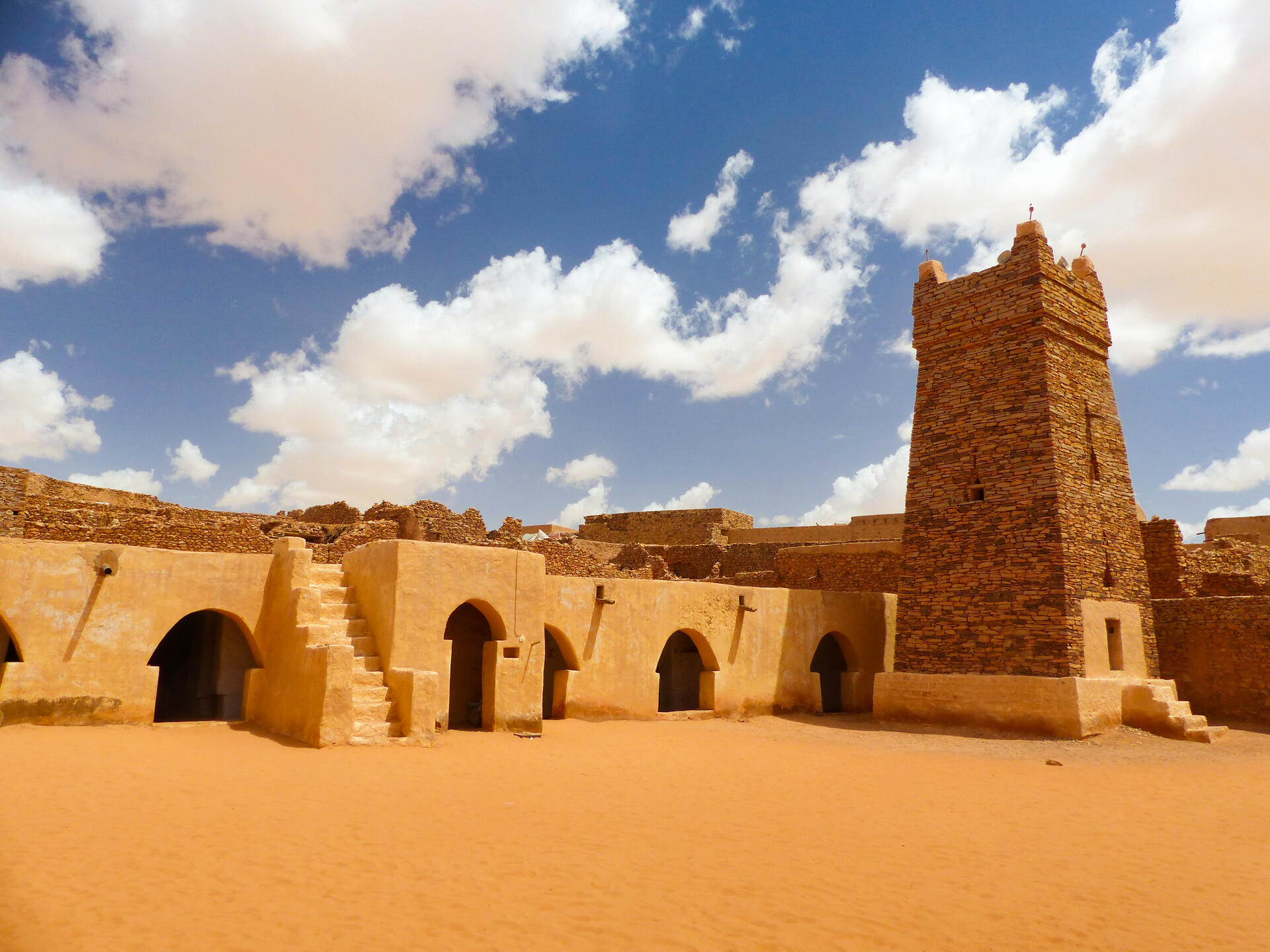
© Mohamed Natti, CC BY-SA 4.0 Resized from original. (This derivative is under the same CC BY-SA license.)
World Heritage Research
Discover scientific research and academic studies that deepen our understanding of Ancient Ksour of Ouadane, Chinguetti, Tichitt and Oualata from its history and significance to its conservation, management, and contemporary challenges.
-
Cultures villageoises du sud-est mauritanien : Néolithique récent de Tichitt (4200/2500 B.P.) et post-néolithique
A recent study sheds light on the enigmatic Tichitt Neolithic Culture (CNT) in southeastern Mauritania, revealing its unique village structure and societal organization. The research confirms that the CNT emerged around 4200 B.P., coinciding with a prolonged arid phase that drove populations southward from uncertain origins. While the culture's general chronology and lifestyle are well-documented, this study addresses gaps in understanding its later phases, including shifts in population centers towards the Tagant region and the southern Sahara, where favorable climates sustained prosperity. It also explores the roles of agriculture, metallurgy, and trade, particularly with the Niger Inner Delta, as well as the influence of Berber migrations from the north during the late Neolithic period. The study employs a combination of archaeological evidence, chronological analysis, and environmental reconstructions to unravel the complexities of this vast cultural ensemble.
Vernet, R. (2026). Cultures villageoises du sud-est mauritanien : Néolithique récent de Tichitt (4200/2500 B.P.) et post-néolithique. Ikosim, n° 12(1), 7–33. https://doi.org/10.3917/ikos.012.0007
View Publication Record | Read Publication -
Revisiting Tichitt: new dates and data from the 1968 excavations by Patrick Munson
New radiocarbon dating and pottery analysis of Patrick Munson's 1968 excavations at Dhar Tichitt, Mauritania, reveal significant gaps in the chronological understanding of the Tichitt Tradition. The study provides 14 AMS dates on charcoal samples, offering greater precision than previous conventional radiocarbon dates and shedding light on the growth, functioning, and interactions among settlements attributed to this tradition. Petrographic and organic residue analysis of excavated pottery adds previously unavailable descriptive details, including time-sensitive changes that were only briefly mentioned in Munson's dissertation. These findings challenge existing interpretive frameworks and open new avenues for understanding the dynamics of West African village development after 2000 BC.
McIntosh, S. K., Casanova, E., & Gauthier, C. (2026). Revisiting Tichitt: new dates and data from the 1968 excavations by Patrick Munson. Azania: Archaeological Research in Africa, 61(3), 402–443. https://doi.org/10.1080/0067270x.2026.2630538
View Publication Record | Read Publication -
Conceptual Framework for CO2 Geological Storage in Salt Diapirsof the Abandoned Chinguetti Field, Mauritanian Coastal Basin
A robust offshore CO2 storage solution emerges from the abandoned Chinguetti Field, part of Mauritania's UNESCO-listed Ksour of Ouadane, Chinguetti, Tichitt, and Oualata. The study reveals that salt diapirs in this field can securely store over 2.5 gigatons of CO2, leveraging their ultra-low permeability and high ductility for long-term containment. Geomechanical analysis confirms safe injection below fracture pressure thresholds, minimizing leakage risks. Reusing existing wells further enhances cost-efficiency and operational control. This approach offers a scalable, technically viable method to mitigate CO2 emissions from Mauritania's energy sector, which contributed nearly one-third of the country's 13.96 million tons of CO2-equivalent emissions in 2024.
Dahmane, B., Aliouane, L., & Rigane, A. (2026). Conceptual Framework for CO2 Geological Storage in Salt Diapirsof the Abandoned Chinguetti Field, Mauritanian Coastal Basin. First EAGE/ALNAFT Workshop – Unlocking Hydrocarbon Potential of West Mediterranean Offshore Frontier Basin of Algeria, 1–5. https://doi.org/10.3997/2214-4609.2026651037
View Publication Record | Read Publication -
Results of Preparatory Surveys on the Tagant Escarpment, Mauritania
A recent survey of the Tagant escarpment in southeastern Mauritania reveals a rich archaeological landscape with numerous stone-built settlements and funerary sites, many yet to be documented. The findings suggest continuity with the nearby Tichitt complex from the Ceramic Late Stone Age, though the region remains understudied despite earlier remote sensing efforts. This preparatory work lays critical groundwork for future research, addressing long-standing gaps in our understanding of this UNESCO-listed area's cultural significance.
Gestrich, N., & Schulze, M. (2025). Results of Preparatory Surveys on the Tagant Escarpment, Mauritania. African Archaeological Review, 42(4), 783–807. https://doi.org/10.1007/s10437-025-09647-3
View Publication Record | Read Publication -
Memory, agency, and labor mobilization in the monumental funerary landscapes of southeastern Mauritania, West Africa
A novel analysis of funerary landscapes in southeastern Mauritania reveals that the spatial distribution and size variability of conical tumulus cairns reflect complex socio-economic dynamics, including labor mobilization and cultural attitudes toward ancestor memorialization. The study introduces a size-based classification system for these monuments, applicable across prehistoric Saharan archaeology, and applies Gini coefficients to quantify monument size inequality within three previously undocumented tumulus fields in the western Tagant Plateau. This approach provides new insights into the social energetics of remembrance, linking material culture to political agency and network obligations.
Linares Matás, G. J. (2023). Memory, agency, and labor mobilization in the monumental funerary landscapes of southeastern Mauritania, West Africa. Journal of Anthropological Archaeology, 70, 101488. https://doi.org/10.1016/j.jaa.2023.101488
View Publication Record | Read Publication -
The Tichitt Culture and the Malian Lakes Region
Researchers have identified approximately 300 stone-walled sites in the Malian Lakes Region, tentatively linking them to the Tichitt culture of the Ceramic Late Stone Age. These sites, varying in size and complexity, are located around sandstone massifs and represent a significant addition to the understanding of this culture's spatial distribution. While no dating or material culture is currently available, the study highlights these features as a priority for future research, potentially shedding light on the connections between the Tichitt culture and the Middle Niger region.
Vernet, R., Gestrich, N., & Coutros, P. R. (2023). The Tichitt Culture and the Malian Lakes Region. African Archaeological Review, 40(4), 761–773. https://doi.org/10.1007/s10437-023-09554-5
View Publication Record | Read Publication -
Una aproximación a las ciudades del saber en el desierto a través del documental kitab
The ancient libraries of Ouadane and Chinguetti, part of the UNESCO World Heritage Sites, hold vast collections of manuscripts that represent invaluable cultural heritage. These 'libraries of the desert' are not only repositories of knowledge but also symbols of identity for local communities. A recent study highlights their significance through an analysis of the documentary film 'Kitab' (2017), which showcases how these communities preserve and transmit ancestral texts, ensuring the continuity of wisdom and cultural diversity in the region.
Lon Roca, N. (2023). Una aproximación a las ciudades del saber en el desierto a través del documental kitab. Cuadernos de Documentación Multimedia, 33, e88955. https://doi.org/10.5209/cdmu.88955
View Publication Record | Read Publication