World Heritage Identification Number: 25
World Heritage since: 1981
Category: Natural Heritage
WHE Type: Protected Areas & National Parks
Transboundary Heritage: No
Endangered Heritage: No
Country: 🇸🇳 Senegal
Continent: Africa
UNESCO World Region: Africa
Map
Djoudj National Bird Sanctuary: A Vital Haven for Avian Species
The Djoudj National Bird Sanctuary, inscribed as a UNESCO World Heritage Site in 1981, stands as a testament to the rich biodiversity found within the Senegal River delta. This expansive wetland, spanning over 16,000 hectares, is a significant ecosystem that serves as a critical habitat for approximately 1.5 million birds.
More to come…UNESCO Description of the World Heritage Site
Situated in the Senegal River delta, the Djoudj Sanctuary is a wetland of 16,000 ha, comprising a large lake surrounded by streams, ponds and backwaters. It forms a living but fragile sanctuary for some 1.5 million birds, such as the white pelican, the purple heron, the African spoonbill, the great egret and the cormorant.
UNESCO Justification of the World Heritage Site
Criterion (vii): By its location, Djoudj National Park is more than a haven for Palaearctic migratory birds. It is an oasis in the desert consisting of a chain of lakes, backwaters, fords and sandbanks. It is the first migration stopover after crossing the Sahara for species of Palaearctic and Afrotropical birds. It should be noted that due to technical improvements to upgrade the conditions of migration reception (building nest boxes), species began to breed. With the annual renovation of these improvements and efforts to control the hydraulic system, the number of migratory as well as nesting species is increasing.
Criterion (x): The property is a wetland of around 16,000 ha comprising a large lake surrounded by streams, ponds and backwaters. This habitat hosts more than 1.5 million birds of 365 species including over 120 species of Palaearctic migrants. The property is a vital sanctuary for nesting species such as the white pelican (Pelecanus onocrotalus), the purple heron (Ardea purpurea), the African spoonbill (Platalea alba), the great egret (Casmerodius albus), the night heron (Nycticorax nycticorax) and the cormorant (Phalacrocorax carbo). The property also contains large populations of crocodiles and manatees.
Encyclopedia Record: Djoudj National Bird Sanctuary
The Djoudj National Bird Sanctuary lies on the southeast bank of the Senegal River in Senegal, in northern Biffeche, north east of St-Louis.Additional Site Details
Area: 16,000 hectares
Number of Components: 1
(x) — Contains most important habitats for biodiversity
Coordinates: 16.414602 , -16.237906
IUCN World Heritage Outlook
The 2025 Conservation Outlook on Djoudj National Bird Sanctuary reports the following assessment:
Source: International Union for Conservation of Nature (IUCN) · View assessment
Image
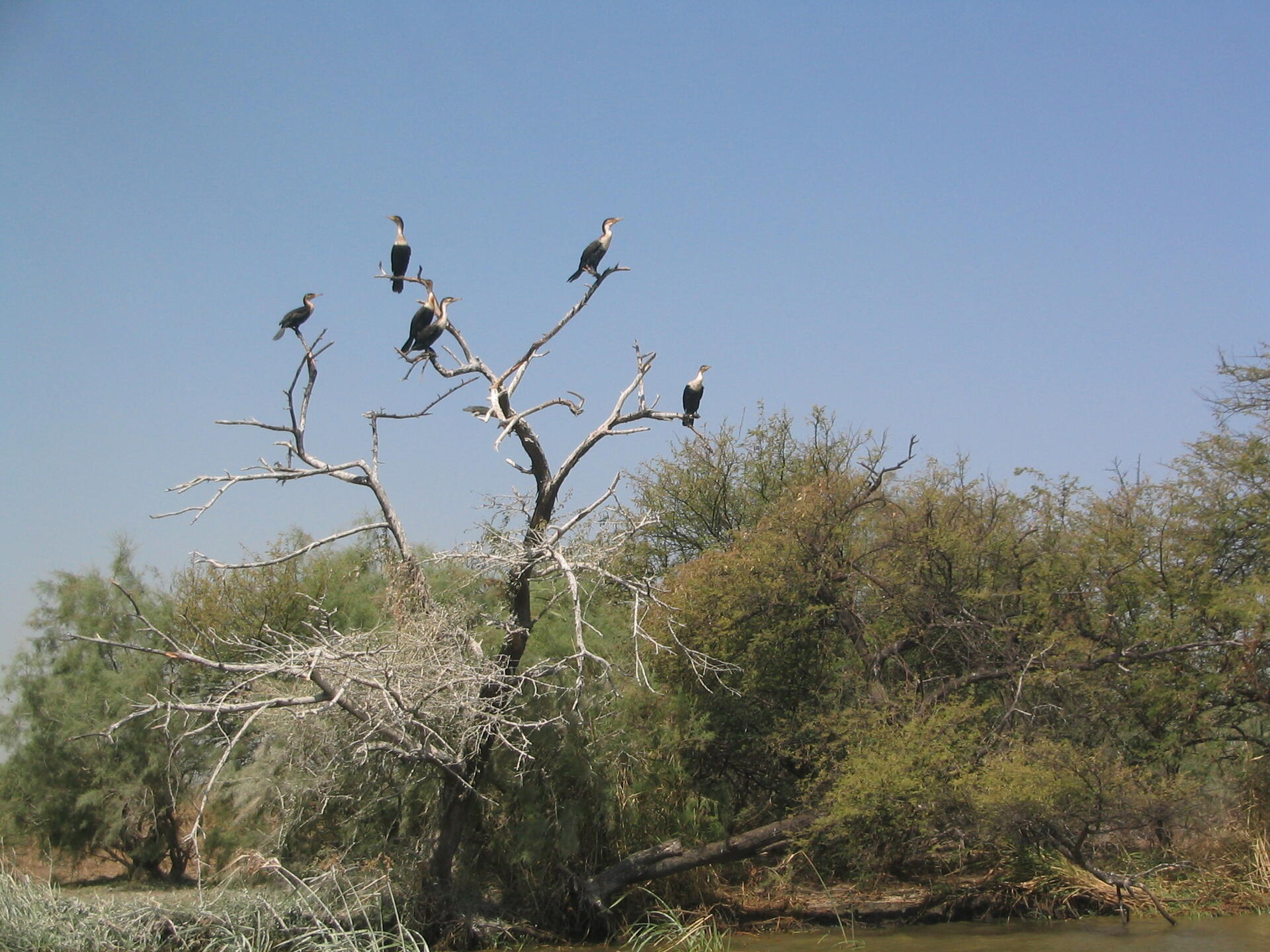
Ji-Elle, Public domain
World Heritage Research
Discover scientific research and academic studies that deepen our understanding of Djoudj National Bird Sanctuary from its history and significance to its conservation, management, and contemporary challenges.
-
Remote sensing and
GPS tracking reveal temporal shifts in habitat use in nonbreeding Black‐tailed GodwitsBlack-tailed Godwits (Limosa limosa limosa) exhibit distinct seasonal shifts in habitat use within the Senegal Delta, crucial for their nonbreeding cycle. During the wet season, they rely heavily on natural wetlands and newly planted rice fields, while mature rice crops become less suitable as they densify. As floodwaters recede, godwits transition to protected areas like Djoudj National Bird Sanctuary (Senegal) and Diawling National Park (Mauritania), favoring wetlands with fewer invasive plants during the dry season. This study used GPS tracking and continuous-time stochastic-process movement models on 22 tagged godwits from 2022–2023, combined with satellite imagery to map habitat types. Findings highlight the dynamic importance of both natural and agricultural wetlands, emphasizing the need for conservation efforts targeting invasive plant eradication in protected areas and agroecological management in rice fields.
Craft, T. B., Piersma, T., Hooijmeijer, J. C. E. W., Zhu, B.-R., D’Souza, M., O’Reilly, E., Fokkema, R. W., Stessens, M., Belting, H., Marlow, C., Ludwig, J., Melter, J., Alves, J. A., Esteban‐Pineda, A., Gutiérrez, J. S., Masero, J. A., Rocha, A. D., Dreef, C., & Howison, R. A. (2024). Remote sensing and
View Publication Record | Read PublicationGPS tracking reveal temporal shifts in habitat use in nonbreeding Black‐tailed Godwits. Journal of Applied Ecology, 62(1), 119–131. Portico. https://doi.org/10.1111/1365-2664.14827 -
Spatio-temporal variations of the LUCC of the Djoudj National Bird Sanctuary in the past 40 years and its sustainable development
Over the past four decades, Djoudj National Bird Sanctuary—a critical stopover for migratory birds along the East Atlantic Flyway—has experienced dramatic shifts in land use and cover (LUCC) driven by climate change and human activities. Research using multitemporal satellite data reveals two distinct phases of significant transformation: 1984–1990, when soil and saline lands converted to wetlands, water bodies, and vegetation, and 2000–2010, marked by a surge in invasive plant coverage (54.02%) while water bodies and wetlands declined. Agricultural expansion around the site, exacerbated by upstream dam construction, has further threatened the sanctuary’s ecosystem, leading to its twice listing as a World Heritage in Danger due to declining bird populations. The study underscores the urgent need for integrated monitoring and regulatory measures to mitigate human impacts on this vital habitat.
Xia, Y., & Fu, B. (2024). Spatio-temporal variations of the LUCC of the Djoudj National Bird Sanctuary in the past 40 years and its sustainable development. International Journal of Geoheritage and Parks, 12(4), 636–648. https://doi.org/10.1016/j.ijgeop.2024.11.004
View Publication Record | Read Publication -
Intercontinental Spread of Eurasian Highly Pathogenic Avian Influenza A(H5N1) to Senegal
In January 2021, Senegal detected the spread of Eurasian highly pathogenic avian influenza A(H5N1) to its territory, marking a significant intercontinental jump from Europe. The virus was identified on a poultry farm in Thies and in great white pelicans within the Djoudj National Bird Sanctuary. This study provides evidence for the transcontinental movement of H5N1, highlighting the role of migratory birds in viral dissemination across continents. Researchers analyzed samples to trace the virus's origin and spread, emphasizing the need for enhanced surveillance and control measures at World Heritage Sites like Djoudj to mitigate risks associated with avian influenza.
Lo, F. T., Zecchin, B., Diallo, A. A., Racky, O., Tassoni, L., Diop, A., Diouf, M., Diouf, M., Samb, Y. N., Pastori, A., Gobbo, F., Ellero, F., Diop, M., Lo, M. M., Diouf, M. N., Fall, M., Ndiaye, A. A., Gaye, A. M., Badiane, M., et al. (2022). Intercontinental Spread of Eurasian Highly Pathogenic Avian Influenza A(H5N1) to Senegal. Emerging Infectious Diseases, 28(1), 234–237. https://doi.org/10.3201/eid2801.211401
View Publication Record | Read Publication -
Conservation of World Heritage and community engagement in a transboundary biosphere reserve: Djoudj National Bird Sanctuary, Senegal
Effective conservation of the Djoudj National Bird Sanctuary, a UNESCO-listed transboundary biosphere reserve, hinges on robust community engagement and sustainable management practices. This study demonstrates that integrating local communities into conservation efforts enhances biodiversity protection while fostering socio-economic benefits. Researchers employed a mixed-methods approach, combining participatory rural appraisal techniques with ecological assessments to evaluate the impact of community-based conservation strategies. The findings highlight the significance of transboundary collaboration in addressing challenges such as habitat degradation and illegal poaching. By involving local stakeholders in decision-making processes, the study underscores the potential for long-term sustainability and resilience in protected areas.
Hay-Edie, T., Mbaye, K., & Sow, M. S. (2012). Conservation of World Heritage and community engagement in a transboundary biosphere reserve: Djoudj National Bird Sanctuary, Senegal. World Heritage, 7–17. https://doi.org/10.1017/cbo9781139567657.004
View Publication Record | Read Publication