World Heritage Identification Number: 761
World Heritage since: 2003
Category: Cultural Heritage
WHE Type: Memorial Sites
Transboundary Heritage: No
Endangered Heritage: No
Country: 🇬🇲 Gambia
Continent: Africa
UNESCO World Region: Africa
Map
Kunta Kinteh Island and Related Sites: A Testimony to the Encounter Between Africa and Europe Along the River Gambia
The Kunta Kinteh Island and Related Sites, inscribed as a UNESCO World Heritage Site in 2003, offer a compelling narrative that reflects the historical relationship between Africa and Europe along the River Gambia. This site spans various epochs, from pre-colonial and pre-slavery times to independence, providing a unique perspective on the continent's interaction with European powers.
More to come…UNESCO Description of the World Heritage Site
James Island and Related Sites present a testimony to the main periods and facets of the encounter between Africa and Europe along the River Gambia, a continuum stretching from pre-colonial and pre-slavery times to independence. The site is particularly significant for its relation to the beginning of the slave trade and its abolition. It also documents early access to the interior of Africa.
UNESCO Justification of the World Heritage Site
Criterion (iii): Kunta Kinteh Island and related sites on the River Gambia provide an exceptional testimony to the different facets of the African-European encounter, from the 15th to 20th centuries. The river formed the first trade route to the inland of Africa, being also related to the slave trade.
Criterion (vi): Kunta Kinteh Island and related sites, the villages, remains of European settlements, the forts and the batteries, were directly and tangibly associated with the beginning and the conclusion of the slave trade, retaining its memory related to the African Diaspora.
Encyclopedia Record: Kunta Kinteh Island
Kunta Kinteh Island, formerly called James Island and St Andrew's Island, is an island in the Gambia River, 30 km (19 mi) from the river mouth and near Juffureh in the Republic of the Gambia. Fort James is located on the island. It is less than 3.2 km from Albreda on the river's northern bank. As an important historical site in the West African slave trade, it is listed as a UNESCO World Heritage Site, together with related sites including a ruined Portuguese chapel and a colonial warehouse in Albreda, the Maurel Frères Building in Juffureh, and Fort Bullen and Six-Gun Battery, which are located at the mouth of the Gambia River.Additional Site Details
Area: 7.5981 hectares
Number of Components: 7
(vi) — Directly associated with events or living traditions
Coordinates: 13.31616667 , -16.35719444
Image
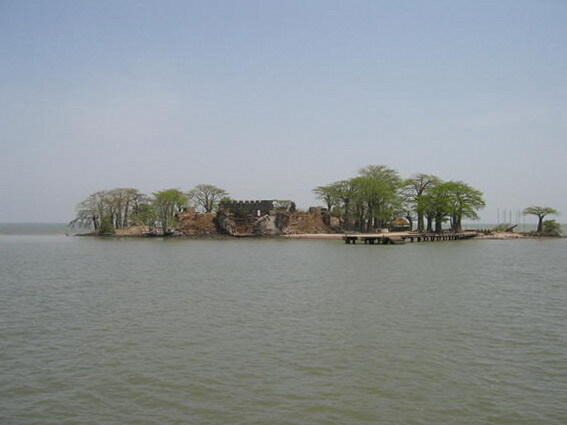
© Jose Canedo, CC BY-SA 1.0 Resized from original. (This derivative is under the same CC BY-SA license.)
World Heritage Research
Discover scientific research and academic studies that deepen our understanding of Kunta Kinteh Island and Related Sites from its history and significance to its conservation, management, and contemporary challenges.
-
World Heritage and the Sustainable Development Goals
Heritage sites, including UNESCO World Heritage Sites (WHS), play a pivotal role in fostering social and economic development while addressing sustainability challenges. This study highlights their potential as catalysts for progress by integrating them with the 2015 Sustainable Development Goals (SDGs). Through case studies such as Kunta Kinteh Island and Associated Sites in The Gambia, the research demonstrates how WHS can contribute to sustainable development, balancing conservation with economic growth. By analyzing the interaction between heritage preservation and sustainability frameworks, the study provides actionable insights for policymakers and stakeholders aiming to leverage WHS for broader societal benefits.
Woodward, S. C., & Cooke, L. (2022). World Heritage and the Sustainable Development Goals. World Heritage, 191–213. https://doi.org/10.4324/9781003044857-12
View Publication Record | Read Publication -
Finding roots: pop culture pilgrimage and the affective geographies of Kunta Kinteh Island.
This study reveals how the transmedia narrative of Roots: The Saga of an American Family has intertwined with Kunta Kinteh Island, a dark tourism site in Gambia marked by the suffering of millions enslaved people. Using a non-representational approach to place, it explores the emotional and cultural significance of the island as both a physical space and a 'factional' heritage site. The research combines an analysis of Roots' narrative with firsthand observations of the site's tourismification, offering insights into the complex interplay between pop culture, memory, and dark tourism.
Wright, K. (2020). Finding roots: pop culture pilgrimage and the affective geographies of Kunta Kinteh Island. Dark Tourism and Pilgrimage, 185–196. https://doi.org/10.1079/9781789241877.0185
View Publication Record | Read Publication -
Strange spaces of mediated memory
Sites commemorating the trans-Atlantic slave trade, such as UNESCO World Heritage Sites in The Gambia, can become 'strange spaces' where historical narratives clash with mediated memories from popular culture. A study found that familiarity with the novel Roots (1976) led participants to experience confusion and frustration when reconciling its imagined geographies with the actual spatial configurations of these heritage sites. This suggests that media-driven interpretations can complicate rather than enhance the understanding of historical narratives at such sites, highlighting the challenges of balancing cultural memory with educational heritage preservation.
Grek-Martin, J. (2020). Strange spaces of mediated memory. Locating Imagination in Popular Culture, 247–264. https://doi.org/10.4324/9781003045359-20
View Publication Record | Read Publication -
Das Erbe des Sklavenhandels im kollektiven Gedächtnis Gambias
Gambia's collective memory of the transatlantic slave trade, particularly at UNESCO-listed sites like Kunta Kinteh Island and Juffureh, is shaped more by tourism than historical recognition. While efforts to preserve and inscribe these memories—through museums, festivals, and oral traditions—have gained global attention (e.g., via Alex Haley's Roots), they primarily serve economic goals rather than addressing the trauma of slavery. High costs and limited local access hinder broader societal engagement, revealing a gap between cultural heritage preservation and its social impact.
Lahr, K. (2014). Das Erbe des Sklavenhandels im kollektiven Gedächtnis Gambias. :None. https://doi.org/10.25365/THESIS.34084
View Publication Record | Read Publication