
World Heritage Identification Number: 1431
World Heritage since: 2025
Category: Natural Heritage
WHE Type: Natural Landscapes & Geographic Features
Transboundary Heritage: No
Endangered Heritage: No
Country: 🇬🇼 Guinea-Bissau
Continent: Africa
UNESCO World Region: Africa
Map
Coastal and Marine Ecosystems of the Bijagós Archipelago - Omatí Minhô: A Unique Biodiversity Haven
The Coastal and Marine Ecosystems of the Bijagós Archipelago - Omatí Minhô, inscribed as a UNESCO World Heritage Site in 2025, represents a remarkable conservation success story in Guinea-Bissau. This extensive network of coastal and marine ecosystems encompasses the marine and intertidal environments of the best-preserved regions within the Bijagós Archipelago.
More to come…UNESCO Description of the World Heritage Site
The property includes a continuous series of coastal and marine ecosystems, corresponding to the marine and intertidal environments of the best-preserved areas of the Bijagós Archipelago in Guinea-Bissau. The Archipelago is the only active deltaic archipelago on the African Atlantic coast and one of the few in the world. The site is home to a rich biodiversity, including endangered Green and Leatherback turtles, manatees, dolphins, and over 870,000 migratory shorebirds. It features mangroves, mudflats, and intertidal zones vital for marine life, and supports rare plant species, diverse fish populations, and bird colonies. Poilão Island is a globally important nesting site for turtles.
UNESCO Justification of the World Heritage Site
Criterion (ix): The Bijagós Archipelago is the only active deltaic archipelago on the Atlantic coast of Africa. The archipelago is particularly important, on the African continent as well as in the Atlantic Ocean and throughout the world, due in particular to the rugged coastline, the width of the continental shelf, the geological and ecological marine processes and land-sea interactions, and the presence of mangroves, estuaries and foreshore shoals. Its origin can be found in the characteristic layout of the islands and delta-shaped channels. The existence of the delta is determined by a series of processes such as the tide, the sedimentary input from the Geba and Corubal rivers, the production and exchange of nutrients in the estuaries and mangroves of the Costa das Rias, upwelling and the convergence of the north and south littoral drifts, which favour the trapping of sediments. These dynamic processes, coupled with shallow areas and reefs, create conditions for high ecological productivity and an important food chain for the maintenance and conservation of life in the marine and intertidal environments where the availability of crustaceans, molluscs and other food sources favours large gatherings of water birds, sharks and rays, manatees, dolphins, sea turtles, among others, some of which are essential for the major migration routes. The deltaic origin of the archipelago also explains the presence of freshwater species that have had to adapt to the progression of marine influences over the millennia. The most representative example is that of the Hippopotamus, the archipelago being the only place on the continent, and thus in the world, where the species lives in seawater on an almost permanent basis.
Criterion (x): The vast sand and mud banks and other foreshore habitats of the property constitute key environments for migratory and/or resident species, in particular wading birds, coastal and marine birds, and sea turtles, among other globally important and threatened species. In these conditions, it constitutes the second most important feeding area in West Africa for the East Atlantic Flyway beyond the resident bird colonies. Total estimates range from around 200,000 to 850,000 birds. This includes nearly 105 species of waterbirds, including 53 resident Afrotropical species (from 18 families) and 50 Palaearctic and intra-African migratory species (from 19 families), out of a total of more than 283 species of birds throughout the archipelago. Furthermore, it is probably the most important site in Africa and one of the most important in the world for nesting sea turtles. Five of the seven existing species of sea turtle frequent the Bijagós Archipelago: the Green Turtle, the Olive Ridley Turtle, the Hawksbill Turtle, the Leatherback Turtle and the Loggerhead Turtle. The nesting of Green Turtles is nevertheless the most remarkable, making the property the third most important area in the world, the second most important in the South Atlantic and the most important in the whole of Africa, in terms of the number of nests. Starting from an annual average of 27,251 Green Turtle nests between 2013 and 2017, the records have repeatedly reached almost 40,000 nests, and up to more than 62,000 in 2020, for the beaches of the islet of Poilão alone. Regional and transatlantic migrations of sea turtles have been recorded in association with the property. The property is also a sanctuary for the diversity of sharks and rays, being probably the area with the greatest hopes among the three most important areas in the world for coastal elasmobranchs, and is renowned for the diversity of its fish populations, particularly cartilaginous fish, including the probable last specimens of sawfish on the West African coast. Further threatened species found in the property include African Manatee, dolphins – in particular the Atlantic Humpback Dolphin – and hippopotamuses living in marine habitats.
Encyclopedia Record: Bijagós Islands
The Bijagós Islands, often misspelled Bijagos in English text and formerly known in English as Bissagots, are a group of about 88 islands and islets located in the Atlantic Ocean off the coast of Guinea-Bissau.Additional Site Details
Area: 394,067.3 hectares
Number of Components: 1
(x) — Contains most important habitats for biodiversity
Coordinates: 11.12 , -15.9488888889
Image
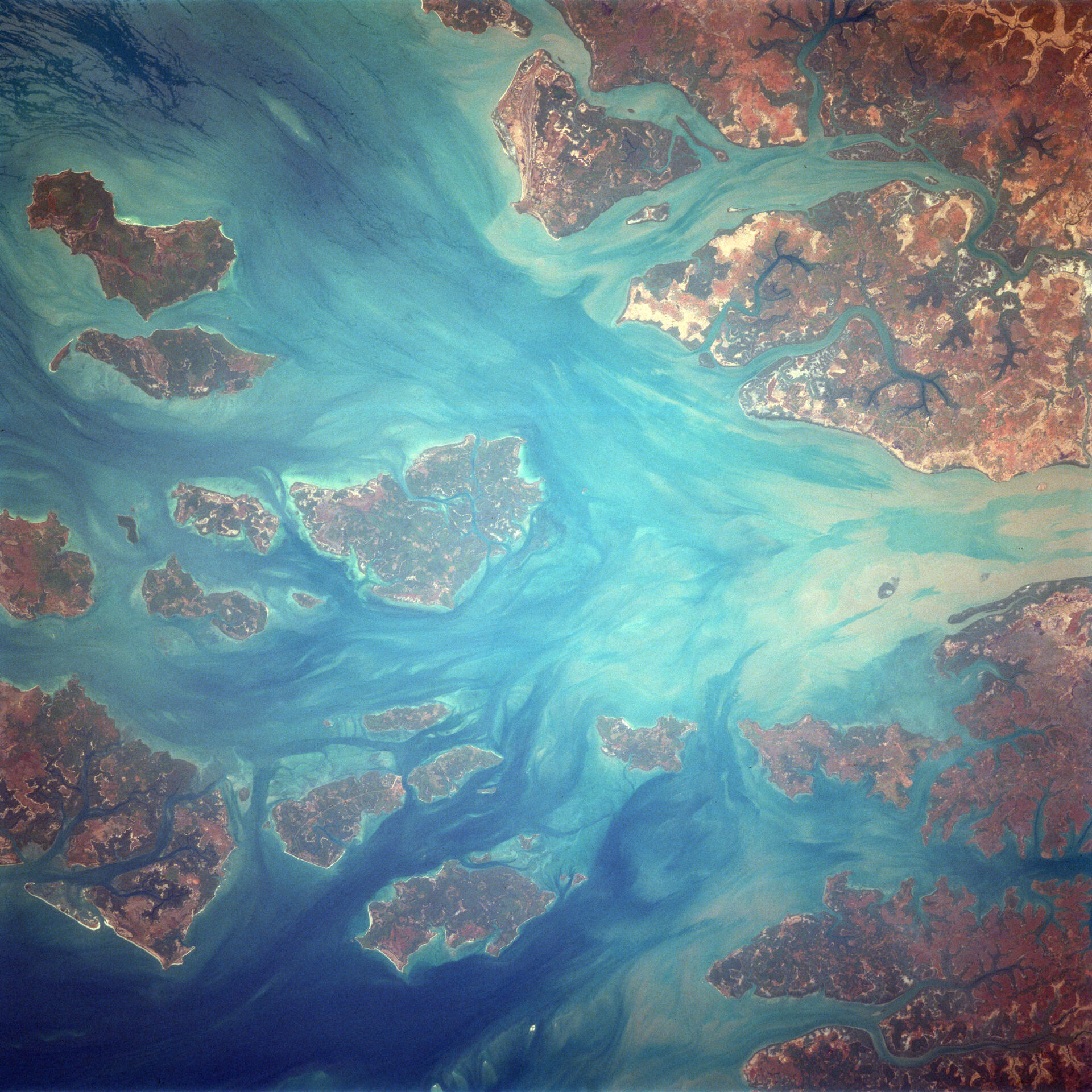
NASA / Crew of STS-37, Public domain
World Heritage Research
Discover scientific research and academic studies that deepen our understanding of Coastal and Marine Ecosystems of the Bijagós Archipelago – Omatí Minhô from its history and significance to its conservation, management, and contemporary challenges.
-
Island treasures: Macroalgae from a marine national park in the Bijagós Archipelago (Guinea-Bissau)
A pioneering survey of marine macroalgae in the João Vieira e Poilão Marine National Park, a UNESCO-listed site within Guinea-Bissau’s Bijagós Archipelago, reveals 16 species, including 11 new to the country. The study, leveraging morphological and molecular analysis (plastid LSU UPA barcode), highlights the park’s biodiversity richness, particularly among mangrove-associated red algae of the genus Bostrychia, which accounted for five identified species. These findings suggest that the archipelago’s macroalgal diversity is significantly higher than previously documented, with newly recorded taxa representing approximately 25% of Guinea-Bissau’s known macroalgae. The research underscores the ecological importance of this protected marine area and provides a foundation for future biodiversity assessments.
de Sousa, F., Sebastiana, M., Veloso, M., Barbosa, C., Indjai, B., & Catarino, L. (2026). Island treasures: Macroalgae from a marine national park in the Bijagós Archipelago (Guinea-Bissau). Regional Studies in Marine Science, 98, 105064. https://doi.org/10.1016/j.rsma.2026.105064
View Publication Record | Read Publication -
Hotspot of Exotic Benthic Marine Invertebrates Discovered in the Tropical East Atlantic: DNA Barcoding Insights From the Bijagós Archipelago, Guinea‐Bissau
A groundbreaking survey of the Bijagós Archipelago, Guinea-Bissau—a UNESCO Biosphere Reserve—revealed 28 new marine benthic invertebrate species, including six documented for the first time in the East Atlantic. Using DNA barcoding and phylogenetic analysis, researchers challenged assumptions about exotic species in the region, uncovering cryptic diversity that suggests some previously labeled non-native species may not be exotic due to their restricted distributions. The study highlights significant gaps in West African marine biodiversity knowledge and raises concerns about underreported human-driven trade of marine species between the Tropical East Atlantic, Americas, Indo-Pacific, and Mediterranean. These findings underscore the need for improved monitoring and management to curb the spread of non-native species.
Moura, C. J., Wirtz, P., Nhanquê, F. T., Barbosa, C., & Serrão, E. (2025). Hotspot of Exotic Benthic Marine Invertebrates Discovered in the Tropical East Atlantic:
View Publication Record | Read PublicationDNA Barcoding Insights From the Bijagós Archipelago, Guinea‐Bissau. Ecology and Evolution, 15(3). Portico. https://doi.org/10.1002/ece3.70964 -
A survey of indoor and outdoor Anopheles density, species composition and circumsporozoite rate of malaria vectors on the Bijagós Archipelago, Guinea-Bissau
A survey of malaria vectors on the Bijagós Archipelago, Guinea-Bissau, reveals that Anopheles melas is the dominant species, accounting for 85.2% of all Anopheles caught, both indoors and outdoors. This suggests it may contribute to year-round malaria transmission in the region. The study also found high hybridization between Anopheles gambiae sensu stricto and Anopheles coluzzii on some islands, with sporozoite rates indicating low but present infection levels (0.86% overall). The research used odour-baited light traps for adult mosquito collection and RFLP-PCR for species identification, providing critical data to tailor effective vector control strategies in this seasonal malaria transmission setting.
Pretorius, E., Jones, R. T., Hutchins, H., Teixeira Da Silva, E., Ceesay, S., Ndiath, M. O., d’Alessandro, U., Rodrigues, A., Logan, J. G., & Last, A. (2025). A survey of indoor and outdoor Anopheles density, species composition and circumsporozoite rate of malaria vectors on the Bijagós Archipelago, Guinea-Bissau. Malaria Journal, 24(1). https://doi.org/10.1186/s12936-025-05372-z
View Publication Record | Read Publication -
Diversity, distribution and conservation of crocodiles (Order: Crocodylia) in Guinea-Bissau, West Africa
A potential rediscovery of the Nile crocodile (Crocodylus niloticus) in Guinea-Bissau challenges long-held beliefs about its extinction in West Africa. This study, using visual surveys, camera trapping, and molecular barcoding, confirms the presence of this species in the Cacheu region while also documenting the distribution of two other crocodile species: the West African crocodile (Crocodylus suchus) across major river basins and coastal lagoons, including the Bijagós Archipelago, and the West African dwarf crocodile (Osteolaemus cf. tetraspis) in southern mainland and archipelagic areas. Habitat loss and deliberate killings pose significant threats to these populations. The research underscores the need for standardized surveys and genetic sampling to assess population dynamics, connectivity, and genetic diversity, which are critical for evolutionary studies and conservation planning. Community-managed reserves and restoration initiatives, alongside local engagement to mitigate human-crocodile conflicts, are recommended as priority conservation strategies.
Pizzigalli, C., Regalla, A., Palmeirim, A. F., Palma, L., Lopes-Lima, M., Razgour, O., Godinho, R., Intipe, W. A., & Brito, J. C. (2025). Diversity, distribution and conservation of crocodiles (Order: Crocodylia) in Guinea-Bissau, West Africa. Scientific Reports, 15(1). https://doi.org/10.1038/s41598-025-08789-3
View Publication Record | Read Publication -
Genomic surveillance of Anopheles mosquitoes on the Bijagós Archipelago using custom targeted amplicon sequencing identifies mutations associated with insecticide resistance
A genomic surveillance study of Anopheles mosquitoes on the Bijagós Archipelago, Guinea-Bissau, identified four insecticide resistance mutations, including the first report of the vgsc L995F kdr-west allele in Anopheles melas. The research used high-throughput multiplex amplicon sequencing to analyze 214 mosquitoes from 13 islands, detecting low overall prevalence of resistance markers but highlighting higher levels of vgsc L995F and N1570Y mutations on Bubaque Island, the most populous and connected island in the archipelago. These findings underscore the need for continued monitoring, particularly given the reliance on pyrethroid insecticide-treated nets for malaria control in the region.
Moss, S., Pretorius, E., Ceesay, S., Hutchins, H., da Silva, E. T., Ndiath, M. O., Jones, R. T., Vasileva, H., Phelan, J., Acford-Palmer, H., Collins, E., Rodrigues, A., Krishna, S., Clark, T. G., Last, A., & Campino, S. (2024). Genomic surveillance of Anopheles mosquitoes on the Bijagós Archipelago using custom targeted amplicon sequencing identifies mutations associated with insecticide resistance. Parasites & Vectors, 17(1). https://doi.org/10.1186/s13071-023-06085-5
View Publication Record | Read Publication -
Seasonal Variation in the Diet of Migratory Shorebirds Wintering in the Bijagós Archipelago, Guinea-Bissau
Migratory shorebirds wintering in the Bijagós Archipelago exhibit significant seasonal shifts in diet, with smaller species increasing polychaete consumption and larger ones favoring bivalves during the critical fuelling period. This dietary flexibility, marked by low overlap between periods, suggests adaptations to prey availability or selection pressures. The study reconstructed diets for eight shorebird species across three non-breeding phases—arrival, mid-winter, and fuelling—revealing distinct trophic strategies that may underpin their survival in this UNESCO-listed coastal ecosystem.
Coelho, A. P., Lopes, P., Rocha, A. D., Barros, A. R. d., Piersma, T., & Alves, J. A. (2024). Seasonal Variation in the Diet of Migratory Shorebirds Wintering in the Bijagós Archipelago, Guinea-Bissau. Ardea, 112(1). https://doi.org/10.5253/arde.2023.a17
View Publication Record | Read Publication -
Inter-island nesting dynamics and clutch survival of green turtles Chelonia mydas within a marine protected area in the Bijagós Archipelago, West Africa
Green turtle nesting success varies significantly among islands within the Bijagós Archipelago's João Vieira-Poilão Marine National Park, with Poilão Island serving as a primary rookery offering optimal conditions for clutch survival. Research from 2015 to 2022 revealed that while Poilão's high nest density leads to increased egg destruction by later nesting turtles, it maintains a higher mean hatching success of 67.9% compared to neighboring islands like Meio (11.9%), Cavalos (36.0%), and João Vieira (76.0%). The study suggests a source-sink dynamic, where Poilão acts as the source due to its superior reproductive output, while adjacent islands with lower survival rates may serve as sinks for migrating turtles. This finding highlights the potential impact of population growth and sea level rise on nesting suitability, emphasizing the need for conservation efforts to consider secondary sites to mitigate localized threats.
Raposo, C., Rebelo, R., Catry, P., Ferreira-Airaud, M. B., Barbosa, C., Garcia, T. B., Regalla, A., Sampaio, M. S., & Patrício, A. R. (2024). Inter-island nesting dynamics and clutch survival of green turtles Chelonia mydas within a marine protected area in the Bijagós Archipelago, West Africa. Marine Biology, 171(7). https://doi.org/10.1007/s00227-024-04463-w
View Publication Record | Read Publication
