World Heritage Identification Number: 153
World Heritage since: 1981
Category: Natural Heritage
WHE Type: Protected Areas & National Parks
Transboundary Heritage: No
Endangered Heritage: No
Country: 🇸🇳 Senegal
Continent: Africa
UNESCO World Region: Africa
Map
Niokolo-Koba National Park: A Biodiverse Haven in Southeastern Senegal
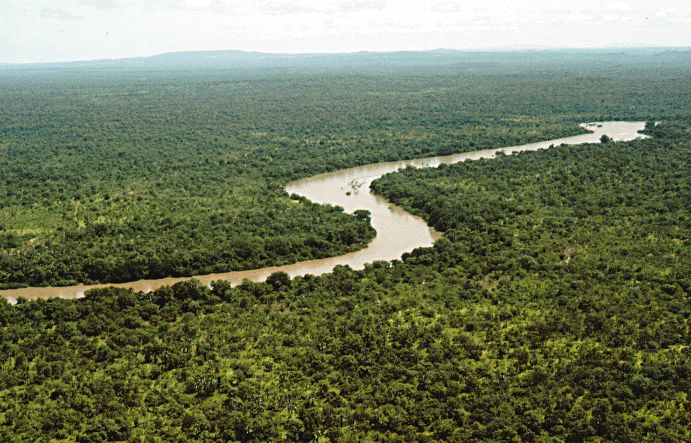
Niokolo-Koba National Park, located in the well-watered region along the banks of the Gambia River, is a significant World Heritage Site in Senegal, bordering Guinea to the east. This expansive protected area, covering approximately 1,172 square kilometers, offers a unique blend of gallery forests and savannahs that harbor a rich and diverse fauna.
More to come…UNESCO Description of the World Heritage Site
Located in a well-watered area along the banks of the Gambia river, the gallery forests and savannahs of Niokolo-Koba National Park have a very rich fauna, among them Derby elands (largest of the antelopes), chimpanzees, lions, leopards and a large population of elephants, as well as many birds, reptiles and amphibians.
UNESCO Justification of the World Heritage Site
Criterion (x): Niokolo-Koba National Park contains all the unique ecosystems of the Sudanese bioclimatic zone such as major waterways (the Gambia, Sereko, Niokolo, Koulountou), gallery-forests, herbaceous savanna floodplains, ponds, dry forests -- dense or with clearings-- rocky slopes and hills and barren Bowés. The property has a remarkable diversity of wildlife, unique in the sub-region. It counts more than 70 species of mammals, 329 species of birds, 36 species of reptiles, 20 species of amphibians and a large number of invertebrates. Lions, reputedly the largest in Africa, are a special attraction, as well as the Derby Eland, the largest antelope in existence. Other important species are also present, such as the elephant, leopard, African wild dog and chimpanzee. The wealth of habitats should be noted, along with the diversity of flora, with over 1,500 important plant species.
Encyclopedia Record: Niokolo-Koba National Park
The Niokolo-Koba National Park is a World Heritage Site and natural protected area in southeastern Senegal, near the Guinea border. It is served by Niokolo-Koba Airport, an unpaved airstrip.Additional Site Details
Area: 913,000 hectares
Number of Components: 1
Coordinates: 12.841271 , -12.899781
IUCN World Heritage Outlook
The 2025 Conservation Outlook on Niokolo-Koba National Park reports the following assessment:
Source: International Union for Conservation of Nature (IUCN) · View assessment
World Heritage Research
Discover scientific research and academic studies that deepen our understanding of Niokolo-Koba National Park from its history and significance to its conservation, management, and contemporary challenges.
-
Woody Plants in Dialan and other Ritual Practices within the Biocultural Landscape of Niokolo Koba National Park, Senegal
Ritual practices within the Dialan belief system in Niokolo-Koba National Park, Senegal, involve 41 woody plant species, with Khaya senegalensis, Piliostigma thonningii, Daniellia oliveri, and Anogeissus leiocarpa being the most prominent. These plants are used for various rituals, including baths, drinks, fumigation, amulets, mask rituals, sacrifices, offerings, and incantations, often performed in specific areas within villages or the park. The study highlights the significance of these practices among isolated Bassari communities, contributing to a deeper understanding of human-environment interactions and emphasizing the need for integrating spiritual and biocultural factors into conservation efforts.
Manka, I., Majerovičová, T., Ballesteros, M., Dème, A., & Beneš, J. (2026). Woody Plants in Dialan and other Ritual Practices within the Biocultural Landscape of Niokolo Koba National Park, Senegal. Human Ecology, 54(1). https://doi.org/10.1007/s10745-026-00672-7
View Publication Record | Read Publication -
Diversity and Spatiotemporal Activity Patterns of Medium and Large Mammals in the Niokolo‐Koba National Park, Senegal
A study of Niokolo-Koba National Park in Senegal reveals that savannah habitats support higher evenness in species abundance distribution compared to forest habitats, despite comparable overall species richness. Using 37 camera traps deployed over 13,080 days, researchers analyzed the spatiotemporal activity patterns of medium and large mammals, finding that these patterns align with known species-specific behaviors. The study also highlights differential habitat use throughout the day, likely driven by spatial segregation between sleeping and foraging sites. These findings underscore the ecological significance of the park's forest-savannah mosaic and provide a baseline for future monitoring efforts in this understudied West African ecosystem.
Ohrndorf, L., Brouillet, A., Zuleger, A. M., Diakhaté, N., Coly, D., Camara, C. Y. K., Diedhiou, A. B., Díez, I. G., Fischer, J., & Zinner, D. (2026). Diversity and Spatiotemporal Activity Patterns of Medium and Large Mammals in the Niokolo‐Koba National Park, Senegal. Ecology and Evolution, 16(7). Portico. https://doi.org/10.1002/ece3.74005
View Publication Record | Read Publication -
Spatial Distribution Modelling of a Threatened Lion Population in Relation to Prey Populations in Niokolo‐Koba National Park, Senegal
A high-performance spatial model reveals that the core habitat for lions in Niokolo-Koba National Park (NKNP), Senegal, is concentrated in the park's central region. This distribution is primarily shaped by elevation, annual precipitation, prey availability, and human pressures such as poaching and livestock grazing. The model achieved an exceptional accuracy (AUC of 0.96), highlighting critical factors that influence lion habitat selection. By integrating satellite-derived data like NDVI with land cover types and proximity to water bodies, researchers identified key environmental variables that support lion populations while also pinpointing areas vulnerable to human encroachment. These findings underscore the importance of targeted conservation strategies to protect lions by mitigating poaching and livestock pressure while preserving prey populations.
Gueye, M., Pellaton, R., Diouf, A., Mané, S., Turek, D., Leirs, H., Bertola, L. D., & de Iongh, H. (2025). Spatial Distribution Modelling of a Threatened Lion Population in Relation to Prey Populations in Niokolo‐Koba National Park, Senegal. African Journal of Ecology, 63(1). Portico. https://doi.org/10.1111/aje.70007
View Publication Record | Read Publication -
Impact of food availability and predator presence on patterns of landscape partitioning among neighbouring Guinea baboon (Papio papio) parties
A study on Guinea baboons (Papio papio) in Niokolo-Koba National Park, Senegal, reveals minimal feeding competition among neighboring parties despite substantial home range overlap. Analysis of four years of GPS collar data showed that food availability and predator presence did not significantly affect the distance between parties, which often remained under 100 meters apart. This suggests a low level of aggressive landscape partitioning in this population, though whether this is unique to Niokolo-Koba or characteristic of Guinea baboons more broadly remains unclear.
Ohrndorf, L., Mundry, R., Beckmann, J., Fischer, J., & Zinner, D. (2025). Impact of food availability and predator presence on patterns of landscape partitioning among neighbouring Guinea baboon (Papio papio) parties. Movement Ecology, 13(1). https://doi.org/10.1186/s40462-025-00534-9
View Publication Record | Read Publication -
Local Communities and Protected Areas: Plant Use and Sources Around Niokolo Koba, Senegal's Largest National Park
A study on Niokolo-Koba National Park, Senegal's largest protected area, reveals that local communities maintain strong biocultural ties to the park despite conservation restrictions. The research identifies 63 woody plant species crucial for livelihoods, with medicine, food, firewood, and construction being primary uses. Nearly 80% of these plants are sourced from village surroundings, while 25% come from the park itself. Ethnic groups and settlement locations significantly influence plant use patterns. The findings highlight the importance of integrating traditional knowledge into conservation strategies to ensure sustainable resource management amid rapid societal changes in Senegal.
Majerovičová, T., Ballesteros, M., Manka, I., Novák, J., Bumerl, J., Deme, A., & Beneš, J. (2025). Local Communities and Protected Areas: Plant Use and Sources Around Niokolo Koba, Senegal’s Largest National Park. Journal of Ethnobiology, 45(2), 99–114. https://doi.org/10.1177/02780771251325402
View Publication Record | Read Publication -
Primates in Burrows: A Cause for Concern? Observations From a One Health Perspective at Niokolo Koba National Park, Senegal
A novel observation at Niokolo-Koba National Park, Senegal, reveals that three primate species frequently visit burrows, with some entering them, potentially increasing disease transmission risk. This behavior suggests burrows as critical 'One Health hotspots' where primates may interact with bats and other taxa known to carry zoonoses. The study highlights the need for monitoring these areas, particularly in regions frequented by rangers or tourists, to mitigate potential health risks. The research employs a descriptive approach, documenting primate-burrow interactions and their implications for disease dynamics.
Vermeulen, C., Vandebos, J., Virginie, D., & Lhoest, S. (2025). Primates in Burrows: A Cause for Concern? Observations From a One Health Perspective at Niokolo Koba National Park, Senegal. Ecology and Evolution, 15(4). Portico. https://doi.org/10.1002/ece3.71062
View Publication Record | Read Publication -
African Conservation Success: Niokolo-Koba National Park (Senegal) Removed from the List of World Heritage in Danger
Niokolo-Koba National Park (NKNP) in Senegal successfully transitioned from the UNESCO World Heritage List of Danger to regular status by 2024, marking a significant conservation achievement. This success was driven by regional and international cooperation, enhanced monitoring, and community engagement, which mitigated threats such as poaching, livestock grazing, and dam construction. The study highlights the complex challenges and governance needs in heritage conservation, emphasizing the importance of long-term investment from national governments and international partners to ensure sustainable financing through ecotourism, recognition, or ecosystem services. The case also underscores the positive impact of improved national governance and collaborative partnerships involving NGOs and the private sector on conservation efforts, particularly in regions with severe human interference and socio-economic pressures.
Houéhounha, D. H. M., Lhoest, S., Ohouko, J., Tiomoko, D., Gueye, M., Vanderbeck, E., & Vermeulen, C. (2025). African Conservation Success: Niokolo-Koba National Park (Senegal) Removed from the List of World Heritage in Danger. Heritage, 8(10), 403. https://doi.org/10.3390/heritage8100403
View Publication Record | Read Publication