World Heritage Identification Number: 967
World Heritage since: 2000
Category: Natural Heritage
WHE Type: Protected Areas & National Parks
Transboundary Heritage: No
Endangered Heritage: No
Country: 🇧🇴 Bolivia (Plurinational State of)
Continent: Americas
UNESCO World Region: Latin America and the Caribbean
Map
Exploring the Biodiversity Hotspot: Noel Kempff Mercado National Park
Noel Kempff Mercado National Park, located in northeastern Santa Cruz Department, Province of José Miguel de Velasco, Bolivia, is a testament to the remarkable diversity and preservation efforts within the Amazon Basin. Established in 1990 and inscribed as a UNESCO World Heritage Site in 2000, this expansive protected area spans an impressive 1,523,000 hectares, making it one of the largest and most intact parks in the region.
More to come…UNESCO Description of the World Heritage Site
The National Park is one of the largest (1,523,000 ha) and most intact parks in the Amazon Basin. With an altitudinal range of 200 m to nearly 1,000 m, it is the site of a rich mosaic of habitat types from Cerrado savannah and forest to upland evergreen Amazonian forests. The park boasts an evolutionary history dating back over a billion years to the Precambrian period. An estimated 4,000 species of flora as well as over 600 bird species and viable populations of many globally endangered or threatened vertebrate species live in the park.
UNESCO Justification of the World Heritage Site
Criteria (ix) and (x): The site contains an array of habitat types including evergreen rainforests, palm forests, cerrado, swamps, savannahs, gallery forests, and semi-deciduous dry forests. The cerrado habitats found on the Huanchaca Meseta have been isolated for millions of years providing an ideal living laboratory for the study of the evolution of these ecosystems. The site also contains a high diversity of plant and animal species, including viable populations of many globally threatened large vertebrates.
Encyclopedia Record: Noel Kempff Mercado National Park
Noel Kempff Mercado National Park is a national park in northeast Santa Cruz Department, Province of José Miguel de Velasco, Bolivia, on the border with Brazil.Additional Site Details
Area: 1,523,446 hectares
Number of Components: 1
(x) — Contains most important habitats for biodiversity
Coordinates: -14.26667 , -60.86667
IUCN World Heritage Outlook
The 2025 Conservation Outlook on Noel Kempff Mercado National Park reports the following assessment:
Source: International Union for Conservation of Nature (IUCN) · View assessment
Image
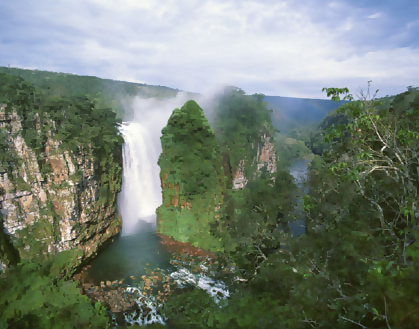
© Rojk, CC BY-SA 3.0 Resized from original. (This derivative is under the same CC BY-SA license.)
World Heritage Research
Discover scientific research and academic studies that deepen our understanding of Noel Kempff Mercado National Park from its history and significance to its conservation, management, and contemporary challenges.
-
Poteranthera inopinata (Melastomataceae), a new species from Noel Kempff Mercado National Park, Bolivia
Scientists have identified Poteranthera inopinata, a new species of flowering plant belonging to the Melastomataceae family, exclusively found in the humid or seasonally flooded savannas of Noel Kempff Mercado National Park in eastern Bolivia. This discovery was made through detailed morphological analysis, distinguishing it by unique traits such as annual habit, glandular-tipped serrated leaves (3–10 mm long), and distinctive androecium structures with prolonged pedoconnectives. The species is compared to its closest relative, P. warmingii, and an updated key for the six recognized Poteranthera species is provided. The study also recommends a conservation assessment for this newly described plant, highlighting its potential ecological significance within the UNESCO-listed park's biodiversity.
ALMEDA, F., & PACIFICO, R. (2023). Poteranthera inopinata (Melastomataceae), a new species from Noel Kempff Mercado National Park, Bolivia. Phytotaxa, 613(3), 271–279. https://doi.org/10.11646/phytotaxa.613.3.6
View Publication Record | Read Publication -
A new species of Microlicia (Melastomataceae) from Bolivia and Brazil, a new synonym, and an identification key for the genus in Mato Grosso, Brazil
Researchers have identified Microlicia windischii as a new species of plant within the Melastomataceae family, discovered in Noel Kempff Mercado National Park (Bolivia) and Serra Ricardo Franco State Park (Brazil). This species is distinguished by its linear-oblong leaf blades and subisomorphic stamens with concolorous, polysporangiate anthers. The study also provides a comparative analysis with related species (M. acuminata, M. arenariifolia, M. consimilis, M. juniperina, and M. multicaulis) and introduces an identification key for four Microlicia species in Mato Grosso, Brazil. Additionally, the research proposes to synonymize M. souzae-limae under M. helvola. The findings contribute to the taxonomic understanding of this genus while highlighting the biodiversity significance of these UNESCO-recognized protected areas.
VERSIANE, A. F. A., DA SILVA, D. N., & ROMERO, R. (2020). A new species of Microlicia (Melastomataceae) from Bolivia and Brazil, a new synonym, and an identification key for the genus in Mato Grosso, Brazil. Phytotaxa, 455(1). https://doi.org/10.11646/phytotaxa.455.1.2
View Publication Record | Read Publication -
The effects of past climate variability on fire and vegetation in the cerrãdo savanna ecosystem of the Huanchaca Mesetta, Noel Kempff Mercado National Park, NE Bolivia
A 14,500-year sedimentary record from Huanchaca Mesetta in Noel Kempff Mercado National Park reveals the resilience of cerrãdo savanna ecosystems to past climate variability. The study found that while fire activity increased during the Holocene due to warming conditions, fuel availability decreased under prolonged dry seasons, shaping modern vegetation patterns. Natural drivers—soil, climate, and fire—rather than human influence have primarily controlled vegetation and fire regimes in this ecosystem. Analyzing phytoliths, stable isotopes, and charcoal provided high-resolution insights into past environmental changes.
Maezumi, S. Y., Power, M. J., Mayle, F. E., McLauchlan, K., & Iriarte, J. (2015). The effects of past climate variability on fire and vegetation in the cerrãdo savanna ecosystem of the Huanchaca Mesetta, Noel Kempff Mercado National Park, NE Bolivia. https://doi.org/10.5194/cpd-11-135-2015
View Publication Record | Read Publication -
The Maned Wolves of Noel Kempff Mercado National Park
Maned wolves (Chrysocyon brachyurus) exhibit unique territorial behavior and seasonal activity patterns, with home ranges varying from 40–123 km² and strong seasonal variations in land use. GPS-collar data revealed that adult maned wolves travel an average of 14 km/night during dry months and 7 km/night in wet months, with activity being sharply nocturnal in the dry season but partly diurnal in the rainy season. The study also found that females hold territories into which males move to form pairs, while young males emigrate. Young females often stay on natal territories as presumed helpers, acquiring the territory upon the disappearance or death of adult females. Dental disease was identified as a major cause of morbidity, with extreme tooth wear observed by 8 years old. Habitat loss and drought-related resource loss are significant conservation threats to the species in Noel Kempff Mercado National Park, Bolivia.
Emmons, L. H. (Ed.). (2012). The Maned Wolves of Noel Kempff Mercado National Park. Smithsonian Contributions to Zoology. https://doi.org/10.5479/si.00810282.639
View Publication Record | Read Publication -
Variation in Diet and Resources
Maned wolves (Chrysocyon brachyurus) in Noel Kempff Mercado National Park exhibit significant dietary flexibility, adapting their food choices based on resource availability. The study found that while small mammals and fruits constitute the core of their diet, these carnivores also opportunistically consume other plant materials when primary resources are scarce. Researchers analyzed scat samples and stomach contents to assess dietary composition across seasons, revealing a dynamic feeding strategy that allows the species to thrive in diverse habitats within the park.
Castro, J. M., & Emmons, L. H. (2012). Variation in Diet and Resources. Smithsonian Contributions to Zoology, (639), 37–55. https://doi.org/10.5479/si.00810282.639.37
View Publication Record | Read Publication