World Heritage Identification Number: 999
World Heritage since: 2000
Category: Natural Heritage
WHE Type: Protected Areas & National Parks
Transboundary Heritage: No
Endangered Heritage: No
Country: 🇧🇷 Brazil
Continent: Americas
UNESCO World Region: Latin America and the Caribbean
Map
Exploring the Pantanal Conservation Area: A Unique Tropical Wetland Ecosystem
The Pantanal Conservation Area, inscribed as a UNESCO World Heritage Site in 2000, offers a captivating glimpse into the rich biodiversity and breathtaking landscapes of one of the world's largest freshwater wetland ecosystems. Situated in western-central Brazil, in the extreme southwest of the states of Mato Grosso and Mato Grosso do Sul, near the borders with Bolivia and Paraguay, this protected area spans approximately 187,818 hectares and represents about 1.3 percent of the Brazilian Pantanal, one of the planet's largest and most ecologically significant wetland regions.
Although the protected property covers only a small fraction of the vast Pantanal wetland, it safeguards some of the region's most ecologically important habitats. UNESCO recognized the site for its extraordinary species richness, its role in maintaining key hydrological and ecological processes, and its importance as a refuge for numerous threatened and rare species. As one of the world's most extensive freshwater wetland systems, the Pantanal serves as a crucial reservoir of biological diversity in South America.
The Pantanal Conservation Area is composed of four protected areas: Pantanal Matogrossense National Park, Acurizal Special Reserve, Penha Special Reserve, and Dorochê Special Reserve. Together, these areas provide sanctuary for an extraordinary array of wildlife, including the jaguar, giant otter, giant anteater, giant armadillo, marsh deer, and numerous bird species such as the hyacinth macaw. The region is recognized internationally for its exceptional biological diversity and high concentration of wildlife.
One of the defining features of the Pantanal Conservation Area is its location between the Cuiabá and Paraguay river basins. The area's wetlands play a crucial role in regulating water flow and sustaining the ecological processes that support the Pantanal's vast floodplain system. During the rainy season, rivers overflow and inundate extensive areas, creating a mosaic of lakes, marshes, grasslands, and forest patches.. As water levels recede during the dry season, new habitats emerge, concentrating wildlife and creating ideal conditions for wildlife observation.
The annual cycle of flooding and drying is the ecological engine that sustains life throughout the Pantanal. Seasonal rains cause rivers to overflow across the floodplain, transporting nutrients and creating a rich mosaic of aquatic and terrestrial habitats. These changing water levels influence the movements and breeding patterns of fish, birds, reptiles, and mammals, while also shaping the distribution of plant communities. The result is a dynamic ecosystem whose remarkable productivity supports one of the highest concentrations of wildlife in the Americas.
The Pantanal's diverse ecosystems cater to a myriad of plant species, creating a vibrant tapestry of colors and textures across the landscape. Seasonally flooded grasslands, gallery forests, savannas, shrublands, and patches of cerrado vegetation combine to form a rich ecological landscape. These habitats provide food and shelter for countless animal species and contribute to the ecological complexity for which the Pantanal is renowned. Aquatic ecosystems are particularly important, sustaining hundreds of fish species whose seasonal migrations form the foundation of complex food webs that support birds, reptiles, and mammals throughout the floodplain.
The Pantanal's exceptional biodiversity is enhanced by its position at the meeting point of several major South American ecosystems. Influences from the Amazon rainforest, the Cerrado savannas, the Chaco woodlands, and elements of the Atlantic Forest converge within the region, creating a remarkable variety of habitats. This ecological crossroads supports an extraordinary mixture of plant and animal species from different biogeographical regions and contributes significantly to the Pantanal's status as one of South America's most important centers of biodiversity.
Beyond its ecological significance, the Pantanal region has long been home to traditional communities whose livelihoods are closely connected to the rhythms of the wetland environment. Sustainable land-use practices and conservation initiatives have become increasingly important in preserving the region's natural heritage while supporting local populations.
Despite its protected status, the Pantanal faces a number of environmental challenges. Increasing pressure from agricultural expansion, changes in land use, severe droughts, and recurring wildfires threatens the delicate balance of the wetland ecosystem. Climate change may further alter the seasonal flood cycles upon which countless species depend. Continued conservation efforts, scientific research, and sustainable management practices are therefore essential to preserving the Pantanal's unique landscapes and extraordinary biodiversity for future generations.
Parts of the Pantanal, including Pantanal Matogrossense, are recognized under the Ramsar Convention on Wetlands, which promotes the conservation and sustainable use of wetland ecosystems. This additional layer of protection complements its status as a UNESCO World Heritage Site and highlights the global importance of the region. Cooperative conservation efforts involving Brazil and neighboring countries focus on maintaining hydrological integrity, improving fire management strategies, and strengthening environmental monitoring across the broader Pantanal basin.
Visitors to the Pantanal Conservation Area can experience one of the world's most extraordinary natural environments. Whether exploring by boat, horseback, or on foot, travelers encounter an abundance of wildlife and ever-changing landscapes shaped by seasonal flooding. The conservation of this remarkable wetland is vital not only for the survival of its unique ecosystems and species but also for maintaining one of the Earth's most important centers of biodiversity.
UNESCO Description of the World Heritage Site
The Pantanal Conservation Area consists of a cluster of four protected areas with a total area of 187,818 ha. Located in western central Brazil at the south-west corner of the State of Mato Grosso, the site represents 1.3% of Brazil's Pantanal region, one of the world's largest freshwater wetland ecosystems. The headwaters of the region's two major river systems, the Cuiabá and the Paraguay rivers, are located here, and the abundance and diversity of its vegetation and animal life are spectacular.
UNESCO Justification of the World Heritage Site
Criterion (vii): The spectacular landscape of the wetlands of the property bordered by the Amolar mountainous chain originates in the combination of steep cliffs with annual hydrological extremes. During the rainy season, between October to April, the rivers overspill and flood vast regions, leaving only small areas inundated. At the end of this period, the waters slowly descend leaving numerous small temporary lakes. This outstanding landscape gives the Pantanal an unique aestheticism, enriched by the abundance and diversity of the wild flora and fauna. For example, it is remarkable to see a group of giant water lilies, impressive aquatic plants, growing near to immense cactus from semi-arid regions.
Criterion (ix): On a reduced scale, this site is a model for ongoing ecological and biological processes in the Pantanal. Considered as a phytogeographic region, the Pantanal is strongly influenced by neighbouring ecosystems (mainly those of the Cerrado and the Amazon, but also those of the Chaquenha and the Atlantic). This group, associating the Amolar Mountain chain with the wetland ecosystems, benefits from a major and unique ecological gradient in the region, contributing to the maintenance of the biological process. The hydrographic network permits the migration of species between the river basins forming the Pantanal, where a vast diversity of fish transit during their initial growing stage. These water courses also play a central role in diversing nutrients to the entire basin. During flood periods, a part of the fauna (notably the largest mammals) migrate from the plain to the higher, drier regions, and during the more severe drought periods, the plain can be the only area in the region to remain humid, thus playing a precious role in the maintenace of the fauna.
Criterion (x): The Pantanal is extremely important for the conservation of biological diversity and the property contains representative habitats comprising around 80 species of mammals, 650 species of birds, 50 of reptiles and 300 of fish (thus the Reserve is vital for the maintenance of fish stock). Several worldwide threatened species are present here, including the giant armadillo,(Priodontesmaximus), the giant anteater (Myrmecophagatridactyla), giant otter (Pteronurabrasiliensis), marsh deer (Blastocerus dichotomus) and the hyacinth macaw (Anodorhynchus hyacinthinus), the largest species of parrot. A healthy jaguar population (Panthera onca), a species almost threatened with extinction, is also present. Furthermore, the region contains a remarkable diversity of aquatic plants.
Encyclopedia Record: Pantanal
The Pantanal is a natural region encompassing the world's largest tropical wetland area, and the world's largest flooded grasslands. It is located mostly within the Brazilian state of Mato Grosso do Sul, but it extends into Mato Grosso and portions of Bolivia and Paraguay. It sprawls over an area estimated at between 140,000 and 195,000 km2. Various subregional ecosystems exist, each with distinct hydrological, geological, and ecological characteristics; up to 12 of them have been defined.Additional Site Details
Area: 187,818 hectares
Number of Components: 1
(ix) — Outstanding example representing ecological and biological processes
(x) — Contains most important habitats for biodiversity
Coordinates: -17.656 , -57.359
IUCN World Heritage Outlook
The 2025 Conservation Outlook on Pantanal Conservation Area reports the following assessment:
Source: International Union for Conservation of Nature (IUCN) · View assessment
Image
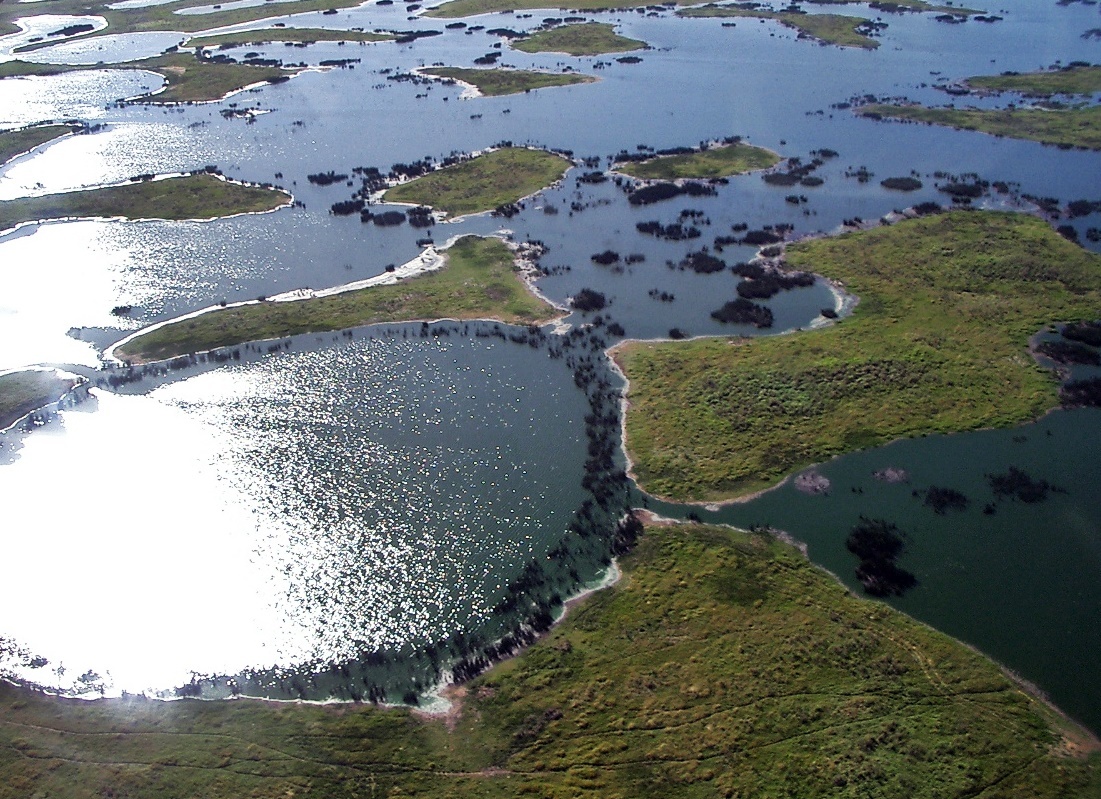
© Alicia Yo, CC BY-SA 3.0 Resized from original. (This derivative is under the same CC BY-SA license.)