World Heritage Identification Number: 529
World Heritage since: 1990
Category: Cultural Heritage
WHE Type: Religious Sites & Sacred Architecture
Transboundary Heritage: No
Endangered Heritage: No
Country: 🇧🇴 Bolivia (Plurinational State of)
Continent: Americas
UNESCO World Region: Latin America and the Caribbean
Map
Jesuit Missions of the Chiquitos: A Unique Fusion of Cultures in Eastern Bolivia
The Jesuit Missions of the Chiquitos, located in the Santa Cruz department of eastern Bolivia, stand as a testament to the harmonious blend of European and Amerindian cultures that took place during the 17th and 18th centuries. This collection of six settlements, collectively designated as a UNESCO World Heritage Site in 1990, offers a glimpse into the rich history and unique architectural styles that emerged from this remarkable fusion.
More to come…UNESCO Description of the World Heritage Site
Between 1696 and 1760, six ensembles of reducciones (settlements of Christianized Indians) inspired by the ‘ideal cities’ of the 16th-century philosophers were founded by the Jesuits in a style that married Catholic architecture with local traditions. The six that remain – San Francisco Javier, Concepción, Santa Ana, San Miguel, San Rafael and San José – make up a living heritage on the former territory of the Chiquitos.
UNESCO Justification of the World Heritage Site
Criterion (iv): The churches of the Jesuit Missions of the Chiquitos in Bolivia, large houses with a double-sloping roof and large porch roof overhanging a west gallery, are a remarkable example of the adaptation of Christian religious architecture to local conditions and traditions. Long walls defining three interior naves divided by wooden columns and two exterior galleries, also supported by columns, constitute – except in the case of San José where construction, in stone, was inspired by a baroque model – a very unique type of architecture marked by the special treatment of the wooden columns and banisters.
Criterion (v) : These traditional architectural ensembles, that often enclose remarkable popular art objects (e.g., at the church of Santa Ana), have become vulnerable under the impact of changes that threatened the Chiquitos populations following the agrarian reform of 1953.
Encyclopedia Record: Jesuit Missions of Chiquitos
The Jesuit Missions of Chiquitos are located in the Santa Cruz department in eastern Bolivia. Six of these former missions collectively were designated as a UNESCO World Heritage Site in 1990. Distinguished by a unique fusion of European and Amerindian cultural influences, the missions were founded as reductions or reducciones de indios by Jesuits in the 17th and 18th centuries to convert local tribes to Christianity.Additional Site Details
Area: Not available
Number of Components: 6
(v) — Outstanding example of traditional human settlement
Coordinates: -16 , -60.5
Image
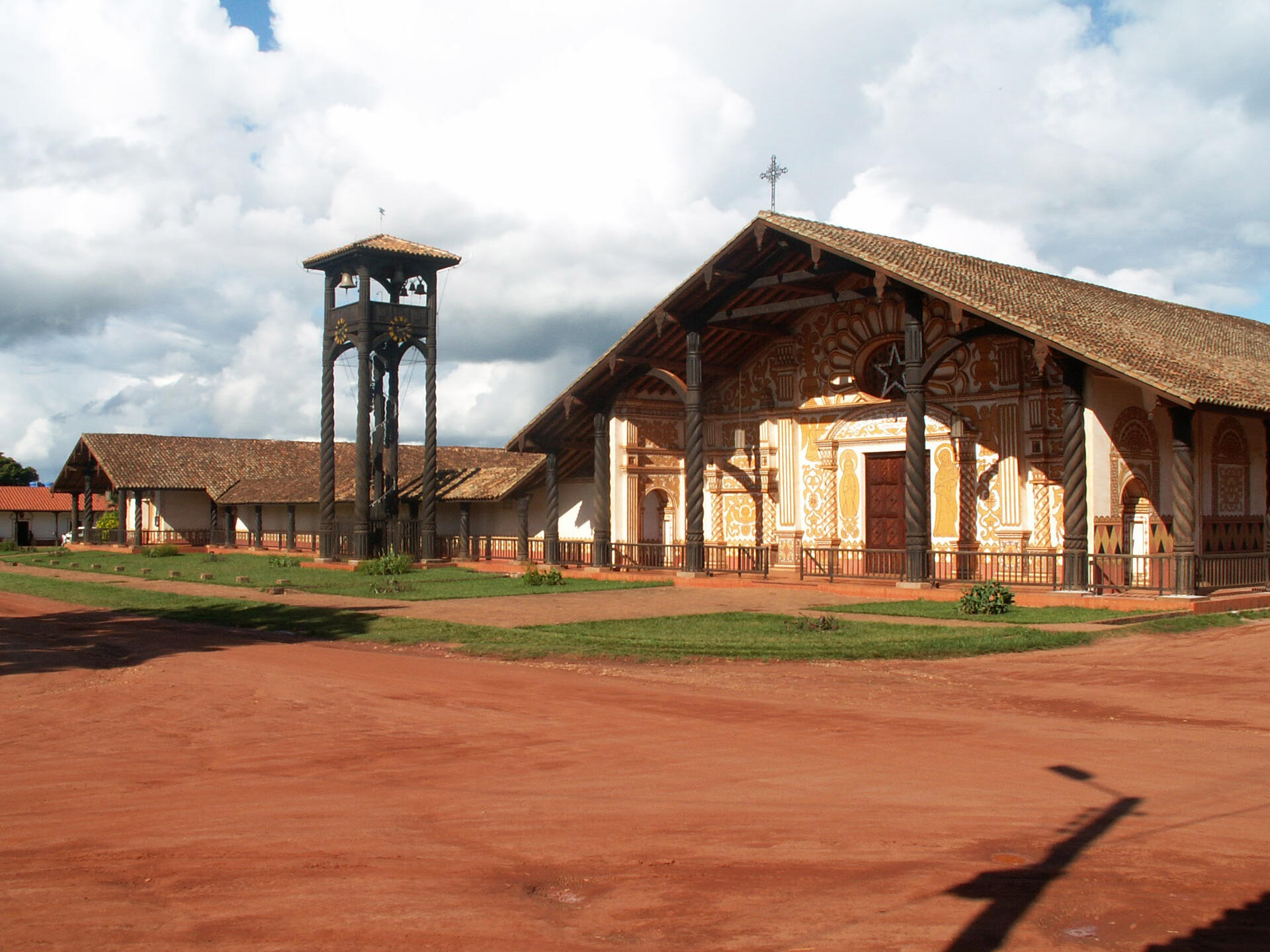
© Daan at Dutch Wikipedia, CC BY-SA 3.0 Resized from original. (This derivative is under the same CC BY-SA license.)
World Heritage Research
Discover scientific research and academic studies that deepen our understanding of Jesuit Missions of the Chiquitos from its history and significance to its conservation, management, and contemporary challenges.
-
Christian Communities and Music in South America : Domenico Zipoli and the Jesuit Missions of the Chiquitos
Music played a pivotal role in the Jesuit missions of Chiquitos, serving as a key tool for cultural integration and Christianization. The study reveals that the Jesuits used music to foster social cohesion among indigenous communities, encouraging their participation in liturgical practices while also teaching Western culture. Domenico Zipoli's musical legacy, discovered among the mission's archives, exemplifies this approach, demonstrating how systematic music education supported Jesuit missionary goals. By analyzing Zipoli's works and broader missionary strategies, the research highlights the enduring impact of music on the establishment of Christian communities in South America, though it also notes limitations in long-term cultural assimilation.
Chang, Y.-M. (2022). Christian Communities and Music in South America : Domenico Zipoli and the Jesuit Missions of the Chiquitos. Theology and Praxis, 82, 769–789. https://doi.org/10.14387/jkspth.2022.82.769
View Publication Record | Read Publication -
The Orientation of Jesuit Churches in the Chiquitos Missions of Eastern Bolivia
Research on the Jesuit Missions of Chiquitos in eastern Bolivia reveals that half of the ten studied churches exhibit potential canonical orientations aligned with solar phenomena, including three with precise equinoctial alignment. Unlike the north–south meridian orientations predominant in the Province of Paraquaria, these findings suggest a deliberate design to optimize illumination effects on significant internal elements, likely influenced by Baroque church architecture principles. The study combines archaeoastronomical measurements with landscape context analysis to propose reasons for these orientations, advancing our understanding of the evangelization strategies and architectural intent of Jesuit missionaries in the region.
Gangui, A. (2021). The Orientation of Jesuit Churches in the Chiquitos Missions of Eastern Bolivia. Journal of Skyscape Archaeology, 159–181. https://doi.org/10.1558/jsa.19631
View Publication Record | Read Publication -
Zamucoan ethnonymy in the 18th century and the etymology of Ayoreo
A new analysis of 18th-century Zamucoan ethnonyms reveals that the term 'Ayoreo,' meaning 'people' or 'human beings,' was not borrowed from other languages but has roots in Old Zamuco, a language spoken by the Jesuit missions of Chiquitos. The study identifies previously undocumented ethnic denominations and shows that some Zamucoan ethnonyms derive from a different Zamucoan variety with a plural suffix matching present-day Ayoreo. While 'Ayoreo' is an autochthonous word, its adoption as an ethnonym emerged later due to social dynamics following the Chaco War. The research combines linguistic analysis of historical sources and comparative etymology to clarify these linguistic and cultural connections.
Ciucci, L. (2021). Zamucoan ethnonymy in the 18th century and the etymology of Ayoreo. Journal de La Société Des Américanistes, 107(2), 77–114. https://doi.org/10.4000/jsa.19809
View Publication Record | Read Publication -
Música para rezos y liturgias de la Semana Santa de los archivos misionales en Bolivia
Research demonstrates that the music used in Holy Week celebrations during the 18th-century Jesuit missions of Chiquitos, Bolivia, can be reconstructed based on archival texts and musical collections. The study analyzes written accounts by Jesuit missionaries and superiors, detailing formal and popular liturgies from Passion Sunday to Holy Saturday. By cross-referencing these texts with surviving music collections from the missions, the research suggests that a comprehensive reconstruction of the ceremonial soundscapes is feasible. This finding opens avenues for further exploration, potentially deepening our understanding of the cultural and musical practices of the era.
Nawrot, P. (2019). Música para rezos y liturgias de la Semana Santa de los archivos misionales en Bolivia. Annales Missiologici Posnanienses, (23), 147–163. https://doi.org/10.14746/amp.2018.23.10
View Publication Record | Read Publication -
Demographic Change and Ethnic Survival Among the Sedentary Populations on the Jesuit Mission Frontiers of Spanish Latin America, 1609–1803: The Formation and Persistence of Mission Communities in a Comparative Context, by Robert H. Jackson
Despite widespread demographic decline and out-migration during the colonial period, Jesuit mission settlements in Spanish Latin America demonstrated remarkable resilience. A comparative study of the Guaraní missions (Paraguay/Río de la Plata) and Chiquitos missions (eastern Bolivia) reveals that these communities persisted through the 18th century, with descendants still inhabiting former mission sites today. The research traces demographic trajectories from the 17th to early 19th centuries, challenging narratives of mission settlements as either utopian refuges or oppressive institutions. By extending analysis beyond the 1767 suppression of the Jesuits, the study highlights long-term survival and cultural persistence in the face of colonial pressures.
Ditchfield, S. (2017). Demographic Change and Ethnic Survival Among the Sedentary Populations on the Jesuit Mission Frontiers of Spanish Latin America, 1609–1803: The Formation and Persistence of Mission Communities in a Comparative Context, by Robert H. Jackson. The English Historical Review, 132(559), 1601–1602. https://doi.org/10.1093/ehr/cew358
View Publication Record | Read Publication -
The Promise and Peril of Gold Mining on Spanish and Portuguese Imperial Frontiers
Gold mining in the Chiquitos region, formerly under Jesuit missions and located on the ambiguous frontier between Spanish and Portuguese territories, sparked diverse pro- and anti-mining discourses from 1796 to 1809. The study reveals that these debates were deeply influenced by geographical factors and colonial beliefs about territorial characteristics, rather than solely economic or political motivations. By analyzing archival records and historical texts, the research demonstrates how the region's transimperial jurisdictional status shaped arguments for and against mining, highlighting the complex interplay between geography, imperial power dynamics, and local perceptions during this period.
Scott, H. V. (2016). The Promise and Peril of Gold Mining on Spanish and Portuguese Imperial Frontiers. Oxford Research Encyclopedia of Latin American History. https://doi.org/10.1093/acrefore/9780199366439.013.249
View Publication Record | Read Publication -
Demographic Change and Ethnic Survival among the Sedentary Populations on the Jesuit Mission Frontiers of Spanish South America, 1609-1803
Despite severe mortality crises from epidemics, warfare, and famine, sedentary native populations on the Jesuit missions of Paraguay and Chiquitos survived and retained their unique ethnic identity between 1609 and 1803. This finding challenges conventional assumptions about Native American historical demography. The study analyzed demographic patterns, including the impact of old-world diseases like smallpox and measles, which occurred approximately every generation, killing thousands. By comparing these patterns with other mission populations, researchers contextualized the resilience and survival of the Paraguay and Chiquitos missions, highlighting their distinct demographic trajectories.
Jackson, R. H. (2015). Demographic Change and Ethnic Survival among the Sedentary Populations on the Jesuit Mission Frontiers of Spanish South America, 1609-1803. https://doi.org/10.1163/9789004285002
View Publication Record | Read Publication -
Indigenous Modernities and the Performance of the Music of Bolivian Mission Archives the Ensamble Moxos
The performance practices of the Ensamble Moxos, an Indigenous ensemble from Bolivia's Jesuit missions, defy conventional categorization as either 'traditional' or 'modern.' This study reveals how their interpretations of 17th-century Baroque mission music—preserved in Chiquitos and Moxos archives since the Jesuits' expulsion in 1767—reflect Indigenous experiences of modernity and cultural identity. By analyzing repertoire performed by Ensamble Moxos, the research demonstrates that these practices embody a unique 'Indigenous modernity,' blending historical continuity with contemporary globalization. The study highlights the resilience of mission music as both a tool for evangelization and a living tradition, offering insight into the complexities of Indigenous engagement with globalized modernity.
Villamizar Rodriguez, M. Indigenous Modernities and the Performance of the Music of Bolivian Mission Archives the Ensamble Moxos. https://doi.org/10.22215/etd/2014-10556
View Publication Record | Read Publication -
The Solomonic Column as a Symbolic Image of Inculturation in the Churches of The Jesuit Missions of Chiquitos (Bolivia).
The Solomonic column, a distinctive element of Christian visual culture, served as a powerful symbol of inculturation in the churches of the Jesuit Missions of Chiquitos (Bolivia). This study reveals how the column's systematic use during the 16th to 18th centuries facilitated the blending of religious and state interests, aligning with the goals of both the Society of Jesus and the Spanish Crown. By analyzing this design element through a transmission lens, the research demonstrates its role in adapting Christian imagery to local contexts, thereby strengthening the missions' cultural and political influence.
Reimers, V. (2014). The Solomonic Column as a Symbolic Image of Inculturation in the Churches of The Jesuit Missions of Chiquitos (Bolivia). Proceedings of the 9th Conference of the International Committee for Design History and Design Studies, 36–37. https://doi.org/10.5151/despro-icdhs2014-0118
View Publication Record | Read Publication -
Arquitectura de madera en las misiones jesuíticas de Chiquitos (Bolivia) del siglo XVIII y sus orígenes prehispánicos y europeos
The wooden architecture of the 18th-century Jesuit missions in Chiquitos, Boliviareveals a unique fusion of pre-Columbian indigenous techniques and European Baroque styles. This study demonstrates that the timber frame structures, characterized by independent wooden porticos supporting monolithic gable roofs, originated from prehispanic communal dwellings. The missionaries adapted this technique, incorporating European joinery, triangular trusses, and ceramic tiles while retaining the native practice of ground-anchored columns—a method abandoned in Europe since the 11th century. Through a quantitative analysis of comparable buildings in Europe and South America, alongside archival research and field studies, the study defines structural typologies and traces the evolution of this construction system from its indigenous roots to its refinement in Chiquitos. This work not only advances understanding of heritage architecture but also provides critical guidance for future conservation efforts.
Rodríguez Trujillo, W. V. Arquitectura de madera en las misiones jesuíticas de Chiquitos (Bolivia) del siglo XVIII y sus orígenes prehispánicos y europeos. https://doi.org/10.5821/dissertation-2117-93458
View Publication Record | Read Publication