World Heritage Identification Number: 883
World Heritage since: 1998
Category: Cultural Heritage
WHE Type: Archaeological Sites
Transboundary Heritage: No
Endangered Heritage: No
Country: 🇧🇴 Bolivia (Plurinational State of)
Continent: Americas
UNESCO World Region: Latin America and the Caribbean
Map
Exploring the Enigmatic Fuerte de Samaipata: A Unique Blend of Cultures
The Fuerte de Samaipata, nestled in the eastern foothills of the Bolivian Andes, stands as a testament to the rich cultural history of South America. This remarkable archaeological site, inscribed as a UNESCO World Heritage Site in 1998, offers a captivating glimpse into the past, blending elements from three distinct cultures: Chané, Inca, and Spanish.
More to come…UNESCO Description of the World Heritage Site
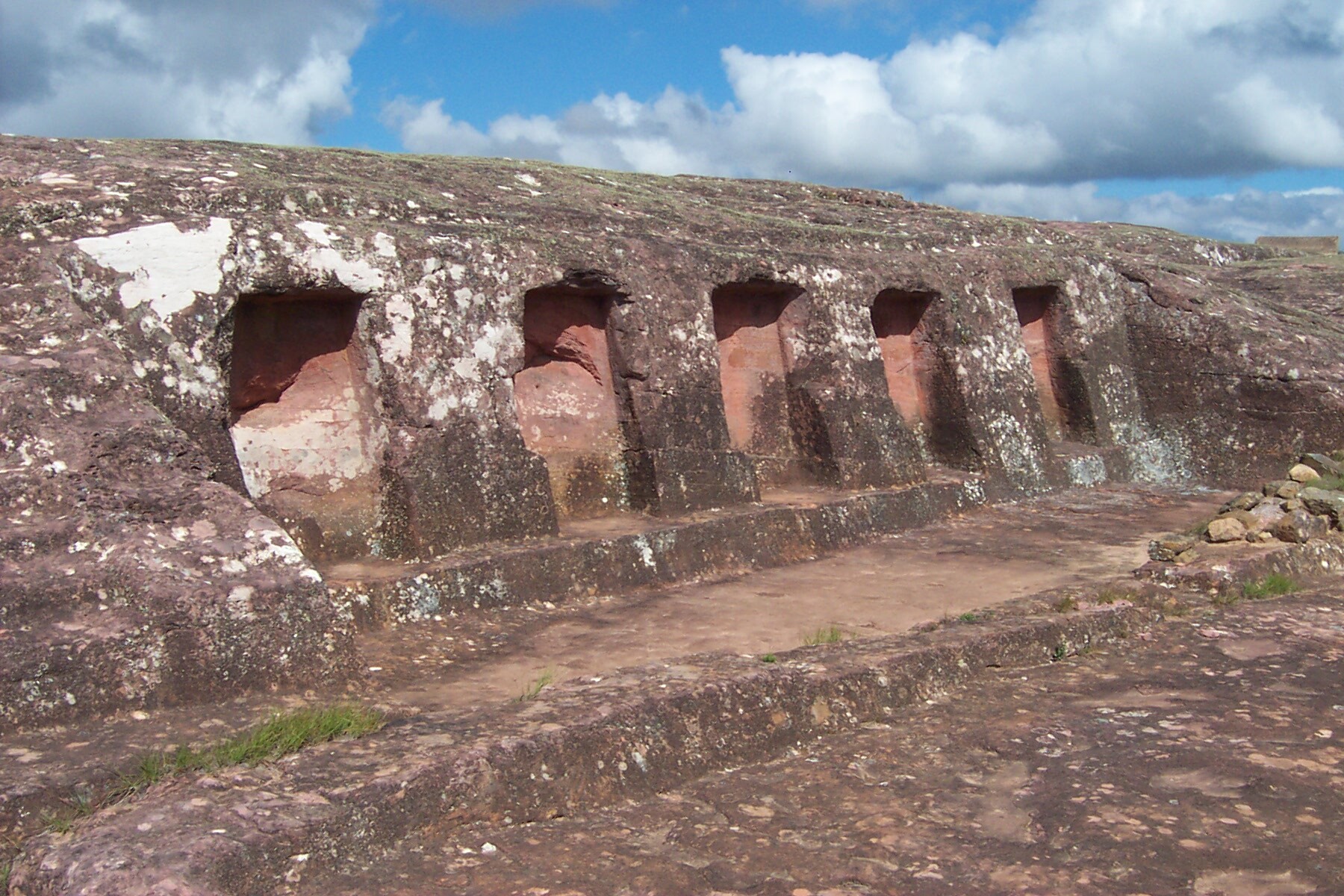
The archaeological site of Samaipata consists of two parts: the hill with its many carvings, believed to have been the ceremonial centre of the old town (14th–16th centuries), and the area to the south of the hill, which formed the administrative and residential district. The huge sculptured rock, dominating the town below, is a unique testimony to pre-Hispanic traditions and beliefs, and has no parallel anywhere in the Americas.
UNESCO Justification of the World Heritage Site
Criterion (ii): The sculptured rock at Samaipata is the dominant ceremonial feature of an urban settlement that represents the apogee of this form of prehispanic religious and political centre.
Criterion (iii): Samaipata bear outstanding witness to the existence in this Andean region of a culture with highly developed religious traditions illustrates dramatically in the form of immense rock sculptures.
Encyclopedia Record: El Fuerte de Samaipata
El Fuerte de Samaipata or Fort Samaipata, also known simply as "El Fuerte", is a Pre-Columbian archaeological site and UNESCO World Heritage Site located in Florida Province, Santa Cruz Department, Bolivia. It is situated in the eastern foothills of the Bolivian Andes and is a popular tourist destination for Bolivians and foreigners alike. It is served by the nearby town of Samaipata. The archaeological site at El Fuerte is unique as it encompasses buildings of three different cultures: Chanè, Inca, and Spanish.Additional Site Details
Area: Not available
Number of Components: 1
(iii) — Unique or exceptional testimony to a cultural tradition
Coordinates: -18.178323 , -63.820485
Image
© Mhwater at Dutch Wikipedia, CC BY-SA 3.0 Resized from original. (This derivative is under the same CC BY-SA license.)
World Heritage Research
Discover scientific research and academic studies that deepen our understanding of Fuerte de Samaipata from its history and significance to its conservation, management, and contemporary challenges.
-
Interpretation of traces of hypothetical quincha walls in Samaipata
Computer simulations reveal that hypothetical quincha walls, likely used for structural purposes at the Fuerte de Samaipata UNESCO World Heritage Site in Bolivia, could indeed withstand the site's strong winds. The study employed 3D laser scanning and finite element method (FEM) analysis to model and assess the structural stability of these walls, which are inferred from rows of small circular holes drilled into the rock. This research challenges previous doubts about their resilience, providing new insights into the construction techniques of pre-Hispanic cultures that developed around this sacred rock over 1200 years.
Kogut, J., Kościuk, J., & Kubicka, A. (2020). Interpretation of traces of hypothetical quincha walls in Samaipata. Architectus, (2(62)). https://doi.org/10.37190/arc200209
View Publication Record | Read Publication -
El Fuerte de Samaipata in the light of current research
Current research on El Fuerte de Samaipata, a UNESCO-listed pre-Hispanic site in Bolivia, highlights the urgent need for preservation of its deteriorating petroglyphs due to environmental and human-induced factors. The study traces the site's investigation history from colonial records to modern scholarship, emphasizing the importance of documenting and safeguarding these rock carvings. By analyzing both historical sources and contemporary studies, researchers aim to mitigate further damage while preserving Samaipata's cultural significance.
Ziółkowski, M. (2020). El Fuerte de Samaipata in the light of current research. Architectus, (2(62)). https://doi.org/10.37190/arc200203
View Publication Record | Read Publication