World Heritage Identification Number: 1360
World Heritage since: 2012
Category: Cultural Heritage
WHE Type: Infrastructure & Industry
Transboundary Heritage: No
Endangered Heritage: No
Country: 🇫🇷 France
Continent: Europe
UNESCO World Region: Europe and North America
Map
The Nord-Pas de Calais Mining Basin: A Testimony to Industrial Europe's History
The Nord-Pas de Calais Mining Basin, located in the northern regions of France, stands as a remarkable testament to the industrial revolution and the development of modern Europe. Inscribed as a UNESCO World Heritage Site in 2012, this expansive mining basin spans over 120,000 hectares and comprises 109 distinct components, offering a unique insight into the lives, working conditions, and societal structures that emerged from three centuries of coal extraction, from the late 17th century through the 20th century.
More to come…UNESCO Description of the World Heritage Site
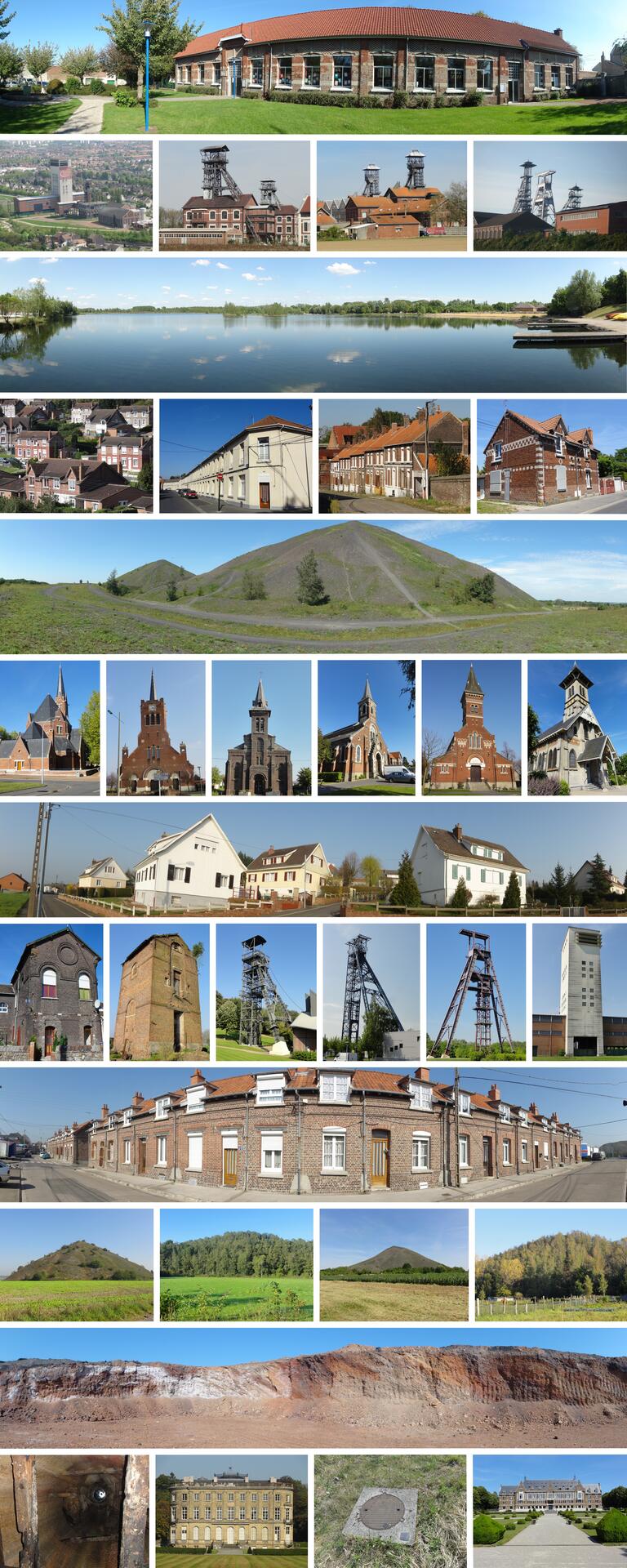
Remarkable as a landscape shaped over three centuries of coal extraction from the 1700s to the 1900s, the site consists of 109 separate components over 120,000 ha. It features mining pits (the oldest of which dates from 1850) and lift infrastructure, slag heaps (some of which cover 90 ha and exceed 140 m in height), coal transport infrastructure, railway stations, workers’ estates and mining villages including social habitat, schools, religious buildings, health and community facilities, company premises, owners and managers’ houses, town halls and more. The site bears testimony to the quest to create model workers’ cities from the mid 19th century to the 1960s and further illustrates a significant period in the history of industrial Europe. It documents the living conditions of workers and the solidarity to which it gave rise.
UNESCO Justification of the World Heritage Site
Criterion (ii): The Nord-Pas de Calais Mining Basin provides exceptional testimony to the exchange of ideas and influences regarding the extraction methods used for underground coal seams, the design of worker housing and urban planning, as well as the international human migration that accompanied the industrialization of Europe.
Criterion (iv): The living and evolving mining landscapes of the Nord-Pas de Calais Basin provide an eminent example of the large-scale development of coal mining in the 19th and 20th centuries, by large industrial companies and their considerable workforce. This is a space structured by urban planning, specific industrial structures and the physical vestiges of coal extraction (slag heaps and subsidence).
Criterion (vi): The social, technical and cultural events associated with the history of the Mining Basin had international repercussions. They are a unique and exceptional illustration of the danger of mine-working and of the history of its major disasters (Courrières). They are testimony to the evolution of the social and technical conditions of coal extraction. They represent a major symbolic place of the workers’ condition and their solidarity, from the 1850s to 1990. They are testimony to the dissemination of the ideals of worker unionism and socialism.
Encyclopedia Record: Nord-Pas de Calais Mining Basin
The Nord-Pas-de-Calais Mining Basin is a mining basin in Northern France that stretches across the Nord and Pas-de-Calais departments. The region is famous for its long history of coal extraction and its testimony to a significant period in the history of industrialisation in Europe, and as a result it was inscribed on the UNESCO World Heritage List in 2012. This area has been shaped by three centuries of coal extraction from the late 17th century through the 20th century, and demonstrates the evolution of coal mining techniques and worker conditions during that time.Additional Site Details
Area: 3,943 hectares
Number of Components: 108
(iv) — Outstanding example of a type of building or landscape
(vi) — Directly associated with events or living traditions
Coordinates: 50.4625 , 3.5461111111
World Heritage Research
Discover scientific research and academic studies that deepen our understanding of Nord-Pas de Calais Mining Basin from its history and significance to its conservation, management, and contemporary challenges.
-
The mining vine, a source of projects for the Nord Pas-de-Calais Mining Basin, UNESCO World Heritage Site
A novel approach to revitalizing the Nord-Pas de Calais Mining Basin has emerged through the concept of the 'mining vine.' This method integrates heritage conservation with contemporary urban planning and development. The study highlights its potential by examining two worker housing estates—Lemay and Sainte-Marie in Pécquencourt—as case studies for territorial transformation. By blending historical significance with modern design, the mining vine offers a sustainable model for post-industrial landscapes, balancing preservation with innovation.
Alessandri, R. (2025). The mining vine, a source of projects for the Nord Pas-de-Calais Mining Basin, UNESCO World Heritage Site. Architecture, Landscape, and Design in Post-Mining Territories, 19–29. https://doi.org/10.4324/9781003476306-5
View Publication Record | Read Publication -
Loos-en-Gohelle, a resilient town
Loos-en-Gohelle, once a small agricultural village with just 500 inhabitants, has demonstrated remarkable resilience following its profound transformation by coal extraction over the past 150 years. This study highlights how the town, located within the Lens-Lièvin agglomeration in the Nord-Pas de Calais Mining Basin, transitioned from a rural landscape to an industrial hub while maintaining cultural and social cohesion. The research approach involves analyzing historical records, urban planning documents, and community narratives to uncover the factors contributing to Loos-en-Gohelle's adaptability. Key findings emphasize the interplay between post-mining regeneration strategies and local identity preservation, offering insights for similar territories undergoing socio-economic shifts.
Caron, J.-F. (2025). Loos-en-Gohelle, a resilient town. Architecture, Landscape, and Design in Post-Mining Territories, 10–18. https://doi.org/10.4324/9781003476306-4
View Publication Record | Read Publication -
An architectural permanence to fight against energy poverty
A groundbreaking approach to retrofitting social housing in the Nord-Pas de Calais Mining Basin demonstrates that inhabitant participation can significantly enhance energy efficiency and combat energy poverty. The study, conducted over three years with Maisons & Cités, reveals that involving residents from the project's inception leads to more tailored and effective retrofit strategies, addressing behavior-driven energy consumption—responsible for half of a home's total usage. This participatory method not only improves energy outcomes but also fosters democratic design practices and empowers local communities. The research challenges traditional power dynamics by embedding architects permanently in project sites, acting as 'local architects' to bridge communication gaps between residents and decision-makers. This innovative model, tested in the Cité d’Orient estate, offers a scalable solution for sustainable urban development.
Pagnier, M. (2025). An architectural permanence to fight against energy poverty. Architecture, Landscape, and Design in Post-Mining Territories, 51–61. https://doi.org/10.4324/9781003476306-8
View Publication Record | Read Publication -
Function and Form in Territorial Planning: The Case of Lens in the Mining Basin in Nord and Pas-de-Calais – France
Lens, France, underwent significant territorial transformation from the 1960s to 1990, shifting its economic focus from mining and textile production to cultural and tourist activities. This study highlights how state planning, EU policies, and collaboration with private and civil entities reshaped Lens's urban space, introducing new functions like a Louvre Museum branch while re-signifying older structures. The research reflects on these spatial transformations during the transition from industrial capitalism to globalization, emphasizing the interplay between form and function in territorial reconversion.
Policarpo, M. A., & Souza, R. d. C. M. d. (2024). Function and Form in Territorial Planning: The Case of Lens in the Mining Basin in Nord and Pas-de-Calais – France. Sociedade & Natureza. https://doi.org/10.14393/sn-v36-2024-70996x
View Publication Record | Read Publication -
Função e Forma no Ordenamento Territorial: o Caso de Lens na Bacia Mineira de Nord e Pas-De-Calais – França
The city of Lens, France, has undergone significant spatial transformations, shifting from its historical role in mining and textile production to a new focus on cultural and tourist activities. This transformation, driven by state planning and EU policies from the 1960s to 1990, aimed to address economic challenges like unemployment and recession. The study highlights how infrastructure development and urban remodeling reshaped Lens's urban space, introducing new functions such as music and cinema workshops, and notable installations like a branch of the Louvre Museum. These changes reflect broader trends in territorial reconversion during industrial capitalism and globalization.
Policarpo, M. A., & Souza, R. d. C. M. d. (2024). Function and Form in Territorial Planning: The Case of Lens in the Mining Basin in Nord and Pas-de-Calais – France. Sociedade & Natureza, 36(1). https://doi.org/10.14393/sn-v36-2024-70996
View Publication Record | Read Publication -
Forecast and mitigation of the pressure build-up in a depleted mine gas reservoir: case study in a French coal basin
A study on the Nord-Pas-de-Calais (NPdC) Mining Basin reveals that the ongoing flooding of underground mine voids, expected to last until 2150, is currently mitigating gas migration due to depleted pressures in some sectors. However, as these voids flood, pressure build-up in isolated sectors poses a significant post-mining risk, potentially leading to hazardous gas emissions at the surface. Researchers from Ineris and GEODERIS used a 3D geometric model of the basin to forecast flooding and pressure changes, aiming to refine the gas monitoring plan. This approach helps prioritize mitigation efforts, such as pressure-relief boreholes, to prevent pressurization in unflooded sectors and anticipate potential failures. The study underscores the need for vigilant monitoring to manage risks associated with mine gas emissions.
Lafortune, S., Gouzy, A., & Vuidart, I. (2023). Forecast and mitigation of the pressure build-up in a depleted mine gas reservoir: case study in a French coal basin. Mine Closure 2023: Proceedings of the 16th International Conference on Mine Closure. https://doi.org/10.36487/acg_repo/2315_011
View Publication Record | Read Publication -
What can architecture do?
Despite its designation as a UNESCO World Heritage Site in 2012, the Nord-Pas de Calais Mining Basin continues to face severe socio-economic challenges. This study highlights the persistent issues of economic decline, pollution, poverty, and unemployment in the region, which have plagued it since its coal exploitation began in the 18th century. The research explores the potential role of architecture in addressing these multifaceted problems, suggesting that architectural interventions could play a crucial part in revitalizing such distressed territories. By examining the basin's history and current conditions, the study aims to provide insights into how design and urban planning can contribute to sustainable development and social transformation.
Mariolle, B. (2023). What can architecture do? EAAE Annual Conference Proceedings, 76–77. https://doi.org/10.51588/eaaeacp.176
View Publication Record | Read Publication