World Heritage Identification Number: 1009
World Heritage since: 2000
Category: Cultural Heritage
WHE Type: Religious Sites & Sacred Architecture
Transboundary Heritage: No
Endangered Heritage: No
Country: 🇧🇪 Belgium
Continent: Europe
UNESCO World Region: Europe and North America
Map
Notre-Dame Cathedral in Tournai: A Blend of Romanesque and Gothic Architectural Styles
The Notre-Dame Cathedral in Tournai, located in the Belgian city of Tournai, is a remarkable architectural gem that showcases a unique blend of Romanesque and early Gothic styles. This cathedral, dedicated to the Virgin Mary, has been a significant religious and cultural landmark for over nine centuries.
More to come…UNESCO Description of the World Heritage Site
The Cathedral of Notre-Dame in Tournai was built in the first half of the 12th century. It is especially distinguished by a Romanesque nave of extraordinary dimensions, a wealth of sculpture on its capitals and a transept topped by five towers, all precursors of the Gothic style. The choir, rebuilt in the 13th century, is in the pure Gothic style.
UNESCO Justification of the World Heritage Site
Criterion (ii): The Notre-Dame Cathedral in Tournai bears witness to a considerable exchange of influence between the architectures of the Ile-de-France, the Rhineland and Normandy during the short period at the beginning of the 12th century that preceded the flowering of Gothic architecture.
Criterion (iv): In its imposing dimensions, the Notre-Dame Cathedral in Tournai is an outstanding example of the great edifices of the school of the north of the Seine, precursors of the vastness of the Gothic cathedrals.
Encyclopedia Record: Tournai Cathedral
The Cathedral of Our Lady, or Tournai Cathedral, is a Roman Catholic cathedral, see of the Diocese of Tournai in Tournai, Belgium. It has been classified both as a Wallonia major heritage site since 1936 and as a World Heritage Site since 2000.Additional Site Details
Area: 0.4963 hectares
Number of Components: 1
(iv) — Outstanding example of a type of building or landscape
Coordinates: 50.60603 , 3.38926
Image
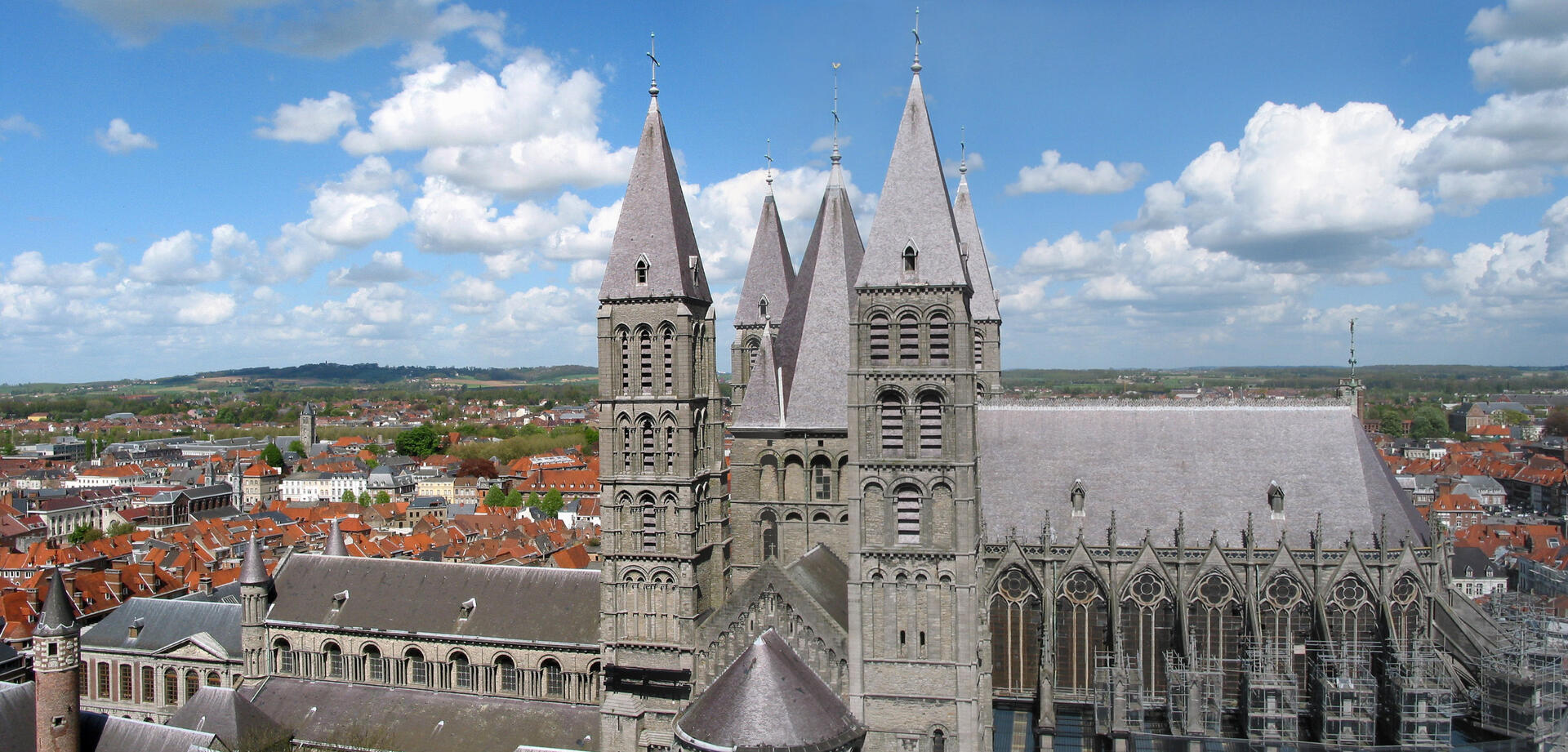
© self-made composite, from photos taken by Jean-Pol Grandmont, CC BY 2.5 Resized from original.
World Heritage Research
Discover scientific research and academic studies that deepen our understanding of Notre-Dame Cathedral in Tournai from its history and significance to its conservation, management, and contemporary challenges.
-
Performance-based fire safety assessment of UNESCO heritage structures: CFD simulation of Gothic timber carpentry in Our-Lady Cathedral of Tournai, Belgium
A performance-based fire safety assessment of the Gothic timber carpentry in Notre-Dame Cathedral, Tournai, reveals that electrical fires can rapidly lead to flashover if unchecked. The study, using computational fluid dynamics (CFD) simulations, found that natural ventilation through windows mitigates heat buildup but is less effective than compartmenting electrical cabinets to limit fire and smoke propagation. This approach balances modern safety needs with the preservation of UNESCO heritage structures, offering actionable recommendations for similar sites while adhering to the Venice Charter's guidelines on interventions.
Domgue Kamwa, L. I., Descamps, T., & Datoussaid, S. (2026). Performance-based fire safety assessment of UNESCO heritage structures: CFD simulation of Gothic timber carpentry in Our-Lady Cathedral of Tournai, Belgium. International Journal of Disaster Resilience in the Built Environment, 17(5), 625–640. https://doi.org/10.1108/ijdrbe-09-2025-0135
View Publication Record | Read Publication -
Music, Liturgy, and Confraternity Devotions in Paris and Tournai, 1300–1550 by Sarah Ann Long
Sarah Ann Long's study reveals that confraternities in Paris and Tournai, during 1300–1550, played a pivotal role in the development of devotional music and liturgy, particularly in response to the plague. Her research demonstrates how these lay-led organizations, distinct from monastic or cathedral institutions, sponsored specialized liturgies for saints like Sebastian, Barbara, Catherine of Alexandria, and Nicholas—venerated for their protective powers against sickness and death. By analyzing fourteen liturgical books containing devotional music and texts, Long connects confraternities to the composition of plainchant and polyphony, highlighting the theological craftsmanship behind chant melodies and contrafacta. This groundbreaking work bridges the gap between popular piety and musical patronage in late medieval northern France.
Morrison, L. (2023). Music, Liturgy, and Confraternity Devotions in Paris and Tournai, 1300–1550 by Sarah Ann Long. Notes, 79(3), 398–401. https://doi.org/10.1353/not.2023.0010
View Publication Record | Read Publication -
Chant grégorien et musique médiévale
Michel Huglo's collection 'Chant grégorien et musique médiévale' offers a comprehensive exploration of Gregorian chant and its evolution, focusing on monophonic and polyphonic additions to the medieval repertoire. The study delves into significant musical works, including the Kyrie, introit tropes from St-Gall, an elegy for William the Conqueror (d. 1087), versus by Venantius Fortunatus for the cathedral of Paris, liturgical dramas from Fleury, early organum, the Mass of Tournai, and a Requiem by Eustache Du Caurroy. This collection represents the second phase of Huglo's research, providing valuable insights into the development and significance of medieval music within the context of UNESCO World Heritage Sites like Notre-Dame Cathedral in Tournai.
Huglo, M. (2023). Chant grégorien et musique médiévale (, Ed.). Routledge. https://doi.org/10.4324/9781003418665
View Publication Record | Read Publication -
Music, Liturgy, and Confraternity Devotions in Paris and Tournai, 1300–1550 Sarah Ann Long.
A groundbreaking study reveals how confraternities, voluntary communities centered on shared spirituality and trade, significantly influenced late medieval music composition and liturgical practices in northern Europe. Unlike previous scholarship that focused solely on cathedrals or monasteries, this research highlights the role of confraternities as patrons and sponsors of new musical works for the Mass and Office, integrating lay piety into diocesan practices. By examining Paris and Tournai as key nodes in regional networks, the study demonstrates how political, commercial, and ecclesiastical connections facilitated the diffusion of devotions and their associated music. Paris, as a university hub, attracted international students and supported extensive book production, while Tournai served as an ecumenical crossroads under French and Burgundian rule, further shaping musical-liturgical creativity in this period.
Blasina, J. J. (2022). Music, Liturgy, and Confraternity Devotions in Paris and Tournai, 1300–1550 Sarah Ann Long. Music and Letters, 103(2), 344–346. https://doi.org/10.1093/ml/gcac023
View Publication Record | Read Publication -
Cathédrale de Tournai
A comprehensive approach to preserving and reimagining Tournai Cathedral was developed by UCLouvain-LOCI in collaboration with local authorities. The project, marking the cathedral's 850th anniversary and its 20th year on the UNESCO list, focused on enhancing and restoring the Gothic choir while stimulating public engagement through educational activities. By leveraging the cultural theme 'the imaginary as a response,' the initiative aimed to ensure the sanctuary's future through debate and creative reinterpretation, culminating in exhibitions at LOCI-Tournai and TAMAT.
Bolle, C., & Haubruge, C. (2022). Cathédrale de Tournai. Lieuxdits, (21), 26–32. https://doi.org/10.14428/ld.vi21.67223
View Publication Record | Read Publication -
L’autel de Lichtervelde et la genèse du manuscrit C de la collection épistolaire d’Étienne d’Orléans, évêque de Tournai (Paris, BnF, lat. 8630A)
A key discovery links the main scribe and compiler of manuscript C (Paris, BnF, lat. 8630A)—a critical medieval collection of Étienne d’Orléans’s letters—to his immediate entourage as bishop of Tournai (1192–1203). The manuscript, compiled in four phases between 1198 and early 1199, includes 302 letters or documents, a third from Étienne’s episcopate, alongside original cathedral archives. Analysis of the scribe’s hand reveals an act from Tournai’s chapter (April 2, 1198) concerning the altar of Lichtervelde, confirming its close association with the bishop. The scribe is likely either Marcel, Étienne’s chaplain and later abbot of Cysoing, or his brother Stephen, a canon of Tournai. This study reconstructs the manuscript’s genesis through paleographic and codicological methods, providing insight into medieval episcopal administration and textual transmission.
Declercq, G. (2022). L’autel de Lichtervelde et la genèse du manuscrit C de la collection épistolaire d’Étienne d’Orléans, évêque de Tournai (Paris, BnF, lat. 8630A). Sacris Erudiri, 61, 375–407. https://doi.org/10.1484/j.se.5.133572
View Publication Record | Read Publication -
En marge d’une édition récente : Exploiter la richesse de l’obituaire de la cathédrale de Tournai
A recently published obituary of the Cathedral of Tournai offers unprecedented insights into medieval life, spanning from 1044 to 1562. This unique source reveals the cathedral's daily operations, including liturgical practices, donations, and social dynamics, providing data unavailable in traditional records. It highlights the diverse contributors—bishops, laypeople, and underprivileged groups—and details aspects such as lighting arrangements, meal foundations, and manuscript donations. The obituary also sheds light on the evolving nature of medieval liturgy, challenging perceptions of its stagnation.
Pycke, J. (2021). En marge d’une édition récente : Exploiter la richesse de l’obituaire de la cathédrale de Tournai. Revue Bénédictine, 131(1), 64–90. https://doi.org/10.1484/j.rb.5.124387
View Publication Record | Read Publication