World Heritage Identification Number: 1369
World Heritage since: 2011
Category: Natural Heritage
WHE Type: Natural Landscapes & Geographic Features
Transboundary Heritage: No
Endangered Heritage: No
Country: 🇦🇺 Australia
Continent: Oceania
UNESCO World Region: Asia and the Pacific
Map
Exploring the Biodiverse Ningaloo Coast: A Unique Marine and Terrestrial World Heritage Site
The Ningaloo Coast, located in the remote northwest coastal region of Western Australia, is a remarkable World Heritage Site that boasts a unique combination of marine and terrestrial landscapes. Spanning over 705,015 hectares, the Ningaloo Coast is situated approximately 1,200 kilometers north of Perth, along the East Indian Ocean.
More to come…UNESCO Description of the World Heritage Site
The 604,500 hectare marine and terrestrial property of Ningaloo Coast, on the remote western coast of Australia, includes one of the longest near-shore reefs in the world. On land the site features an extensive karst system and network of underground caves and water courses. Annual gatherings of whale sharks occur at Ningaloo Coast, which is home to numerous marine species, among them a wealth of sea turtles. The terrestrial part of the site features subterranean water bodies with a substantial network of caves, conduits, and groundwater streams. They support a variety of rare species that contribute to the exceptional biodiversity of the marine and terrestrial site
UNESCO Justification of the World Heritage Site
Criterion (vii): The landscapes and seascapes of the property are comprised of mostly intact and large-scale marine, coastal and terrestrial environments. The lush and colourful underwater scenery provides a stark and spectacular contrast with the arid and rugged land. The property supports rare and large aggregations of whale sharks (Rhincodon typus) along with important aggregations of other fish species and marine mammals. The aggregations in Ningaloo following the mass coral spawning and seasonal nutrient upwelling cause a peak in productivity that leads approximately 300-500 whale sharks to gather, making this the largest documented aggregation in the world.
Criterion (x): In addition to the remarkable aggregations of whale sharks the Ningaloo Reef harbours a high marine diversity of more than 300 documented coral species, over 700 reef fish species, roughly 650 mollusc species, as well as around 600 crustacean species and more than 1,000 species of marine algae. The high numbers of 155 sponge species and 25 new species of echinoderms add to the significance of the area. On the ecotone, between tropical and temperate waters, the Ningaloo Coast hosts an unusual diversity of marine turtle species with an estimated 10,000 nests deposited along the coast annually. The majority of subterranean species on land, including aquatic species in the flooded caves are rare, taxonomically diverse and not found elsewhere in the southern hemisphere. The combination of relict rainforest fauna and small fully aquatic invertebrates within the same cave system is exceptional. The subterranean fauna of the peninsula is highly diverse and has the highest cave fauna (troglomorphic) diversity in Australia and one of the highest in the world. Above ground, the diversity of reptiles and vascular plants in the drylands is likewise noteworthy.
Encyclopedia Record: Ningaloo Coast
The Ningaloo Coast is a World Heritage Site located in the north west coastal region of Western Australia. The 705,015-hectare (1,742,130-acre) heritage-listed area is located approximately 1,200 kilometres (750 mi) north of Perth, along the East Indian Ocean. The distinctive Ningaloo Reef that fringes the Ningaloo Coast is 260 kilometres (160 mi) long and is Australia's largest fringing coral reef and the only large reef positioned very close to a landmass. The Muiron Islands and Cape Farquhar are within this coastal zone.Additional Site Details
Area: 705,015 hectares
Number of Components: 1
(x) — Contains most important habitats for biodiversity
Coordinates: -22.5625 , 113.8102777778
IUCN World Heritage Outlook
The 2025 Conservation Outlook on Ningaloo Coast reports the following assessment:
Source: International Union for Conservation of Nature (IUCN) · View assessment
Image
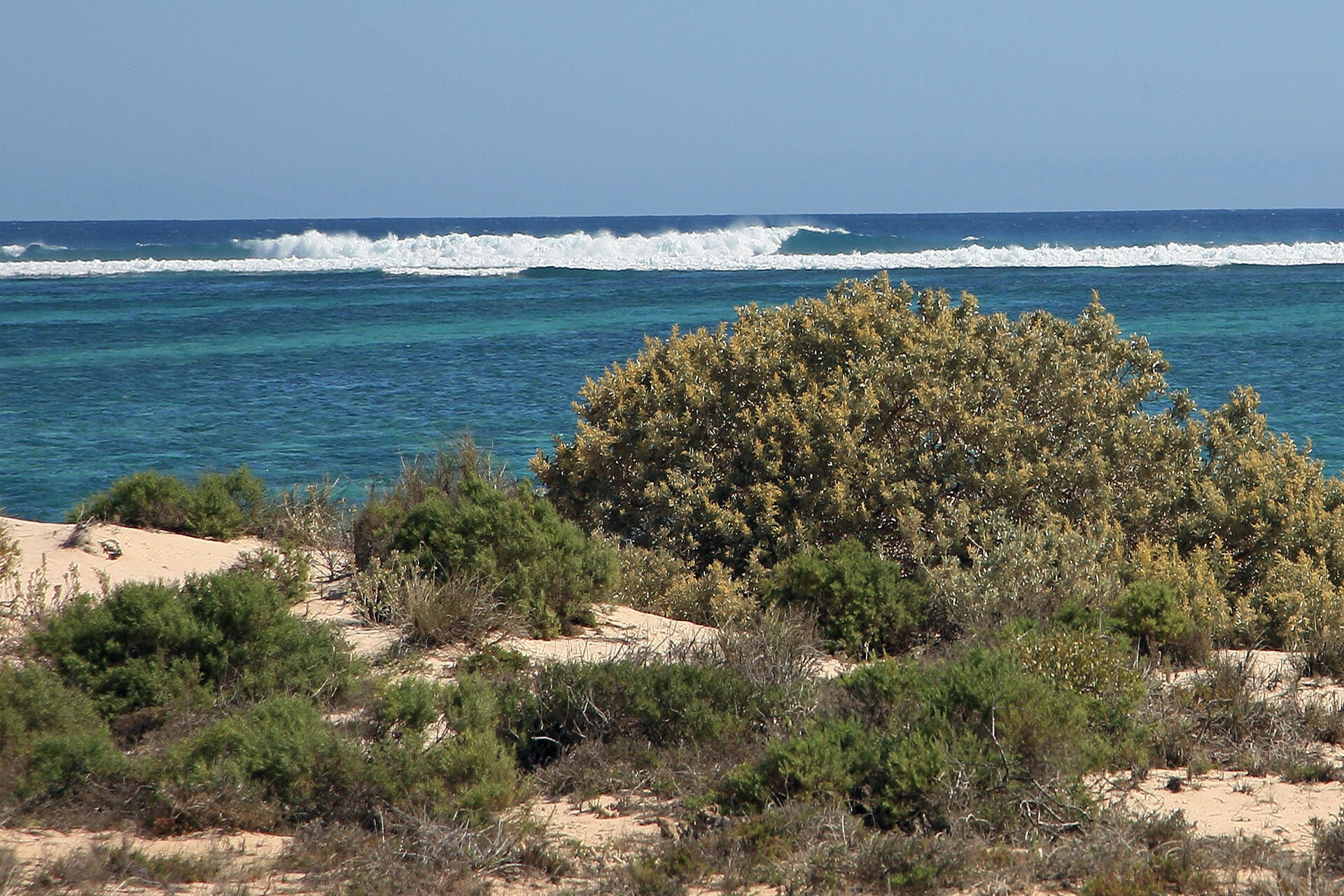
© W. Bulach, CC BY-SA 4.0 Resized from original. (This derivative is under the same CC BY-SA license.)
World Heritage Research
Discover scientific research and academic studies that deepen our understanding of Ningaloo Coast from its history and significance to its conservation, management, and contemporary challenges.
-
Scale and world heritage on the Ningaloo Coast
Research on the Ningaloo Coast, Western Australia, reveals that scale is not merely a technical tool but a dynamic force shaping heritage landscapes. It exposes how political contests and ethical considerations influence resource flows, intertwining with physical heritage forms. This study demonstrates the intricate connections between human actions and non-human forces in defining heritage, offering insights into the complex interplay of social dynamics and environmental factors at UNESCO World Heritage Sites.
Jones, T., Jones, R., & Hughes, M. (2023). Scale and world heritage on the Ningaloo Coast. Heritage Is Movement, 48–53. https://doi.org/10.4324/9781003374008-5
View Publication Record | Read Publication -
Engaging More Effectively With Visitors to Coastal Regions for Improved Management Outcomes: Insights From the Ningaloo Coast, Australia
Visitors to the Ningaloo Coast World Heritage Area, while optimistic about its future sustainability, lack awareness of local rules and regulations and recognize tourism as a significant threat. Most believe their own environmental behavior is high, though this varies by gender. They primarily gather information during visits through signage and visitor centers. The study used a case approach to assess visitors' perceptions, behaviors, and responses to different message framings, aiming to inform more effective coastal management strategies.
Cvitanovic, C., van Putten, E. I., Kelly, R., Feldman, H. R., van Steveninck, T. J., Mackay, M., Badullovich, N., & Gourlay, T. (2020). Engaging More Effectively With Visitors to Coastal Regions for Improved Management Outcomes: Insights From the Ningaloo Coast, Australia. Frontiers in Marine Science, 7. https://doi.org/10.3389/fmars.2020.00583
View Publication Record | Read Publication -
Rapid wound healing in a reef manta ray masks the extent of vessel strike
A reef manta ray's rapid wound healing, documented over nearly three years, reveals that lacerations from vessel strikes can close to 95% within 295 days, leaving distinctive scars. This finding challenges prior assumptions about the cause of such scars, which were often attributed to failed predation attempts. Researchers analyzed an extensive photo-identification catalogue from the Ningaloo Coast World Heritage Area, demonstrating that propeller-induced scarring is more common than previously recognized. The study provides critical baseline data on wound healing rates in manta rays and suggests increased vessel strikes in this region, with implications for spatial and behavioral management strategies to mitigate future conflicts.
McGregor, F., Richardson, A. J., Armstrong, A. J., Armstrong, A. O., & Dudgeon, C. L. (2019). Rapid wound healing in a reef manta ray masks the extent of vessel strike. Plos One, 14(12), e0225681. https://doi.org/10.1371/journal.pone.0225681
View Publication Record | Read Publication -
Community Perceptions of a World Heritage Nomination Process: The Ningaloo Coast Region of Western Australia
Local community involvement in the Ningaloo Coast's World Heritage nomination process revealed mixed perceptions, with support for designation overshadowed by controversy. Key concerns included political and social dominance, mistrust, misinformation, and perceived unfairness, influenced by past government actions. The study highlights challenges in participatory governance, questioning how local communities can effectively engage in such processes for globally significant coastal regions.
Hughes, M., Jones, T., & Phau, I. (2016). Community Perceptions of a World Heritage Nomination Process: The Ningaloo Coast Region of Western Australia. Coastal Management, 44(2), 139–155. https://doi.org/10.1080/08920753.2016.1135275
View Publication Record | Read Publication -
Heritage designation and scale: a World Heritage case study of the Ningaloo Coast
Heritage designation and scale are not just hierarchical abstractions but dynamic relationships shaped by spatial politics. This study redefines 'scale' in heritage research to include size (geographical), level (vertical), and relation, revealing how these elements interact in specific contexts. Using the Ningaloo Coast World Heritage Site as a case study, it demonstrates that heritage processes are constituted through complex interrelationships, with researchers' choices about scale being inherently political. The analysis highlights how spatial politics come into focus when examining configurations of size, level, and relation within heritage designation processes.
Jones, T., Jones, R., & Hughes, M. (2015). Heritage designation and scale: a World Heritage case study of the Ningaloo Coast. International Journal of Heritage Studies, 22(3), 242–260. https://doi.org/10.1080/13527258.2015.1120226
View Publication Record | Read Publication