World Heritage Identification Number: 578
World Heritage since: 1991
Category: Natural Heritage
WHE Type: Natural Landscapes & Geographic Features
Transboundary Heritage: No
Endangered Heritage: No
Country: 🇦🇺 Australia
Continent: Oceania
UNESCO World Region: Asia and the Pacific
Map
Unveiling the Natural Wonders of Shark Bay, Western Australia
Shark Bay, a World Heritage Site located in the Gascoyne region of Western Australia, stands out as one of the most significant natural treasures on Earth. Stretching over an expansive area of approximately 23,000 square kilometers, this remote region lies around 800 kilometers north of Perth, marking the westernmost point of the Australian continent. Shark Bay consists of two large bays, sheltered by peninsulas and the long Dirk Hartog island, creating a unique coastal environment.
The site's official short description by UNESCO highlights three exceptional natural features that set Shark Bay apart from other regions. Firstly, the vast sea-grass beds, covering an astounding 4,800 square kilometers, are the largest and richest in the world. These seagrass meadows serve as crucial habitats for various marine species, including dugongs, or 'sea cows,' which can be found in abundance within Shark Bay.
Dugongs are herbivorous marine mammals that primarily feed on sea grasses. They are highly vulnerable to human activities and face numerous threats, making their presence in Shark Bay even more remarkable. The site is also home to five of Australia's 26 species of endangered mammals, as well as 35 percent of Australian bird species and abundant marine flora and fauna, further emphasizing its importance in preserving biodiversity.
Another unique feature of Shark Bay is its stromatolites. These colonies of algae form hard, dome-shaped deposits and represent some of the oldest forms of life on Earth, with modern-day microbial life similar to organisms that existed over 3.5 billion years ago. Found in specific locations within the bay, these structures offer valuable insights into the early stages of life on our planet.
Beyond these notable characteristics, Shark Bay boasts a diverse array of ecosystems, including mangrove forests, coral reefs, and sandy beaches. The region is particularly renowned for its birdlife, with over 250 bird species recorded, many of which migrate here seasonally.
In addition to its natural wonders, Shark Bay holds cultural significance for the local Indigenous communities. Particularly, the Malgana, Nhanda and Yingkarta peoples have lived in harmony with this environment for thousands of years, passing down traditional knowledge and connection to the land and sea from generation to generation.
The designation of Shark Bay as a World Heritage Site in 1991 recognizes its outstanding universal value and underscores the need for its protection and conservation. Visitors to Shark Bay are invited to immerse themselves in this pristine wilderness, appreciating its natural beauty while respecting the delicate balance between humans and the environment.
To bring it all together, Shark Bay, Western Australia, offers a captivating glimpse into the richness and diversity of Earth's natural heritage. Its vast sea-grass beds, thriving dugong populations, and ancient stromatolites make it a must-visit destination for anyone seeking to connect with the wonders of our planet.
UNESCO Description of the World Heritage Site
At the most westerly point of the Australian continent, Shark Bay, with its islands and the land surrounding it, has three exceptional natural features: its vast sea-grass beds, which are the largest (4,800 km2) and richest in the world; its dugong (‘sea cow’) population; and its stromatolites (colonies of algae which form hard, dome-shaped deposits and are among the oldest forms of life on earth). Shark Bay is also home to five species of endangered mammals.
UNESCO Justification of the World Heritage Site
Criterion (vii): One of the superlative natural phenomena present in this property is its stromatolites, which represent the oldest form of life on Earth and are comparable to living fossils. Shark Bay isalso one of the few marine areas in the world dominated by carbonates not associated with reef-building corals. This has led to the development of the Wooramel Seagrass Bank within Shark Bay, one of the largest seagrass meadows in the world with the most seagrass species recorded from one area. These values are supplemented by marine fauna such as dugong, dolphins, sharks, rays, turtles and fish, which occur in great numbers. The hydrologic structure of Shark Bay, altered by the formation of the Faure Sill and a high evaporation, has produced a basin where marine waters are hypersaline (almost twice that of seawater) and contributed to extensive beaches consisting entirely of shells. The profusion of peninsulas, islands and bays create a diversity of landscapes and exceptional coastal scenery.
Criterion (viii): Shark Bay contains, in the hypersaline Hamelin Pool, the most diverse and abundant examples of stromatolites (hard, dome-shaped structures formed by microbial mats) in the world. Analogous structures dominated marine ecosystems on Earth for more than 3,000 million years. The stromatolites of Hamelin Pool were the first modern, living examples to be recognised that have a morphological diversity and abundance comparable to those that inhabited Proterozoic seas. As such, they are one of the world’s best examples of a living analogue for the study of the nature and evolution of the earth’s biosphere up until the early Cambrian. The Wooramel Seagrass Bank is also of great geological interest due to the extensive deposit of limestone sands associated with the bank, formed by the precipitation of calcium carbonate from hypersaline waters.
Criterion (ix): Shark Bay provides outstanding examples of processes of biological and geomorphic evolution taking place in a largely unmodified environment. These include the evolution of the Bay’s hydrological system, the hypersaline environment of Hamelin Pool and the biological processes of ongoing speciation, succession and the creation of refugia. One of the exceptional features of Shark Bay is the steep gradient in salinities, creating three biotic zones that have a marked effect on the distribution and abundance of marine organisms. Hypersaline conditions in Hamelin Pool have led to the development of a number of significant geological and biological features including the ‘living fossil’ stromatolites. The unusual features of Shark Bay have also created the Wooramel Seagrass Bank. Covering 103,000 ha, it is the largest structure of its type in the world. Seagrasses are aquatic flowering plants that form meadows in near-shore brackish or marine waters in temperate and tropical regions, producing one of the world’s most productive aquatic ecosystems. Australia has one of the highest diversity of seagrasses globally, with 12 species occurring in the Bay.
Criterion (x): Shark Bay is a refuge for many globally threatened species of plants and animals. The property is located at the transition zone between two of Western Australia’s main botanical provinces, the arid Eremaean, dominated by Acacia species and the temperate South West, dominated by Eucalyptus species, and thus contains a mixture of two biotas, many at the limit of their southern or northern range. The property contains either the only or major populations of five globally threatened mammals, including the Burrowing Bettong (now classified as Near Threatened), Rufous Hare Wallaby, Banded Hare Wallaby, the Shark Bay Mouse and the Western Barred Bandicoot. A number of globally threatened plant and reptile species also occur in the terrestrial part of the property. Shark Bay’s sheltered coves and lush seagrass beds are a haven for marine species, including Green Turtle and Loggerhead Turtle (both Endangered, and the property provides one of Australia’s most important nesting areas for this second species). Shark Bay is one of the world’s most significant and secure strongholds for the protection of Dugong, with a population of around 11,000. Increasing numbers of Humpback Whales and Southern Right Whales use Shark Bay as a migratory staging post, and a famous population of Bottlenose Dolphin lives in the Bay. Large numbers of sharks and rays are readily observed, including the Manta Ray which is now considered globally threatened.
Encyclopedia Record: Shark Bay
Shark Bay is a World Heritage Site in the Gascoyne region of Western Australia. The 23,000-square-kilometre (8,900 sq mi) area is located approximately 800 kilometres (500 mi) north of Perth, on the westernmost point of the Australian continent.Additional Site Details
Area: 2,200,902 hectares
Number of Components: 1
(viii) — Outstanding example representing major earth stages
(ix) — Outstanding example representing ecological and biological processes
(x) — Contains most important habitats for biodiversity
Coordinates: -25.48611111 , 113.4361111
IUCN World Heritage Outlook
The 2025 Conservation Outlook on Shark Bay, Western Australia reports the following assessment:
Source: International Union for Conservation of Nature (IUCN) · View assessment
Image
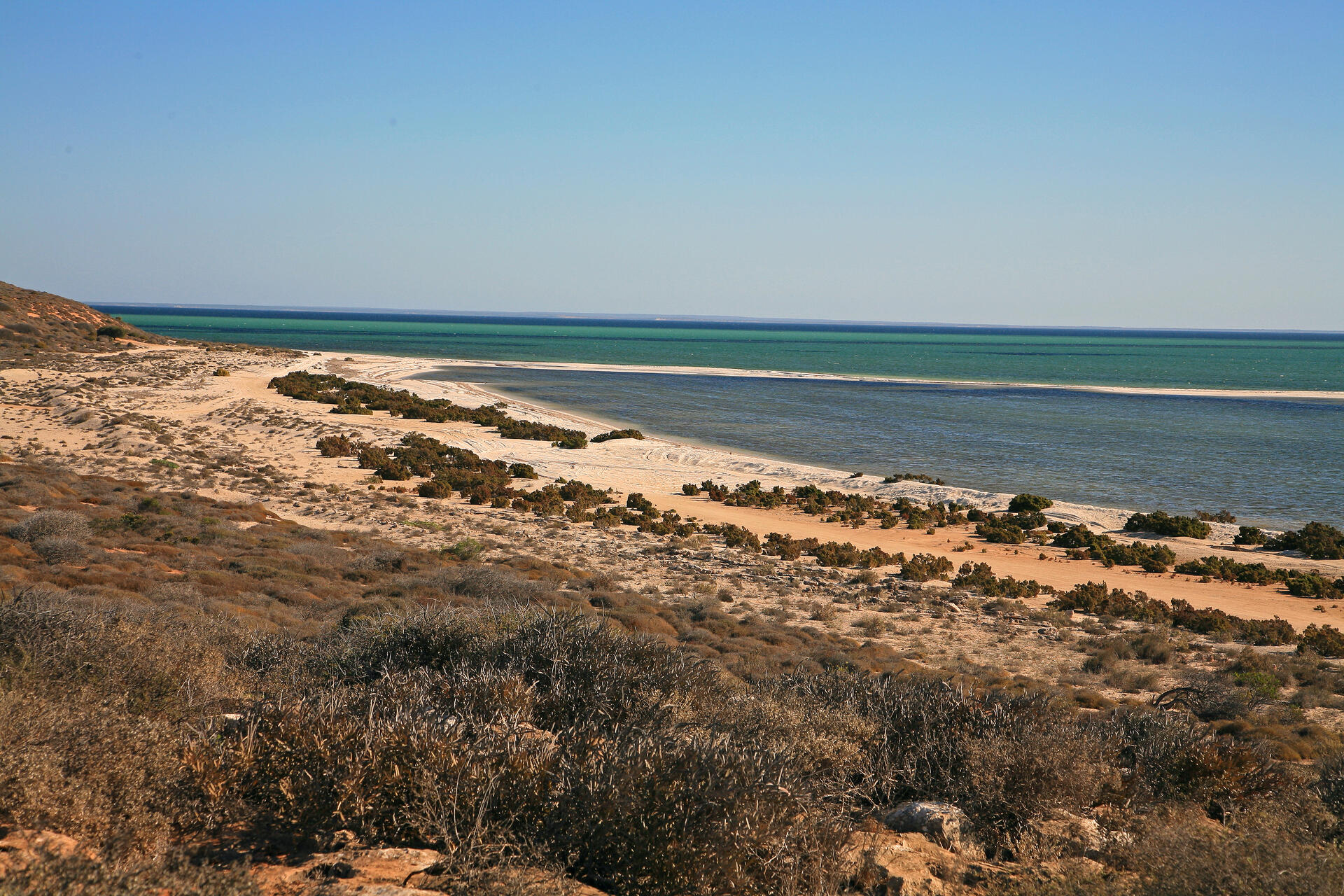
© W. Bulach, CC BY-SA 4.0 Resized from original. (This derivative is under the same CC BY-SA license.)
World Heritage Research
Discover scientific research and academic studies that deepen our understanding of Shark Bay, Western Australia from its history and significance to its conservation, management, and contemporary challenges.
-
Healing country together: A seagrass restoration case study from Gathaagudu (Shark Bay)
A successful seagrass restoration project in Shark Bay, Western Australia, demonstrates the power of integrating Western science with Indigenous traditional ecological knowledge. The partnership, involving the Malgana Aboriginal Corporation Ranger program, facilitated two-way knowledge sharing through On Country workshops, leading to effective restoration methods tailored for Gathaagudu. This collaboration not only restored seagrass ecosystems but also fostered cultural education, language preservation, and a deeper connection between people and their environment. The study highlights the potential of such partnerships to address long-standing restoration challenges while promoting holistic healing for both people and Country.
Sinclair, E. A., Statton, J., Austin, R., Breed, M. F., Cross, R., Dodd, A., Kendrick, A., Krauss, S. L., McNeair, B., McNeair, N., McNeair, S., Oakley, M., Oakley, P., Oxenham, T., Pedrocchi, N. D., Roelofs, T. P., Wear, L., & Kendrick, G. A. (2024). Healing country together: A seagrass restoration case study from Gathaagudu (Shark Bay). Ocean & Coastal Management, 256, 107274. https://doi.org/10.1016/j.ocecoaman.2024.107274
View Publication Record | Read Publication -
Bidirectional fabric evolution in Hamelin Pool microbialites, Shark Bay, Western Australia
Researchers at Shark Bay, Western Australia, have uncovered bidirectional fabric evolution in microbialites within Hamelin Pool, revealing that these structures evolve both upward and downward as they grow. The study identified four accretionary mat types—pustular, smooth, colloform, and transitional—and demonstrated that while the surface mats change with water depth, subsurface microfabrics undergo a taphonomic progression from depositional architecture to micritic thickening and cement infilling. This bidirectional evolution suggests microbialites are not solely products of accretionary mat types but also result from early lithification processes, potentially enhancing their preservation in the geological record. The findings were derived from mesoscale and microscale observations, including polished slabs, thin section scans, optical microscopy, scanning electron microscopy, and energy-dispersive X-ray spectroscopy.
Vitek, B. E., Suosaari, E. P., Oehlert, A. M., Dupraz, C., Pollier, C. G. L., & Reid, R. P. (2023). Bidirectional fabric evolution in Hamelin Pool microbialites, Shark Bay, Western Australia. The Depositional Record, 9(4), 959–988. Portico. https://doi.org/10.1002/dep2.244
View Publication Record | Read Publication -
Little change in surface sediment carbon stock following seagrass restoration in Shark Bay, Western Australia
A study on seagrass restoration in Shark Bay, Western Australia, reveals that surface sediment carbon stocks show little to no recovery up to five years after the restoration of Posidonia australis. Despite efforts to restore seagrass meadows, organic carbon concentrations and isotopic signatures (δ13C) in newly restored areas remained statistically indistinguishable from unvegetated sand. This suggests that carbon sequestration capacity does not return quickly even with successful seagrass reestablishment. The findings highlight the slow recovery of sediment carbon stocks following restoration efforts, with potential implications for climate change mitigation strategies relying on seagrass restoration.
Rahayu, Y. P., Kendrick, G. A., Fraser, M. W., & Vanderklift, M. A. (2023). Little change in surface sediment carbon stock following seagrass restoration in Shark Bay, Western Australia. Estuarine, Coastal and Shelf Science, 294, 108535. https://doi.org/10.1016/j.ecss.2023.108535
View Publication Record | Read Publication -
Assessing the Influence of HGT on the Evolution of Stress Responses in Microbial Communities from Shark Bay, Western Australia
Research at Shark Bay, Western Australia, reveals that horizontal gene transfer (HGT) has played a significant role in the evolution of stress response mechanisms in microbial communities inhabiting pustular mats. These mats serve as modern analogs of ancient microbial systems and are subject to various environmental stresses such as osmotic stress, oxidative stress, and arsenic toxicity. Using the MetaCHIP tool, scientists identified HGT events related to stress response genes in 83 metagenome-assembled genomes. Phylogenetic analyses suggest that these gene transfers may have occurred outside modern pustular mats, indicating a potentially long history of HGT. Notably, a specific osmoprotectant transport gene shows recent adaptations, hinting at interactions between Planctomycetota and Myxococcota within the mats. The findings underscore the ongoing microbial adaptations and evolution in these unique ecosystems.
Skoog, E. J., Fournier, G. P., & Bosak, T. (2023). Assessing the Influence of HGT on the Evolution of Stress Responses in Microbial Communities from Shark Bay, Western Australia. Genes, 14(12), 2168. https://doi.org/10.3390/genes14122168
View Publication Record | Read Publication -
Metagenomic, (bio)chemical, and microscopic analyses reveal the potential for the cycling of sulfated EPS in Shark Bay pustular mats
Research at Shark Bay, Western Australia, reveals that sulfated extracellular polymeric substances (EPS) play a significant role in microbial interactions and carbon cycling within ancient peritidal pustular mats. Metagenomic analysis identified cyanobacteria as the primary producers of these sulfated polysaccharides, while enzymes like sulfatases and glycosyl hydrolases, detected across multiple bacterial clades, indicate active degradation processes. Biochemical and microscopic analyses confirmed that sulfur abundance correlates with cyanobacterial presence, suggesting a dynamic cycle of synthesis, modification, and degradation that influences biomineralization and microbial community structure.
Skoog, E. J., Moore, K. R., Gong, J., Ciccarese, D., Momper, L., Cutts, E. M., & Bosak, T. (2022). Metagenomic, (bio)chemical, and microscopic analyses reveal the potential for the cycling of sulfated EPS in Shark Bay pustular mats. ISME Communications, 2(1). https://doi.org/10.1038/s43705-022-00128-1
View Publication Record | Read Publication -
The microbial carbonate factory of Hamelin Pool, Shark Bay, Western Australia
Hamelin Pool, located in Shark Bay, Western Australia, functions as a modern microbial carbonate factory, offering critical insights into sedimentary deposits of microbial origin found in the geologic record. This study reveals that while the pool is renowned for its living marine stromatolites, erosion and degradation of weakly lithified microbial mats significantly contribute to the production and accumulation of sand-sized micritic grains. Comprehensive mapping shows that over 40 km² of upper intertidal shoreline and 20 km² of subtidal pavements are colonized by these mats, which erode to form irregular peloidal grains and platey micritic intraclasts. Together, these sediments make up nearly 26% of the total sediment in the pool, plausibly producing around 24,000 metric tons annually. This dual process of construction by lithifying microbial mats and erosion of weakly lithified mats provides a modern analog for ancient microbialite-micritic sediment facies associations.
Suosaari, E. P., Reid, R. P., Mercadier, C., Vitek, B. E., Oehlert, A. M., Stolz, J. F., Giusfredi, P. E., & Eberli, G. P. (2022). The microbial carbonate factory of Hamelin Pool, Shark Bay, Western Australia. Scientific Reports, 12(1). https://doi.org/10.1038/s41598-022-16651-z
View Publication Record | Read Publication -
Structure and function of Shark Bay microbial communities following tropical cyclone Olwyn: A metatranscriptomic and organic geochemical perspective
Tropical cyclones significantly alter microbial communities and geochemical processes in Shark Bay, Western Australia. Following Cyclone Olwyn (2015), black sludge deposits formed between microbialite columns, dominated by heterotrophic and anaerobic microbes like methanogens and sulfate-reducing bacteria. These microbes drove calcium carbonate precipitation, aiding mat preservation. Organic geochemical analysis revealed elevated C25 highly branched isoprenoid (HBI) alkenes, linked to cyclone-induced relocation of subtidal sediments containing HBI-producing diatoms. Additionally, sulfur-bound hopanoids and benzohopanes in mucilaginous cobbles suggested microbial matter influenced by cyclone-driven anoxia, promoting organic sulfurization. The study used metatranscriptomic and GC-MS analyses to uncover these post-cyclone changes.
Campbell, M. A., Coolen, M. J. L., Visscher, P. T., Morris, T., & Grice, K. (2021). Structure and function of Shark Bay microbial communities following tropical cyclone Olwyn: A metatranscriptomic and organic geochemical perspective. Geobiology, 19(6), 642–664. Portico. https://doi.org/10.1111/gbi.12461
View Publication Record | Read Publication