World Heritage Identification Number: 1709
World Heritage since: 2025
Category: Cultural Heritage
WHE Type: Cultural Landscapes
Transboundary Heritage: No
Endangered Heritage: No
Country: 🇦🇺 Australia
Continent: Oceania
UNESCO World Region: Asia and the Pacific
Map
Murujuga Cultural Landscape: A Journey Through Time and Culture
The Murujuga Cultural Landscape, inscribed as a UNESCO World Heritage Site in 2025, offers a remarkable glimpse into the rich cultural history of Australia's indigenous peoples. This significant site, spanning the Burrup Peninsula, the Dampier Archipelago's 42 islands, and adjacent marine areas, is a testament to the enduring connection between the land, sea, and the Ngarda-Ngarli, the Traditional Owners and Custodians of this sacred territory.
More to come…UNESCO Description of the World Heritage Site
Murujuga is a landscape of ancient rocks located in northwest Australia, which encompasses the Burrup Peninsula, the Dampier Archipelago’s 42 islands, and nearby marine areas. It is shaped by the Lore—rules and narratives that were put in place to create the Country—and the enduring presence of the Ngarda-Ngarli, Traditional Owners and Custodians of the site. The property holds profound cultural and spiritual significance, reflecting over 50,000 years of continuous care and use. Murujuga is renowned for its dense concentration of petroglyphs, featuring unique motifs that display artistic and technical mastery.
Encyclopedia Record: Murujuga National Park
Murujuga National Park is a national park on Burrup Peninsula in the Pilbara region in the north-west of Western Australia, covering an area of 48.51 km2 (18.73 sq mi).Additional Site Details
Area: 99.881 hectares
Number of Components: 1
(iii) — Unique or exceptional testimony to a cultural tradition
(v) — Outstanding example of traditional human settlement
Coordinates: -20.5650277778 , 116.6685277778
Image
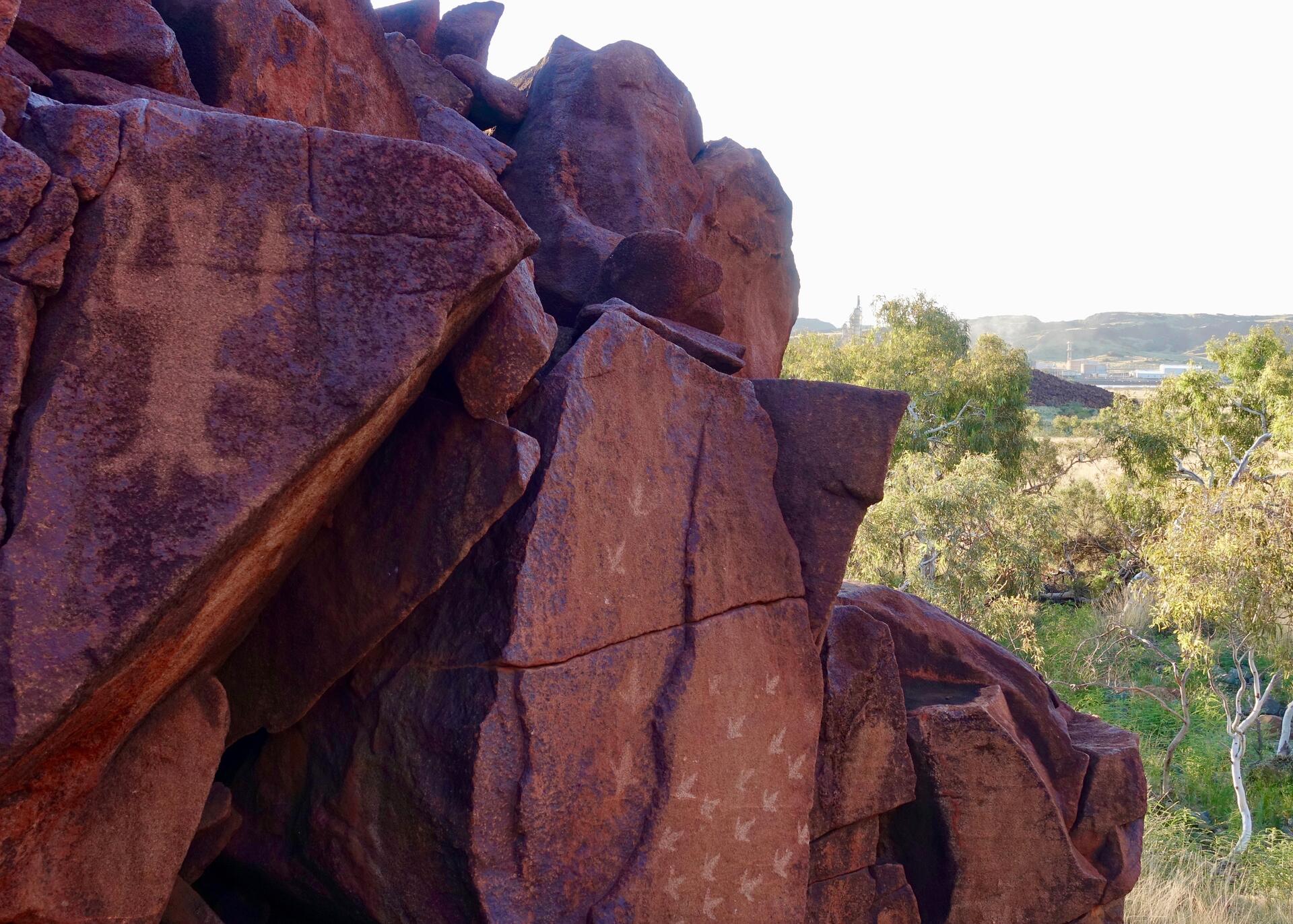
© Marius Fenger, CC BY-SA 4.0 Resized from original. (This derivative is under the same CC BY-SA license.)
World Heritage Research
Discover scientific research and academic studies that deepen our understanding of Murujuga Cultural Landscape from its history and significance to its conservation, management, and contemporary challenges.
-
Provenance analysis of stone artefact assemblages using petrography and pXRF at Murujuga (the Dampier Archipelago), Western Australia
Over half of the stone artefacts at Nganjarli (Deep Gorge) on Murujuga, Western Australia, were sourced from non-local outcrops, a finding that highlights complex human mobility patterns in this culturally significant landscape. Researchers used petrography and portable X-ray fluorescence (pXRF) to analyze artefact assemblages across four sites, demonstrating the technique's effectiveness for in situ provenance analysis. By distinguishing local rock types using geochemical markers like zirconium (Zr) and titanium (Ti), the study revealed that most artefacts at other sites were locally sourced. This approach enhances understanding of landscape attachment and mobility in a region rich in tool-stone resources.
Fairweather, J. H., George, A. D., & McDonald, J. (2025). Provenance analysis of stone artefact assemblages using petrography and pXRF at Murujuga (the Dampier Archipelago), Western Australia. Journal of Archaeological Science: Reports, 66, 105334. https://doi.org/10.1016/j.jasrep.2025.105334
View Publication Record | Read Publication -
Local—National—Global: Defining Indigenous Values of Murujuga’s Cultural Landscape in the Frame of International Patrimony
The pursuit of UNESCO World Heritage recognition for Murujuga, Australia, highlights a significant disconnect between Indigenous custodial values and the international framework of Outstanding Universal Value (OUV). While the Ngarda-Ngarli people seek global validation to strengthen protection against industrial encroachment, their conceptualization of ngurra (country) as an integrated natural and cultural domain challenges UNESCO's binary distinction. This study demonstrates that World Heritage status could empower local custodianship but also underscores the need for frameworks that better align with Indigenous perspectives.
Stevens, A., & McDonald, J. (2024). Local—National—Global: Defining Indigenous Values of Murujuga’s Cultural Landscape in the Frame of International Patrimony. Deep-Time Images in the Age of Globalization, 219–231. https://doi.org/10.1007/978-3-031-54638-9_15
View Publication Record | Read Publication -
Without them – what then? People, petroglyphs and Murujuga
Murujuga, a culturally significant landscape with one of the world's largest concentrations of petroglyphs, has been successfully managed and protected through collaboration between five Aboriginal language groups and the Murujuga Aboriginal Corporation (MAC), despite historical conflicts in Australian rock art research. Unlike other regions marred by professional-amateur rivalries, Murujuga's preservation efforts have thrived due to political cooperation and partnerships with Traditional Owners, leading to its inclusion on Australia's National Heritage List (2007) and the UNESCO World Heritage Tentative List (2020). The landscape's spiritual significance and unique stone arrangements, recognized through decades of advocacy, underscore the importance of Indigenous custodianship in safeguarding cultural heritage amid industrial pressures.
Mulvaney, K. (2022). Without them – what then? People, petroglyphs and Murujuga. Histories of Australian Rock Art Research, 155–172. https://doi.org/10.22459/ta55.2022.09
View Publication Record | Read Publication -
Seeing and managing rock art at Nganjarli: A tourist destination in Murujuga National Park, Western Australia
Nganjarli, a key site within Murujuga National Park and the Dampier Archipelago National Heritage Place, has been identified as a primary destination for tourism due to its rich rock art, shell middens, and artifact scatters. The study reveals that Nganjarli has functioned as an aggregation locale over time, with archaeological evidence indicating early occupation phases. Innovative scientific approaches, including digital imaging and geochemical testing of lithic artifacts using X-ray fluorescence, have been crucial in interpreting the site's cultural significance. These findings, along with targeted shell harvesting patterns, have been integrated into upgraded tourist facilities to enhance visitor experience while respecting the cultural values and aspirations of Murujuga custodians.
McDonald, J., Mulvaney, K., Beckett, E., Fairweather, J., Morrison, P., de Koning, S., Dortch, J., & Jeffries, P. (2021). Seeing and managing rock art at Nganjarli: A tourist destination in Murujuga National Park, Western Australia. Australian Archaeology, 87(3), 268–293. https://doi.org/10.1080/03122417.2021.1978915
View Publication Record | Read Publication -
The integrated cultural landscape of North Gidley Island: Coastal, intertidal and nearshore archaeology in Murujuga (Dampier Archipelago), Western Australia
Recent archaeological research at Murujuga, Western Australia, reveals that Indigenous Australian cultural landscapes extend beyond modern shorelines into submerged and intertidal zones. The study demonstrates that sea-level fluctuations during the Last Glacial Maximum (LGM) exposed vast coastal areas, which were later inundated as sea levels rose. Submerged sites, such as those in the Cape Bruguieres channel and Gidley Islands, provide evidence of past human activity, including rock art engravings, grinding patches, quarries, and upstanding stones—some now located in intertidal zones. By integrating aerial, pedestrian, and intertidal surveys with subtidal data, researchers have reconstructed a continuous cultural landscape that spans both terrestrial and submerged environments, offering new insights into the depth and resilience of Indigenous Australian maritime traditions.
Leach, J., Wiseman, C., O’Leary, M., McDonald, J., McCarthy, J., Morrison, P., Jeffries, P., Hacker, J., Ulm, S., Bailey, G., & Benjamin, J. (2021). The integrated cultural landscape of North Gidley Island: Coastal, intertidal and nearshore archaeology in Murujuga (Dampier Archipelago), Western Australia. Australian Archaeology, 87(3), 251–267. https://doi.org/10.1080/03122417.2021.1949085
View Publication Record | Read Publication -
Aboriginal artefacts on the continental shelf reveal ancient drowned cultural landscapes in northwest Australia
Researchers have uncovered Australia's first confirmed ancient underwater archaeological sites off the Murujuga coastline, revealing evidence of drowned cultural landscapes submerged by rising sea levels. Two key sites were identified: Cape Bruguieres, with over 260 lithic artefacts at depths up to -2.4 meters, and Flying Foam Passage, linked to a submerged freshwater spring at -14 meters. Using advanced remote sensing techniques and predictive mapping, the study analyzed artefact conditions and geomorphological data to determine that these sites were inundated no later than 7000–8500 years ago. The findings highlight significant differences between underwater and onshore lithic assemblages, supporting the chronological interpretation. This groundbreaking work establishes new strategies for detecting submerged archaeological targets and underscores the urgent need for legislative protection of Australia's vast drowned landscapes, which hold critical clues to its ancient human history.
Benjamin, J., O’Leary, M., McDonald, J., Wiseman, C., McCarthy, J., Beckett, E., Morrison, P., Stankiewicz, F., Leach, J., Hacker, J., Baggaley, P., Jerbić, K., Fowler, M., Fairweather, J., Jeffries, P., Ulm, S., & Bailey, G. (2020). Aboriginal artefacts on the continental shelf reveal ancient drowned cultural landscapes in northwest Australia. Plos One, 15(7), e0233912. https://doi.org/10.1371/journal.pone.0233912
View Publication Record | Read Publication -
Protecting past, present and progress: the reality of coexistence with National and World Heritage properties
A study on Murujuga, also known as the Dampier Archipelago, reveals that coexistence between industrial operations and cultural heritage can yield significant benefits while posing substantial challenges. The research highlights that formalizing and enumerating heritage values enhances targeted management, stakeholder collaboration, impact assessment, and a values-driven approach. However, it also identifies difficulties such as increased regulation, activism, and reputational risks. Despite these challenges, the study notes that certain structures inherent in heritage listing can be leveraged to mitigate these issues. The findings underscore the potential for positive outcomes when balancing industrial development with the preservation of cultural landscapes.
Thomas, D. (2020). Protecting past, present and progress: the reality of coexistence with National and World Heritage properties. The APPEA Journal, 60(2), 544–547. https://doi.org/10.1071/aj19136
View Publication Record | Read Publication -
Seeing the Landscape: Multiple Scales of Visualising Terrestrial Heritage on Rosemary Island (Dampier Archipelago)
A combination of photogrammetry, LiDAR, and microphotography reveals the potential for remote sensing techniques to document and reconstruct Aboriginal stone structures on Rosemary Island (Murujuga), offering insights into their distribution and resilience to sea-level rise. The study highlights how these methods can be used to detect similar submerged features in adjacent waters, while also acknowledging challenges posed by naturally rocky and spinifex-covered landscapes. Topographic LiDAR surveys conducted before and after a wildfire further demonstrate the utility—and limitations—of such techniques for understanding terrestrial heritage in dynamic environments.
McDonald, J., Beckett, E., Hacker, J., Morrison, P., & O’Leary, M. (2020). Seeing the Landscape: Multiple Scales of Visualising Terrestrial Heritage on Rosemary Island (Dampier Archipelago). Open Quaternary, 6. https://doi.org/10.5334/oq.81
View Publication Record | Read Publication -
Murujuga, Northwestern Australia: When Arid Hunter-Gatherers Became Coastal Foragers
Research at Murujuga, a UNESCO-listed cultural landscape in northwestern Australia, reveals the transition of arid hunter-gatherers to coastal foragers during the early Holocene. The study provides evidence for Australia's earliest domestic stone structures, dated between 8063 and 7355 cal BP, on Rosemary Island, challenging assumptions about island abandonment and recolonization. By integrating a 47,000-year occupation sequence from the Pilbara region with predictive models of sea-level rise, the research offers insights into how mobile arid hunter-fisher-gatherers adapted to changing seascape dynamics. This work not only advances our understanding of human adaptation in coastal environments but also contributes to the broader narrative of insular abandonment and resilience.
McDonald, J., & Berry, M. (2016). Murujuga, Northwestern Australia: When Arid Hunter-Gatherers Became Coastal Foragers. The Journal of Island and Coastal Archaeology, 12(1), 24–43. https://doi.org/10.1080/15564894.2015.1125971
View Publication Record | Read Publication