World Heritage Identification Number: 896
World Heritage since: 1999
Category: Cultural Heritage
WHE Type: Buildings & Architectural Ensembles
Transboundary Heritage: No
Endangered Heritage: No
Country: 🇩🇪 Germany
Continent: Europe
UNESCO World Region: Europe and North America
Map
A Cultural Testimony: Museumsinsel (Museum Island), Berlin
The Museumsinsel, or Museum Island, situated in the historical heart of Berlin, Germany, stands as a testament to the architectural and cultural development of museums in the 19th and 20th centuries. This UNESCO World Heritage Site, inscribed in 1999, offers a unique insight into the evolution of museum design and the preservation of art and civilization's history.
The Museum Island complex, originally conceived in 1823 and constructed between 1830 and 1930, was commissioned by the Prussian Kings. The project was executed by four principal architects, each contributing their distinctive styles to the various museums that now form this impressive ensemble. The island, which spans the northern part of Spree Island, is one of Berlin's most frequented tourist attractions and ranks among Europe's most significant museum sites.
The Altes Museum, the oldest of the five museums, was completed in 1830. Its neoclassical architecture reflects the Age of Enlightenment's influence, while its collection focuses on ancient Greek and Roman artifacts. The Neues Museum, built between 1843 and 1855, exhibits artifacts from Egypt, the Near East, and Prehistory.
The Alte Nationalgalerie, erected in 1876, displays works from the Romantic period to the end of the 19th century. The Bode-Museum, added in 1904, features sculptures, coins, and Byzantine art. Lastly, the Pergamon Museum, inaugurated in 1930, boasts the Pergamon Altar and the Ishtar Gate of Babylon. The museum is currently undergoing extensive renovations, with partial reopening expected in Spring 2027 and full completion by 2037.
Each museum was intentionally designed to create an organic connection with the art it houses, reflecting the visionary project's aim to preserve and display art in a harmonious setting. The importance of the museum's collections, which span the development of civilizations throughout the ages, is further accentuated by the urban and architectural quality of the buildings.
In addition to the original museums, the Museum Island also includes the Berlin Cathedral, located next to the open Lustgarten park. Although not part of the original UNESCO designation, the historic Berlin Cathedral contributes significantly to the island's cultural significance.
Since German reunification, the Museum Island has undergone extensive rebuilding and expansion according to a master plan. In 2019, a new visitor center and art gallery, the James Simon Gallery, was opened within the Museum Island heritage site. The recently reconstructed Berlin Palace, housing the Humboldt Forum museum, was added south of the Karl Liebknecht Boulevard in 2020. Adjacent to the west branch of the Spree lies the German Historical Museum
As a cultural treasure trove, Museumsinsel (Museum Island) provides visitors with an unparalleled experience of the history of art, civilization, and architectural development. The island serves as a reminder of the past while offering insights into the present, making it an essential destination for anyone interested in understanding the rich tapestry of human history.
UNESCO Description of the World Heritage Site
The museum as a social phenomenon owes its origins to the Age of Enlightenment in the 18th century. The five museums on the Museumsinsel in Berlin, built between 1824 and 1930, are the realization of a visionary project and show the evolution of approaches to museum design over the course of the 20th century. Each museum was designed so as to establish an organic connection with the art it houses. The importance of the museum's collections – which trace the development of civilizations throughout the ages – is enhanced by the urban and architectural quality of the buildings.
UNESCO Justification of the World Heritage Site
Criterion (ii): The Berlin Museumsinsel is a unique ensemble of museum buildings, which illustrates the evolution of modern museum design over more than a century.
Criterion (iv): The modern museum is a social phenomenon that owes its origins to the Age of Enlightenment, and its extension to all people to the French Revolution. The Museumsinsel is the most outstanding example of this concept given material form and placed in a symbolic central urban setting.
Encyclopedia Record: Museum Island
The Museum Island is a museum complex on the northern part of Spree Island in the historic heart of Berlin, Germany. It is one of the capital's most visited sights and one of the most important museum sites in Europe. Originally built from 1830 to 1930, initially by order of the Prussian Kings, according to plans by five architects, the Museum Island was designated a UNESCO World Heritage Site in 1999 because of its testimony to the architectural and cultural development of museums in the 19th and 20th centuries. It consists of the Altes Museum, the Neues Museum, the Alte Nationalgalerie, the Bode-Museum and the Pergamon Museum. As the Museum Island designation includes all of Spree Island north of the Karl Liebknecht Boulevard, the historic Berlin Cathedral is also located there, next to the open Lustgarten park. To the south of Liebknecht Boulevard, the reconstructed Berlin Palace houses the Humboldt Forum museum and opened in 2020. Also adjacent, across the west branch of the Spree is the German Historical Museum. Since German reunification, the Museum Island has been rebuilt and extended according to a master plan. In 2019, a new visitor center and art gallery, the James Simon Gallery, was opened within the Museum Island heritage site.Additional Site Details
Area: 8.6 hectares
Number of Components: 1
(iv) — Outstanding example of a type of building or landscape
Coordinates: 52.51972222 , 13.39861111
Image
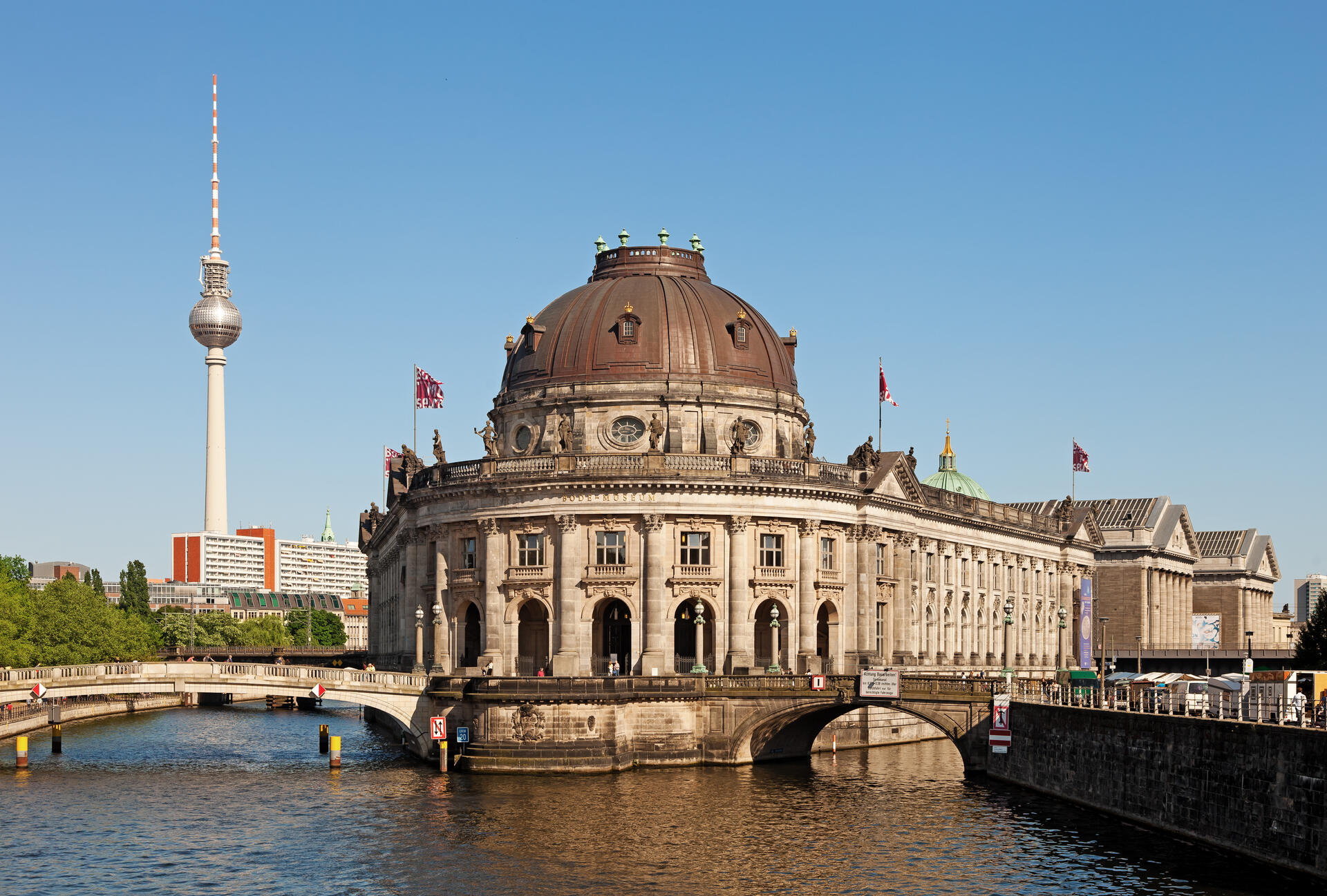
© Thomas Wolf, www.foto-tw.de, CC BY-SA 3.0 Resized from original. (This derivative is under the same CC BY-SA license.)
World Heritage Research
Discover scientific research and academic studies that deepen our understanding of Museumsinsel (Museum Island), Berlin from its history and significance to its conservation, management, and contemporary challenges.
-
Berlin, la réinvention des images patrimoniales
Berlin's post-reunification urban transformation has successfully reimagined its historical and cultural landscape, particularly through the revitalization of iconic sites like Museumsinsel (Museum Island). This study reveals how the city strategically reinterpreted its Prussian heritage to project a modern, globally relevant identity while addressing both domestic and international political agendas. The research focuses on key monuments—such as the Reichstag, Grand Hotel at the Esplanade, and Potsdamer Platz—that were either destroyed or damaged during wartime but later became central to Berlin's commemorative, architectural, and urban projects from 1990 to 2020. By analyzing these efforts, the study demonstrates how a cohesive visual, architectural, and patrimonial narrative was constructed, positioning Berlin as a symbolic capital in the 21st century.
OULEBSIR, N. (2026). Berlin, la réinvention des images patrimoniales. Cahiers d’Études Germaniques, 1 volume(90), 75–90. https://doi.org/10.4000/16hmu
View Publication Record | Read Publication -
Architect Karl Schinkel and Hegel’s Lectures on Aesthetics Postscript to Douglas Crimp’s Article “The End of Art and the Origin of the Museum”
A key insight from this study challenges the prevailing narrative of Douglas Crimp’s 1987 thesis on the 'end of art' and the origins of the museum, particularly regarding the Altes Museum on Berlin's Museum Island. The research reveals that both architect Karl Schinkel and philosopher G.W.F. Hegel played pivotal roles in shaping the museum's conceptual foundations during the 1820s, aligning with Prussian educational reforms under Altenstein. Unlike Crimp’s focus on a material principle gap in art history, this study emphasizes Hegel’s lectures on aesthetics (winter semester 1820/1821), where he introduced a fourth stage of artistic progression—'Civil Baukunst'—to complement the traditional tripartite structure. It also explores the tension between Schinkel’s rationalist architectural approach and Hegel’s spiritual interpretation of beauty, which influenced construction technologies. The study uses selective commentary to recontextualize Crimp’s thesis within broader aesthetic debates of the era.
Loungina, D. A., & Vasileva, M. V. (2026). Architect Karl Schinkel and Hegel’s Lectures on Aesthetics Postscript to Douglas Crimp’s Article “The End of Art and the Origin of the Museum”. Voprosy Filosofii, (3), 143–153. https://doi.org/10.21146/0042-8744-2026-3-143-153
View Publication Record | Read Publication -
Postcolonial Provenance Research, Transcultural Cooperation, and Restitution Practices: Lessons Learnt from the Humboldt Forum
Postcolonial provenance research and restitution practices, as demonstrated by the Humboldt Forum on Museum Island in Berlin, reveal that restitution is not the conclusion but the initiation of a transformative process. This approach, involving transcultural cooperation with Indigenous communities and institutions from the Global South, fosters trust, participation, and mutual learning. The study highlights successful strategies for addressing colonial-era looted artworks through collaborative efforts, setting a precedent for redefining museum relations with non-European cultures. Key lessons emphasize the importance of ongoing dialogue and shared ownership in cultural heritage, offering a model for future restitution practices that bridge historical injustices and pave the way for equitable partnerships.
Parzinger, H. (2025). Postcolonial Provenance Research, Transcultural Cooperation, and Restitution Practices: Lessons Learnt from the Humboldt Forum. Proceedings of the American Philosophical Society, 166(4), 14–28. https://doi.org/10.1353/pro.2025.a976879
View Publication Record | Read Publication -
Samuel Beckett betrachtet zwei Männer, die den Mond betrachten
Samuel Beckett's 1936–1937 journey through Germany, documented in his posthumously discovered 'German Diaries,' offers a unique lens on the perception and preservation of art during a pivotal historical period. His extensive visits to museums, including the Kaiser-Friedrich-Museum (now part of Museum Island, Berlin), reveal a deep engagement with classical art amidst the rising tide of Nazi censorship, particularly the purging of 'degenerate art.' Beckett's meticulous observations, from Hamburg to Munich, highlight the stark contrast between his admiration for old masters and the contemporary political climate. Notably, his visit to Dresden's Zwinger and the replacement of religious greetings with 'Heil Hitler' in Regensburg underscore the era's cultural shifts. This account provides invaluable insights into an artist's perspective on art and history during a transformative period.
Oberhauser, F. (2024). Samuel Beckett betrachtet zwei Männer, die den Mond betrachten. Literaturblatt Für Baden-Württemberg, (5), 20. https://doi.org/10.53458/litbw.vi5.13052
View Publication Record | Read Publication -
Working Through Colonial Collections
Ethnological museums, including those housing colonial collections, face ongoing challenges in reckoning with their colonial legacies. This study reveals how the Ethnological Museum in Berlin navigated substantial transformations during its transition to the Humboldt Forum, grappling with debates over German colonialism and its impact on museum practices. Through two years of ethnographic fieldwork, archival research, and oral histories, the research exposes the museum's embeddedness in colonial logics, highlighting how these manifest in everyday activities such as preservation, curation, and research. The findings offer insights into the laborious processes of confronting colonialism within museums, providing a case study for other ethnological and Western institutions to learn from.
von Oswald, M. (2022). Working Through Colonial Collections. https://doi.org/10.11116/9789461664242
View Publication Record | Read Publication -
Rezension von: Krohm, Hartmut, Riemenschneider auf der Museumsinsel
A detailed examination of the sculptures by Tilman Riemenschneider, housed in Berlin's Museum Island, reveals their profound artistic and historical significance. The study, conducted through a thorough analysis of 175 works, highlights the masterful craftsmanship and cultural depth of these altdeutscher Bildhauerkunst pieces, offering new insights into their techniques, symbolism, and placement within the broader context of European sculpture. Published in 2006, this work serves as both a scholarly reference and an accessible exploration for enthusiasts, combining rigorous academic research with vivid visual documentation.
Setzler, S., & Krohm, H. (2022). Rezension von: Krohm, Hartmut, Riemenschneider auf der Museumsinsel. Schwäbische Heimat, 58(4), 481. https://doi.org/10.53458/sh.v58i4.3738
View Publication Record | Read Publication -
Berlin
Berlin's architectural evolution since the reopening of the Neues Museum in 2009 is documented through 30 key projects, highlighting significant urban development milestones such as the expansion of the Axel Springer building and the iconic Museumsinsel. The book provides a comprehensive overview of both prominent and lesser-known architectural achievements, offering insights into Berlin's transformation through interviews with leading figures in its architecture scene. This publication serves as an indispensable resource for understanding the interplay between architectural innovation and urban planning in modern Berlin.
Heilmeyer, F., & Hofmeister, S. (Eds.). (2022). Berlin. https://doi.org/10.11129/9783955535902
View Publication Record | Read Publication