World Heritage Identification Number: 1239
World Heritage since: 2008
Category: Cultural Heritage
WHE Type: Buildings & Architectural Ensembles
Transboundary Heritage: No
Endangered Heritage: No
Country: 🇩🇪 Germany
Continent: Europe
UNESCO World Region: Europe and North America
Map
Berlin Modernism Housing Estates: A Legacy of Innovative Urban Planning and Architecture
The Berlin Modernism Housing Estates, inscribed as a UNESCO World Heritage Site in 2008 and extended in 2026 to include the Waldsiedlung Zehlendorf, stand as a testament to the progressive social, political, and cultural climate of Berlin during the Weimar Republic (1919–1933). These seven housing estates, each unique in its design and approach, exemplify the building reform movement that aimed to improve housing and living conditions for individuals with lower incomes.
The estates' origins span the period from 1910 to 1934, when Berlin faced rapid urban growth, housing shortages, and significant social change. Following World War I, Germany experienced severe economic challenges and a pressing need for affordable housing. In response, the city of Berlin embraced innovative ideas in urban planning, architecture, and garden design. This forward-thinking attitude led to the creation of these housing estates, which have since left a lasting impact on housing developments around the world.
The Berlin Modernism Housing Estates embodied a new vision of urban living that prioritized health, comfort, and community. Guided by the principles of "light, air, and sunshine," their architects rejected the overcrowded, poorly ventilated tenement blocks that had dominated nineteenth-century Berlin, instead designing neighbourhoods with abundant natural daylight, fresh air, landscaped courtyards, and generous green spaces. These principles reflected a growing belief that well-designed housing could improve both living conditions and residents' quality of life.
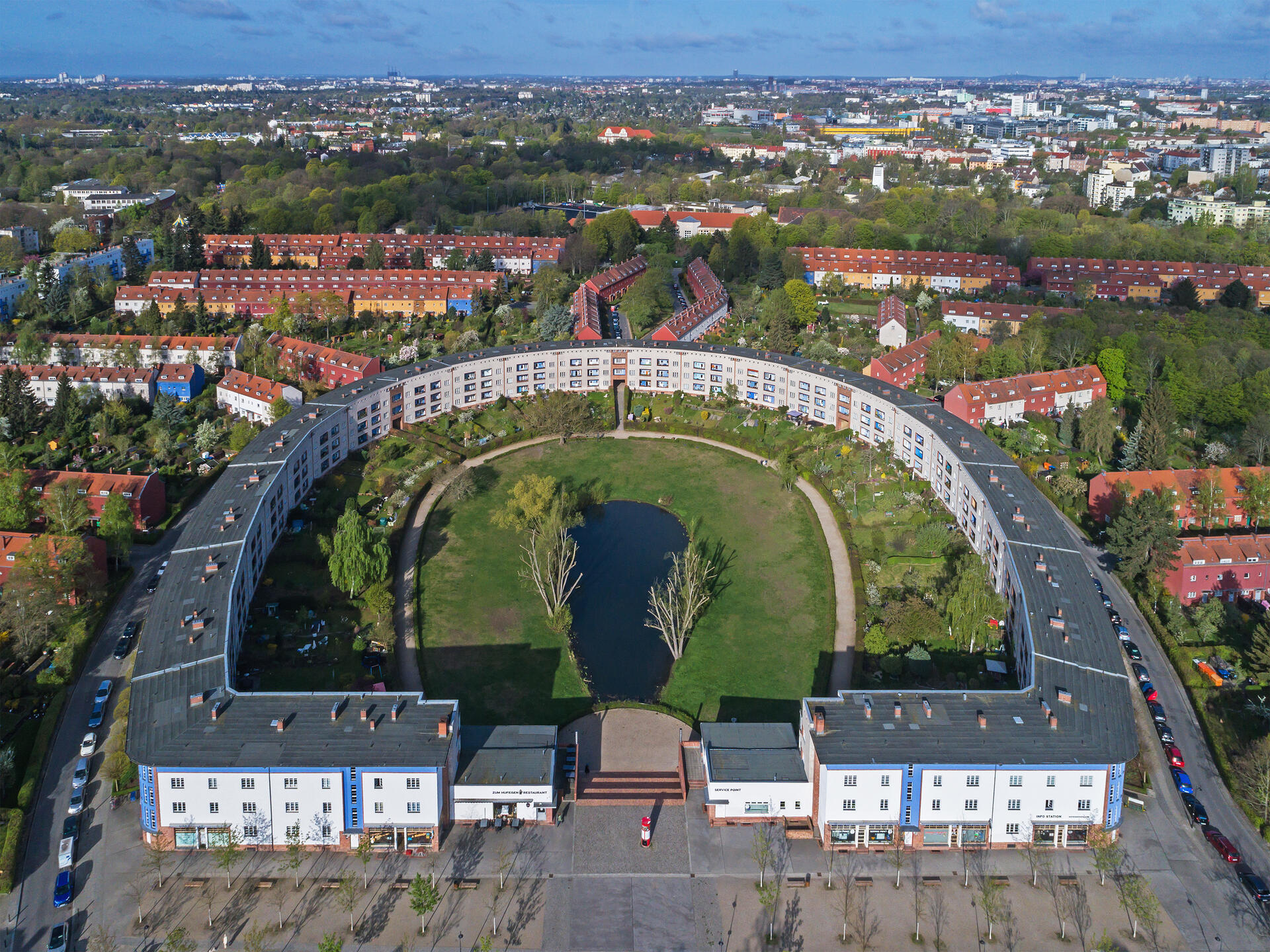
One of the most notable figures associated with these projects is Bruno Taut, who played a crucial role in shaping the estates' design philosophy. Taut advocated for a more harmonious relationship between people and nature, incorporating elements such as gardens, parks, and open spaces into his designs. His work can be seen most prominently in the Hufeisensiedlung (Horseshoe Estate) in Britz, where, in collaboration with city planner Martin Wagner, he sought to create a self-contained community with shared facilities, generous green spaces, and the iconic horseshoe-shaped residential block surrounding a landscaped pond.
Another key figure was Martin Wagner, Berlin's chief city planner and one of the driving forces behind the city's municipal housing programme. Rather than serving primarily as an architect, Wagner championed progressive housing reform and worked closely with architects such as Bruno Taut to create healthy, affordable communities. His influence is evident throughout Berlin's municipal housing programme, including the Wohnstadt Carl Legien, designed by Bruno Taut and Franz Hillinger, where carefully planned apartment blocks surround landscaped courtyards that maximize sunlight, fresh air, and opportunities for community life.
Walter Gropius, founder of the Bauhaus school, also made significant contributions to the housing estates. His work can be seen in the Großsiedlung Siemensstadt, where he implemented principles of modernist architecture such as clean lines, minimal ornamentation, and an emphasis on functionality. Developed under the overall planning direction of Hans Scharoun, Siemensstadt brought together several leading modernist architects. The estate's buildings were carefully arranged to maximize natural light, ventilation, and access to landscaped open spaces, reflecting the modernist belief that good design could improve everyday life.
Although Bruno Taut, Martin Wagner, and Walter Gropius are among the best-known names associated with the estates, the project was a collaborative effort involving several leading architects of the era. Figures such as Hans Scharoun, Hugo Häring, Otto Rudolf Salvisberg, Fred Forbat, Otto Bartning, Paul Rudolf Henning, and Franz Hillinger each contributed distinctive designs while sharing a common commitment to functional planning, modern construction techniques, and high-quality affordable housing. Together, they helped establish Berlin as a leading centre of architectural innovation during the early twentieth century.
Each of the seven housing estates offers exceptional examples of new urban and architectural typologies. Together they comprise Gartenstadt Falkenberg, Siedlung Schillerpark, Hufeisensiedlung, Wohnstadt Carl Legien, Weiße Stadt, Großsiedlung Siemensstadt, and Waldsiedlung Zehlendorf. For instance, the Weiße Stadt (White City) features a distinctive combination of white-rendered façades, flat roofs, and large windows, creating a striking visual identity. The Hufeisensiedlung estate, designed by Bruno Taut in collaboration with Martin Wagner, remains one of the world's most celebrated examples of modern social housing.
In addition to their architectural and urban planning innovations, the Berlin Modernism Housing Estates also represent important milestones in the history of housing policy. They demonstrate how progressive housing policies, combined with innovative architecture and landscape design, can contribute to healthier and more dignified living conditions for individuals with lower incomes, setting a precedent for social housing developments worldwide.
The influence of the Berlin Modernism Housing Estates extended far beyond Germany. Their innovative planning principles—including standardized construction, efficient apartment layouts, the integration of architecture with landscape, and healthy living environments based on the ideals of light, air, and sunshine—became models for social housing projects across Europe and elsewhere during the twentieth century. UNESCO recognizes the estates as outstanding examples of how architecture, urban planning, and progressive public policy combined to address one of the defining social challenges of the modern city.
Today, these housing estates continue to serve as vibrant communities within Berlin, offering a glimpse into the city's rich architectural and cultural heritage. Their inclusion on the UNESCO World Heritage List, together with the 2026 extension of the property, acknowledges their significance not only to Berlin but also to the broader global history of urban planning, architecture, and social reform. As cities continue to confront housing challenges, the Berlin Modernism Housing Estates offer enduring lessons in innovation, thoughtful planning, and the power of good design to improve everyday life.
UNESCO Description of the World Heritage Site
Berlin Modernism Housing Estates. The property consists of seven housing estates that testify to innovative housing policies from 1910 to 1933, especially during the Weimar Republic, when the city of Berlin was particularly progressive socially, politically and culturally. The property is an outstanding example of the building reform movement that contributed to improving housing and living conditions for people with low incomes through novel approaches to town planning, architecture and garden design. The estates also provide exceptional examples of new urban and architectural typologies, featuring fresh design solutions, as well as technical and aesthetic innovations. Bruno Taut, Martin Wagner and Walter Gropius were among the leading architects of these projects which exercised considerable influence on the development of housing around the world.
Encyclopedia Record: Berlin Modernism Housing Estates
The Berlin Modernism Housing Estates is a World Heritage Site designated in 2008, comprising seven separate subsidized housing estates in Berlin. Dating mainly from the years of the Weimar Republic (1919–1933), when the city of Berlin was particularly progressive socially, politically and culturally, they are outstanding examples of the building reform movement that contributed to improving housing and living conditions for people with low incomes through innovative approaches to architecture and urban planning. The estates also provide exceptional examples of new urban and architectural typologies, featuring fresh design solutions, as well as technical and aesthetic innovations. Waldsiedlung Zehlendorf was inscribed as an extension of the existing site in 2026.Additional Site Details
Area: 137.8 hectares
Number of Components: 7
(iv) — Outstanding example of a type of building or landscape
Coordinates: 52.4483333333 , 13.45
World Heritage Research
Discover scientific research and academic studies that deepen our understanding of Berlin Modernism Housing Estates from its history and significance to its conservation, management, and contemporary challenges.
-
Heritage Protection as Progressive Urbanism Defending the Legacies of the Welfare State
Berlin Modernism Housing Estates, recognized as a UNESCO World Heritage Site, represent groundbreaking urban and architectural innovations from the early 20th century. These six housing estates, primarily constructed during the Weimar Republic (1910–1933), stand as exceptional examples of progressive welfare-state policies aimed at improving living conditions for low-income populations. They introduced novel approaches to town planning, architecture, and garden design, significantly influencing global urban development. The estates exemplify how heritage protection can serve as a tool for preserving the legacies of progressive urbanism while addressing contemporary challenges in sustainable city planning.
Pendlebury, J. (2025). Heritage Protection as Progressive Urbanism Defending the Legacies of the Welfare State. Built Form. LOCKSS. https://doi.org/10.63955/builtform.24
View Publication Record | Read Publication