World Heritage Identification Number: 1541
World Heritage since: 2017
Category: Cultural Heritage
WHE Type: Historic Cities & Urban Areas
Transboundary Heritage: No
Endangered Heritage: No
Country: 🇨🇳 China
Continent: Asia
UNESCO World Region: Asia and the Pacific
Map
Kulangsu, a Historic International Settlement: A Unique Blend of Cultures
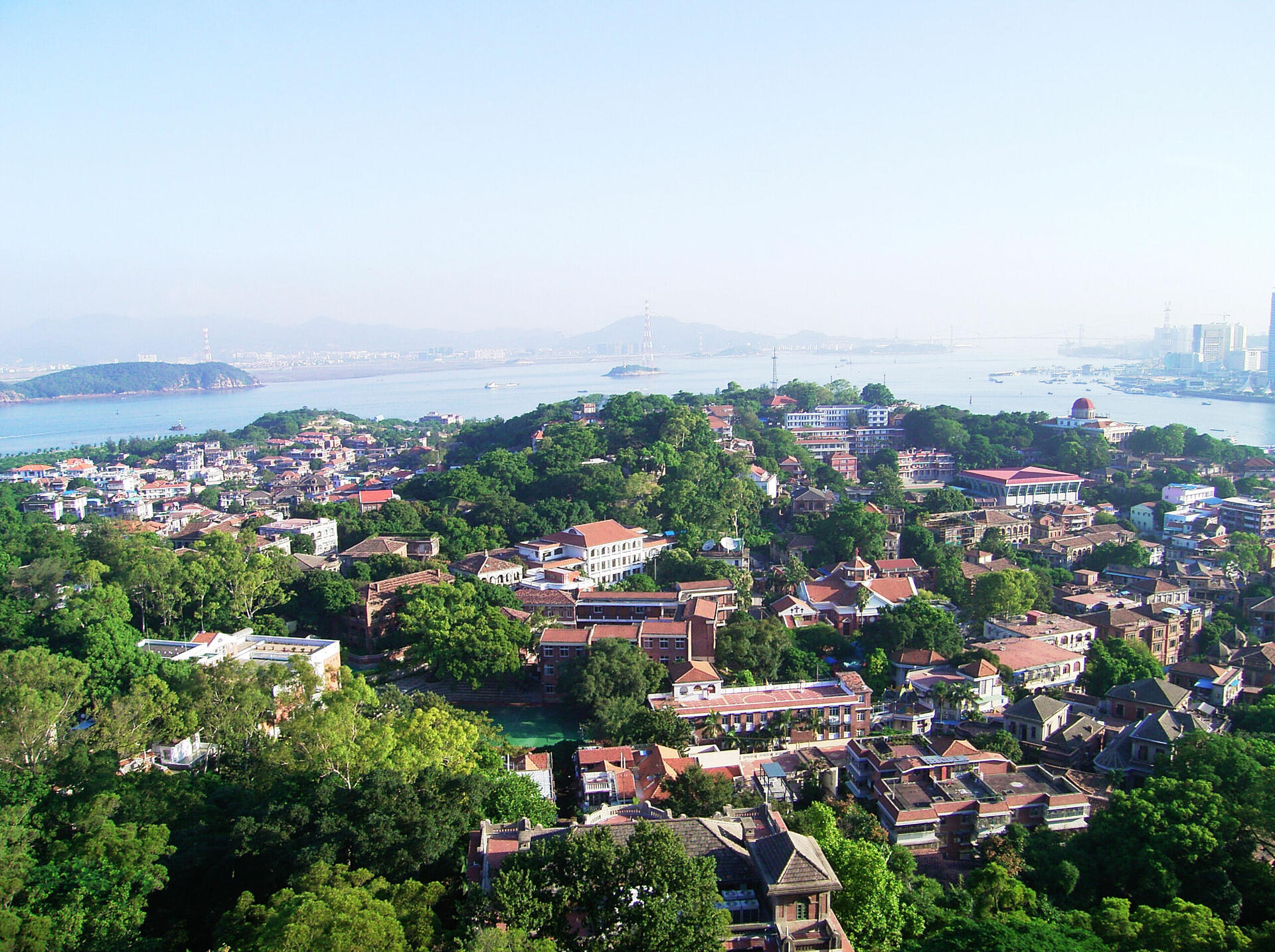
Kulangsu, also known as Gulangyu, is a small island situated on the estuary of the Chiu-lung River, opposite the city of Xiamen in southeastern China. Inscribed as a UNESCO World Heritage Site in 2017, Kulangsu stands out as a significant example of cultural fusion resulting from extensive Sino-foreign exchanges. This unique island offers a captivating blend of architectural styles that reflect its rich history and diverse cultural influences.
The island's history dates back to 1843 when a commercial port was opened at Xiamen, leading to increased interactions between China and foreign nations. In 1903, Kulangsu was designated as an international settlement, marking a turning point in its development. As an essential gateway for trade and diplomacy, the island rapidly transformed into a vibrant hub for cultural exchange.
One of the most striking features of Kulangsu is its eclectic mix of architectural styles. Visitors can admire buildings showcasing Traditional Southern Fujian Style, Western Classical Revival Style, and Veranda Colonial Style. These architectural influences were brought by various nationalities who settled on the island, such as the British, French, Japanese, and Portuguese.
A particularly noteworthy testament to the fusion of various stylistic influences is the emergence of the Amoy Deco Style. This innovative architectural movement represents a synthesis of the Modernist style of the early 20th century and Art Deco. The Amoy Deco Style is unique to Kulangsu and serves as a distinctive symbol of the island's cultural heritage.
Some notable structures on Kulangsu include the Shuzheng Garden, a traditional Southern Fujian-style residence featuring intricate carvings and delicate landscaping, and the Grand Theatre, an impressive example of Neoclassical architecture. Kulangsu’s rich musical culture — reflected in landmarks such as its concert hall and the Gulangyu Piano Museum — has earned it the nickname “Piano Island.”
In addition to its architectural wonders, Kulangsu boasts a rich cultural scene. The island is home to numerous museums, art galleries, and music venues, offering visitors a chance to immerse themselves in the island's artistic and intellectual traditions. Furthermore, Kulangsu's picturesque streets and tranquil gardens provide a serene escape from the bustling city of Xiamen. The Hulishan Fortress, a well-preserved military installation constructed during the late Qing Dynasty, is located nearby on Xiamen Island.
Today, Kulangsu continues to attract millions of tourists each year, making it one of China's most popular tourist destinations. Its unique blend of cultures, stunning architecture, and rich history make it an unforgettable destination for travelers seeking to explore the best of China's cultural heritage.
UNESCO Description of the World Heritage Site
Kulangsu is a tiny island located on the estuary of the Chiu-lung River, facing the city of Xiamen. With the opening of a commercial port at Xiamen in 1843, and the establishment of the island as an international settlement in 1903, this island off the southern coast of the Chinese empire suddenly became an important window for Sino-foreign exchanges. Kulangsu is an exceptional example of the cultural fusion that emerged from these exchanges, which remain legible in its urban fabric. There is a mixture of different architectural styles including Traditional Southern Fujian Style, Western Classical Revival Style and Veranda Colonial Style. The most exceptional testimony of the fusion of various stylistic influences is a new architectural movement, the Amoy Deco Style, which is a synthesis of the Modernist style of the early 20th century and Art Deco.
UNESCO Justification of the World Heritage Site
Criterion (ii): Kulangsu Island exhibits in its architectural features and styles the interchange of Chinese, South East Asian and European architectural and cultural values and traditions produced in this variety by foreign residents or returned overseas Chinese who settled on the island. The settlement created did not only mirror the various influences settlers brought with them from their places of origin or previous residence but it synthesized a new hybrid style – the so-called Amoy Deco Style, which developed in Kulangsu and exerted influences over a far wider region in South-east Asian coastal areas and beyond. In this, the settlement illustrates the encounters, interactions and fusion of diverse values during an early Asian globalization stage.
Criterion (iv): Kulangsu is the origin and best representation of the Amoy Deco Style. Named after Xiamen’s local Hokkien dialect name Amoy, Amoy Deco Style refers to an architectural style and typology, which first occurred in Kulangsu and illustrates the fusion of inspirations drawn from local building traditions, early western and in particular modernist influences as well as the southern Fujian Migrant culture. Based on these the Amoy Deco Style shows a transformation of traditional building typology towards new forms, which were later referenced throughout South-East Asia and became popular in the wider region.
Encyclopedia Record: Gulangyu
Gulangyu, Gulang or Kulangsu is an island off the coast of Xiamen, Fujian, southeastern China. A UNESCO World Cultural Heritage Site, the island is one of China's most visited tourist attractions, attracting more than 10 million visitors per year.Additional Site Details
Area: 316.2 hectares
Number of Components: 1
(iv) — Outstanding example of a type of building or landscape
Coordinates: 24.4475 , 118.0619444444
World Heritage Research
Discover scientific research and academic studies that deepen our understanding of Kulangsu, a Historic International Settlement from its history and significance to its conservation, management, and contemporary challenges.
-
The Role of Psychological-Physical-Physiological Factors in Decision-Making Behavior in Disasters: Insights from an Experimental Study in Gulangyu
A novel quantitative approach reveals that the proportion of sky elements and interactions among plant-building, building-sky, building-other, sky-sign, and sky-road elements significantly influence risk decision-making behavior (RDMB) in disaster scenarios. Video-based simulations effectively immerse participants, while eye-tracking technology demonstrates that buildings and signs attract the most visual attention, increasing environmental complexity. This study highlights the impact of streetscape features on RDMB, offering a human-centered perspective to enhance resilience and emergency response strategies in heritage tourism destinations like Gulangyu.
Du, Y., Li, Y., Yang, M., Wang, Y., & Liu, J. (2025). The Role of Psychological-Physical-Physiological Factors in Decision-Making Behavior in Disasters: Insights from an Experimental Study in Gulangyu. Journal of Urban Technology, 32(2), 31–62. https://doi.org/10.1080/10630732.2025.2476234
View Publication Record | Read Publication -
The Development of Bed and Breakfast Industry in Gulangyu Island: A Cultural Anthropology Perspective
A rapid expansion of the bed and breakfast (B&B) industry on Gulangyu Island reflects shifting cultural practices and economic behaviors among tourists and locals. Unlike previous studies that focused solely on tourism or economics, this research employs cultural anthropology to analyze how B&Bs integrate into the island's heritage community, particularly under pandemic conditions. By examining social interactions, spatial adaptations, and symbolic meanings tied to accommodation choices, the study reveals how B&Bs serve as microcosms of cultural negotiation between preservation and modernization. These insights offer a nuanced framework for balancing heritage conservation with contemporary hospitality development in international settlements.
Yile, M. (2024). The Development of Bed and Breakfast Industry in Gulangyu Island: A Cultural Anthropology Perspective. Anthropological Explorations of Gender, Identity, and Economics, 182–193. https://doi.org/10.9734/bpi/mono/978-81-970867-8-6/ch17
View Publication Record | Read Publication -
Evaluation of Walkability on Gulangyu Based on Residents' Perceptions
Residents' perceptions of landscape factors significantly influence walking behavior on Gulangyu, a car-free historic international settlement. The study found that function is the strongest predictor of purposeful walking, while recreational walkers are influenced by a combination of function, safety, comfort, aesthetics, and pleasantness. Using descriptive statistics, correlation, and logistic regression analysis, researchers identified key landscape elements that enhance walkability, providing a basis for improving pedestrian-friendly environments in heritage sites.
SHI, Y., HARUMAIN, Y. A. S., & MOHIDIN, H. H. B. (2023). EVALUATION OF WALKABILITY ON GULANGYU BASED ON RESIDENTS’ PERCEPTIONS. Transport Problems, 18(1), 203–216. https://doi.org/10.20858/tp.2023.18.1.17
View Publication Record | Read Publication -
Exploring Gendered Walking Behavior and Environment Perception in Heritage City: The Case of Gulangyu, China
A study on gender differences in walking behavior and environmental perception in Gulangyu, China—a car-free UNESCO World Heritage Site—reveals significant disparities between male and female walkers. Males were found to engage more frequently in walking behaviors and rated the walking environment higher than females, including perceptions of comfort. The research used ordered regression models and independent sample t-tests to analyze data, highlighting the need for greater attention to healthy walking behavior and environmental perceptions for women in Chinese heritage cities. This finding underscores the importance of designing inclusive urban spaces that cater to diverse needs and experiences.
Shi, Y., Shamsul Harumain, Y. A., & Mohidin, H. H. B. (2023). EXPLORING GENDERED WALKING BEHAVIOR AND ENVIRONMENT PERCEPTION IN HERITAGE CITY: THE CASE OF GULANGYU, CHINA. Planning Malaysia, 21. https://doi.org/10.21837/pm.v21i30.1406
View Publication Record | Read Publication -
Visual Preference Analysis and Planning Responses Based on Street View Images: A Case Study of Gulangyu Island, China
Tourists' visual preferences for street environments on Gulangyu Island, China, are significantly influenced by specific features such as variety, green view index, crowdedness, sky openness, and enclosure. Variety has the strongest positive impact, while crowdedness has the most substantial negative effect. The study used street view images and a stated preference survey to analyze these preferences, revealing that streets with high visual utility typically feature an ideal natural environment, spacious roads, open skies, and limited architecture. Additionally, there is a balance between green view and enclosure, where excessive enclosure reduces the positive impact of green views.
Huang, J., Liang, J., Yang, M., & Li, Y. (2022). Visual Preference Analysis and Planning Responses Based on Street View Images: A Case Study of Gulangyu Island, China. Land, 12(1), 129. https://doi.org/10.3390/land12010129
View Publication Record | Read Publication -
A Study on Psychological Evaluation of Street Space and Composition of Indication Elements on Gulangyu Island and Xiamen Island in Xiamen City
Psychological evaluation experiments and indication method studies reveal distinct characteristics of street space on Gulangyu Island and Xiamen Island, both part of the UNESCO-listed Kulangsu Historic International Settlement. The research quantifies how spatial composition and visual elements influence perception, offering insights into urban design and heritage preservation. By analyzing responses to street environments, the study identifies key factors that shape public experience in these culturally significant areas.
TSUMITA, H., & MIWATA, M. (2021). A STUDY ON PSYCHOLOGICAL EVALUATION OF STREET SPACE AND COMPOSITION OF INDICATION ELEMENTS ON GULANGYU ISLAND AND XIAMEN ISLAND IN XIAMEN CITY. Journal of Architecture and Planning (Transactions of AIJ), 86(781), 771–781. https://doi.org/10.3130/aija.86.771
View Publication Record | Read Publication -
Spatial Evolution Path of Historical International Community from the Perspective of Actor Network: A Case Study of Gulangyu Island
Gulangyu Island exemplifies the spatial evolution of an international community shaped by cultural diversity and modernization. The study reveals that the transformation from a traditional Minnan community to a multicultural hub was driven by key actors—foreign nationals during the foreign culture dissemination phase (1840–1902) and returning overseas Chinese during the multicultural integration phase (1903–1940). Actor network theory, combined with historical map analysis and geographic data integration, demonstrates how administrative recruitment and spatial practices facilitated this evolution. The findings offer insights for coastal cities aiming to develop islands while fostering multicultural integration in local communities.
Li, Y., Guo, J., Zhao, L., Chen, Y., Wang, C., Wang, C., & Li, J. (2021). Spatial Evolution Path of Historical International Community from the Perspective of Actor Network: A Case Study of Gulangyu Island. https://doi.org/10.21203/rs.3.rs-779248/v1
View Publication Record | Read Publication -
Spatial evolution path of Gulangyu Island historical international community: from the perspective of actor-network theory
Gulangyu Island's transformation from a traditional Minnan community to a multicultural international settlement was driven by shifting key actors and their network dynamics. Research applying actor-network theory reveals that foreign nationals (1840–1902) and returning overseas Chinese (1903–1940) acted as pivotal agents, reshaping the island's spatial evolution through administrative influence and cultural integration practices. The study highlights how these actors' roles in governance and community management fostered a unique blend of Chinese and Western cultures, setting a precedent for multicultural coexistence. By analyzing historical maps and geographic data, the research offers insights into the island's development, providing a model for other coastal cities to promote sustainable, culturally diverse urbanization.
Li, Y., Guo, J., Zhao, L., Chen, Y., Wang, C., Wang, C., & Li, J. (2021). Spatial evolution path of Gulangyu Island historical international community: from the perspective of actor-network theory. Heritage Science, 9(1). https://doi.org/10.1186/s40494-021-00624-y
View Publication Record | Read Publication -
Mediating effect on landscape experience in scenic area: a case study in Gulangyu Island, Xiamen City
Research on Kulangsu (Gulangyu) Island, Xiamen City, reveals significant mediating effects of service provision—particularly catering and recreational facilities—on the relationship between visual and auditory landscape perceptions. Catering experiences notably mediate between sculpture appreciation and auditory comfort (13.87%), while recreational facilities influence natural scenery perception and auditory harmony (15.64%). These findings underscore the integrated nature of sensory and psychological experiences in landsenses ecology, offering critical insights for scenic area planning, design, and management to enhance visitor satisfaction.
Xiong, Y., Yang, L., Wang, X., & Liu, J. (2020). Mediating effect on landscape experience in scenic area: a case study in Gulangyu Island, Xiamen City. International Journal of Sustainable Development & World Ecology, 27(3), 276–283. https://doi.org/10.1080/13504509.2020.1725919
View Publication Record | Read Publication -
Toward a model of destination resident–environment relationship: the case of Gulangyu, China
A groundbreaking study on Gulangyu Island, Chinareveals that residents' environmentally responsible behavior and willingness to sacrifice for the environment are significantly influenced by destination environmental quality and eco-friendly reputation. The research demonstrates that both factors directly impact resident environmental identification and commitment, which in turn shape their behaviors. Notably, environmental identification and commitment fully mediate the effects of environmental quality on these outcomes, while partially mediating the influence of destination reputation. This suggests that fostering a strong sense of environmental belonging among residents is key to promoting sustainable practices in heritage destinations.
Su, L., Huang, S. (., & Pearce, J. (2019). Toward a model of destination resident–environment relationship: the case of Gulangyu, China. Journal of Travel & Tourism Marketing, 36(4), 469–483. https://doi.org/10.1080/10548408.2019.1568954
View Publication Record | Read Publication