World Heritage Identification Number: 887
World Heritage since: 2008
Category: Cultural Heritage
WHE Type: Agriculture Landscapes, Parks & Gardens
Transboundary Heritage: No
Endangered Heritage: No
Country: 🇵🇬 Papua New Guinea
Continent: Oceania
UNESCO World Region: Asia and the Pacific
Map
Unraveling the Mysteries of Kuk Early Agricultural Site: A Testament to Ancient Agriculture in Papua New Guinea
The Kuk Early Agricultural Site, located in the Wahgi Valley of the highlands in Papua New Guinea, stands as a remarkable testament to human ingenuity and adaptation. Inscribed as a UNESCO World Heritage Site in 2008, this unique location offers a fascinating glimpse into the early stages of agriculture and the transformative impact it had on human societies.
More to come…UNESCO Description of the World Heritage Site
Kuk Early Agricultural Site consists of 116 ha of swamps in the western highlands of New Guinea 1,500 metres above sea-level. Archaeological excavation has revealed the landscape to be one of wetland reclamation worked almost continuously for 7,000, and possibly for 10,000 years. It contains well-preserved archaeological remains demonstrating the technological leap which transformed plant exploitation to agriculture around 6,500 years ago. It is an excellent example of transformation of agricultural practices over time, from cultivation mounds to draining the wetlands through the digging of ditches with wooden tools. Kuk is one of the few places in the world where archaeological evidence suggests independent agricultural development and changes in agricultural practice over such a long period of time.
UNESCO Justification of the World Heritage Site
Criterion (iii): The extent of the evidence of early agriculture on the Kuk site can be seen as an exceptional testimony to a type of exploitation of the land which reflects the culture of early man in the region.
Criterion (iv): Kuk is one of the few places in the world where archaeological evidence suggests independent agricultural development and changes in agricultural practice over a 7,000 and possibly a 10,000 year time span.
Encyclopedia Record: Kuk Swamp
Kuk Swamp is an archaeological site in Papua New Guinea, that lies in the Wahgi Valley of the highlands at an altitude of about 1550 m some 12–13 km northeast of Mount Hagen, the capital of Western Highlands Province. The swamp developed in a former lake basin, as it was filled by an alluvial fan or deposits of water-transported material. Archaeological evidence for early agricultural drainage systems was found here, beginning about 9,000 years ago. It includes draining ditches of three major classes, which were used to convert the area to an anthropogenic grassland. The native crop taro was grown here.Additional Site Details
Area: 116 hectares
Number of Components: 1
(iv) — Outstanding example of a type of building or landscape
Coordinates: -5.7837111111 , 144.3317222222
Image
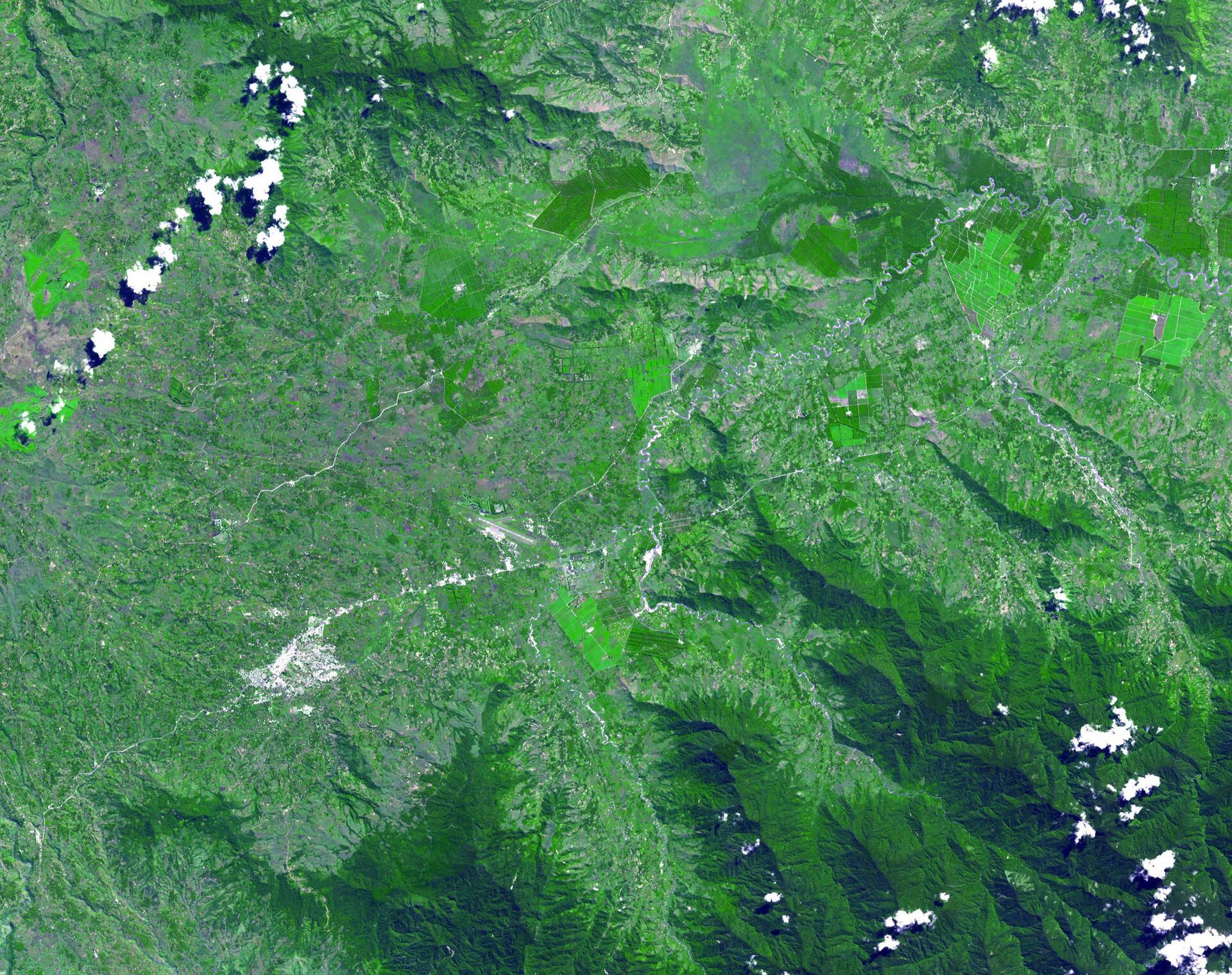
NASA: JPL, Public domain
World Heritage Research
Discover scientific research and academic studies that deepen our understanding of Kuk Early Agricultural Site from its history and significance to its conservation, management, and contemporary challenges.
-
Origin and Development of Agriculture in New Guinea, Island Melanesia, and Polynesia
Agriculture in the Pacific Islands began with early Holocene practices centered on vegetative propagation and underground storage organs, later evolving into complex systems. Kuk Swamp in Papua New Guinea's highlands offers one of the earliest records of agricultural intensification, showing mounded cultivation around 7000–6400 cal BP and wetland drainage by 4400–4000 cal BP. Unlike other regions in Near Oceania, which focused on fruit- and nut-bearing trees, Kuk’s landscape reveals a shift toward more intensive land management. By 3250–2800 cal BP, these practices spread with Lapita pottery-bearers into the western Pacific, while later Polynesian colonization (1000–750 cal BP) introduced new crops like the sweet potato, reshaping regional agriculture.
Denham, T. (2018). Origin and Development of Agriculture in New Guinea, Island Melanesia, and Polynesia. Oxford Research Encyclopedia of Environmental Science. https://doi.org/10.1093/acrefore/9780199389414.013.171
View Publication Record | Read Publication -
Phase 2: Mounded Cultivation During the Mid Holocene
Archaeological evidence from Kuk Swamp in the highlands of New Guinea reveals the earliest unequivocal proof of mounded cultivation, dating between 6950 and 6440 years ago. This discovery challenges earlier debates about whether land use practices at Kuk constituted agriculture, providing definitive support for its classification as such. The study contrasts with previous claims that such evidence was insufficient, instead offering robust data from Kuk and comparable mid-Holocene sites in the Wahgi Valley, including Mugumamp and Warrawau. The findings underscore New Guinea's role in the independent origins of agriculture, reinforcing arguments for early agricultural development in the region. This research builds on extensive investigations at Kuk, which have served as a benchmark for interpreting similar finds across highland sites.
Denham, T., Golson, J., & Hughes, P. (2017). Phase 2: Mounded Cultivation During the Mid Holocene. Ten Thousand Years of Cultivation at Kuk Swamp in the Highlands of Papua New Guinea. https://doi.org/10.22459/ta46.07.2017.12
View Publication Record | Read Publication -
Traim tasol … Cultural heritage management in Papua New Guinea
Cultural heritage management in Papua New Guinea is characterized by diverse practices, from community-based ethnoarchaeological projects to large-scale World Heritage nominations. A key insight is the successful integration of archaeological research with local oral traditions and ethnoscience, as demonstrated in a project among the Kalam people of the Simbai Valley. This approach highlights the importance of linking fieldwork with documented cultural knowledge, offering a model for sustainable heritage management. The study also examines challenges associated with the World Heritage nomination process at the Kuk Early Agricultural Site, providing critical observations on the sector's evolving commercial landscape. Conducted over 20 years, this research underscores the need for nuanced, context-specific strategies in managing Papua New Guinea's rich cultural and archaeological heritage.
Denham, T. (2013). Traim tasol … Cultural heritage management in Papua New Guinea. Transcending the Culture–Nature Divide in Cultural Heritage. https://doi.org/10.22459/ta36.12.2013.08
View Publication Record | Read Publication