World Heritage Identification Number: 1561
World Heritage since: 2021
Category: Cultural Heritage
WHE Type: Historic Cities & Urban Areas
Transboundary Heritage: No
Endangered Heritage: No
Country: 🇨🇳 China
Continent: Asia
UNESCO World Region: Asia and the Pacific
Map
Quanzhou: A Vibrant Maritime Emporium in Song-Yuan China
Quanzhou, located on the north bank of the Jin River in southern Fujian, People's Republic of China, served as a significant maritime emporium during the Song and Yuan periods (10th to 14th centuries AD). Inscribed as a UNESCO World Heritage Site in 2021, this bustling port city played a pivotal role in Asian maritime trade during a highly influential era.
More to come…UNESCO Description of the World Heritage Site
The serial site of Quanzhou illustrates the city’s vibrancy as a maritime emporium during the Song and Yuan periods (10th - 14th centuries AD) and its interconnection with the Chinese hinterland. Quanzhou thrived during a highly significant period for maritime trade in Asia. The site encompasses religious buildings, including the 11th century AD Qingjing Mosque, one of the earliest Islamic edifices in China, Islamic tombs, and a wide range of archaeological remains: administrative buildings, stone docks that were important for commerce and defence, sites of ceramic and iron production, elements of the city’s transportation network, ancient bridges, pagodas, and inscriptions. Known as Zayton in Arabic and western texts of the 10th to 14th centuries AD.UNESCO Justification of the World Heritage Site
Criterion (iv): Quanzhou, Emporium of the World in Song–Yuan China outstandingly illustrates, through its component parts, the territorial integrated structure and the key institutional, transportation, production, marketing and socio-cultural factors that turned it into a global-level emporium and key commercial hub during a highly prosperous stage of Asia's maritime trade in the 10th - 14th centuries AD. The property demonstrates Quanzhou’s great contributions to the economic and cultural development of East and South-east Asia.
Encyclopedia Record: Quanzhou
Quanzhou is a prefecture-level port city on the north bank of the Jin River, beside the Taiwan Strait in southern Fujian, People's Republic of China. It is Fujian's most populous metropolitan region, with an area of 11,245 square kilometers (4,342 sq mi) and a population of 8,782,285 as of the 2020 census. Its built-up area is home to 6,669,711 inhabitants, encompassing the Licheng, Fengze, and Luojiang urban districts; Jinjiang, Nan'an, and Shishi cities; Hui'an County; and the Quanzhou District for Taiwanese Investment. Quanzhou was China's 12th-largest extended metropolitan area in 2010.Additional Site Details
Area: 536.08 hectares
Number of Components: 16
Coordinates: 24.7102777778 , 118.4441666667
Image
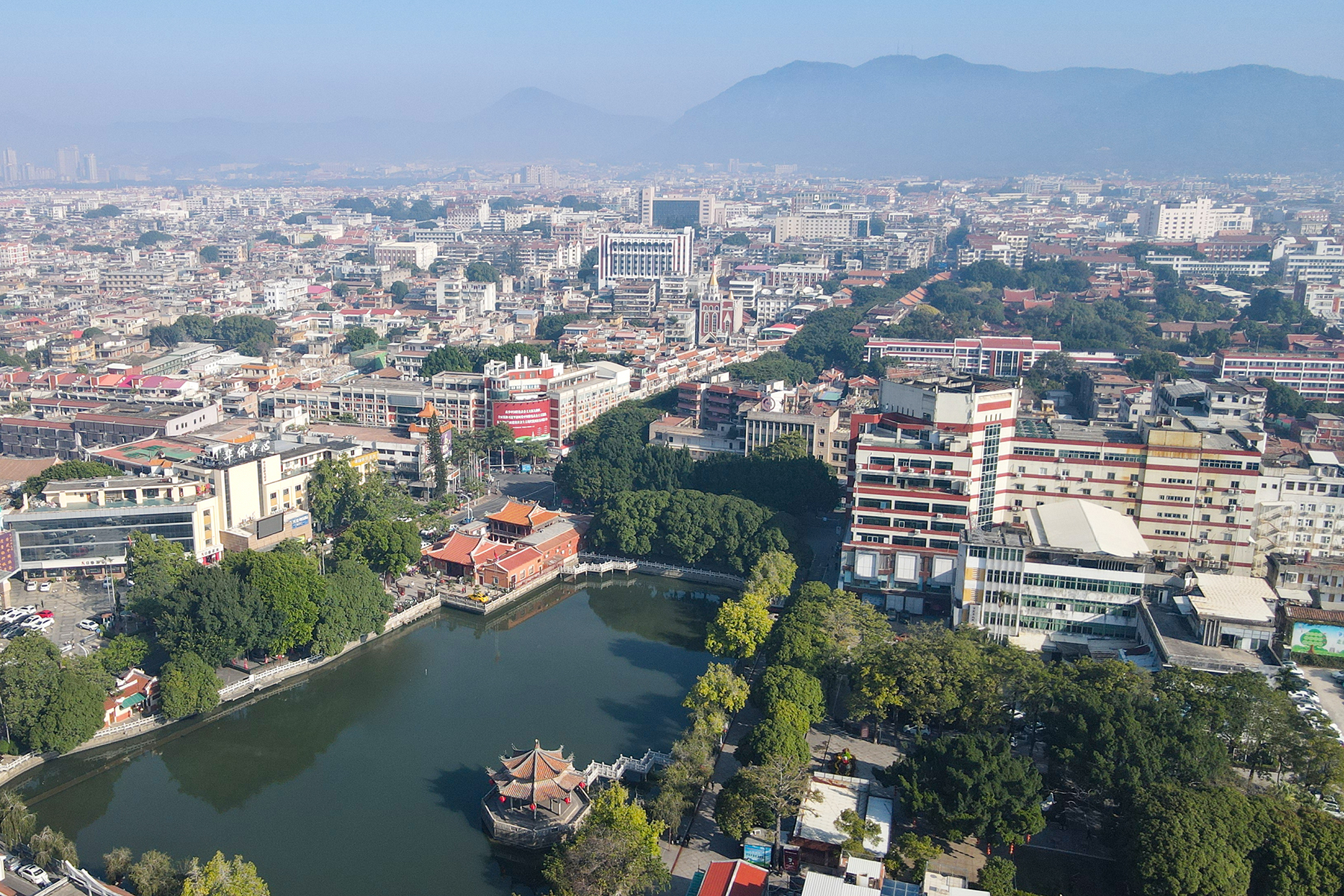
© Windmemories, CC BY-SA 4.0 Resized from original. (This derivative is under the same CC BY-SA license.)
World Heritage Research
Discover scientific research and academic studies that deepen our understanding of Quanzhou: Emporium of the World in Song-Yuan China from its history and significance to its conservation, management, and contemporary challenges.
-
Multilingual, multicultural and multi-religious diversity: chronotopic affect in the semiotic landscape of Zhongshan Road, Quanzhou
Zhongshan Road in Quanzhou, a key site on the historical maritime silk road, embodies complex chronotopic affects—emotional responses shaped by multilingual, multicultural, and multi-religious diversity. The study reveals that globalisation-driven mobility of sociolinguistic resources leads to functional shifts across scales (e.g., from local to global, religious to mundane), creating layered time-space frames within a single site or even individual signs. These chronotopes evoke distinct affects like love and nostalgia, illustrating how historical and modern elements interweave in semiotic landscapes. The research employs ethnographic methods, including photographs, observation notes, and interviews, to analyze these dynamics.
Zhang, H., & Wu, S. (2025). Multilingual, multicultural and multi-religious diversity: chronotopic affect in the semiotic landscape of Zhongshan Road, Quanzhou. Journal of Multilingual and Multicultural Development, 47(4), 2310–2330. https://doi.org/10.1080/01434632.2025.2468775
View Publication Record | Read Publication -
Durability Analysis of Brick-Faced Clay-Core Walls in Traditional Residential Architecture in Quanzhou, China
Research on brick-faced clay-core walls (BCWs) in Quanzhou, a UNESCO World Heritage City, reveals that their durability stems from three key mechanisms: the protective and reinforcing synergy between brick and clay, the impact of external pollutant infiltration, and the stability of silicate minerals. Using advanced techniques such as finite element mechanics analysis (FEM), scanning electron microscopy (SEM), X-ray fluorescence (XRF), and X-ray diffraction (XRD), scientists analyzed the northern gable of Ding Gongchen’s former residence to uncover these insights. The study highlights that maintaining the structural integrity of BCWs relies on the interplay between brick and clay materials, as well as the stability of silicate minerals, offering a foundation for sustainable preservation of such traditional constructions.
Ding, Y., Guan, R., Chen, L., Wang, J., Zhang, Y., Fu, Y., & Zhang, C. (2025). Durability Analysis of Brick-Faced Clay-Core Walls in Traditional Residential Architecture in Quanzhou, China. Coatings, 15(8), 909. https://doi.org/10.3390/coatings15080909
View Publication Record | Read Publication -
Authenticity and place attachment as dual pathways for sustainable tourism in the historic Quanzhou West Street, China
Research on Quanzhou West Street, a UNESCO-listed heritage site, reveals that both tangible and experiential authenticity significantly enhance visitors' emotional connection to the place, reinforcing sustainable tourism. The study found that object-related authenticity (physical heritage features) and existential authenticity (cultural engagement) positively influence place identity and dependence, with place identity acting as a mediator between authenticity and functional reliance on the site. This dual pathway suggests that preserving historic fabric while fostering authentic cultural experiences is crucial for long-term sustainability. The findings underscore the need for integrated conservation efforts, visitor management to prevent over-commercialization, and community involvement in governance. The research provides actionable insights for managing historic urban landscapes sustainably.
Zhu, Y., Han, G., Zhuang, J., & Wang, M. (2025). Authenticity and place attachment as dual pathways for sustainable tourism in the historic Quanzhou West Street, China. Scientific Reports, 15(1). https://doi.org/10.1038/s41598-025-28662-7
View Publication Record | Read Publication -
The Service Experience Innovation Model of Cultural Tourism in Historic Districts: A Case Study on Zhongshan Road in Quanzhou, Fujian Province of China
Researchers have developed the TESP model, a framework for innovative cultural tourism services that integrates technological, experiential, systemic, and platform dimensions. This model, applied to Zhongshan Road in Quanzhou, China, highlights the importance of creating a sense of place through traditional culture while leveraging digital platforms and interpersonal networks to promote local economic prosperity. The study identifies six stages of tourist experience—Connect and Attract, Orientate, Interact, Extend and Retain, Advocate, and Recollect—and emphasizes humanistic innovation as a key driver for enhancing service experiences in historic districts. Using an exploratory case study approach that combines secondary data analysis with on-site observations, the findings provide practical insights for cultural heritage tourism and offer guidance for experience providers, managers, and marketing professionals.
Lin, Y.-H., & Chen, C.-L. (2024). The Service Experience Innovation Model of Cultural Tourism in Historic Districts: A Case Study on Zhongshan Road in Quanzhou, Fujian Province of China. Sustainability, 16(9), 3567. https://doi.org/10.3390/su16093567
View Publication Record | Read Publication -
Quantitative research of street interface morphology in urban historic districts: a case study of west street historic district, Quanzhou
A novel method for quantifying street interface morphology in historical urban districts offers valuable insights for their protection and renewal. This study introduces four key parameters—Distance-Height Ratio, Interface Density, Build-To-Line Rate, and Near-Line Rate—to analyze the spatial characteristics of Xijie, a historic cultural street district in Quanzhou, China. By focusing on meso-level spatial morphology rather than macro-level planning, this approach provides actionable strategies for preserving historical streets while addressing gaps in existing research. The findings validate the method's feasibility and contribute to sustainable urban heritage conservation.
Huang, K., Kang, P., & Zhao, Y. (2024). Quantitative research of street interface morphology in urban historic districts: a case study of west street historic district, Quanzhou. Heritage Science, 12(1). https://doi.org/10.1186/s40494-024-01351-w
View Publication Record | Read Publication -
Spatial non-stationarity effects of the driving factors on landscape ecological risk: A case of the Xiamen-Zhangzhou-Quanzhou Urban Agglomeration, China
Landscape ecological risk (LER) in the Xiamen-Zhangzhou-Quanzhou Urban Agglomeration (XZQUA), China, has shown a declining trend from 1980 to 2020, accompanied by increasing spatial autocorrelation. The study identified construction land area, distance from roads, elevation, and temperature as key drivers of LER, with significant spatial non-stationarity in their effects. Construction land and elevation negatively impacted LER, while proximity to roads had a positive effect. These findings highlight the need for targeted ecological risk interventions tailored to geographical contexts, offering critical insights for regional policymakers.
Lin, Y., Zhang, F., Jin, Y., Wen, L., Yu, Y., Zhang, L., Weng, A., & Ge, Y. (2024). Spatial non-stationarity effects of the driving factors on landscape ecological risk: A case of the Xiamen-Zhangzhou-Quanzhou Urban Agglomeration, China. Ecological Indicators, 167, 112660. https://doi.org/10.1016/j.ecolind.2024.112660
View Publication Record | Read Publication -
Development of Rural Regions in China: Evidence of Industry Integration by the Residents of Yongan Village (Quanzhou City, China)
Yongan Village, Quanzhou, China, demonstrates a novel rural development model that integrates primary, secondary, and tertiary industries in the sequence of '1 + 3 + 2,' prioritizing tertiary industry growth to drive sustainable rural development. This approach, which emphasizes agro-tourism and rising tourist inflows, offers a practical framework for transforming rural regions economically while maintaining long-term viability. The study provides theoretical insights and actionable guidance for similar initiatives in China and other developing nations, enriching the discourse on rural sustainability.
Wang, Y., & Tian, R. (2023). Development of Rural Regions in China: Evidence of Industry Integration by the Residents of Yongan Village (Quanzhou City, China). Sustainability, 15(4), 2928. https://doi.org/10.3390/su15042928
View Publication Record | Read Publication