World Heritage Identification Number: 1116
World Heritage since: 2003
Category: Cultural Heritage
WHE Type: Natural Landscapes & Geographic Features
Transboundary Heritage: No
Endangered Heritage: No
Country: 🇦🇷 Argentina
Continent: Americas
UNESCO World Region: Latin America and the Caribbean
Map
Exploring the Cultural Landscape of Quebrada de Humahuaca, Argentina
The Quebrada de Humahuaca, a stunning mountain valley nestled within the province of Jujuy in northwest Argentina, offers a unique blend of natural beauty and rich cultural heritage. Stretching approximately 155 kilometers from north to south, this picturesque valley is characterized by its dramatic landscapes, vibrant indigenous cultures, and significant historical sites that have shaped the region's identity for thousands of years.
More to come…UNESCO Description of the World Heritage Site
Quebrada de Humahuaca follows the line of a major cultural route, the Camino Inca, along the spectacular valley of the Rio Grande, from its source in the cold high desert plateau of the High Andean lands to its confluence with the Rio Leone some 150 km to the south. The valley shows substantial evidence of its use as a major trade route over the past 10,000 years. It features visible traces of prehistoric hunter-gatherer communities, of the Inca Empire (15th to 16th centuries) and of the fight for independence in the 19th and 20th centuries.
UNESCO Justification of the World Heritage Site
Criterion (ii): The Quebrada de Humahuaca valley has been used over the past 10,000 years as a crucial passage for the transport of people and ideas from the high Andean lands to the plains.
Criteria (iv) and (v): The Quebrada de Humahuaca valley reflects the way its strategic position has engendered settlement, agriculture and trade. Its distinctive pre-Hispanic and pre-Incan settlements, as a group with their associated field systems, form a dramatic addition to the landscape and one that can certainly be called outstanding.
Encyclopedia Record: Quebrada de Humahuaca
The Quebrada de Humahuaca is a narrow mountain valley located in the province of Jujuy in northwest Argentina, 1,649 km (1,025 mi) north of Buenos Aires. It is about 155 km (96 mi) long, oriented north–south, bordered by the Altiplano in the west and north, by the Sub-Andean hills in the east, and by the warm valleys in the south.Additional Site Details
Area: 172,116.4 hectares
Number of Components: 1
(iv) — Outstanding example of a type of building or landscape
(v) — Outstanding example of traditional human settlement
Coordinates: -23.19986111 , -65.34886111
Image
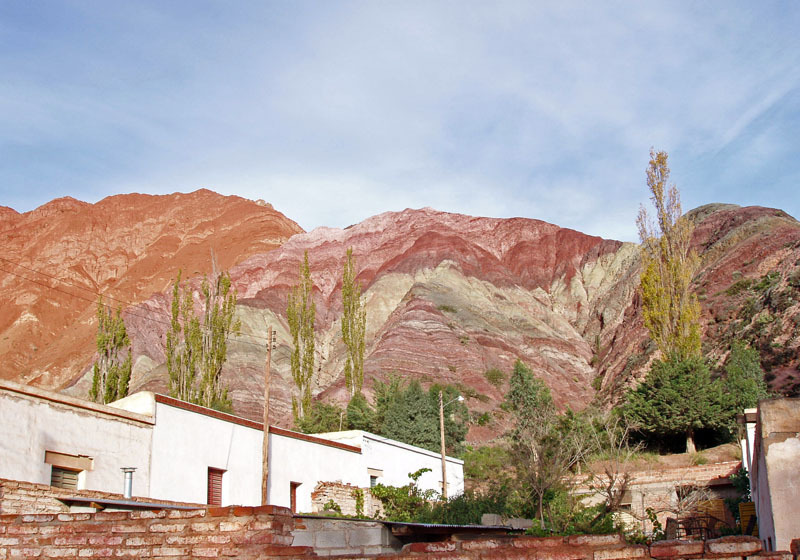
© Unknown, CC BY-SA 3.0 Resized from original. (This derivative is under the same CC BY-SA license.)
World Heritage Research
Discover scientific research and academic studies that deepen our understanding of Quebrada de Humahuaca from its history and significance to its conservation, management, and contemporary challenges.
-
Developing a collaborative research agenda for Quebrada de Humahuaca, Argentina
A collaborative research agenda for Quebrada de Humahuaca, Argentina—a UNESCO World Heritage cultural landscape—was developed to enhance its management and governance. This agenda, shaped through inclusive stakeholder engagement under the Heritage Place Lab initiative (2021–2022), identifies key conflicts, threats, and defining values of the site. By systematically analyzing these factors, researchers prioritized actionable research areas that address practical needs for long-term sustainability. The approach combines participatory methodology with systematic analysis to create a practice-driven framework, offering a model for improving governance in similar heritage properties.
Aguilar, G. E., Conti, A., García, R. E., Mallo, J., Millón, V., Morello, A., & Pasin, S. M. (2023). Developing a collaborative research agenda for Quebrada de Humahuaca, Argentina. Journal of Cultural Heritage Management and Sustainable Development, 13(3), 447–466. https://doi.org/10.1108/jchmsd-09-2022-0156
View Publication Record | Read Publication -
Cuentas minerales y circulación macrorregional en los Andes centro-sur durante el primer milenio d. C. Una mirada desde la quebrada de Humahuaca (Jujuy, Argentina)
A study of 2,200 mineral beads from Tilcara, Argentina, reveals significant macroregional trade networks during the first millennium AD. The beads, primarily made of sodalite and turquoise with minor crisocola and jasper, show standardized morphologies and dimensions, suggesting organized production. This indicates high mobility of ornamental goods and strong connections between local populations in Jujuy and regions like Bolivia and northern Chile, aligning with broader trade circuits documented for Formative Period settlements.
López Campeny, S. M. L. (2023). Cuentas minerales y circulación macrorregional en los Andes centro-sur durante el primer milenio d. C. Una mirada desde la quebrada de Humahuaca (Jujuy, Argentina). Estudios Sociales Del NOA, (24). https://doi.org/10.34096/esnoa.n24.12892
View Publication Record | Read Publication -
Guerra, sufragios y caciques. Las transformaciones de los pueblos de indios de la Quebrada de Humahuaca en los inicios del Siglo XIX
Early 19th-century transformations in the indigenous communities of Quebrada de Humahuaca, Argentina, were marked by shifts in power dynamics, militarization, and emerging citizenship processes. A key finding is the significant role of indigenous military participation during the wars of independence, which reshaped local governance structures and cacicazgos (chiefdoms). The study highlights how the implementation of suffrage further altered these relationships, reflecting broader societal changes. Using historical analysis, the research examines archival records to trace these transformations, offering insights into the complex interplay between war, politics, and indigenous autonomy during this pivotal period.
Sica, G. (2023). Guerra, sufragios y caciques. Las transformaciones de los pueblos de indios de la Quebrada de Humahuaca en los inicios del Siglo XIX. Boletín Del Instituto de Historia Argentina Y Americana Dr. Emilio Ravignani, (59), 1–35. https://doi.org/10.34096/bol.rav.n59.11606
View Publication Record | Read Publication -
La Sociabilidad del Caminar en la Quebrada de Humahuaca (Jujuy, Argentina)
In the rural areas of Quebrada de Humahuaca, walking emerges as a foundational practice that fosters unique forms of sociability. This study reveals that pedestrian mobility in the region is not merely a means of transportation but a catalyst for social interactions, shaped by shared corporeal experiences and intersubjective relationships. The research employs an existential phenomenological approach to explore how movement and bodily techniques influence these interactions, highlighting norms and values that govern both walking and social life. The findings underscore the importance of spatial context in defining sociability, offering insights into the cultural significance of mobility in the Andes meridionales.
Fontes, C. (2023). LA SOCIABILIDAD DEL CAMINAR EN LA QUEBRADA DE HUMAHUACA (JUJUY, ARGENTINA). Chungará (Arica), (ahead), 0. https://doi.org/10.4067/s0717-73562023005000901
View Publication Record | Read Publication -
Tecnología ósea en las nacientes de la Quebrada de Humahuaca
A unique bone instrument, potentially ornamental and crafted from an astragalus, has been identified in the upper reaches of Quebrada de Humahuaca, Argentina. This discovery, derived from a preliminary analysis of artifacts dating between 2000–960 years ago, marks the first report of such a specimen in the region. The study categorizes bone tools into six morphological and four functional types, providing new insights into the technological sophistication of late Holocene populations inhabiting this UNESCO World Heritage Site. Radiocarbon-dated stratigraphic layers from sites Antumpa, Cóndor II, and Casas Grandes Bajo underpin the chronological context of these findings.
Hernández, A. (2022). Tecnología ósea en las nacientes de la Quebrada de Humahuaca. Revista Del Museo de Antropología, 59–64. https://doi.org/10.31048/1852.4826.v15.n1.34487
View Publication Record | Read Publication -
Andean pre-Hispanic pottery forming 3D analysis: a pilot study from Quebrada de Humahuaca (Argentina) using digital methods
A pilot study using advanced digital methods reveals that paddling was likely employed to shape the body of a pre-Hispanic pottery vessel from Quebrada de Humahuaca, Argentina—a technique previously unrecognized in traditional pottery manufacturing in the region. Researchers analyzed a globular pot from the Pucara de Volcán site using 3D modeling via close-range photogrammetry and techniques like Morphological Residue Model (MRM) and Virtual Reflectance Transformation Imaging Visualization (V-RTI). These methods enhanced surface micro-topography visibility, identifying key macro-traces such as sub-circular depressions and horizontal pressure lines that correspond to paddling. The study also suggests coiling was used for the pot's collar. While the findings highlight the potential of digital techniques in pottery analysis, their accuracy depends on the precision of 3D models.
Scaro, A. (2022). Andean pre-Hispanic pottery forming 3D analysis: a pilot study from Quebrada de Humahuaca (Argentina) using digital methods. Virtual Archaeology Review, 13(27), 66–80. https://doi.org/10.4995/var.2022.16863
View Publication Record | Read Publication -
Dinámicas de desterritorialización y reterritorialización en Purmamarca, Patrimonio Mundial de la UNESCO: Quebrada de Humahuaca (Argentina)
UNESCO's designation of Argentina's Quebrada de Humahuaca as a World Heritage Site in 2003 triggered profound territorial transformations in the town of Purmamarca, marked by exponential growth in tourism infrastructure and a decline in residential space. This study reveals how these changes precipitated a process of precarization, prompting local residents to organize into indigenous communities to secure land rights, housing, and other entitlements. Researchers employed a multi-method approach, combining archival analysis, satellite imagery, fieldwork, photographic documentation, and interviews to trace the dynamics of desterritorialization and reterritorialization in Purmamarca.
Mancini, C. E., & Tommei, C. I. (2022). Dinámicas de desterritorialización y reterritorialización en Purmamarca, Patrimonio Mundial de la UNESCO: Quebrada de Humahuaca (Argentina). Ciudad Y Territorio Estudios Territoriales, 54(213), 701–722. https://doi.org/10.37230/cytet.2022.213.10
View Publication Record | Read Publication