World Heritage Identification Number: 327
World Heritage since: 1985
Category: Cultural Heritage
WHE Type: Buildings & Architectural Ensembles
Transboundary Heritage: No
Endangered Heritage: No
Country: 🇯🇴 Jordan
Continent: Asia
UNESCO World Region: Arab States
Map
Quseir Amra: A Gem of Early Islamic Art and Architecture
Quseir Amra, also known as Qasr Amra, is a remarkable example of early Islamic art and architecture, located in present-day eastern Jordan. This desert castle, inscribed as a UNESCO World Heritage Site in 1985, offers a unique glimpse into the artistic and architectural traditions of the Umayyad period (661-750 AD).
More to come…UNESCO Description of the World Heritage Site
Built in the early 8th century, this exceptionally well-preserved desert castle was both a fortress with a garrison and a residence of the Umayyad caliphs. The most outstanding features of this small pleasure palace are the reception hall and the hammam, both richly decorated with figurative murals that reflect the secular art of the time.
UNESCO Justification of the World Heritage Site
Criterion (i): The Quseir Amra paintings constitute a unique artistic achievement in the Umayyad Period. The extensive fresco paintings of the reception hall and bath building, in creating a place of relaxation for the Prince away from earthly cares, provides new insight to early Islamic art and its derivation from classical and Byzantine precedents. The zodiac dome, human portraits and depictions of animals and birds in the hunting scenes are found only in this early period of Islamic art.
Criterion (iii): Quseir Amra bears exceptional testimony to the Umayyad civilization which was imbued with a pre-Islamic secular culture and whose austere religious environment left little trace in the visual arts.
Criterion (iv): Together with the remains of the fort/garrison buildings several hundred metres to the north and traces of agricultural water catchment works, the fresco-painted bath building with its reception hall and adjacent well, tank and water-lifting hydraulic system, drainage pipes and cesspool represent an outstanding example of an Umayyad desert establishment. In view of the fact that the relief decorations of the monumental frontal façade of Qasr el Mushatta were sent to the Berlin Museum and that the ruins of Qasr al Khayr al-Sharqui and Qasr al-Khayr al-Gharbi contain few decorative elements, Qusair Amra remains, together with Qasr Hisham and its mosaics, the best preserved of the decorated Umayyad palaces and castles in Jordan and Syria.
Encyclopedia Record: Qusayr 'Amra
Qusayr 'Amra or Quseir Amra, sometimes also named Qasr Amra, is the best-known of the desert castles located in present-day eastern Jordan. It was built some time between 723 and 743, by Walid Ibn Yazid, the future Umayyad caliph Walid II, whose dominance of the region was rising at the time. It is considered one of the most important examples of early Islamic art and architecture.Additional Site Details
Area: 0.0445 hectares
Number of Components: 1
(iii) — Unique or exceptional testimony to a cultural tradition
(iv) — Outstanding example of a type of building or landscape
Coordinates: 31.8018055556 , 36.5873055556
Image
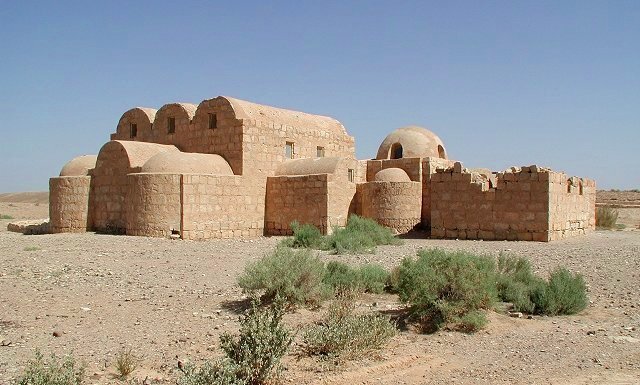
© Unknown, CC BY-SA 3.0 Resized from original. (This derivative is under the same CC BY-SA license.)
World Heritage Research
Discover scientific research and academic studies that deepen our understanding of Quseir Amra from its history and significance to its conservation, management, and contemporary challenges.
-
Pre-Islamic Motives in the Interior of Umayyad Palaces Quseir Amra and Mshatta (661-750 A.D.)
Research on the Umayyad Palaces of Quseir Amra and Mshatta in Jordan reveals that religious and cultural syncretism played a pivotal role in shaping early Muslim architectural traditions. The study highlights how multicultural and multi-confessional influences during the 7th to 8th centuries led to unique artistic solutions, blending recent and ancient motifs. This synthesis of traditions underscores the ideological and aesthetic complexity of Umayyad palace interiors, offering new insights into the development of Islamic art and architecture. The analysis focuses on decorative elements, demonstrating their significance in reflecting broader historical and cultural interactions.
Alshurman, A. S. H., & Orlov, I. I. (2022). Pre-Islamic Motives in the Interior of Umayyad Palaces Quseir Amra and Mshatta (661-750 A.D.). Манускрипт, 15(1), 9–14. https://doi.org/10.30853/mns20230001
View Publication Record | Read Publication