World Heritage Identification Number: 233
World Heritage since: 1993
Category: Cultural Heritage
WHE Type: Buildings & Architectural Ensembles
Transboundary Heritage: No
Endangered Heritage: No
Country: 🇮🇳 India
Continent: Asia
UNESCO World Region: Asia and the Pacific
Map
Qutb Minar and Its Monuments: A Testament to the Rich History of Delhi
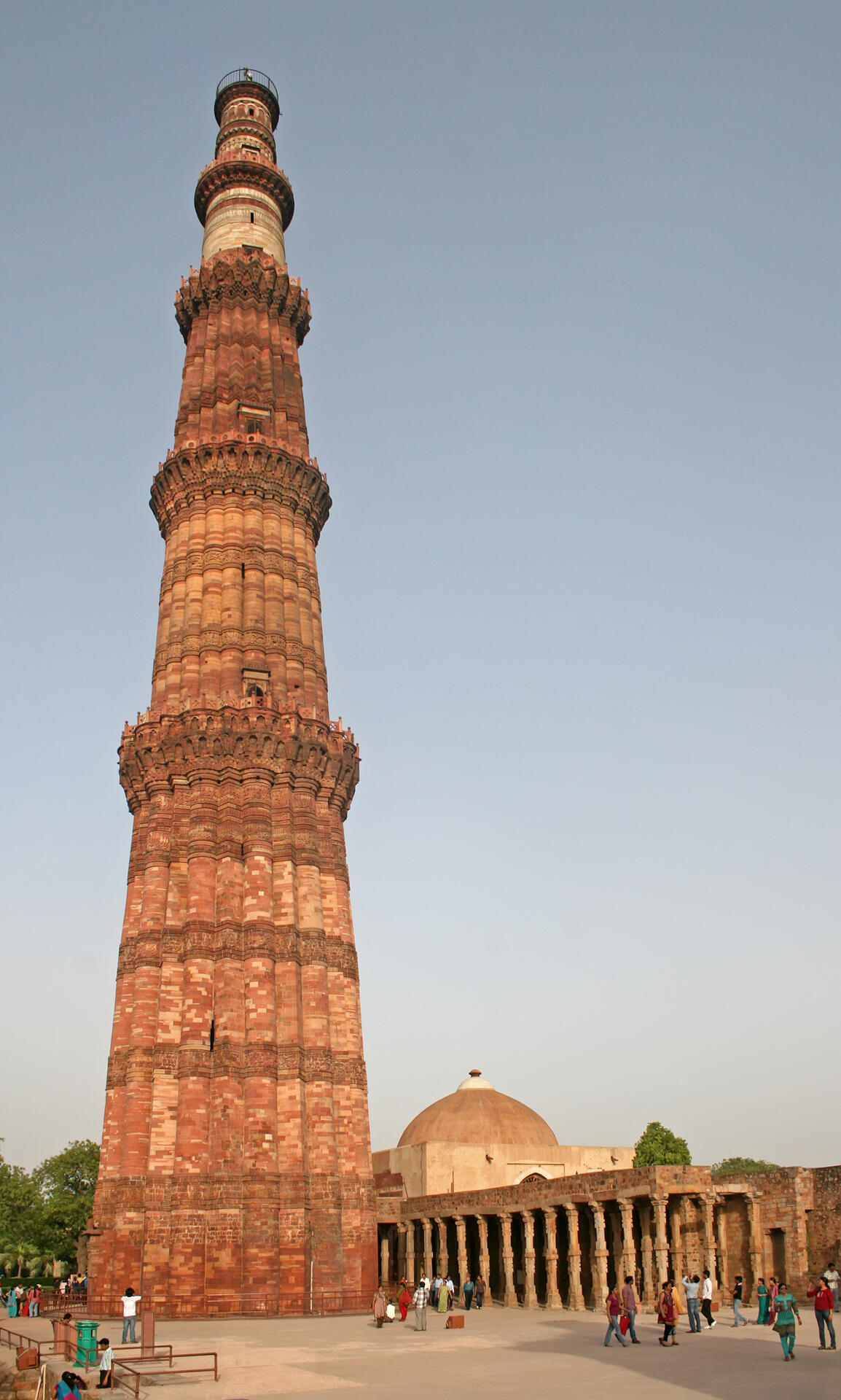
The Qutb Minar and its Monuments, located in Mehrauli, Delhi, India, stand as a testament to the rich history and cultural diversity that characterizes the city. Inscribed as a UNESCO World Heritage Site in 1993, this architectural ensemble offers a unique blend of Islamic and Indian architectural influences, reflecting the dynamic interplay of different cultural and artistic traditions.
The Qutb Minar itself, one of the tallest masonry minarets in the world, is the centerpiece of the complex. Commissioned by Qutb-ud-din Aibak, the first Sultan of Delhi, construction began in the late 12th century. Aibak, a former slave who rose to become a military commander, established the Mamluk Dynasty, which ruled Delhi from 1206 to 1290.
After Aibak's death in 1210, his successor, Iltutmish, continued the construction of the Qutb Minar, adding three storeys to the original structure. The tower was later repaired and restored by subsequent rulers, including Firuz Shah Tughlaq. Standing at 72.5 meters tall, it tapers from approximately 2.75 meters in diameter at its pinnacle to 14.32 meters at its base, showcasing intricate fluting patterns that alternate between angular and rounded forms.
Adjacent to the Qutb Minar lies the Quwwatu'l-Islam Mosque, one of the earliest surviving mosques in Northern India. Constructed using materials reclaimed from earlier Hindu and Jain temples, the mosque reflects the complex architectural and political history of the period. Approximately 20 Brahman temples are traditionally cited in connection with the reused material, while other historical accounts have identified material from a larger number of Brahmanical and Jain temples. The mosque features several notable architectural elements, including intricately carved pillars, inscriptions, decorative stonework, and the beautifully carved screen that separates the prayer hall from the courtyard.
Another significant monument within the complex is the Alai Darwaza, or the "Alai Gate," constructed during the reign of Alauddin Khalji in 1311. This gateway, regarded as a masterpiece of Indo-Muslim art, boasts exquisite stone carvings, intricate geometric decoration, latticework, inscriptions, and elegant arches. It represents an important stage in the development of Indo-Islamic architecture in India, combining Islamic architectural forms with the craftsmanship and decorative traditions of the Indian subcontinent.
In addition to these iconic structures, the Qutb Minar complex also houses the unfinished Alai Minar, the tomb of Iltutmish, the Iron Pillar, and other historic remains. The Alai Minar was intended by Alauddin Khalji to be twice the height of the Qutb Minar, but only its first storey was completed before his death. Standing at approximately 25 meters today, the unfinished structure remains an impressive example of the architectural ambitions of the Delhi Sultanate.
The Iron Pillar, which predates the Islamic monuments by several centuries, is another remarkable feature of the complex. Bearing a Sanskrit inscription associated with a ruler named Chandra, generally identified as the Gupta ruler Chandragupta II, the pillar provides evidence of the site's much earlier history and the layers of cultural heritage preserved within the complex. Its exceptional resistance to corrosion has also made it an important subject of historical and metallurgical interest.
Today, the Qutb Minar and its Monuments serve as a vital window into the rich history and architectural development of medieval India. These architectural marvels offer a tangible connection to the past, providing insight into the interaction between Islamic architectural traditions and established Indian artistic and building practices. As a UNESCO World Heritage Site, the Qutb Minar complex stands as an important testament to the enduring legacy of the Delhi Sultanate and the diverse cultural and architectural heritage of India.
UNESCO Description of the World Heritage Site
Built in the early 13th century a few kilometres south of Delhi, the red sandstone tower of Qutb Minar is 72.5 m high, tapering from 2.75 m in diameter at its peak to 14.32 m at its base, and alternating angular and rounded flutings. The surrounding archaeological area contains funerary buildings, notably the magnificent Alai-Darwaza Gate, the masterpiece of Indo-Muslim art (built in 1311), and two mosques, including the Quwwatu'l-Islam, the oldest in northern India, built of materials reused from some 20 Brahman temples.
UNESCO Justification of the World Heritage Site
Criterion (iv): The religious and funerary buildings in the Qutb Minar complex represent an outstanding example of the architectural and artistic achievements of early Islamic India.
Encyclopedia Record: Qutb Minar complex
The Qutb Minar complex are monuments and buildings from the Delhi Sultanate at Mehrauli in Delhi, India. Construction of the Qutub Minar "victory tower" in the complex, named after the religious figure Sufi Saint Khwaja Qutbuddin Bakhtiar Kaki, was begun by Qutb-ud-din Aibak, who later became the first Sultan of Delhi of the Mamluk dynasty. It was continued by his successor Iltutmish, and finally completed much later by Firoz Shah Tughlaq, a Sultan of Delhi from the Tughlaq dynasty (1320–1412) in 1368 AD. The Qubbat-ul-Islam Mosque, later corrupted into Quwwat-ul Islam, stands next to the Qutb Minar.Additional Site Details
Area: Not available
Number of Components: 1
Coordinates: 28.52583 , 77.18528
World Heritage Research
Discover scientific research and academic studies that deepen our understanding of Qutb Minar and its Monuments, Delhi from its history and significance to its conservation, management, and contemporary challenges.
-
The Qutb Complex
The Qutb Minar and its Monuments, a UNESCO World Heritage Site in Delhi, exemplify the fusion of Persianate and Indic architectural traditions. This study reveals how the complex, initiated in the late 12th century, evolved through successive additions by Muslim rulers, blending Iranian influences like Aibak's arched screen and the towering Qutb Minar with local Indic elements such as naturalistic carvings and stone construction. The research examines the motivations behind its construction, including the use of spolia, and explores radical shifts in visual aesthetics, inscriptions, and political messaging. By analyzing epigraphic evidence—including graffiti—and architectural innovations, this work offers new insights into the complex's role in India's cultural and political landscape during the early centuries of Muslim rule.
Asher, C. B. (2021). The Qutb Complex. Art and Architectural Traditions of India and Iran, 17–31. https://doi.org/10.4324/9781003229421-3
View Publication Record | Read Publication -
The Architecture plan of Qutb Complex (Delhi) and its Decoration Analysis
The Qutb Complex in Delhi exemplifies the earliest stage of Indo-Muslim architecture and decorative art, showcasing a unique fusion of Hindu and Islamic motifs from the 12th to 13th centuries. This study reveals that the complex's architectural style, featuring red sandstone and marble carvings with arabesque patterns, Kufic and Naskh calligraphy, floral designs, and geometric elements—including Hindu influences—represented an innovative amalgamation of cultural aesthetics. The research analyzes the decorative motifs across monuments like Quwat-ul Islam Mosque (1191 A.D.), Qutab Minar (1202 A.D.), Iltutmish Tomb (1235 A.D.), and Alai Darwaza (1311 A.D.), demonstrating how these designs evolved under successive monarchs. By examining historical data, the study concludes that this fusion was a groundbreaking addition to Indo-Muslim art, contributing to the complex's serene and majestic ambiance while reflecting regional artistic logic.
Khan, S. N., & Bilal, M. A. (2020). The Architecture plan of Qutb Complex (Delhi) and its Decoration Analysis. Perennial Journal of History, 1(1), 49–68. https://doi.org/10.52700/pjh.v1i1.21
View Publication Record | Read Publication -
The Early History of Delhi
Delhi's early history, spanning from the Stone Age to the medieval period, is revealed through archaeological discoveries. Surface finds and excavations at sites like Anangpur show human activity dating back tens of thousands of years. Protohistoric remains unearthed at Bhorgarh and Mandoli, along with Ashoka’s Minor Rock Edict I, indicate Maurya influence in the region as early as the 3rd century BCE. The Qutb complex, a medieval site, preserves enigmatic Gupta-period structures, while Lal Kot provides evidence of Rajput and early Sultanate phases. Despite sparse textual, archaeological, epigraphic, and numismatic records, these findings outline the evolution of Delhi’s rural and urban settlements long before its rise as a significant political center.
Singh, U. (2019). The Early History of Delhi. Oxford Research Encyclopedia of Asian History. https://doi.org/10.1093/acrefore/9780190277727.013.221
View Publication Record | Read Publication -
Delhi’s Qutb Complex: The Minar, Mosque and Mehrauli
Delhi's Qutb Complex, featuring the iconic Qutb Minar and its monuments, stands as a testament to the architectural and historical significance of the region. This comprehensive study by Catherine B. Asher delves into the intricate details of the complex, offering insights into its construction, evolution, and cultural importance. The research approach combines thorough historical analysis with architectural examination, providing a nuanced understanding of the site's development from its inception in the 12th century to its current status as a UNESCO World Heritage Site. Asher's work not only highlights the technical prowess behind the monuments but also explores their social and political contexts, enriching our knowledge of India's medieval history.
Michell, G. (2018). Catherine B. Asher: Delhi’s Qutb Complex: The Minar, Mosque and Mehrauli. Mumbai: The Marg Foundation, 2017. $69.95. ISBN 978 93 83243 19 8. Bulletin of the School of Oriental and African Studies, 81(1), 160–161. https://doi.org/10.1017/s0041977x18000186
View Publication Record | Read Publication -
Review: Delhi's Qutb Complex: The Minar, Mosque and Mehrauli, by Catherine B. Asher
Catherine B. Asher's book, 'Delhi's Qutb Complex: The Minar, Mosque and Mehrauli,' provides a comprehensive, long-term history of the UNESCO World Heritage Site, spanning from its origins in the late 12th century to its evolution through the 13th century and beyond into early modern and colonial periods. The work highlights the Qutb Minar's architectural significance while also addressing the often-overlooked smaller structures within the complex, offering a nuanced perspective on its development. Asher synthesizes extensive academic literature, aiming to contextualize contemporary debates, particularly those involving Hindutva nationalists who interpret certain elements of the mosque as evidence of violent subjugation. The book's rich illustrations and broad appeal make it a valuable resource for both scholars and the general public.
Rajagopalan, M. (2018). Review: Delhi’s Qutb Complex: The Minar, Mosque and Mehrauli, by Catherine B. Asher. Journal of the Society of Architectural Historians, 77(3), 349–350. https://doi.org/10.1525/jsah.2018.77.3.349
View Publication Record | Read Publication -
Chapter Five
Modern narratives of the Qutb Minar and Quwwat-ul-Islam mosque complex reveal a duality: while historically symbolizing Islamic iconoclasm through the reuse of Hindu and Jain fragments, contemporary interpretations frame this as a form of modern iconoclasm. The study traces how colonial authorities, global preservation bodies, Hindu nationalists, and secular nation-states have positioned the site ambiguously—balancing international reverence with religious reclamations. This tension underscores the complex interplay between heritage preservation, political narratives, and cultural memory in postcolonial India.
Rajagopalan, M. (2016). Chapter Five. Building Histories, 155–190. https://doi.org/10.7208/chicago/9780226331898.003.0006
View Publication Record | Read Publication