World Heritage Identification Number: 251
World Heritage since: 1983
Category: Cultural Heritage
WHE Type: Buildings & Architectural Ensembles
Transboundary Heritage: No
Endangered Heritage: No
Country: 🇮🇳 India
Continent: Asia
UNESCO World Region: Asia and the Pacific
Map
Agra Fort: A Testament to Mughal Architecture and Power
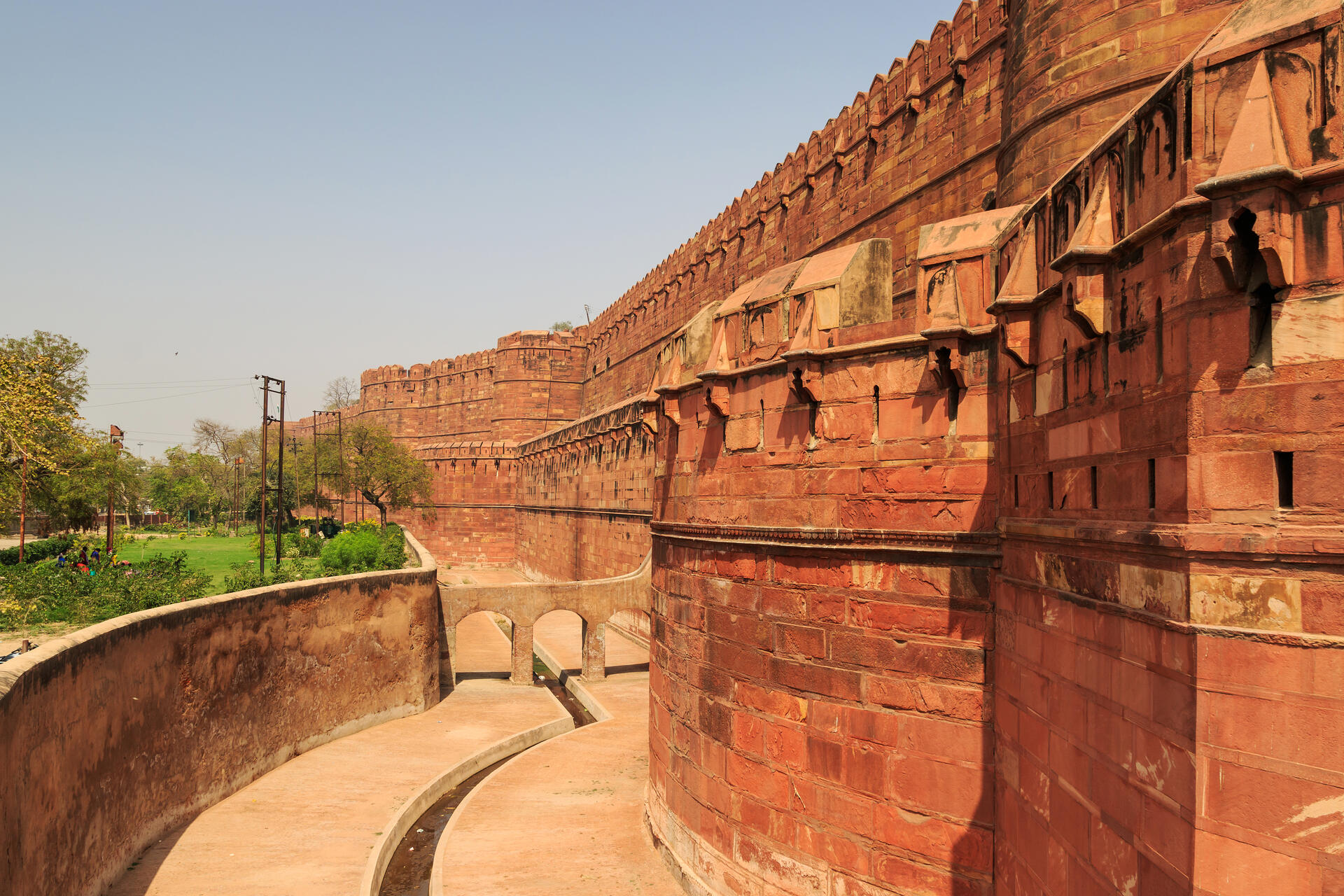
Agra Fort, also known as the Red Fort of Agra, is one of the most important surviving monuments of the Mughal Empire. Located in the historic city of Agra, Uttar Pradesh, India, the massive fortress is enclosed by approximately 2.5-kilometer-long walls made primarily of red sandstone. Inscribed on the UNESCO World Heritage List in 1983, Agra Fort offers a remarkable glimpse into the power, architectural ambition, and artistic achievements of the Mughal period.
The fort witnessed major developments in Mughal political power and served as an imperial residence for generations of rulers. However, the history of the site predates the present Mughal fort. An earlier brick fort known as Badalgarh stood at Agra when Humayun was crowned there in 1530. The existing Agra Fort largely dates from the extensive rebuilding undertaken by Mughal Emperor Akbar beginning in 1565. Akbar ordered the earlier structure to be rebuilt in red sandstone, creating the foundation of the monumental complex that survives today. The fort was subsequently expanded and embellished by later Mughal rulers, particularly Shah Jahan, who added numerous buildings constructed in white marble.
Agra remained an important center of Mughal power until Shah Jahan transferred the imperial capital to Shahjahanabad (Delhi) in the late 1630s. During the Mughal period, the fort was known by names including Lal Qila and Qila-i-Akbari. After the decline of Mughal power, the fort passed through several phases of control, including a period under the Jats of Bharatpur and later the Marathas. The British subsequently captured Agra Fort from the Marathas in 1803.
Agra Fort is not merely a military fortress, but a large walled imperial complex containing palaces, audience halls, mosques, gardens, and other structures. Among its notable buildings is the Jahangir Mahal, which is generally attributed to Akbar and is one of the principal surviving residential structures from his reign. The Khas Mahal, built during the reign of Shah Jahan, is distinguished by its refined marble architecture and decorative details. The Diwan-i-Khas, or Hall of Private Audience, was used for important imperial meetings and state affairs, while the Diwan-i-Aam served as the Hall of Public Audience.
The fort also contains exquisite Mughal mosques, including the Moti Masjid (Pearl Mosque) and the Nagina Masjid. The Moti Masjid was built during the reign of Shah Jahan and is notable for its elegant white-marble construction and three domes. The smaller Nagina Masjid was also built under Shah Jahan and served as a private mosque associated with the women of the imperial court.
Agra Fort shares a close historical and geographical relationship with the Taj Mahal, the celebrated Mughal monument commissioned by Shah Jahan. The Taj Mahal lies approximately 2.5 kilometers southeast of Agra Fort, across the Yamuna River. Both monuments reflect the pinnacle of Mughal architectural tradition and are associated with Shah Jahan, though their principal phases of construction belong to different periods: the rebuilding of Agra Fort began under Akbar in the 16th century, while the Taj Mahal was commissioned by Shah Jahan in the 17th century.
Today, Agra Fort stands as a lasting testament to the Mughal Empire's power, artistry, and cultural influence. Its imposing walls, imperial palaces, audience halls, mosques, gardens, and marble buildings provide visitors with remarkable insight into the history of Mughal India. The fort continues to captivate travelers with its grandeur, intricate designs, and profound historical significance, making it a must-visit destination for anyone interested in Indian history and architecture.
UNESCO Description of the World Heritage Site
Near the gardens of the Taj Mahal stands the important 16th-century Mughal monument known as the Red Fort of Agra. This powerful fortress of red sandstone encompasses, within its 2.5-km-long enclosure walls, the imperial city of the Mughal rulers. It comprises many fairy-tale palaces, such as the Jahangir Palace and the Khas Mahal, built by Shah Jahan; audience halls, such as the Diwan-i-Khas; and two very beautiful mosques.
Encyclopedia Record: Agra Fort
The Agra Fort is a historical Mughal fort in the city of Agra, also known as Agra's Red Fort. Mughal emperor Humayun was crowned at this fort in 1530. It was later renovated by the Mughal emperor Akbar from 1565 and the present-day structure was completed in 1573. It served as the main residence of the rulers of the Mughal dynasty until 1638, when the capital was shifted from Agra to Delhi. It was also known as the "Lal-Qila" or "Qila-i-Akbari". Before being captured by the British, the last Indian rulers to have occupied it were the Marathas. In 1983, the Agra fort was inscribed as a UNESCO World Heritage Site because of its importance during Mughal rule. It is about 2.5 kilometers (1.6 mi) northwest of its more famous sister monument, the Taj Mahal. The fort can be more accurately described as a walled city. It was later renovated by Shah Jahan.Additional Site Details
Area: Not available
Number of Components: 1
Coordinates: 27.179806 , 78.021528
World Heritage Research
Discover scientific research and academic studies that deepen our understanding of Agra Fort from its history and significance to its conservation, management, and contemporary challenges.
-
Economic Potential of Tourism: A Case Study of Agra
Agra Fort, despite its historical and architectural significance, lags behind the Taj Mahal in tourist awareness and economic benefits. A study reveals that while Agra attracts a substantial number of visitors, most are unaware of its other monuments, limiting the region's potential for tourism-driven economic growth. The research evaluates factors contributing to this disparity and analyzes challenges faced by tourists in Agra. Using a case study approach, it examines the economic impact of tourism on the state, highlighting the need for better promotion and visitor engagement strategies to maximize benefits.
Srivastava, S. (2011). ECONOMIC POTENTIAL OF TOURISM: A CASE STUDY OF AGRA. Tourismos, Vol. 6 No. 2 (2011). https://doi.org/10.26215/TOURISMOS.V6I2.223
View Publication Record | Read Publication -
Use of ICT and Digital Technology to Conserve India's Cultural Heritage
A comprehensive cultural heritage information system leveraging ICT and digital technologies can significantly enhance the preservation, documentation, and management of Agra Fort. This study underscores the transformative potential of web-based applications and digital tools in safeguarding cultural assets for future generations. By integrating advanced technologies, such as those proposed, researchers can effectively conserve the knowledge content associated with heritage items, ensuring their longevity and accessibility. The approach involves identifying gaps in current preservation methods and addressing them through systematic documentation and digital archiving, thereby bridging traditional conservation practices with modern technological advancements.
Gireesh Kumar, T. K. (2021). Use of ICT and Digital Technology to Conserve India’s Cultural Heritage. Handbook of Research on Knowledge and Organization Systems in Library and Information Science, 457–477. https://doi.org/10.4018/978-1-7998-7258-0.ch024
View Publication Record | Read Publication -
Green Urbanism in Medieval India, Agra Fort: A Sustainable Eco-City
Medieval Indian cities, including Agra Fort, demonstrated advanced green urbanism principles that outpaced modern urban settlements in sustainability and density. This study reveals how pre-modern technology cities thrived with efficient resource use, providing insights into historical eco-city design. By analyzing Agra Fort's development, the research reconstructs its sustainable practices—such as water management, vegetation integration, and spatial organization—that ensured long-term functionality without modern infrastructure. The approach combines archival analysis, spatial mapping, and comparative urban studies to uncover these adaptive strategies, offering lessons for contemporary urban planning in developing nations.
Zuberi, F. (2017). Green Urbanism in Medieval India, Agra Fort: A Sustainable Eco-City. Procedia Environmental Sciences, 37, 12–21. https://doi.org/10.1016/j.proenv.2017.03.009
View Publication Record | Read Publication