World Heritage Identification Number: 252
World Heritage since: 1983
Category: Cultural Heritage
WHE Type: Religious Sites & Sacred Architecture
Transboundary Heritage: No
Endangered Heritage: No
Country: 🇮🇳 India
Continent: Asia
UNESCO World Region: Asia and the Pacific
Map
The Taj Mahal: A Symbol of Love and Architectural Mastery
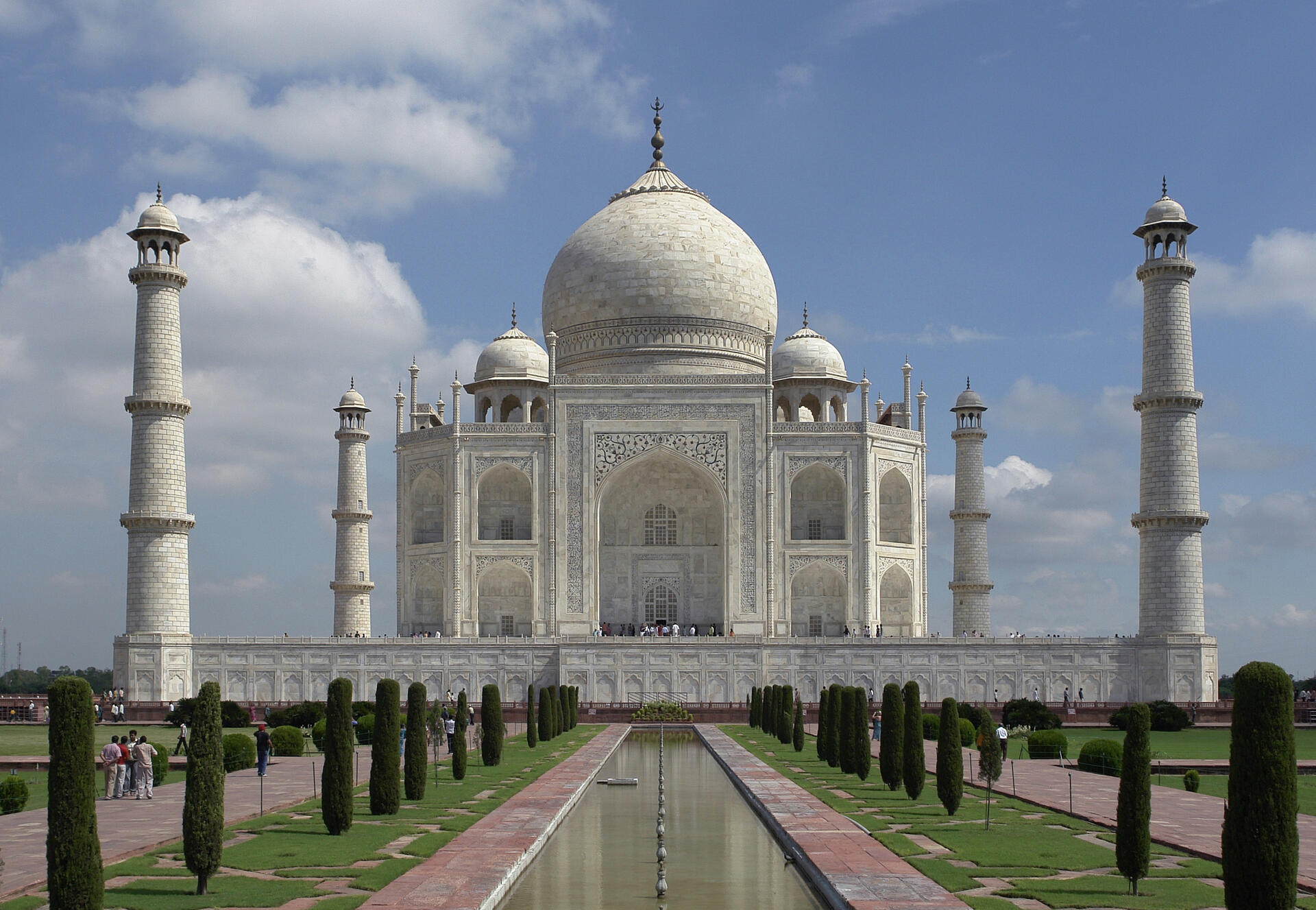
The Taj Mahal, located in Agra, Uttar Pradesh, India, stands as a testament to the enduring power of love and the heights of architectural achievement. Inscribed as a UNESCO World Heritage Site in 1983, this ivory-white marble mausoleum has captivated visitors from around the globe for centuries.
Commissioned by the Mughal Emperor Shah Jahan in 1631, the Taj Mahal was built in memory of his beloved wife, Mumtaz Mahal. While construction of the main mausoleum was largely finished by 1648, the surrounding buildings and gardens were completed over the next five years, with the entire complex considered complete around 1653.
The architectural team was led by Ustad Ahmad Lahauri, the court architect to Emperor Shah Jahan, who played a pivotal role in the design and execution of the Taj Mahal. His vision, along with the expertise of skilled artisans, engineers, and craftsmen, guided the creation of one of the most remarkable structures in history. In total, around 20,000 workers—including masons, marble cutters, carvers, calligraphers, painters, and laborers—were involved in the monumental task.
The Taj Mahal is not just a mausoleum but an entire complex spanning over 17 hectares (42 acres). At its heart lies the main tomb, surrounded by formal gardens, a mosque, and a guest house. The complex is enclosed by a crenelated wall on three sides, with the River Yamuna flowing gently along the fourth side.
The architecture of the Taj Mahal is a harmonious blend of Persian, Islamic, and Indian styles. The central dome, flanked by four minarets, rises majestically above the symmetrical layout of the building. The intricate calligraphy and geometric patterns adorning the exterior walls reflect the rich cultural heritage of the Mughal Empire.
Inside the mausoleum, the tombs of Shah Jahan and Mumtaz Mahal are housed in a chamber decorated with semi-precious stones and inlaid with precious gems. The walls are adorned with verses from the Quran, adding a spiritual dimension to the monument. However, the actual tombs of Shah Jahan and Mumtaz Mahal are symbolic; their real tombs are located in a lower chamber beneath the main floor, while the ones inside the mausoleum are ornamental.
The Taj Mahal is renowned for its stunning symmetry, precision, and the use of white marble. The reflection of the setting sun casts a warm glow over the monument, making it appear even more ethereal. This spectacle, combined with the tranquil beauty of the surrounding gardens, creates an atmosphere that transcends time and culture.
The Taj Mahal is not merely a historical site; it is a living symbol of love and artistic excellence. Its enduring allure continues to draw millions of visitors each year, reinforcing its status as one of the most universally admired masterpieces of the world's heritage.
UNESCO Description of the World Heritage Site
An immense mausoleum of white marble, built in Agra between 1631 and 1648 by order of the Mughal emperor Shah Jahan in memory of his favourite wife, the Taj Mahal is the jewel of Muslim art in India and one of the universally admired masterpieces of the world's heritage.
UNESCO Justification of the World Heritage Site
Criterion (i): Taj Mahal represents the finest architectural and artistic achievement through perfect harmony and excellent craftsmanship in a whole range of Indo-Islamic sepulchral architecture. It is a masterpiece of architectural style in conception, treatment and execution and has unique aesthetic qualities in balance, symmetry and harmonious blending of various elements.
Encyclopedia Record: Taj Mahal
The Taj Mahal is an ivory-white marble mausoleum on the right bank of the river Yamuna in Agra, Uttar Pradesh, India. It was commissioned in 1631 by the fifth Mughal emperor, Shah Jahan, to house the tomb of his beloved wife, Mumtaz Mahal; it also houses the tomb of Shah Jahan himself. The tomb is the centrepiece of a 17-hectare (42-acre) complex, which includes a mosque and a guest house, and is set in formal gardens bounded on three sides by a crenellated wall.Additional Site Details
Area: Not available
Number of Components: 1
Coordinates: 27.17417 , 78.04222
Image
©
- Taj_Mahal,_Agra,_India_edit2.jpg: Yann; edited by King of Hearts
- derivative work: Jbarta (talk)
World Heritage Research
Discover scientific research and academic studies that deepen our understanding of Taj Mahal from its history and significance to its conservation, management, and contemporary challenges.
-
Taj Mahal conservation and the scope of electromagnetic sensing
Electromagnetic sensing techniques, including micro-Raman spectroscopy and terahertz (THz) imaging, offer a rapid and reliable method for detecting surface and sub-surface damage in marble structures like the Taj Mahal. This approach, tested on white slabs with ornamental motifs similar to those at the site, successfully mapped minute changes caused by sulfur, organic materials, and water damage with high accuracy. By providing objective, non-invasive assessments, these techniques could significantly reduce the time-consuming and subjective nature of traditional visual evaluations, leading to more efficient and cost-effective conservation efforts for cultural heritage sites.
Bandyopadhyay, A., Chanda, P., Aalam, U., Khatri, K., Bertling, K., Torniainen, J., Rakić, A. D., & Sengupta, A. (2026). Taj Mahal conservation and the scope of electromagnetic sensing. Journal of Physics: Photonics, 8(1), 12004. https://doi.org/10.1088/2515-7647/ae3a25
View Publication Record | Read Publication -
Unlocking Human Imagination in South Asian Tangible Cultural Heritage: Analyzing Sahir Ludhianvi's "Taj Mahal"
Sahir Ludhianvi's poetry reimagines the Taj Mahal as more than an architectural marvel, revealing it to be a profound symbol of human emotion and cultural identity. Through phenomenological and literary analysis, this study demonstrates how the monument embodies eternal love and emotional depth, transcending its physical form to represent intangible human experiences. The research highlights the interplay between architecture and imagination, suggesting that future interdisciplinary studies combining literature, architecture, and phenomenology could deepen our understanding of how tangible heritage shapes cultural narratives.
Saira Iqbal, Pakeeza Tabbasum, & Arslan Butt. (2025). Unlocking Human Imagination in South Asian Tangible Cultural Heritage: Analyzing Sahir Ludhianvi’s “Taj Mahal”. Social Science Review Archives, 3(1), 1086–1096. https://doi.org/10.70670/sra.v3i1.404
View Publication Record | Read Publication -
A Universal Symbol of “Love & Romanticism”:The Taj Mahal
The Taj Mahal, an ivory white marble mausoleum located on the south bank of the Yamuna River in Agra, India, stands as a universal symbol of eternal love and romanticism. Commissioned in 1631 by Mughal Emperor Shah Jahan to house the tomb of his beloved wife Mumtaz Mahal, this architectural marvel is the centerpiece of a 17-hectare complex that includes a mosque, guest house, and formal gardens. Its enduring beauty lies in its strategic location, intricate architecture, and the profound emotions embedded in its construction. The Taj Mahal's significance transcends its role as a mausoleum, representing purity, beauty, and the legacy of Mughal craftsmanship. Recognized globally, it remains a must-visit destination, encapsulating the essence of love and historical grandeur.
Mr. Prasenjit Ghosh. (2024). A Universal Symbol of “Love & Romanticism”:The Taj Mahal. International Journal of Advanced Research in Science, Communication and Technology, 706–709. Internet Archive. https://doi.org/10.48175/ijarsct-18791
View Publication Record | Read Publication -
For the Love of the Taj Mahal
Local perceptions of the Taj Mahal reveal a complex interplay between romanticized global narratives and deeply personal, often spiritual, interpretations. While the monument is globally recognized as a symbol of romantic love, residents of Taj Ganj associate it with intimate care, peril, and even rejection of love itself. This study demonstrates how colonial-era associations and government tourism campaigns perpetuated the romantic love narrative, contrasting sharply with local perspectives that include spiritual connections to the entombed royals and practical concerns about caretaking. By analyzing diverse local viewpoints—ranging from householders to conservation workers—the research highlights the incommensurate ways in which different groups engage with the Taj Mahal's legacy.
Malhotra, S. (2024). For the Love of the Taj Mahal. Dissent with Love, 169–186. https://doi.org/10.4324/9781032614410-14
View Publication Record | Read Publication -
The Impact of the Rubber Dam on Taj Mahal
A planned rubber dam on the Yamuna River, located just 1.5 kilometers east of the Taj Mahal, is expected to significantly enhance tourism by restoring scenic views and reducing pollution, potentially increasing visitor stay duration, revenue, and satisfaction. The study, which analyzes academic sources, archives, and online forums, suggests that the dam could revive the Taj's reflection on the river while mitigating dust-related pollution—a major tourist complaint due to the dried-up, malodorous riverbed. However, concerns about construction disruption, pollution risks, and unconfirmed foundation issues may negatively impact tourism and Agra's image. To ensure sustainable tourism without compromising the Taj Mahal's cultural integrity, the authors recommend thorough hydrogeological studies, robust pollution control measures, and stakeholder engagement.
Kumar, H. (2024). THE IMPACT OF THE RUBBER DAM ON TAJ MAHAL. ShodhKosh: Journal of Visual and Performing Arts, 5(7). https://doi.org/10.29121/shodhkosh.v5.i7.2024.6242
View Publication Record | Read Publication -
Taj Mahal is the Crystallization of Iranian Architecture and a Symbol of God's Throne on Earth
The Taj Mahal, often celebrated as a symbol of love and Islamic architecture, is revealed to be a crystallization of Iranian architectural influence, blending elements from Persian, Hindu, British, and Akbari traditions. Research demonstrates that its design and construction were significantly shaped by Iranian artists, including Essa Shirazi (designer), Amanat Khan Shirazi (calligrapher), and Mohammad Hanif Kandahari, reflecting deep historical ties between Iran and India during the Safavid and Gurkanian periods. The monument exemplifies Indian-Iranian Islamic architecture, showcasing the impact of Iranian culture on garden design, literature, art, and architecture in the subcontinent. This study underscores the Taj Mahal's role as a tangible manifestation of multiculturalism and the enduring legacy of Iranian artistic contributions to global heritage.
Asadi, S. (2023). Taj Mahal is the Crystallization of Iranian Architecture and a Symbol of God’s Throne on Earth. The Academic Research Community Publication, 34–47. https://doi.org/10.21625/archive.v7i3.1036
View Publication Record | Read Publication -
Tourist Guides’ Perspectives of Demarketing the Taj Mahal
Demarketing strategies implemented at the Taj Mahal to curb overcrowding and preserve its condition are largely supported by local tourist guides, despite not directly affecting their livelihoods. The study, involving 17 in-depth interviews with guides, found that these measures benefit both monument conservation and stakeholders' income. While demarketing is a delicate approach, its careful implementation—considering stakeholder input—could serve as a model for managing excessive tourism at other heritage sites. This research offers novel insights into the effectiveness of such strategies in India, where the Taj Mahal stands as a pioneer in adopting this method.
Kainthola, S., Tiwari, P., & Chowdhary, N. R. (2021). Tourist Guides’ Perspectives of Demarketing the Taj Mahal. Technological University Dublin. https://doi.org/10.21427/QKPZ-AM84
View Publication Record | Read Publication