World Heritage Identification Number: 1346
World Heritage since: 2010
Category: Cultural Heritage
WHE Type: Historic Cities & Urban Areas
Transboundary Heritage: No
Endangered Heritage: No
Country: 🇮🇷 Iran (Islamic Republic of)
Continent: Asia
UNESCO World Region: Asia and the Pacific
Map
Tabriz Historic Bazaar Complex: A Commercial and Cultural Hub Along the Silk Road
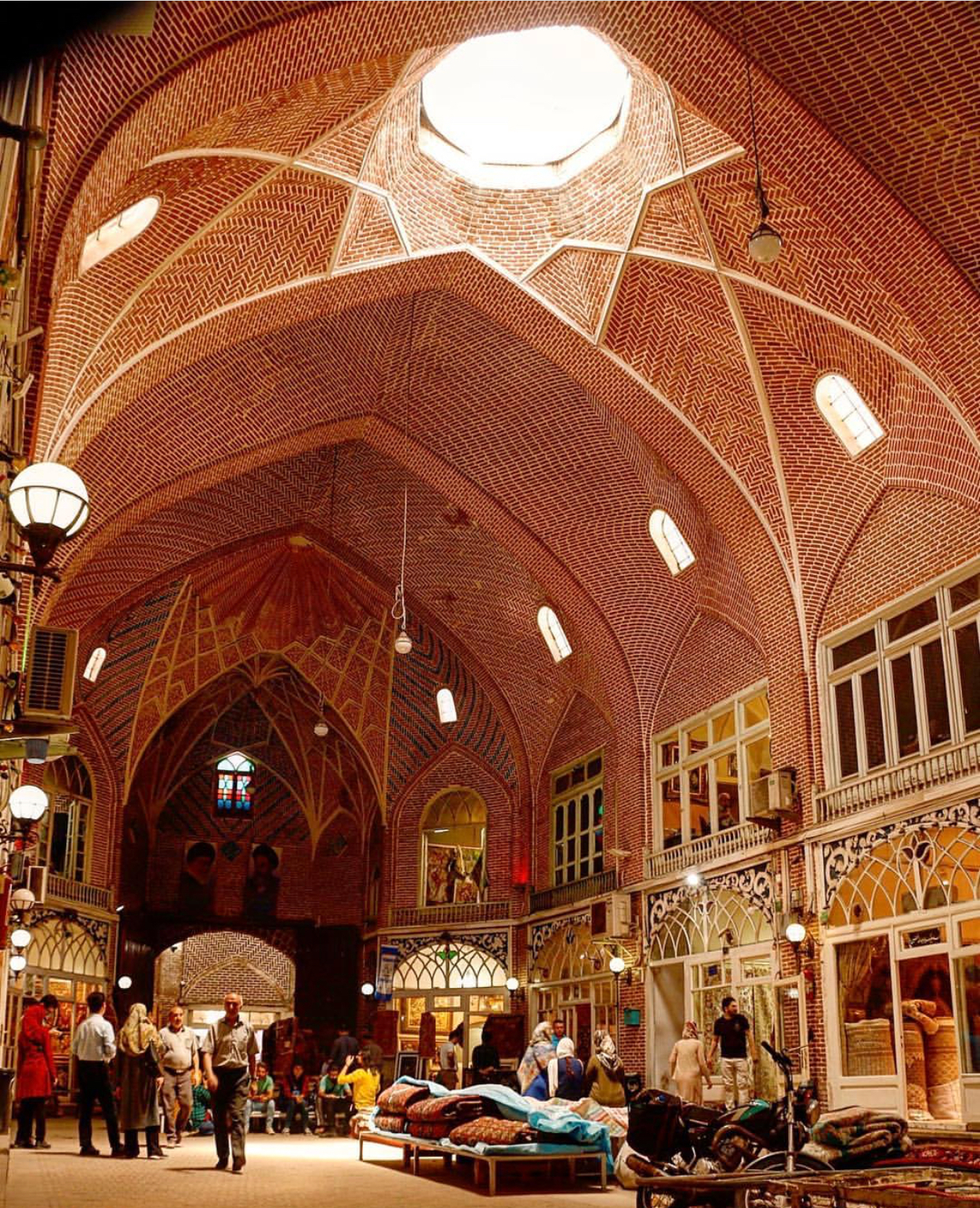
The Tabriz Historic Bazaar Complex, located in the heart of Tabriz, Iran, is a testament to the city's rich history and significance along the ancient Silk Road. Inscribed as a UNESCO World Heritage Site in 2010, this extensive network of interconnected, covered brick structures serves as one of the most important commercial centers on this historical trade route.
More to come…UNESCO Description of the World Heritage Site
Tabriz has been a place of cultural exchange since antiquity and its historic bazaar complex is one of the most important commercial centres on the Silk Road. Tabriz Historic Bazaar Complex consists of a series of interconnected, covered, brick structures, buildings, and enclosed spaces for different functions. Tabriz and its Bazaar were already prosperous and famous in the 13th century, when the town, in the province of Eastern Azerbaijan, became the capital city of the Safavid kingdom. The city lost its status as capital in the 16th century, but remained important as a commercial hub until the end of the 18th century, with the expansion of Ottoman power. It is one of the most complete examples of the traditional commercial and cultural system of Iran.
UNESCO Justification of the World Heritage Site
Criterion (ii): Tabriz Historic Bazaar Complex was one of the most important international trade and cultural centres in Asia and the world between the 12th and the 18th centuries, thanks to the centuries-old east-west trade routes. Tabriz Bazaar is an exceptional example of an architectural-urban commercial area, which is reflected in its highly varied and integrated architectural buildings and spaces. The bazaar is one of the most sustainable socio-economic structures, and its great complexity and articulation attests to the wealth in trade and cultural interaction of Tabriz.
Criterion (iii): Tabriz Historic Bazaar bears witness to one of the most complete socio-cultural and commercial complexes among bazaars. It is an exceptional physical, economic, social, political, and religious complex that bears an exceptional testimony to a civilization that is still living. Over the centuries, thanks to its strategic location and to wise policies of endowments and tax exemptions, Tabriz Bazaar has developed into a socio-economic and cultural system in which specialized architectural structures, functions, professions, and people from different cultures are integrated into a unique living environment.
Criterion (iv): Tabriz Historic Bazaar is an outstanding example of an integrated multi-functional urban complex in which interconnected architectural structures and spaces have been shaped by commercial activities and related necessities. A large number of specialized buildings and structures are concentrated and reciprocally connected in a relatively compact area to form what is almost a single integrated structure.
Encyclopedia Record: Bazaar of Tabriz
The Bazaar of Tabriz is a historic market in central Tabriz, Iran. It is one of the oldest bazaars in the Middle East and the largest covered bazaar in the world. It is one of Iran's UNESCO World Heritage Sites.Additional Site Details
Area: 28.9733 hectares
Number of Components: 3
(iii) — Unique or exceptional testimony to a cultural tradition
(iv) — Outstanding example of a type of building or landscape
Coordinates: 38.0813888889 , 46.2930555556
Image
© Rei nikoo, CC BY-SA 4.0 Resized from original. (This derivative is under the same CC BY-SA license.)
World Heritage Research
Discover scientific research and academic studies that deepen our understanding of Tabriz Historic Bazaar Complex from its history and significance to its conservation, management, and contemporary challenges.
-
Introduction to Tabriz Historic Bazaar Complex as One of the UNESCO World Heritage Sites in Iran
Tabriz Historic Bazaar Complex, recognized as the largest covered bazaar globally and a UNESCO World Heritage Site, stands as a testament to resilience amidst natural disasters. Despite enduring severe earthquakes, floods, and fires throughout history, this ancient commercial hub in northwest Iran has not only survived but continues to thrive as Tabriz's most vital economic center. This study introduces the complex internationally for preservation efforts, leveraging qualitative research and personal observations. The findings offer valuable insights for conservationists, architects, interior designers, and urban planners focused on cultural heritage and historic cities.
Asbagh, N. B. (2025). Introduction to Tabriz Historic Bazaar Complex as One of the UNESCO World Heritage Sites in Iran. Proceedings of the International Conference of Contemporary Affairs in Architecture and Urbanism-ICCAUA, 8(1). https://doi.org/10.38027/iccaua2025en0120
View Publication Record | Read Publication -
A Case Study from the World Heritage Site of the Tabriz Historic Bazaar and Fire Management, Iran
Fires pose a significant threat to the Tabriz Historic Bazaar Complex, a UNESCO World Heritage Site renowned for its historical and cultural significance. Research identifies key risk factors including outdated electrical systems, inefficient management practices, and inadequate emergency infrastructure, which contribute to frequent fire incidents. The study proposes practical mitigation strategies to enhance fire prevention and response, aiming to safeguard this invaluable heritage site. By analyzing past fire accidents and their root causes, the research offers actionable insights for improving structural safety and disaster resilience in similar urban complexes.
Nazari, F., & Aminian, M. (2023). A Case Study from the World Heritage Site of the Tabriz Historic Bazaar and Fire Management, Iran. Managing Disaster Risks to Cultural Heritage, 200–212. https://doi.org/10.4324/9781003263647-12
View Publication Record | Read Publication -
Towards an Operational Framework of Crowd Evacuation Simulation in Historic Bazaars in Fire Disasters
Historic bazaars, such as Tabriz's, face significant fire disaster risks due to their complex physical and social structures that often deviate from modern safety standards. This study proposes an operational framework for crowd evacuation simulation in these settings, emphasizing the need to account for both human behavioral patterns and environmental constraints like bottlenecks and obstacles before simulating fire and smoke spread. The research, based on field studies of Tabriz and Istanbul bazaars alongside library reviews, identifies critical factors including physical environment interactions and human-psychological dynamics that must be integrated into evacuation planning simulations. This framework aims to optimize emergency strategies by addressing practical simulation requirements, ultimately enhancing safety in these culturally significant yet vulnerable spaces.
Arzhangi, S. (2019). Towards an Operational Framework of Crowd Evacuation Simulation in Historic Bazaars in Fire Disasters. Sofeh Journal, 29(3), 101–119. https://doi.org/10.29252/soffeh.29.3.101
View Publication Record | Read Publication -
A Short Glimpse to the Urban Development of Tabriz during the History
Tabriz, a historic metropolis in northwest Iran and former capital of multiple dynasties, stands out for its rapid urban growth and the preservation of one of the world's largest roofed bazaars. Recognized as a UNESCO World Heritage Site since 2010, the Tabriz Historic Bazaar Complex reflects the city's rich cultural legacy, including its role as the 'city of the firsts.' Despite severe earthquakes that destroyed ancient structures, Tabriz remains a symbol of resilience and historical significance, earning accolades such as Iran's most beautiful city in 2012. This study sheds light on the city's urban development trajectory through a comprehensive literature review, aiming to deepen understanding of its dynamic growth patterns and challenges, including the emergence of slum settlements on its peripheries.
ASBAGH, N. B. (2019). A Short Glimpse to the Urban Development of Tabriz during the History. Journal of Contemporary Urban Affairs, 3(2), 73–83. https://doi.org/10.25034/ijcua.2018.4703
View Publication Record | Read Publication -
Sustainable Architecture of the Bazaar of Tabriz and its relation with the social and cultural aspects
The Tabriz Historic Bazaar Complex exemplifies how sustainable architecture integrates bioclimatic, economic, social, and cultural elements to create dynamic urban spaces. Unlike conventional studies that focus solely on modern design or historical preservation, this research highlights the enduring relevance of traditional architectural practices in fostering social cohesion and economic vitality. By analyzing Tabriz’s bazaar—an iconic Iranian infrastructure—the study identifies key elements sustaining its active role as a cultural and economic hub. The approach combines present-day observations with historical analysis, offering new perspectives on how sustainable architecture can inform future urban development while preserving heritage. This work underscores the importance of context-specific design in achieving long-term sustainability.
Kalan, A. M., & Oliveira, E. (2014). Sustainable Architecture of the Bazaar of Tabriz and its relation with the social and cultural aspects. IARS International Research Journal, 4(1). LOCKSS. https://doi.org/10.51611/iars.irj.v4i1.2014.33
View Publication Record | Read Publication